A pergola can be bright enough for dinner yet remain uncomfortable because alternating bands of light and shadow divide the table, floor, and seated faces. This is not primarily a low-light problem. It is evidence that the strongest beam is crossing too many repeated slat edges before reaching the area below.
The first fix should not be another light aimed from the same direction. Trace the stripes back to the source, see where they interfere with actual use, and then decide whether the problem is localized enough for a seating adjustment or broad enough to require a different lighting layer.
That distinction prevents overcorrection. Shadows confined to an unused edge can remain. Hard bands crossing faces, food-preparation surfaces, steps, or the primary walking route need attention even when the overall pergola looks bright.
Beam Through Slats
Pronounced striping develops when a directional source crosses a series of slat edges and projects their shadows below. A light mounted high on the house can cause this just as easily as one attached to the pergola.
Direction matters more than the fixture category. A beam traveling across the slat pattern intersects many repeated edges. Light arriving closer to the long direction of the slats may cross fewer of them, although posts, beams, and roof angle can still interrupt it. The useful question is how much structure the light must pass before reaching its target.
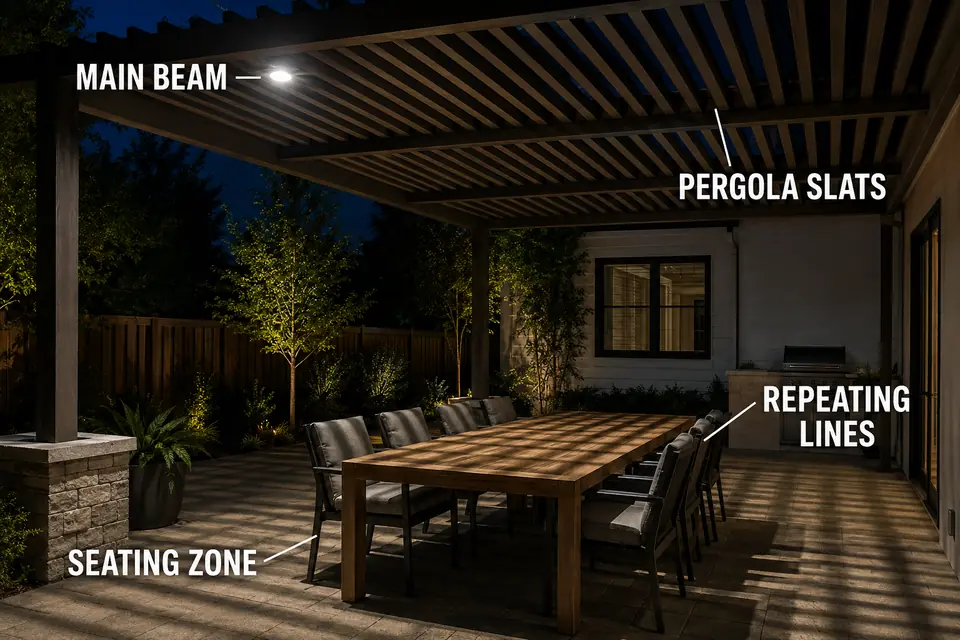
Source height and distance determine where the pattern lands. A high source can extend the lines across the floor, while a lower side source may place the strongest bands across chair backs or seated faces. A table can therefore appear usable while the people around it remain poorly lit.
The pattern also shifts with surface height. Shadows visible on the floor will not necessarily align with those on a tabletop or a person’s face. Test all three levels before changing the light. Correcting the floor alone can leave the most disruptive band exactly where someone sits.
This mechanism is one part of planning light beneath a pergola. For this diagnosis, stay focused on the source whose direction matches the visible stripes.
Turn off one lighting layer at a time. If the lines disappear with a particular source, that source is controlling the pattern. If they remain under several fixtures, more than one hard beam may be crossing the structure.
Repeating Shadow Lines
The problem is not that a shadow exists. It is the repeated sequence of hard light-dark transitions, which pulls attention away from the table, walking surface, or person sitting opposite.
Contrast sets the repair threshold. Soft bands along an unoccupied edge can add depth without interfering with use. Closely spaced stripes across faces, task areas, steps, or the main route create a functional problem.
Surface color can change how severe the lines appear. Pale tabletops, cushions, and concrete reflect more of the exposed light, making adjacent shadow bands look harder. Dark wood may hide the pattern on the table while the same beam remains disruptive across faces or a light-colored floor. Changing the surface may alter the appearance, but it does not correct the beam path.
A narrow, intense source can brighten the exposed bands without filling the blocked ones. This is one reason brighter outdoor light can reduce visibility rather than improve it: the eye must keep reading adjacent surfaces with very different brightness.
Dimming the responsible source is a useful diagnostic move. If the pattern becomes calmer while the table and route remain visible, excessive contrast was the main problem. If the dark bands still conceal useful surfaces, the arrangement needs support from another direction rather than more output from the original one.
Always make this judgment from beneath the pergola. A striped floor can look dramatic from the yard but prove harmless from the table—or appear mild from outside while cutting directly across seated faces.
Seating Position
Test every primary chair before moving a fixture. Shadow position changes with viewing height, so a line that misses the tabletop may cross a seated person’s eyes or mouth.
A small furniture adjustment is credible only when the conflict is localized. Moving a chair or table slightly may place faces between the hardest bands or shift a task surface away from one concentrated line.
Test the new position with chairs pulled out as they would be during use. A solution judged with every chair tucked tightly under the table may fail as soon as guests sit down. The relevant position is the occupied one, including the space needed to enter and leave the seat.
The move still has to preserve the pergola. Do not push chairs toward a post, narrow the walking route, or break the relationship between the table and outdoor kitchen to hide an area-wide lighting failure. If stripes occupy most of the usable zone, relocating furniture merely transfers the problem.
Perimeter Light
Use perimeter light when the central activity zone needs support but does not require another beam through the full slat field. It should reduce dependence on the shadow-producing source, not create a bright border around the pergola.
Aim restrained output toward the table edge, the floor beside pulled-out chairs, or the approach route. The entire structure does not need equal brightness; the support layer only needs to preserve visibility where the main source leaves a weak area.
Perimeter placement works best when it reaches the target without crossing the full roof structure. A source mounted below the slat plane or along an open side may encounter fewer repeated obstructions. It still needs shielding so the lamp itself does not become the brightest object in a seated person’s view.
An exposed edge light may soften the floor pattern while replacing it with face glare. An excessively bright boundary can also create the imbalance associated with a stage-lit patio.
The correction should end with the occupied zone. If it brightens nearby windows, fencing, or the wider yard without improving the seats, its aim is too broad.
Softer Cross Light
When the stripes span most of the usable area, softer cross light is usually stronger than continued furniture adjustments. It lifts the darkest bands from another direction without trying to erase every natural shadow.
The supporting source should be broader and less intense than the beam causing the pattern. Positioning it near the side of the pergola—and where its output crosses fewer repeated edges—can reduce contrast without drawing a second set of equally hard lines.
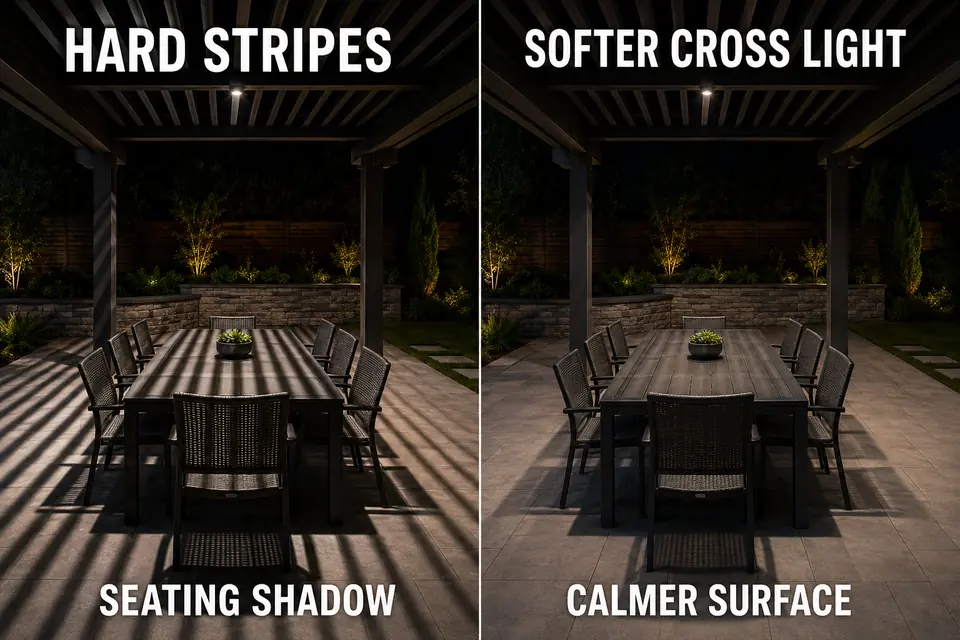
Do not place another narrow source directly opposite the first. Two hard beams can produce doubled shadows and a busier surface. The cross light should fill the interruptions, not redraw them from the other side.
The cross light should also remain visually secondary. If it becomes the obvious source or creates its own bright patch, it is acting as another main beam rather than fill. Reduce its output or broaden its coverage until the dark bands lift without a new focal point appearing.
Reassess the original beam after the supporting layer is operating. It may no longer need the same output or angle. Slight dimming or redirection can preserve useful task light while allowing the softer layer to control contrast.
The result should retain some depth. A flat, uniform wash can make the pergola brighter than necessary and push light beyond the occupied area. The target is a calmer transition between bands, not equal brightness from post to post.
Shadow Test
Run the final test after full darkness at the output used on a normal evening. Dusk can hide the problem because remaining sky light temporarily fills shadows that become much harder later.
Sit in each primary position. Check faces, the center and edges of the table, the floor beside pulled-out chairs, and the route into the pergola. Then stand at the grill or counter if those task areas share the structure.
Switch each lighting layer off briefly to identify what it contributes. This isolates any source that still produces hard lines, direct glare, or an unnecessarily bright boundary. If the problem extends beyond the slat pattern, the next step is correcting the broader outdoor light placement rather than continuing to add fill light.
Check the scene with your eyes before relying on a phone photo. Automatic exposure can deepen the dark bands or flatten them, depending on which part of the pergola the camera measures. A photo can document the pattern, but comfort and useful visibility must be judged from the occupied positions.
Restore the layers and make one adjustment at a time. The test does not pass because every shadow has disappeared. It passes when faces and useful surfaces are no longer divided by hard bands, the route remains readable, and the pergola does not need broad glare to feel usable.
For broader guidance on keeping exterior illumination directed toward its intended area, see the National Park Service outdoor lighting principles.