
A dog run does not need even brightness from fence to fence. It needs one continuous ground route between the back door, gate, active area, and cleanup point. If that route breaks into dark sections, making the entire yard brighter usually adds glare before it improves visibility.
This is why a dog run can look well lit from the house but perform poorly once you step inside it. A wall light may brighten the fence, lawn, and nearby trees while leaving the narrow strip used by both the dog and owner in shadow.
The useful layout begins with the surfaces that must remain visible at ground level. The main light should reach those surfaces without becoming the brightest object in the scene. Fence shadows, motion coverage, and neighbor-facing spill can then be judged against the same rule: keep useful light inside the route and unnecessary light outside it.
Ground Visibility
Judge the layout from inside the run, not just from the back door. You should be able to follow the walking line, recognize changes between paving and grass, and see the area where the dog usually stops without looking toward an exposed bright source.
Test two viewpoints. First, look from the house to confirm that the entrance and gate are readable. Then stand inside the run and face both directions. This second view often reveals glare hidden from the house because the fixture becomes exposed only after you pass beneath or in front of it.
Aiming the fixture farther outward may make the illuminated area look larger, but it also lifts more light toward eye level. The stronger layout sends the brightest part of the beam into the near and middle ground, with softer coverage reaching the far end.
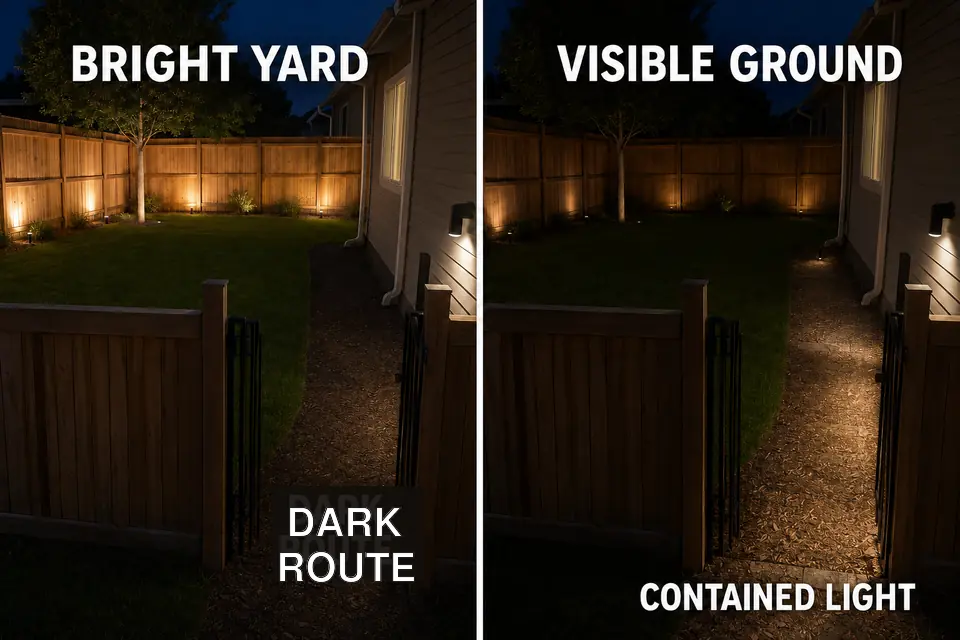
Pay particular attention to surface changes. A gate threshold, stepping stone, low edging, or worn depression can disappear when light passes across it at the wrong angle. If one of these points remains dark, correct the local aim before raising the overall output. This same contrast problem explains why brighter outdoor lights can produce worse visibility.
Fence Shadow
Treat a bright fence beside dark ground as an aiming failure, not proof that the run has enough light. A close fence can catch the main beam and create a shadow directly below posts, rails, projecting caps, or an open gate.
This failure is especially deceptive with a light mounted above or directly on the fence. From across the yard, the illuminated boards look convincing. From inside the run, the dog may still be moving through the dark strip beneath them.
Follow the shadow to its source
Stand at the gate and find where the ground first becomes dark. Looking upward from that point usually reveals the obstruction: a fence post, gate panel, fixture housing, or gate positioned across the useful part of the beam.
The first correction should not be a brighter bulb or wider beam. Shift the light across the route, lower its aiming point, or position it far enough from the obstruction to reach the ground beside the fence. Uniformly illuminated fence boards add little if the walking edge disappears.
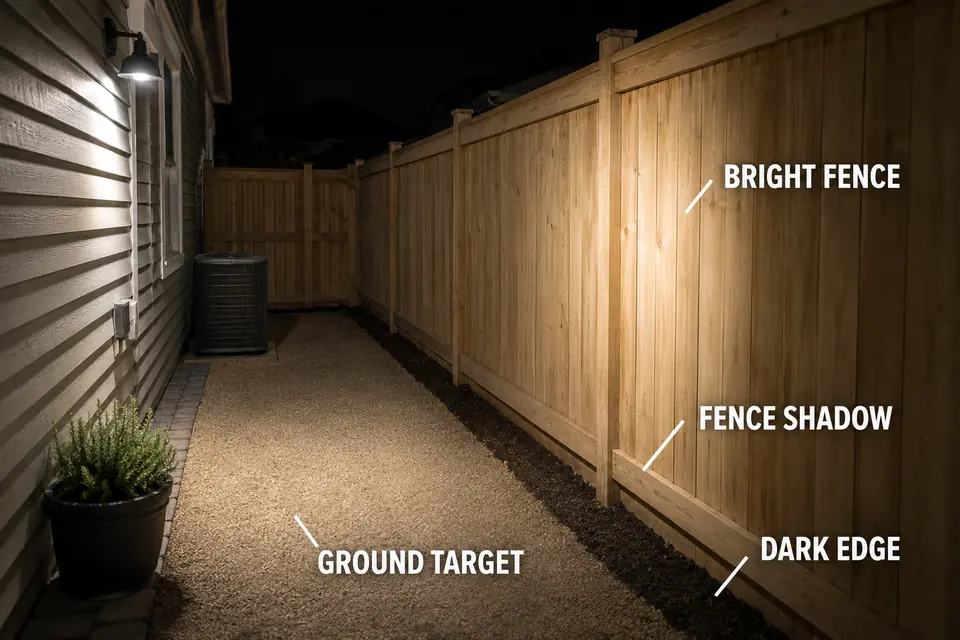
Repeat the check with the gate in its normal open and closed positions. A gate that causes no problem while closed can block the light after someone enters the run. Related fence lights that shine in the wrong direction also need an aiming correction before another fixture is added.
Waste Pickup
Use waste pickup as the detail test for the entire lighting layout. If small objects disappear against grass, gravel, mulch, fallen leaves, or irregular paving, the run is only generally bright—it is not task-visible.
Test from normal standing height at the actual cleanup point. Turn as you normally would and look down. If your body blocks the only useful light, the task area will fall into shadow even though the rest of the run remains visible.
This is where a single light positioned behind the owner commonly fails. Changing the side angle can reveal texture and preserve contrast without increasing brightness across the yard. On grass or mulch, some light arriving from the side often separates an object from the surface more clearly than flat light traveling in the viewer’s direction.
The cleanup area does not need sports-field brightness. It needs enough directional definition to remain readable after the owner steps into the beam.
Motion Trigger
Aim the sensor at the approach route, not the largest area it can detect. The light should activate before the owner reaches the gate, but movement elsewhere in the yard should not repeatedly switch on the dog run’s brightest source.
Walk from the back door toward the gate at normal speed. The threshold should become visible before the next step, rather than lighting only after you have entered the run.
Test the route in both directions
A sensor may detect someone crossing its field more reliably than someone walking directly toward it. Test entry, movement inside the run, and the return to the house as three separate paths, even when they overlap in a small space.
Branches, a neighboring walkway, passing vehicles, or activity beyond the fence can cause unnecessary activation when the detection field extends outside the task zone. If the intended approach remains unreliable, correct the relationship between the motion light and walking path before raising sensitivity.
The useful detection area is therefore not the longest one. It is the smallest area that reliably reads the approach, active zone, and return route.
Neighbor Aim
Set the property boundary as the beam’s stopping point, never its target. After the light covers the gate, walking line, and cleanup area, additional reach toward the fence top or beyond the fence rarely improves use inside the run.
Check direct glare separately from illuminated spill. Stand at the far end of the run and look back. If the exposed source is uncomfortably bright from that position, someone across the boundary at a similar sightline may experience glare even if little light visibly lands on their property.
Then inspect both side boundaries where access allows. A fixture can look properly aimed from behind while sending high-angle light sideways, particularly when it is mounted near a corner or aimed diagonally through a narrow run.
Where the layout permits, direct the main output downward and inward toward the home-side portion of the run. The source should disappear behind its cutoff or shielding before a viewer reaches the fence line.
If the beam reaches neighboring windows, patios, or frequently used areas, reduce that spill before extending coverage elsewhere. The same boundary test used for backyard lights that cross the property line applies even when the dog run occupies only one small corner.
Low Guide Light
Add a low guide light only where the ground route actually breaks. A dark gate corner, turn, surface transition, or fence-side strip may need local definition, but that does not justify making the main fixture brighter.
The guide light’s job is to reveal a decision point underfoot rather than project across the full run. Keep it shielded from normal eye level and aim it at the surface or edge that disappears from the main beam.
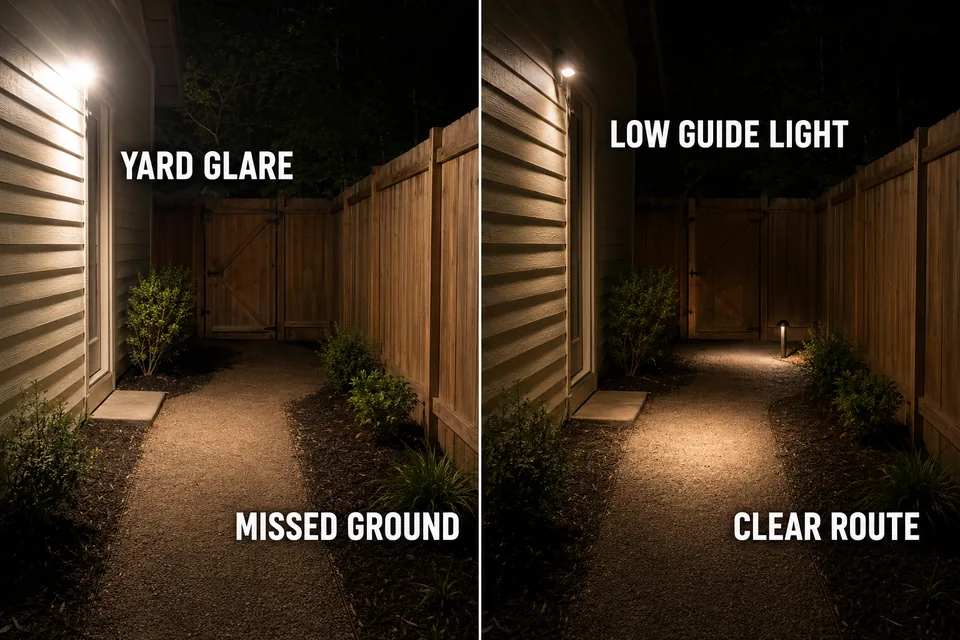
Avoid repeating small lights along every fence panel. That arrangement can create alternating bright spots and dark gaps while placing more visible sources in the owner’s line of sight. One correction at the break in the route is usually stronger than a runway-like row.
Make the final judgment from four positions: the back door, inside the gate, the cleanup point, and the property edge. The layout works when the ground route remains connected from each position, the pickup surface retains visible texture, and no exposed source dominates the view. If one location still fails, correct that location rather than relighting the whole yard.
For additional technical context, the U.S. Department of Energy explains how controlling source intensity and angle can reduce glare in outdoor LED lighting.