Once transformer failure is confirmed, the replacement should power your existing lights correctly and give you controls that suit your routine. You do not necessarily need more wattage or more features than before.
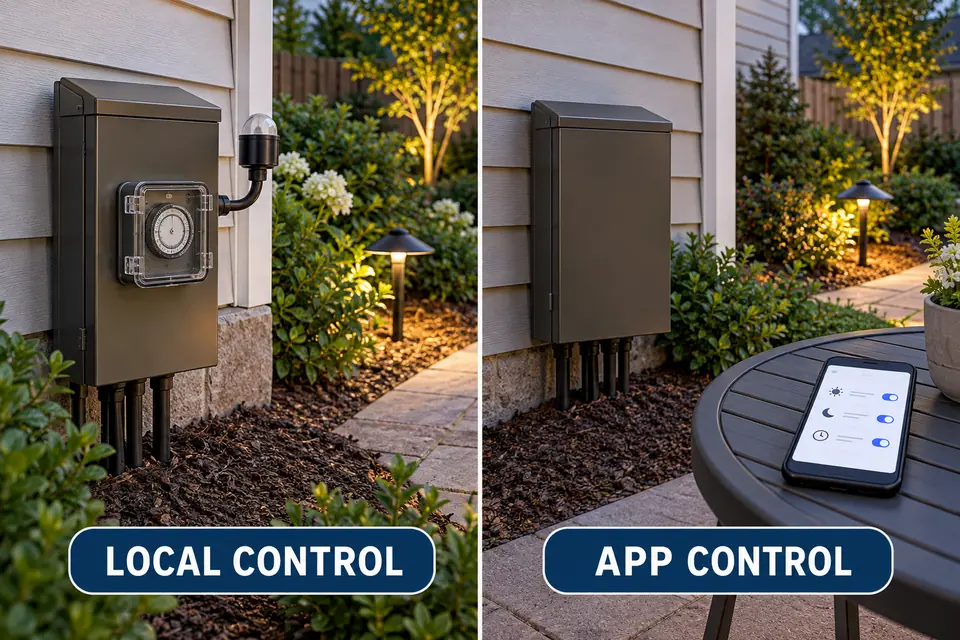
For straightforward local scheduling, start with an outdoor landscape transformer with a timer and photocell. For phone-based adjustments or separately scheduled areas, consider a smart landscape transformer with those capabilities documented.
Before browsing either category, establish the electrical requirements. A convenient controller is only useful when its output matches the lights you intend to keep.
Check These Four Requirements Before You Shop
Use the installed fixture specifications and the old transformer’s label to narrow the field.
| Requirement | What to confirm |
|---|---|
| AC or DC output | Whether the installed fixtures accept AC, DC, or both |
| Output voltage | The permitted input range for every connected fixture |
| Load capacity | Actual connected load and the replacement’s applicable loading limits |
| Fixture compatibility | Whether existing lights require a particular controller or communication system |
A listing that says only “12V” or “LED compatible” does not settle these questions. Some fixtures accept both AC and DC; others do not. Proprietary lighting systems may also require a compatible controller to retain dimming, color, or individual fixture control.
Once those requirements are known, choose between the two control categories below. The detailed capacity and wiring checks follow.
Choose a Conventional Transformer for Simple Local Scheduling
A conventional outdoor landscape transformer with a timer and photocell is the strongest starting point when your lights follow one routine and you prefer adjustments at the enclosure.
For a front walkway and planting bed that switch together every evening, app control may add little practical value. Local controls can provide the schedule you need without network setup or an account.
Check the actual operating modes before buying. “Timer and photocell” may mean dusk-to-dawn operation, a fixed number of hours after dark, clock-based scheduling, or specific combinations. Dusk activation followed by a fixed clock-time shutoff is not the same as running for six hours after sunset.
Look for:
- Matching AC/DC output, voltage, and sufficient usable capacity.
- An included timer and photocell, rather than compatibility with separately purchased accessories.
- The exact on/off routine you want.
- Accessible manual controls and documented recovery after a power interruption.
Photocell placement matters. A sensor exposed to a nearby porch light or tucked into deep shade may receive an unsuitable daylight signal. A supported remote photocell can help when the transformer’s mounting location is poor for sensing outdoor light.
Skip this category if remote adjustments or different schedules for separate areas are essential and the particular unit cannot provide them.
If your lights should switch together and you want controls at the unit, browse conventional timer-and-photocell transformers first. Concentrate on the correct electrical match and scheduling mode.
RESTORE YOUR EVENING LIGHTING ROUTINE
Conventional Outdoor Landscape Transformers with Timer and Photocell
Start here when you want compatible lights to follow a straightforward dusk or timed schedule without managing an app.
Look for: matching AC/DC output and voltage, adequate capacity, an included timer and photocell, and your preferred shutoff mode.
Choose smart instead if phone-based adjustments or separately scheduled areas are essential.
Choose a Smart Transformer for Phone Control or Separate Schedules
A smart landscape lighting transformer earns its place when you will use app adjustments or supported control of different areas.
For example, you may want the front path to stay on later than backyard accent lights. A compatible smart transformer with independently controlled outputs can support that arrangement if the areas have suitable separate wiring.
However, app control does not automatically include independent zones, dimming, or color adjustment. Those capabilities need explicit support, sometimes from both the transformer and the fixtures.
Look for:
- Documented electrical compatibility with your existing lights.
- Independently controlled outputs when separate schedules are required.
- Suitable total and per-output capacity.
- Network requirements that work at the mounting location.
- Clear offline operation, local controls, and power-restoration behavior.
Also check how dusk scheduling works. A physical photocell responds to surrounding light; an astronomical schedule uses time and location to calculate sunset. Choose the behavior you want rather than assuming every smart transformer uses a light sensor.
Skip this category if one locally controlled routine already meets your needs. Reject a candidate if the manual does not explain how essential schedules behave without a connection.
If changing schedules from your phone or controlling separately wired areas would make the system more useful, browse smart landscape transformers first. Pay for documented capabilities you will use.
ADJUST YOUR LIGHTING WITHOUT GOING OUTSIDE
Smart Landscape Lighting Transformers
Start here when you want phone-based adjustments or different schedules for separately wired areas.
Look for: matching electrical output, sufficient total and per-zone capacity, independent outputs where needed, and documented offline operation.
Choose conventional instead if a simple routine controlled at the enclosure already does the job.
Size the Replacement for the Lights You Have Now
Once you have chosen a control category, narrow the capacity range.
Do not automatically copy the old transformer’s wattage. It may have powered halogen lamps that were later replaced with LEDs, or additional fixtures may have increased the connected load.
Record:
- The quantity and actual input rating of each lamp or integrated fixture.
- The load connected to each cable run.
- Any definite additions the replacement must support.
- Any manufacturer-specified minimum load or LED loading restrictions.
Use actual consumption rather than “50-watt equivalent” brightness claims.
For AC LED systems, check whether the fixture manufacturer provides a VA rating for transformer sizing. Watts and volt-amperes are not always interchangeable. Use the sizing figures required by the equipment documentation.
A manufacturer’s voltage-drop calculator illustrates how total VA, wire gauge, and run length work together when planning a system. A wattage number alone does not describe the whole installation. www.fxl.com
Leave Capacity According to the Specified Loading Method
An 80% loading target is a common planning approach, but it should not replace the instructions for the particular transformer.
For example, if the manufacturer specifies that target and the applicable connected load is 96W:
96W ÷ 0.80 = 120W required nameplate capacity.
A compatible 150W unit would exceed that calculated requirement, subject to its other limits. Use the appropriate VA figures instead when the manufacturer’s sizing method requires them. www.voltlighting.com
Extra capacity makes sense for planned additions. It does not repair damaged wiring, poor connections, or excessive voltage drop.
Count Cable Connections, Voltage Taps, and Zones Separately
Several terminals on the front of a transformer do not necessarily mean several independently controlled lighting zones.
| Feature | What it provides | What it does not prove |
|---|---|---|
| Multiple cable terminals | Connections for supported cable arrangements | Separate schedules |
| Multiple voltage taps | A choice of output voltages | Independent switching |
| Independently controlled zones | Separate operation of connected groups | Unlimited capacity on each output |
Check how many existing cable runs must connect and whether the terminals accept their conductor sizes and quantities. Do not assume several wires can share a terminal unless the instructions permit it.
For independently controlled outputs, check both the total rating and the limit for each output. A transformer with enough overall capacity may still be unsuitable for one heavily loaded zone.
Your existing wiring also sets boundaries. Fixtures sharing one cable run cannot become separately scheduled transformer-controlled groups just because the replacement has extra channels.
Higher Voltage Taps Are for a Verified Need
A multi-tap transformer can help accommodate voltage loss along a run. The important limit is the voltage reaching each fixture, including the nearest one.
Do not select the highest tap by default or assume the previous setting will be correct for a different replacement. Have the loaded system checked against the installed fixtures’ permitted range.
“Multi-tap” is also an incomplete specification. Compare the actual available voltages rather than assuming every model offers the same choices. www.fxl.com
Verify What Happens When Internet or Power Is Lost
For a smart transformer, “works offline” needs a precise explanation. An internet outage, a missing Wi-Fi network, and an electrical outage are different events.
| Event | Behavior to verify |
|---|---|
| Internet service fails while the router remains on | Whether existing schedules continue |
| The local Wi-Fi network becomes unavailable | Whether stored schedules and timekeeping continue |
| Electrical power returns after an outage | Whether the transformer resumes its schedule, remains off, or restores a previous state |
| Your phone or app is unavailable | Whether basic local switching remains possible |
| The account or cloud service becomes unavailable | Which essential functions remain usable |
A stored schedule does not necessarily mean the clock survives a power interruption. Likewise, a local button may allow switching without letting you change the schedule.
For conventional models, check clock retention, timer reset requirements, and whether the selected mode resumes automatically.
If predictable recovery matters to you, require a clear answer in the manual or written confirmation before ordering. Do not infer it from a general “memory function” claim.
Check the Mounting Location Before Placing the Order
Compare enclosure dimensions, mounting clearances, cord reach, cable entry positions, and supported wire sizes. A replacement can be electrically suitable yet awkward to install in the existing space.
For a typical U.S. plug-in installation, confirm the specified 120V input and follow the manufacturer’s outdoor receptacle and GFCI requirements. A hardwired replacement involves appropriate electrical work rather than a simple plug-in exchange.
Outdoor suitability has limits. An outdoor enclosure is not automatically suitable for standing water, burial, or operation inside a sealed box. Installation instructions may require upright mounting and free air around the transformer. www.fxl.com
If irrigation spray, water entry, or restricted ventilation contributed to the previous failure, correct that condition during replacement. Otherwise, the new unit may face the same damaging environment.
Make the Final Choice
Buy a conventional timer-and-photocell transformer when the electrical requirements match, the existing runs can be connected properly, and one locally managed routine meets your needs.
Buy a smart landscape transformer when those same compatibility checks pass and you will use its documented app or scheduling functions. Require independent outputs if different areas need different schedules.
Delay the purchase if output type, fixture-system compatibility, load capacity, or essential recovery behavior remains unclear.
Choose the compatible category first, then compare models within it. Additional capacity and connected features should serve a specific purpose in the system you already own.