When an outdoor LED flickers only below freezing, start by recording when the flicker stops—or whether it stops at all.
That timing, the fixture’s replaceable parts, and its documented temperature limits determine whether a bulb comparison, professional assessment, or different replacement specification makes sense.
Cold can affect electronic startup behavior or expose a marginal connection. It does not identify a failed component by itself.
A light that eventually settles also needs attention: steady operation after warming does not establish that its next cold start will be reliable.
Cold-Start Failure vs All-Night Flicker
Compare starts after the light has cooled outdoors. Switching it off briefly after it has been running does not recreate that condition; its internal components may still be warm.
If the light flickers immediately, then settles into steady operation, temperature-sensitive startup behavior is one possibility.
Record how long that takes. There is no universal number of flickering minutes that proves driver failure or counts as acceptable LED warm-up.
Flicker that continues later—or returns after apparently steady operation—needs a different interpretation. A brief startup problem cannot explain the entire pattern. Record that distinction without leaving a suspect fixture operating unattended to see what happens overnight.
Check whether the freezing-only pattern holds. If the same symptom occurs on mild evenings, or several lights fluctuate together, the broader outdoor LED flicker checks become more relevant than temperature alone.
Treat 32°F (0°C) as the reference for freezing water, not a universal failure point for LEDs. Compare this particular light’s behavior with its stated starting and operating limits.
Driver, Bulb, and Contact Differences
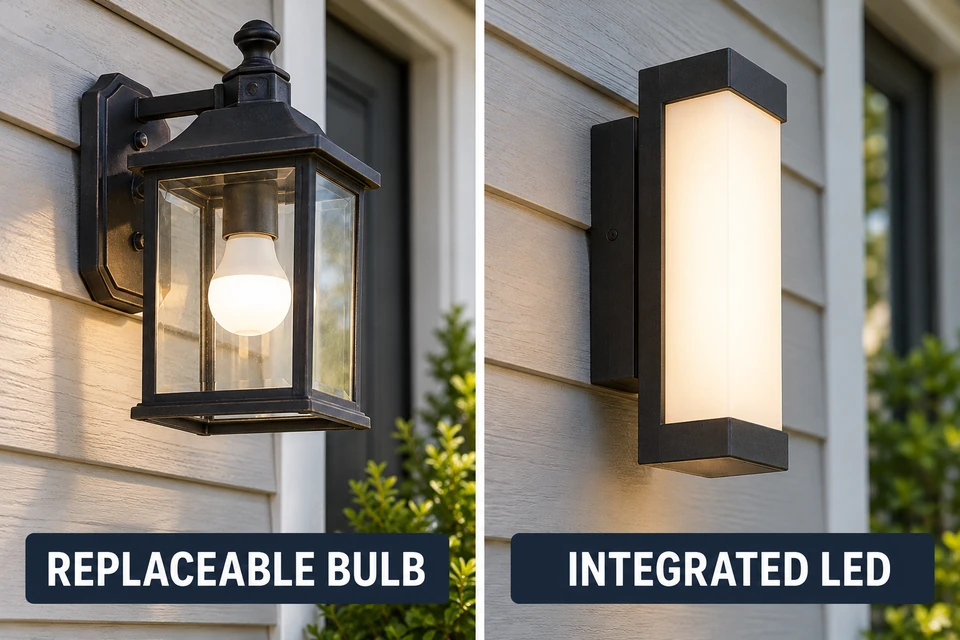
Identify whether the light accepts a replacement bulb before choosing a test. Similar-looking outdoor housings can require entirely different repair paths.
Fixtures With Replaceable LED Bulbs
A conventional screw-in LED bulb normally contains its own power-conversion electronics. Replacing it changes those electronics and the light source, while leaving the socket, fixture wiring, and controls in place.
That makes a compatible bulb substitution useful, but its result needs care. Removing and installing a bulb also changes the contact between its base and the socket. An improvement supports a bulb-or-contact explanation; it does not conclusively separate the two.
Integrated LED Fixtures
An integrated fixture has no ordinary replacement bulb. Its driver may be serviceable, or the manufacturer may treat the light as a complete replacement assembly. Check the model documentation before assuming either.
Cold can affect electronic behavior, while thermal contraction can alter an already marginal contact. Neither mechanism can be confirmed by looking at the housing. Properly installed connections should not be presumed to loosen whenever winter arrives.
Comparing the First Minutes After Switch-On
Change one variable at a time. Replacing the bulb and adjusting the controls between observations leaves you unable to tell which change mattered. Stop the comparison if the warning signs in the next section appear.
- Record the starting conditions. Note the approximate outdoor temperature, whether conditions are dry or wet, how long the light has been off, and its normal control setting. A nearby weather reading provides context, though it may differ from conditions at the fixture.
- Observe one normal switch-on. Record whether visible flicker starts immediately, whether it stops a few minutes later, and whether it returns during the same observed operating period. Use the actual elapsed time rather than assuming a particular number of minutes proves a fault. Avoid rapid on/off cycling.
- Compare a milder-weather start. Keep the same bulb and control setting. Note any change in moisture conditions: a dry cold evening and a wet mild evening are not a clean temperature comparison. If several lights flicker together, record that too.
- Compare a suitable replacement bulb only where appropriate. For an accessible, dry, undamaged fixture with a user-replaceable bulb, isolate power and follow the manufacturer’s replacement instructions. Use a compatible bulb, then assess it after it has experienced comparable outdoor cold.
A room-temperature bulb carried outside may work immediately even if its behavior changes after cooling. Count the comparison only after the replacement has faced conditions similar to those that triggered the original symptom.
Judge the visible symptom directly. Bands or pulsing that appear only on a phone camera can reflect how the camera captures the light; they do not by themselves establish the freezing-weather flicker you are investigating.
Condensation and Loose Contact Clues
Visible moisture, corrosion, or mounting movement changes the next step, even when flicker has appeared only on freezing nights. Check for these clues before continuing the temperature comparison.
Warning Sign: Stop using the fixture if you notice a burning odor, crackling, scorching, repeated breaker or GFCI trips, water at electrical parts, or loose or damaged mounting. Isolate power if you can do so safely and arrange qualified assessment. Do not repeatedly reset protection, handle wet electrical parts, or continue operating the light to complete a comparison.
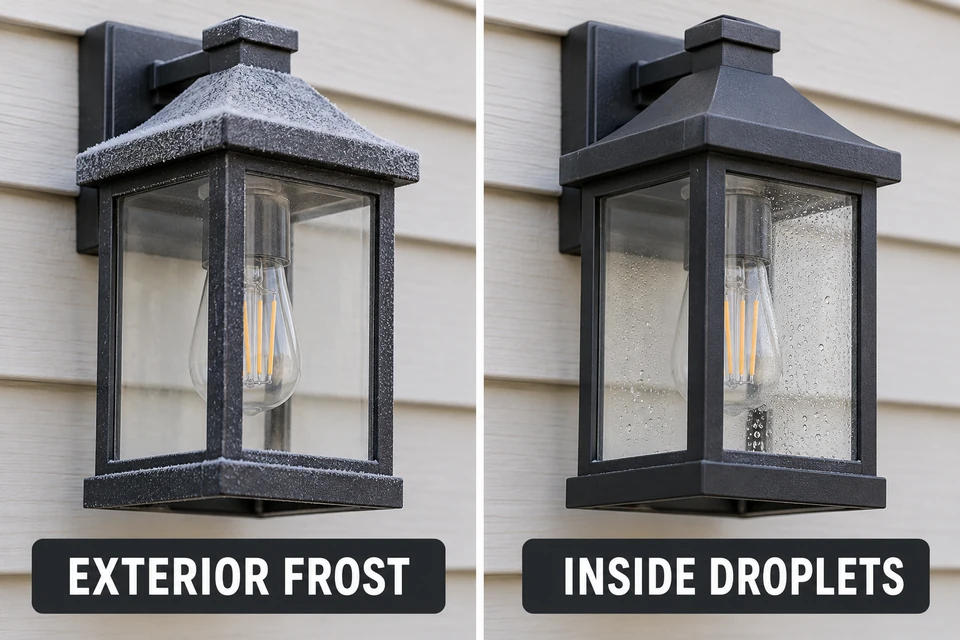
Droplets inside the glazing show visible moisture, but they do not establish that water has reached electrical contacts. Equally, clear glazing does not prove that concealed electrical areas are dry.
If the light also flickers during naturally occurring wind or nearby door movement, that additional clue matters. Follow the separate guidance for flicker that follows wind or door movement rather than attributing everything to temperature.
Do not shake, strike, or press on the fixture to reproduce the symptom. Cold contraction may contribute to a marginal connection, but confirming and repairing that connection requires more than an exterior observation.
Choosing Repair or Cold-Rated Replacement
Check the exact model’s minimum starting temperature, if stated, and its ambient operating range before choosing a replacement. Storage temperatures and driver case-temperature limits answer different questions. Compare the applicable rating with the lowest expected temperature at the installation, not just today’s reading.
Exposure protection is a separate requirement. The fixture’s outdoor exposure ratings help establish suitability for moisture and weather, but a wet-location or IP rating alone does not establish low-temperature starting capability.
For a replaceable bulb, select a documented temperature range suitable for the location along with the correct base, voltage, enclosure suitability, and control compatibility. “Outdoor LED” without a usable temperature specification leaves the original question unanswered.
If a compatible bulb performs steadily after a comparable cold start, that supports keeping the existing fixture, provided its socket and housing are sound. If flicker continues, further fixture, contact, or control assessment is more useful than repeatedly trying different bulbs.
For an integrated fixture, check warranty coverage and manufacturer-approved service options. When assessing an integrated LED driver problem, a qualified technician can determine whether an approved replacement driver is available and whether the rest of the fixture remains serviceable.
A nonserviceable assembly or damaged housing may justify fixture replacement. Equipment operating below its documented minimum needs a suitable specification. Equipment flickering within its stated range needs diagnosis or warranty assessment; choosing a lower temperature rating alone may leave the actual fault unresolved.
Confirm the repair or replacement under comparable freezing conditions. The useful result is a stable cold start and continued steady operation—not simply a light that eventually stops flickering.
For an example of separately documented temperature and environmental specifications, see MEAN WELL’s LED driver technical catalog; an individual driver’s limits do not establish the complete fixture’s rating.