
This is not primarily a general flicker problem. When an outdoor light blinks at the exact moment a door closes or a gust pushes against the wall, physical movement is probably changing electrical contact somewhere in or behind the fixture.
The sensitive point may be a bulb that is not seated normally. It may instead be the socket, fixture leads, mounting box, or a concealed splice disturbed when the assembly moves. The timing narrows the diagnosis, but it does not prove which component is defective.
Do not hit the wall, shake the light, or slam the door harder to confirm the symptom. The useful test is whether ordinary movement repeatedly produces the flicker—and whether the bulb or the mounted assembly moves with it.
Why Vibration Is the Key Diagnostic Clue
Treat the timing as evidence only when the relationship repeats under normal conditions. One blink during one door closure may be coincidental; flicker synchronized with separate ordinary closures or natural gusts is much more diagnostic.
That pattern differs from flicker that also happens without vibration. Random dimming can originate in several electrical or electronic conditions. A movement-triggered blink points more specifically toward changing contact pressure.
Vibration can travel through siding, masonry, mounting hardware, the electrical box, and the fixture body. If a contact is already marginal, that small movement may interrupt it for a fraction of a second. The light may blink once, dim briefly, or flicker until the wall stops moving.
The trigger identifies a movement-sensitive fault zone—not the failed part. Generating a stronger impact will not distinguish a loose bulb from a damaged socket or concealed connection. It may simply worsen the movement.
Bulb Contact vs Mounting-Box Movement
The central decision is whether the evidence stays at the bulb or extends into the fixture’s attachment to the wall. Turn the circuit off at the breaker and let the fixture cool before touching the bulb or inspecting it closely.
Evidence That Stays at the Bulb
A screw-in bulb left slightly short of its normal seated position can lose contact when vibration reaches the socket. With power off, a cooled bulb may be checked for normal seating. Do not force it, overtighten it, or work it back and forth if corrosion makes it resist movement.
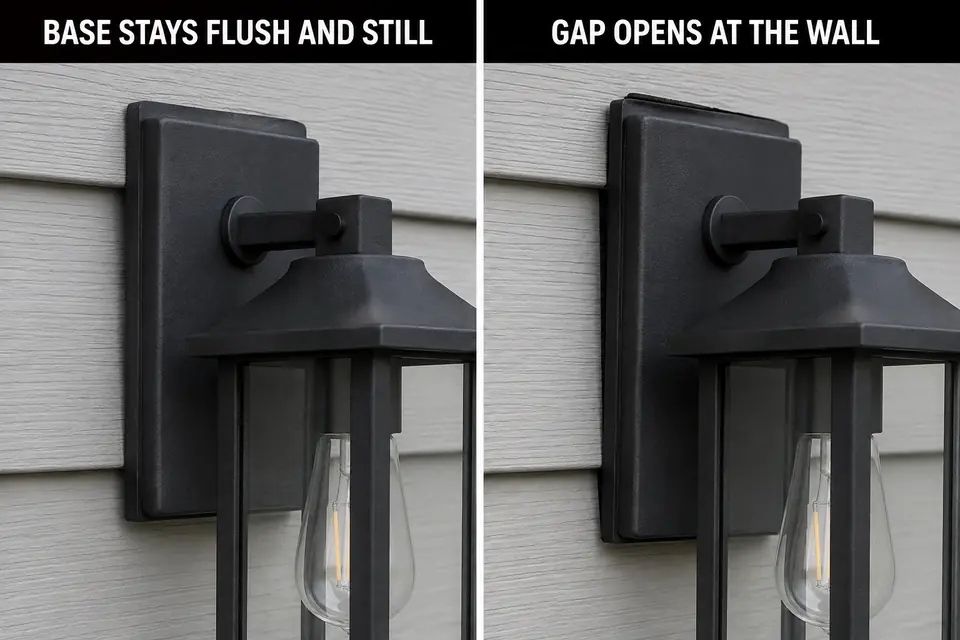
A bulb-level possibility remains plausible only when the fixture body and backplate stay flush and still. Reseating the bulb is meaningful only if there is no movement, wall gap, heat damage, corrosion, or socket deterioration elsewhere.
A properly seated bulb that still loses contact may indicate a socket or internal fixture problem. Do not bend the socket contact or insert tools into it.
Evidence That Involves the Mounted Assembly
The diagnosis changes as soon as the backplate, canopy, fixture body, or mounting surface shifts. A correctly seated bulb cannot compensate for an assembly that transfers movement to its conductors or splices.
Look for rocking, a changing backplate angle, or a gap opening between the fixture and wall. These clues do not reveal whether the bracket, electrical box, fastener, siding block, or surrounding material has failed. They do establish that the problem is no longer confined to bulb seating.
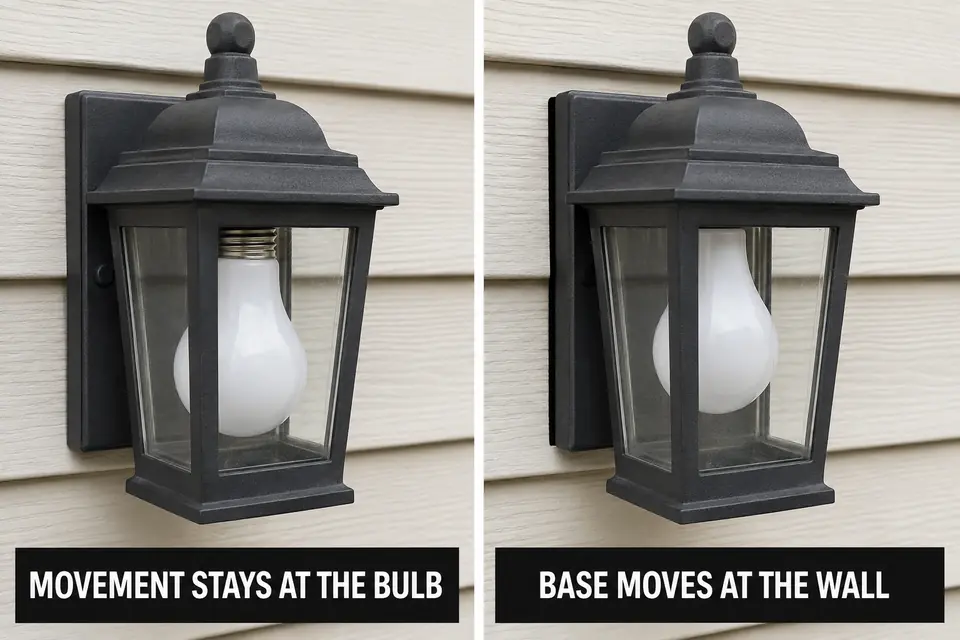
Reseating a bulb does not clear movement elsewhere. If the base or mounting surface shifts, the circuit should remain off even if the light begins working normally again.
Reproducing the Symptom Without Striking the Fixture
Use ordinary operation to confirm the correlation; do not manufacture a stronger event. If the light cannot be watched safely from the ground, stop rather than climbing or handling it while energized.
- Watch from a safe position while another person closes the door normally. Do not slam it or repeat the closure rapidly.
- Note whether the flicker occurs at the moment the door stops and whether the fixture visibly shifts.
- If wind is the suspected trigger, wait for a natural gust. Do not push the fixture, siding, or wall.
- Stop if a gap opens or you notice movement, buzzing, crackling, odor, discoloration, or damaged material.
Also note whether nearby lights remain steady. One affected fixture keeps attention on its local bulb, socket, mounting, and connections. Several lights responding together would broaden the fault zone and should not be diagnosed by manipulating this fixture.
A light that also cuts out at unrelated times may belong under the broader process for intermittent outdoor-light operation. Failure to reproduce the blink does not clear the installation; the marginal contact may simply have settled temporarily. Do not increase the force to make it return.
Visible Looseness That Requires Shutdown
Visible movement at the wall is the stop-use threshold. The fixture does not need to hang dramatically loose before its support and concealed wiring require inspection.
Movement at the Wall Is Enough to Stop
Warning evidence includes a backplate that rocks or tilts, a canopy that no longer remains flush, a displaced gasket, or a wall gap that changes when the door closes. Cracked mounting material, corrosion around the attachment point, and loose exterior parts also move the problem beyond a bulb check.
A changing gap does not prove that the electrical box itself has separated. The bracket, fasteners, box, mounting block, or surrounding wall material may be responsible. Identifying the failed part requires access behind the fixture and should not be attempted while it is energized.
Heat or Insulation Damage Raises the Boundary
Brown discoloration, softened plastic, melting, damaged insulation, or a burning odor points beyond mechanical looseness toward possible heating at a poor connection. The signs of heat or melting at an outdoor connection explain why tightening a visibly damaged part is not an adequate repair.
Buzzing or crackling during the flicker also matters when no damage is visible. Do not continue operating the light to learn whether the sound becomes louder.
Warning Sign: If the fixture shifts at the wall, a mounting gap changes, or you notice heat damage, crackling, burning odor, or damaged insulation, switch off the circuit and leave it off. Do not tighten exterior hardware while energized or assume that pushing the fixture back into position has corrected hidden damage.
When Vibration Reveals Hidden Wiring Damage
A fixture can look straight while vibration disturbs something concealed behind it. A conductor may be pinched, pulled tight by mounting movement, weakened near an entry point, or joined through a splice that no longer maintains dependable pressure.
The light returning immediately after each blink does not make that contact healthy. Repeated interruption can increase arcing, heat, and conductor damage while leaving the fixture apparently normal between events.
Exterior observation ends here. Do not remove the fixture, probe terminals, or move conductors in search of the sensitive point. Keep the circuit off until the mounting and concealed connections can be inspected safely.
An electrician can evaluate the mounting box, fixture bracket, socket leads, branch conductors, splices, grounding path, and evidence of heat or abrasion. The discussion of loose outdoor wiring connections provides related context, but a vibration-sensitive fixture still requires diagnosis at its actual mounting location.
Report the exact trigger, whether the response was immediate, whether the fixture moved, and whether you noticed sound, odor, heat, corrosion, or a changing wall gap.
The practical dividing line is simple: bulb-only evidence may justify one careful power-off seating check; movement at the mounted assembly or an unexplained recurring flicker requires shutdown and professional inspection.
For additional warning signs that warrant professional inspection, see the Electrical Safety Foundation International’s electrical safety guidance.