
When an outdoor post light works only in one pole position, the return of light is part of the fault. Movement may be temporarily restoring contact at a loose connection or damaged conductor. Leaving the pole in that position can hide the interruption while the underlying damage remains.
Do not move the pole again to confirm the symptom. Shut off its identified electrical supply from a safe location and leave it off for inspection. The observation you already have is enough to justify service.
This diagnosis concerns a wired post light. Its supply, access arrangement, and wiring route must be established before anyone opens it.
What Movement Says About the Connection
A change in pole position can alter contact pressure at a loose termination or bring damaged conductor ends back into contact. That makes an unstable electrical path a concern even if the lamp subsequently glows steadily.
The visible moving point cannot reliably locate the fault. A pole can transmit movement to fixture leads near its top, wiring inside its shaft, or the supply connection near ground level. The observation narrows the suspected mechanism more reliably than it identifies the failed component.
Without a movement relationship, other causes of a post light not working may deserve attention. Once operation has changed with pole position, repeating a general bulb-and-control troubleshooting routine can distract from the connection problem that needs inspection.
A dark lamp also does not establish that the pole is electrically safe. An interrupted connection can stop illumination while parts of the circuit remain energized. Avoid touching the pole to judge its stability or checking whether it works in another position.
Base, Handhole, and Underground Transition Points
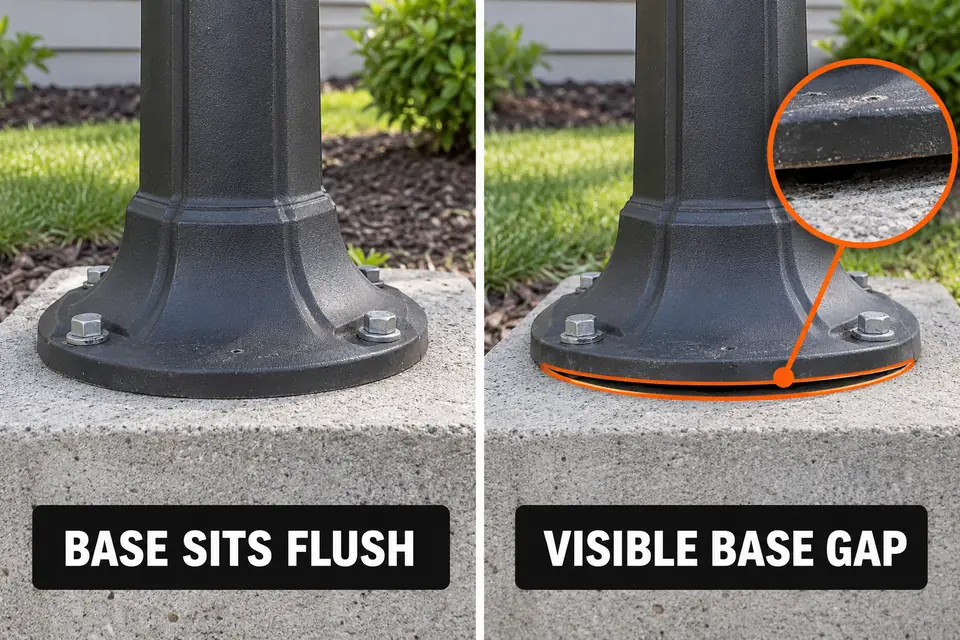
A visible base gap helps an electrician assess where movement occurs, but a flush base does not clear the wiring. Mechanical support and electrical entry often sit close together at the lower pole; damage can remain concealed even when the exterior looks intact.
Base and Handhole Access
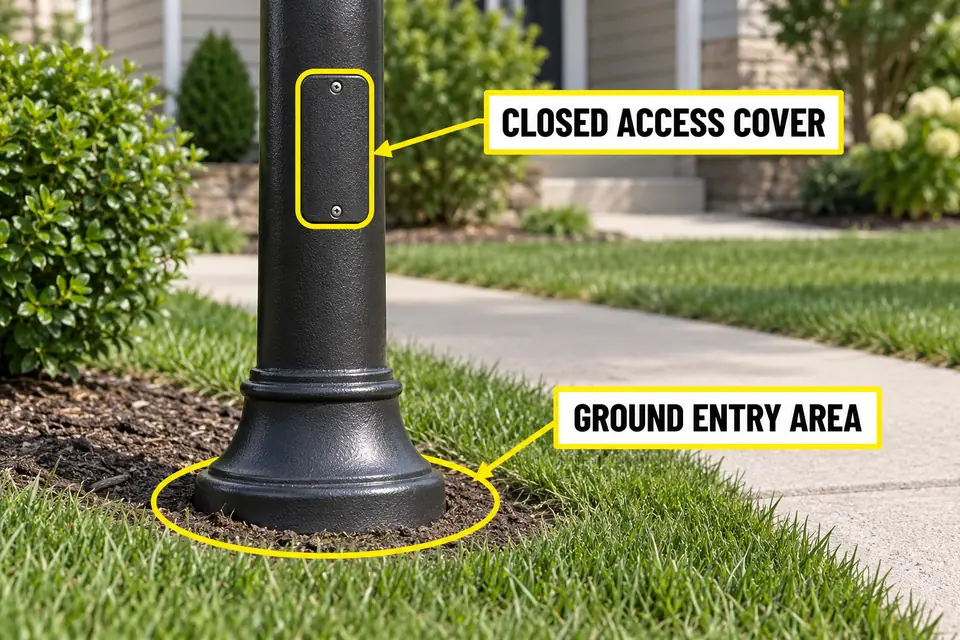
Some post lights have a base compartment or a small covered opening called a handhole. Others have no separate access opening and use a different service arrangement. A visible cover identifies a possible professional access point, not a homeowner inspection step.
From a safe position, note an already-visible displaced cover, base gap, corrosion, or separated conduit. Leave covers and mounting hardware in place. These details help describe the installation without proving which connection has failed.
Wiring Inside the Pole
Internal conductors may pass through openings, connect to fixture leads, or change direction near the base. If movement pulls on a termination or presses wiring against an edge, the resulting strain can affect contact, insulation, or the conductor itself.
This explains why tightening the mounting hardware alone may leave the electrical problem unresolved. The pole could become more rigid while existing wire damage remains concealed inside it.
The Underground Transition
Where a pole meets a comparatively fixed underground cable or conduit, movement can transfer force to the supply entry. Stress may reach a connection, an entry fitting, or a damaged section of conductor beyond the visible loose point.
That makes damage to underground lighting cables a possible part of the investigation, especially after an impact or nearby ground disturbance. It does not justify digging around the base or pulling cable to look for the fault.
Report what is already visible and leave localization to professional inspection and testing. Do not remove a cover, reach into an opening, or expose the buried transition.
Why Repositioning Is Not a Repair
Holding the pole in its working position preserves a temporary contact condition. It does not secure a loose termination, replace damaged insulation, or restore a weakened conductor.
A wedge, tie, or improvised support can conceal the symptom while leaving strain on the wiring. Further movement may worsen the damage, so finding a position that “holds” is not a useful repair milestone.
Steady light output and an untripped breaker do not prove the installation is safe. A connection can remain defective without producing the conditions needed to trip the protective device.
The eventual repair must address the electrical defect and any mechanical movement imposing strain. Correcting only the pole’s position—or repairing a connection while leaving damaging movement unresolved—can leave part of the problem in place.
Stabilizing the Area Without Energizing It
Stabilize the area by controlling access and preventing disturbance. Leave straightening, bracing, and anchoring the pole to the professionals handling its condition.
For a hardwired installation, turn off the identified circuit breaker using its normal operating handle from a safe, dry location. Do not remove the panel cover. A timer, photocell, or wall control is not a substitute for supply isolation, and the lamp going dark does not verify that all wiring is de-energized.
If the light has a positively identified plug-in low-voltage supply, disconnect it only at a safely accessible, dry supply point. If you cannot identify or reach the supply safely, keep clear and request professional help.
While awaiting service:
- Leave the identified supply off; do not restore it to demonstrate the fault.
- Tell others the light is out of service and prevent accidental re-energization.
- Keep people, pets, and equipment away from the pole and its immediate surroundings.
- Record existing observations or take a photograph from a safe position without touching or moving anything.
A leaning pole, separating base, or visibly unstable support needs prompt professional attention. Keep clear of where it could fall; do not try to catch or hold it.
When the Pole Must Be Opened Professionally
Movement-dependent operation already crosses the professional inspection boundary. Waiting for scorch marks, exposed wiring, or complete failure adds no useful diagnostic certainty.
An electrician handles hardwired supply connections, internal pole wiring, grounding and bonding where applicable, and concerns at the underground transition. If inspection localizes the defect to the luminaire itself, manufacturer or fixture service may then be appropriate for a serviceable assembly or sealed component.
When arranging an electrician’s inspection of outdoor lighting, explain that the light changed state when the pole moved. Report when this began, any recent impact or landscaping work, and visible changes at the base or cover. Describe the previous event; leave the circuit off rather than offering a live demonstration.
Professional inspection may involve confirming isolation, examining connections and cable entries, and testing conductor and insulation condition. Those findings determine whether repair belongs at the fixture, inside the pole, or along its supply; the symptom alone does not justify replacing the entire installation.
Return the light to service after the defect has been corrected and electrical integrity and mechanical stability have been verified. A completed repair must remove the dependence on pole position. Getting the lamp to glow again does not establish that.
For broader warning-sign guidance, the Electrical Safety Foundation’s electrical safety advice identifies flickering or dimming lights as symptoms that deserve attention.