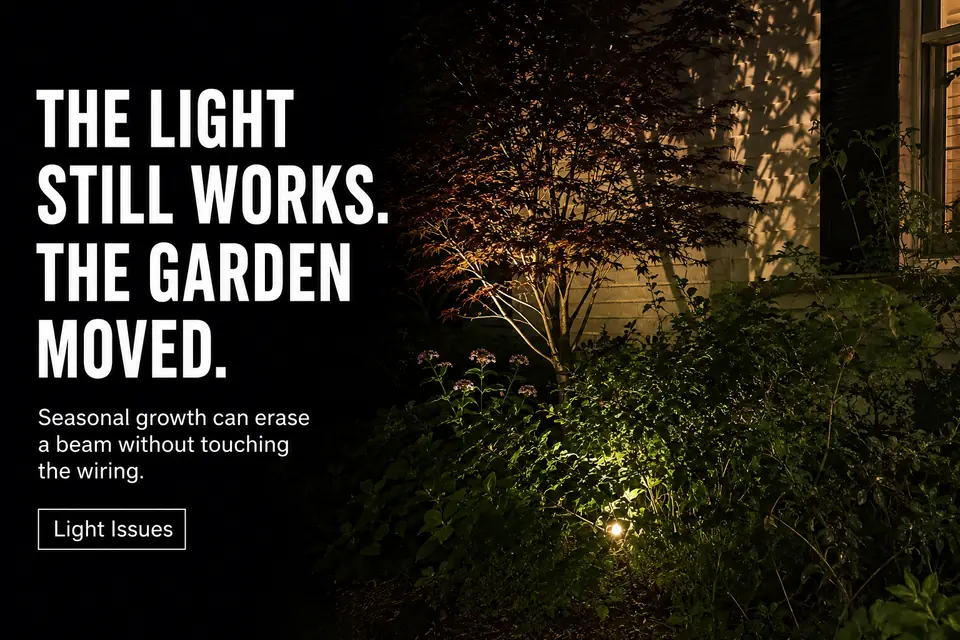
A landscape light can switch on and still appear to have failed. The lamp glows, but the tree trunk fades or the path edge disappears behind bright leaves.
The fixture stays in one position while shoots extend, leaves unfold, and shrubs widen. Growth may touch the source, cross the beam farther away, or alter the outline used when the light was aimed.
Do not begin with a brighter lamp or large pruning cut. Find where the relationship changed, make the smallest correction, and check it after dark from the intended viewpoint.
Spring Growth Shift
Winter and early spring make a lighting layout look unusually open. Bare branches leave a clear route to the target, but the first growth flush can surround the lens or cross that route.
The earliest sign is usually a change in the effect, not a completely dark target. Watch for leaf-shaped shadows that were not present before, a bright patch appearing on the front of a shrub, or the upper part of a tree losing continuity while the lower trunk remains lit. These signs show that living material is entering the lighting geometry.
Growth does not have to cover the entire lens to matter. One new shoot can divide a narrow beam, while a soft mass of leaves can turn a defined accent into broad scattered glow. The visual change may therefore appear uneven: one fixture still looks normal, another seems weak, and a third lights the wrong surface even though all three receive power.
Inspect twice. Daylight reveals leaf contact, access, and visible obstructions. After dark, stand at the normal path, patio, street, or window viewpoint to find which layer catches the beam. Waiting until the target vanishes encourages unnecessary adjustments.
Fixture Buried by Leaves
When foliage closes around the source, the light may create a glowing nest inside the plant. Nearby leaves become unusually bright, sharp shadows scatter across the bed, and little useful light escapes to the intended surface. Controls may also become difficult to reach without pushing stems aside.
Turn the system off and allow the fixture to cool before touching vegetation around it. Remove loose leaves and soft growth that rest against the fixture, but do not pull on the cable, twist the stake, disturb buried connections, or force the housing into a new position. The goal is to restore access and an open front zone, not quietly alter the installation.
Also inspect the space behind and below the housing. Dense groundcover can conceal the stake, trap fallen leaves around the base, and make a stable fixture appear crooked when the plant mass presses against it. If clearing the plant reveals a loose stake, exposed conductor, damaged insulation, or an unstable connection, stop treating the problem as foliage maintenance. The visible growth may have hidden a separate repair need.

Retest before doing anything else. If the target returns, the failure was local burial. For a solar unit, growth may also shade its charging surface; that is a separate problem covered in this guide to overgrown bushes around solar garden lights. Do not confuse a blocked beam with reduced solar charging.
Beam Blocked by Shrubs
A fixture can be fully visible and still lose its target. Follow an imaginary straight corridor from the lens to the tree, wall, sculpture, or path edge. A branch or shrub face entering that corridor can intercept most of the output without coming close to the housing.
At night, the first obstruction often identifies itself: front leaves look too bright, a hard silhouette appears, or part of the target disappears. View from the intended observation point; looking from behind the fixture can hide a side branch blocking the sightline that matters.

More brightness will only make the intercepted leaves brighter. Clear or redirect the obstruction first. If the light continues to fail after the living material is out of the corridor, diagnose outdoor lights that still miss the target area as a placement or aim problem rather than continuing to prune.
The intended target also matters. A small amount of foliage crossing a broad wall wash may only soften its edge, while the same growth can destroy a narrow trunk accent or leave a path marker visually disconnected. Judge the obstruction by whether the original lighting job still reads clearly, not by whether any light reaches the area at all.
Re-Aim Timing
Re-aim only after foliage has been cleared from the source and the first beam obstruction has been identified. Otherwise, the adjustment compensates for a temporary leaf position and may create a different miss when the plant is trimmed or finishes its main growth flush.
Use a small correction, then return to the normal viewpoint. Confirm the target reads clearly without pushing light into windows, seating, walkways, or neighboring property. During rapid spring extension, wait for the plant outline to settle before locking a final aim.
Avoid chasing growth with repeated upward or sideways adjustments. If an adjusted tree light concentrates too much output on one patch of bark or breaks the canopy into disconnected hot spots, treat it as a tree uplight that still looks harsh, not as a reason to keep moving the beam.
A useful temporary correction should remain reversible. Note the original position before loosening an adjustment point, change only one direction at a time, and compare the result from the same viewpoint. If several large corrections are needed to avoid one shrub, the fixture is no longer being re-aimed within its intended role; it is compensating for a placement conflict.
Pruning vs Moving Fixtures
Selective pruning fits a temporary conflict when a small, appropriate cut restores the corridor without changing the plant’s form. Moving becomes more reasonable when healthy regrowth repeatedly occupies the same space or routine access disappears every season.
Pruning should not be driven by the light alone. Timing and acceptable cuts vary by plant, and pruning changes growth and form. The University of Minnesota Extension’s pruning guidance explains why plant type, condition, and timing matter. If keeping the beam open requires severe shaping or removal of flowering growth each year, the placement is asking the plant to accommodate the fixture indefinitely.

Relocation is a layout correction, not routine trimming. Before moving anything, account for stable footing, drainage, mowing exposure, the cable route, the new sightline, and possible glare. If the conflict is built into the location, use the same field logic as correcting poor outdoor light placement. Work involving buried cable or electrical connections should stay within local requirements and appropriate professional boundaries.
The durable choice is the one that lets both systems behave normally. The plant should be able to hold its intended form, and the fixture should remain accessible while keeping an open route to its target. A nearby position that solves today’s blockage but enters another plant’s mature spread simply transfers the same maintenance problem to the next season.
Seasonal Check
Check the arrangement when spring foliage fills out, after the main growth flush or substantial pruning, and after storms or rapid extension visibly changes a plant’s outline. These are growth triggers, not universal calendar dates.
Use daylight to inspect access and contact. Use darkness to judge what the light actually reaches. Keep the check focused on five failure points:
- Is the fixture body and lens free from leaf contact?
- Is the full corridor to the target open, not just the space around the source?
- Does the intended tree, wall, or path edge remain readable from its normal viewpoint?
- Has the aim created new glare, spill, or a bright foliage patch?
- Is this a one-time growth conflict or the same conflict returning in the plant’s normal envelope?
A powered fixture is not the same as a preserved lighting effect. Clear the smallest obstruction first, observe the result after dark, and escalate from re-aiming to pruning or relocation only when the seasonal pattern justifies it. That keeps the garden’s intended nighttime structure visible without forcing either the plant or the light into constant correction.