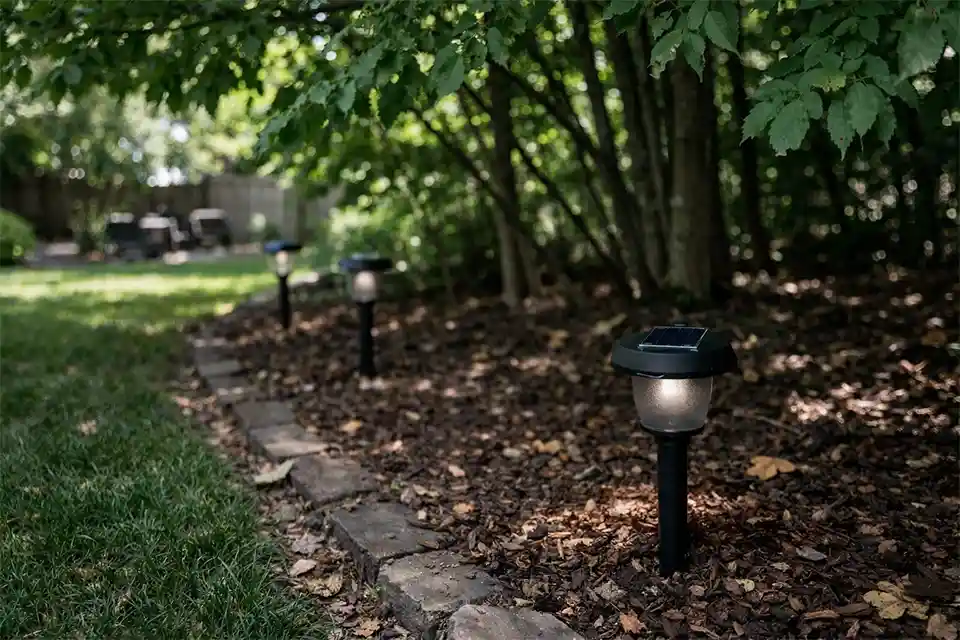
If your solar lights sit under tall trees, the problem is usually not the bulb, not the switch, and not even the battery at first. It is placement. Most solar yard lights need roughly 6 to 8 hours of direct sun to charge well, and the most valuable window is usually about 10 a.m. to 2 p.m. If that period is blocked by canopy, the light may still turn on at dusk but fade in 1 to 2 hours.
That is the pattern to watch. Weak runtime after a clear day usually points to undercharging. No runtime at all after a clear day can mean undercharging plus battery wear, moisture, or internal failure. That difference matters because people often replace parts when the real problem is that the panel never had enough sunlight to begin with.
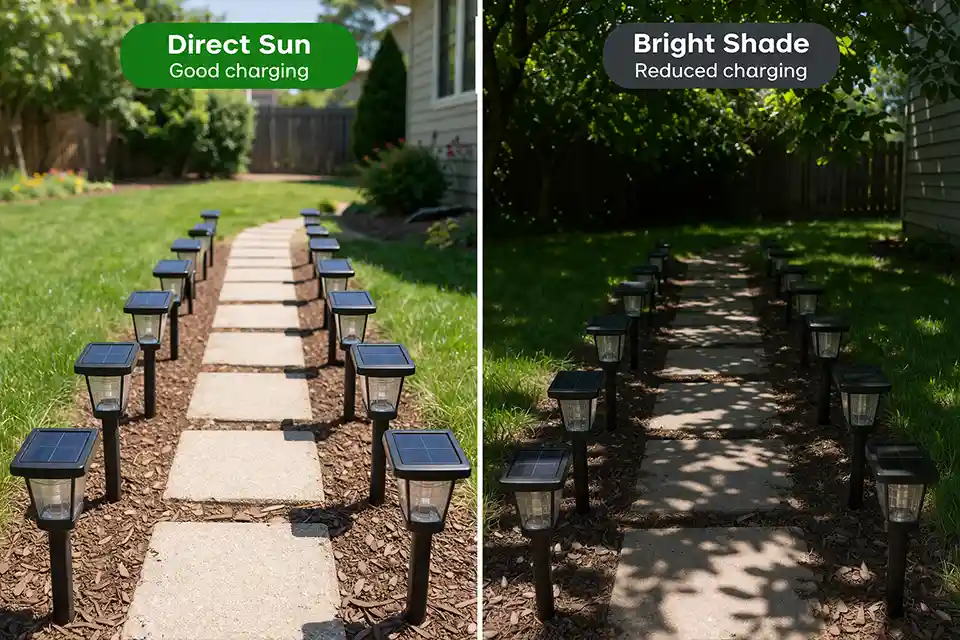
The mistake is easy to make because shaded yards can still look bright. To your eyes, the area seems well lit. To a small solar panel, “bright shade” is often still a charging failure.
Quick Diagnostic Checklist
- The panel gets less than 3 to 4 hours of direct sun per day
- Midday sun, roughly 10 a.m. to 2 p.m., is blocked by branches
- The light turns on but fades in under 2 hours after a sunny day
- A similar light in open sun lasts 6 to 8 hours or more
- The panel has visible dust, pollen, sap, or leaf film
- The battery is older than about 18 to 24 months
If most of those are true, shade is the main cause until something more specific proves otherwise.
What People Usually Blame Too Early
The biggest time-waster here is battery replacement before a real sun check. Yes, batteries wear out. Yes, chronic undercharging shortens battery life. But if a fixture only gets 2 hours of filtered sun through a dense canopy, a fresh battery is usually just a temporary mask. It may improve for a few nights, then fall back into the same weak pattern.
The second thing people misread is nighttime behavior. A light that comes on at dusk feels “mostly okay.” It is not. That is just a symptom. The real question is how long it stays on. Runtime is the useful signal because it reflects stored energy, not just whether the circuit still responds after sunset.
That is why broad troubleshooting guides like Why Your Solar Outdoor Lights Aren’t Charging and How to Fix It only get you part of the way. In a yard shaded by tall trees, sun exposure is not one possible cause among many. It is usually the first thing to settle before anything else deserves attention.
Why Tall Trees Cause a Different Kind of Charging Failure
Tall trees do not just make shade. They make bad charging conditions in a way people tend to underestimate. The panel may get 6 hours of daylight but only 45 to 90 minutes of true direct sun. That sounds close enough. It usually is not. Small all-in-one solar lights do not have much margin, especially lower-cost models with battery capacities in the 600 to 1,200 mAh range.
Tree cover also creates moving shade, which is worse than many people realize. A panel can spend the strongest charging hours in intermittent shadow from leaves and branches, then get open sky only when the sun angle is already weaker. The yard looks fine all day, but the charging window that matters was lost.
What people overestimate is trimming as an easy fix. What they underestimate is how much performance depends on a clean midday exposure, not just a brighter yard overall. A few branch cuts may improve appearance without creating a meaningful charging gain. If trimming does not add at least 2 to 3 hours of direct sun where the panel sits, the result is often underwhelming.
Tree-heavy yards also layer in secondary problems. Sap, pollen, and leaf residue reduce panel efficiency further. In humid or rainy regions, shaded fixtures stay damp longer after weather or irrigation, and that can push battery contacts and internal compartments toward corrosion.
If the lights also show fogging, rust, or moisture marks, the failure pattern may be overlapping with Why Solar Outdoor Lights Fail So Quickly and What’s Really Causing It.
The Fix That Actually Changes the Outcome
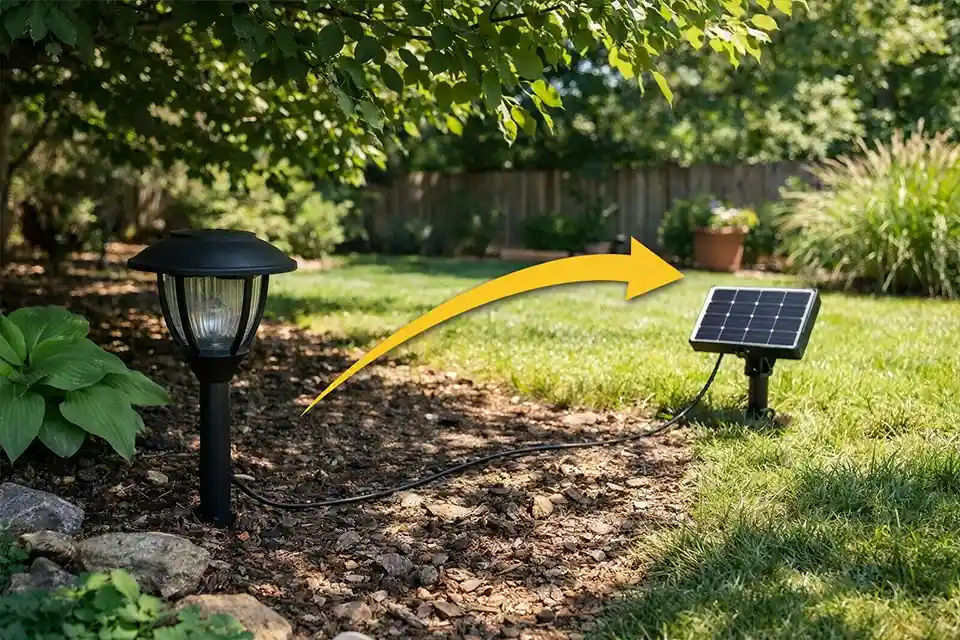
When tall-tree shade is the main problem, the best fix is usually relocation, not repair. Move the light, or better yet move the panel, to a place that gets 6 to 8 hours of direct sun. If the fixture has a separate remote panel, that option often makes far more sense than cycling through new batteries and replacement heads.
Use this table to decide what is actually worth doing:
| Condition | Healthier Pattern | Failing Pattern | Best Decision |
|---|---|---|---|
| Daily direct sun | 6–8 hours | Under 3–4 hours | Relocate light or panel |
| Runtime after clear day | 6–10 hours | 0–2 hours | Treat as charging deficit first |
| Panel condition | Clean and dry by midday | Dirty, damp, sap-coated | Clean, then retest for 2 days |
| Battery age | Under 18 months | Over 24 months | Replace only after fixing exposure |
| Yard layout | Open southern or western sky | Dense canopy over peak sun | Use remote panel or switch systems |
That last row is where many people keep wasting effort. They keep treating a site problem like a parts problem.
Cleaning the panel helps only when dirt is a meaningful share of the loss. If cleaning changes runtime from 1 hour to 2 hours, you did not solve it. You just removed one layer of inefficiency from a location that is still wrong.
Pro Tip: Move one suspect light into full sun for 48 hours before buying anything. If it suddenly runs 6 hours or more, the yard layout has already given you the answer.
When the Normal Solar Fix Stops Making Sense
There is a point where standard solar troubleshooting becomes the wrong project. If the lights are on the north side of the house, under mature trees, and still heavily shaded after pruning, you may not have a repair issue at all. You may have a mismatch between product type and site conditions.
That is the boundary many homeowners miss. Replacing batteries every season is not a fix. It is a way of compensating for a yard that never gives the panel enough input. In that situation, low-voltage wired lighting often makes more sense long term. If you still want solar, use fixtures with remote panels that can be mounted 6 to 10 feet away, or farther if the design allows, in a true sun zone.
This also explains uneven performance across the same yard. Lights at the canopy edge may stay on 5 to 7 hours while identical fixtures deeper under the trees fade in 1 to 2. That pattern is more useful than brand comparisons because it shows the site is driving the failure. It is the same logic behind How to Fix Solar Lights With Uneven or Dimming Output: the fixture may be the same, but the charging conditions are not.
If repeated undercharging has already been happening for a year or two, battery wear may now be real, not just suspected. That is when it helps to understand Why Are My Solar Light Batteries Dying So Quickly. But even then, shade still comes first. Replacing a tired battery without fixing the charging environment usually resets the countdown, not the problem.
What to Do, In Order
Start with the panel, not the parts. Clean it. Then watch the actual light path at midday, not the general brightness of the yard. After that, move one light into a genuinely sunny location for 48 hours and compare runtime. That single test is more useful than replacing a batch of batteries based on guesswork.
If the test light recovers and runs normally, you have your answer: the fixtures are workable, but the installation spot is not. At that point, either relocate them, switch to remote-panel models, or stop forcing solar where the site does not support it.
That is the practical dividing line. Many people looking for Best Solutions for Solar Lights Not Turning On at Night assume the product failed. In heavily shaded yards, the more honest answer is that the product was asked to do a job the site would not allow.
Pro Tip: Recheck performance after full leaf-out in late spring. A setup that was acceptable in March can become a chronic undercharger by June without anything actually breaking.
For broader official guidance, see the U.S. Department of Energy solar basics page.