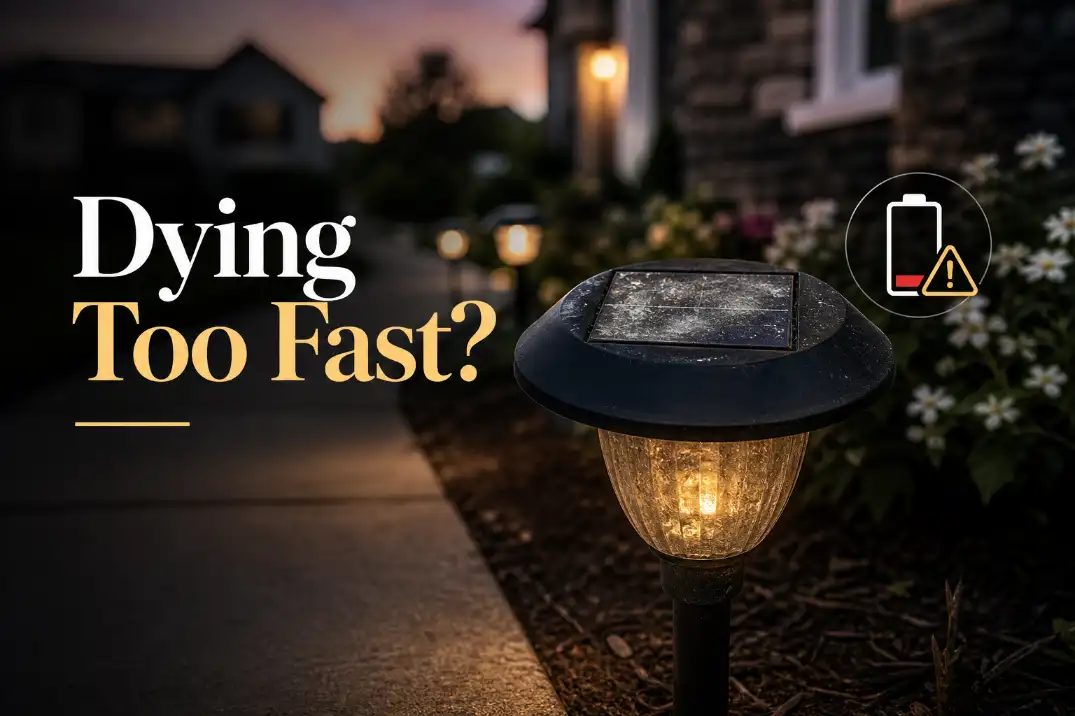
Solar outdoor lights usually fail quickly because the light is losing the energy battle before night even starts. The panel does not collect enough usable sun, the battery cannot store enough charge, or moisture has damaged the small contacts and control board inside.
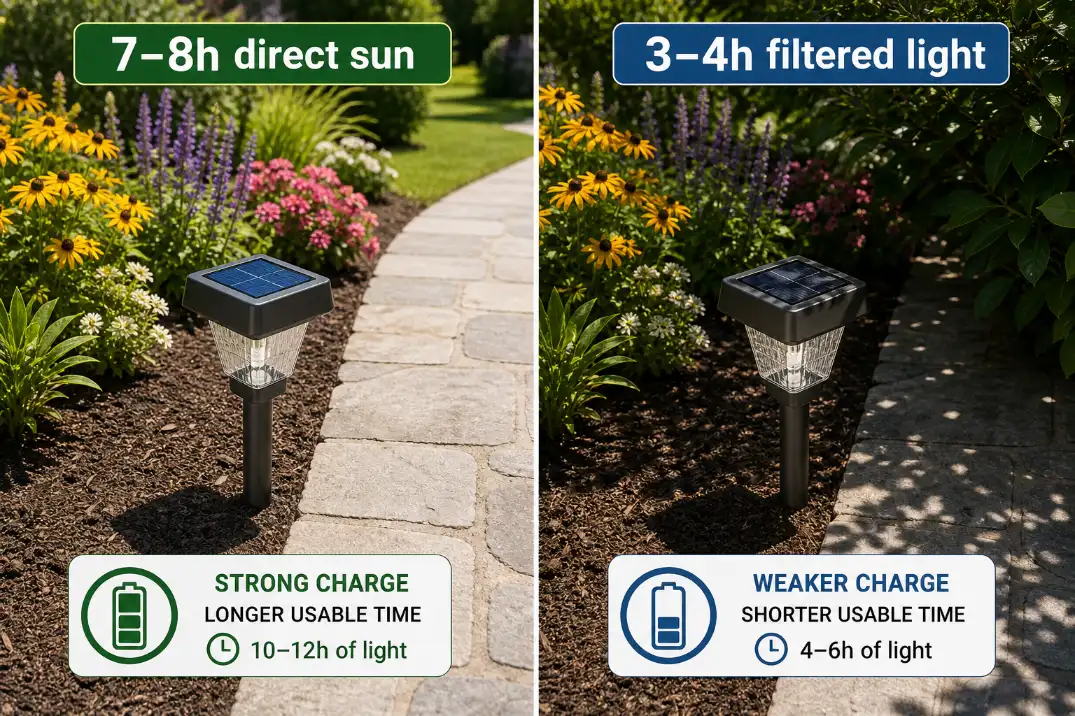
A healthy solar path light often needs 6–8 hours of direct sun to run about 6–10 hours at night. If it fades after 30–90 minutes, the problem is rarely just the LED.
Start with three checks: how much direct sun the panel gets, whether the battery still holds charge, and whether water has reached the battery bay or switch.
A light that dies after rain is a different problem from one that only struggles in December. A light that works in full sun for two days but fails in its installed spot is not really broken; it is undercharged.
How Fast Is Too Fast for Solar Lights to Fail?
“Failing quickly” can mean several different things. The timing matters because it points to different causes.
| Failure pattern | Most likely meaning | What to check first |
|---|---|---|
| Dead within a few days | Setup issue, pull tab, switch, defective unit | Switch position, battery tab, 48-hour full-sun charge |
| Fades after 30–90 minutes | Weak battery or poor charging | Battery condition and direct sun exposure |
| Dies after rain or sprinklers | Moisture intrusion | Seams, battery bay, switch, corroded contacts |
| Works in summer, weak in winter | Seasonal energy shortage | Sun angle, shorter days, longer nights |
| Fails after one hot season | Heat, UV damage, low-grade battery | Cloudy panel, cracked housing, battery age |
| New battery helps briefly, then fades | Site or circuit problem | Panel output, moisture, control board damage |
A solar light that loses runtime slowly over 1–3 years is often aging normally. A light that collapses in a few weeks usually has a placement, moisture, or product-quality problem.
The Real Problem Is the Solar Light’s Energy Budget
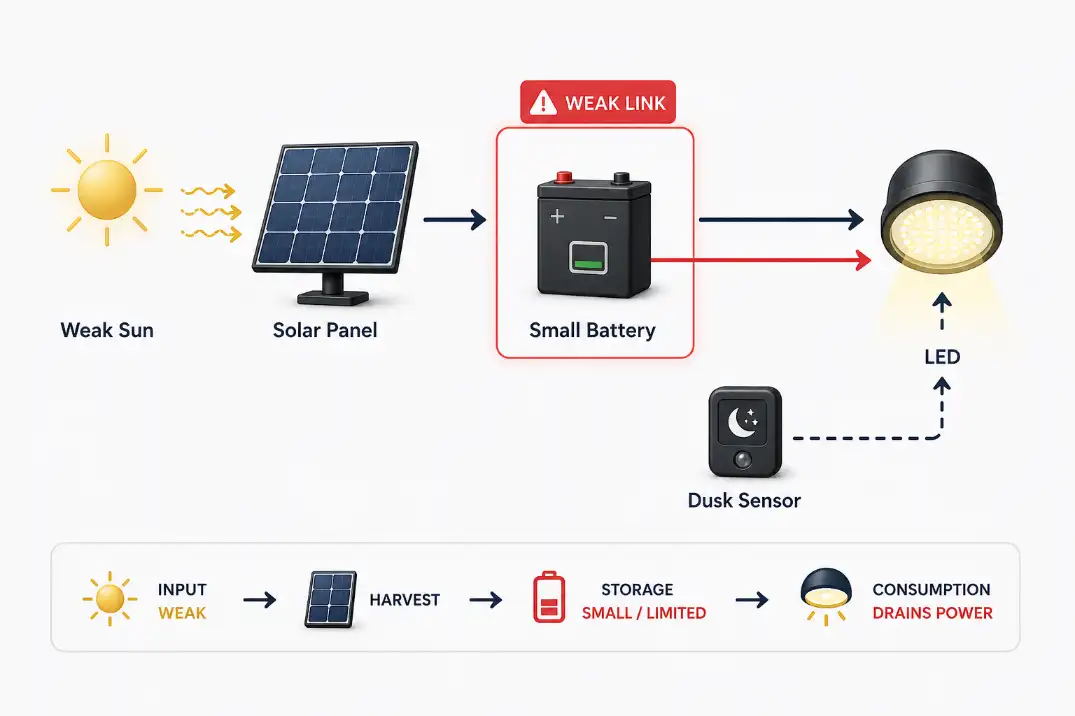
Solar lights are small energy systems. The panel earns power during the day, the battery stores it, the LED spends it at night, and the sensor decides when spending begins. If any part is weak, runtime drops.
The panel earns power only in direct sun
The phrase “outdoor solar light” makes these fixtures sound self-sufficient, but most small models have very little energy margin. A panel in bright shade may look like it is getting daylight, yet still collect far less usable power than one in direct sun.
That is why a light beside a fence, under a shrub, near a north-facing wall, or below a roof overhang can fail even when the yard looks bright. If the panel receives only 3–4 hours of direct sun, cleaning it will not make it behave like a panel receiving 7–8 hours.
A useful test is to move the light into open direct sun for two full days. If runtime improves sharply, the installed location is the real issue. For a deeper look at this placement problem, see Sun Exposure Issues in Solar Lights.
Bright lights drain small batteries faster
A decorative path light and a high-output security light should not be judged the same way. A low-output path light may only need a small battery to glow through the evening. A brighter fixture spends stored energy much faster, especially if it stays on continuously instead of using motion mode.
This is where cheap solar lights disappoint. The package may promise long runtime, but the fixture may combine a small panel, small battery, and bright LED. That works only under ideal summer sun. In cloudy weather, shade, or long winter nights, the math falls apart.
Pro Tip: For steps, gates, and security areas, motion mode usually gives better real-world reliability than a small solar light trying to stay bright all night.
The Most Likely Causes, Ranked
Most solar light failures are not mysterious. The mistake is giving every possible cause equal weight.
Weak sun exposure beats almost every other cause
If the panel is shaded, the light starts every night with a partial charge. After several undercharged nights, the battery may appear bad even when the site is the bigger problem.
This is common around fast-growing shrubs, tall ornamental grasses, fences, porch columns, and trees that were not casting shade when the lights were first installed. A light can work well in May and fail by August simply because plants have grown over the panel. If landscaping is crowding the fixture, Solar Garden Lights and Overgrown Bushes covers that specific failure pattern.
Batteries usually fail before LEDs
The LED is visible, so it gets blamed first. But if the light turns on briefly, glows weakly, or performs better after a full sunny day, the LED is probably not the first failure point.
Rechargeable batteries in small solar lights often last about 1–3 years, sometimes less in harsh conditions. Repeated deep discharge, high summer heat, freezing winters, and chronic undercharging can all shorten battery life. If several fixtures from the same set are fading at different rates, the ones in worse microclimates are aging faster.
Battery replacement is worth trying when the fixture is dry, the contacts are clean, and the panel still gets strong sun. For more detail on battery-specific symptoms, see Why Are My Solar Light Batteries Dying So Quickly?.
Dirty Panels Matter, But Shade Matters More
A dusty or pollen-coated panel can reduce charging. In dry Arizona yards, windy areas, or spring pollen season, cleaning every 1–2 months can help. Use a damp microfiber cloth and mild soap if needed.
But dirt is usually a maintenance issue. Shade is a design issue. If cleaning improves the light for one or two nights and the problem returns, dirt was not the main cause.
A cloudy, yellowed, or UV-damaged plastic panel cover is different. That is not surface dirt. Once the plastic itself blocks light, wiping will not restore normal charging.
Moisture Makes Small Problems Permanent
Water is the failure multiplier. It can turn a weak battery contact into random flickering, a sticky switch into a dead fixture, or a small seal gap into corrosion.
Waterproof does not mean sprinkler-proof
Many solar lights are sold as outdoor or weather-resistant, but that does not mean every seam can handle daily side spray. Rain falls mostly from above. Sprinklers often hit the battery door, switch seam, panel edge, or lens joint from the side.
A light rated around IP44 may handle splashes, but repeated side spray from irrigation can still reach seams and switches. For sprinkler-heavy areas, a higher weather-resistance rating, such as IP65, and a better-sealed battery compartment matter more than the word “waterproof” on the package.
This is why the lights along one irrigation zone may fail faster than the rest of the yard. In humid Florida, coastal California, and rainy Midwest regions, moisture exposure can also build slowly through condensation and wet soil splash.
If water reaches the battery bay, look for white, green, or orange corrosion on the spring contacts. Once corrosion reaches the control board, drying the fixture may not restore reliable performance. For the broader pattern, see Moisture Damage in Outdoor Lighting Explained.
Condensation becomes a problem when it stays
A little fog inside the lens after a cold night can happen. It becomes more serious when moisture remains for 24–48 hours, leaves mineral streaks, returns after every watering cycle, or appears inside the battery compartment.
That distinction matters. Brief condensation may be cosmetic. Persistent internal moisture is an electrical problem.
Weather Can Make a Good Light Look Bad
A solar light can be healthy and still perform worse under certain seasonal conditions. The key is whether the decline matches the weather or continues even when conditions improve.
Winter runtime drop can be normal
In northern states, winter creates three problems at once: shorter days, lower sun angle, and longer nights. A light that runs 8 hours in June may run only 3–5 hours in December without being defective.
Cold also reduces battery performance, especially around and below freezing. If the light recovers during sunny stretches or improves in spring, the issue may be seasonal capacity rather than permanent failure.
If the fixture performs poorly through warm, sunny weather too, stop blaming winter. At that point, sun exposure, battery aging, or moisture is more likely. For more seasonal detail, see Weather Effects on Solar Lights Runtime.
Summer heat can shorten battery life
Cold hurts temporary runtime. Heat often hurts long-term life.
A fixture mounted near dark stone, asphalt, metal railings, or reflective hardscape can run much hotter than the surrounding air. That heat stresses batteries and plastic housings. After one harsh summer, a low-grade battery may no longer hold a useful charge, and a cheap lens or panel cover may begin to haze.
This is one reason two identical lights can age differently in the same yard. One sits in open soil with airflow. The other bakes beside concrete and fails first.
Sensor Problems That Look Like Battery Failure
Not every solar light that fails at night has a weak battery. Sometimes the light has enough power but is confused about when to use it.
Nearby lights can stop the fixture from turning on
The dusk sensor reads surrounding light. Porch lights, streetlights, garage lights, reflective windows, and security fixtures can make a solar light think it is still daytime. The result may look like a dead light, but the timing is wrong rather than the battery being empty.
A battery problem usually creates short runtime. A sensor problem usually creates wrong on/off behavior. If the light works when covered by your hand or moved away from artificial light, the sensor is reacting to the environment. For that scenario, see Sensor Failures in Solar Lights: Wrong On/Off Timing.
Bad switches and contacts create random failures
Small switches sit in one of the worst locations on a solar light: exposed to dirt, moisture, and temperature swings. A corroded switch may work one night and fail the next.
Slide the switch several times, then leave the light in direct sun. If performance changes randomly, the problem may be a poor internal contact. On a higher-quality fixture, that may be worth cleaning. On a sealed bargain fixture, replacement is the smarter move.
Quick Diagnostic Checklist
Use this order before buying a new set:
- Charge one failing light in full direct sun for 48 hours.
- Confirm the panel gets at least 6 hours of direct sun in its actual location.
- Clean the panel and check whether haze is surface dirt or aged plastic.
- Open the battery bay and look for corrosion, water stains, or loose springs.
- Replace the rechargeable battery only if the fixture is dry and serviceable.
- Check nearby porch lights, streetlights, or reflective glass if timing is wrong.
- Compare summer and winter runtime before calling seasonal loss permanent failure.
Repair or Replace?
This is where many people waste time. A solar light is only worth repairing if the rest of the fixture is still healthy.
Replace the battery when the fixture is still healthy
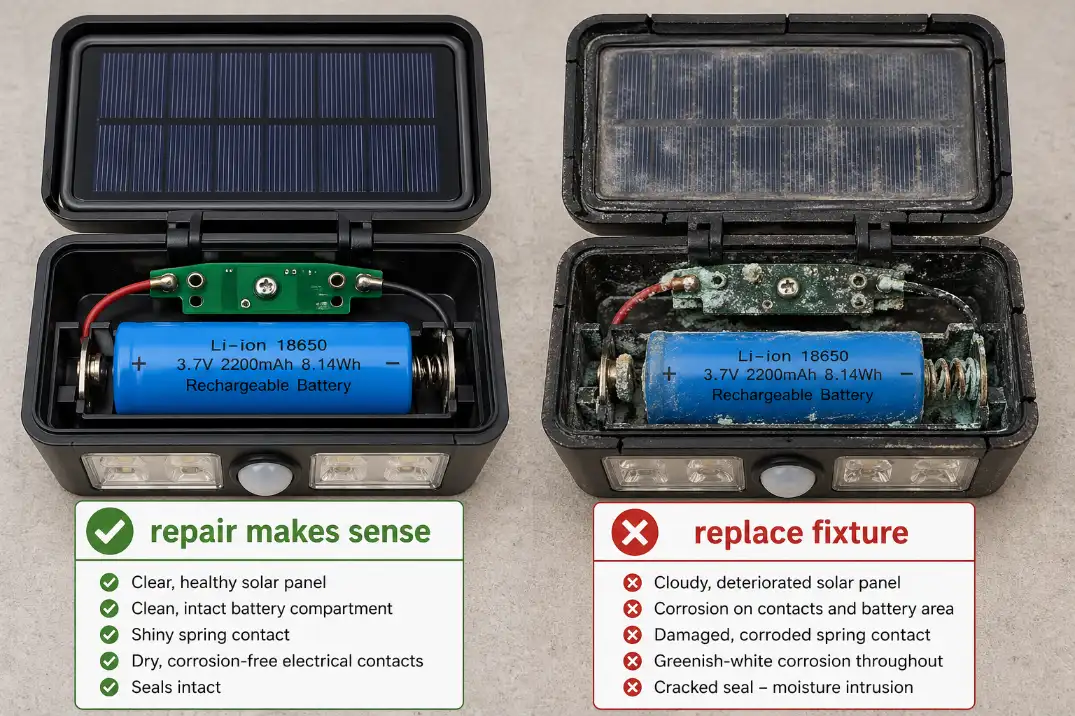
Battery replacement makes sense when:
- the panel is clear, not yellowed or cloudy
- the housing is dry inside
- the battery compartment is accessible
- the contacts are clean
- the fixture gets at least 6 hours of direct sun
- the light improves after a 48-hour full-sun charge
Use only the correct rechargeable battery type and rating. Do not replace a rechargeable battery with a regular alkaline battery. It may leak, fail to recharge, or damage the charging circuit.
Replace the whole light when the failure is structural
A new battery will not fix a cracked housing, a cloudy solar panel, a leaking seam, or a corroded circuit board. If moisture returns after drying, if the panel is permanently hazy, or if the battery contacts are badly corroded, replacement is the better decision.
The clearest cutoff is this: if a correct new rechargeable battery plus two full sunny days does not restore useful runtime, stop treating the battery as the main problem. The fixture, panel, circuit, or location is limiting performance.
Questions People Usually Ask
Why do cheap solar lights fail after one season?
They often have small panels, small batteries, thin seals, and plastic that ages quickly in sun and heat. The fixture may work in ideal conditions but have little margin for shade, weather, irrigation, or long nights.
Can a solar light be too bright for its battery?
Yes. A bright LED drains stored power faster. If the battery and panel are small, high brightness can create short runtime even when the fixture is technically working.
Is it normal for solar lights to get weaker after cloudy weather?
Some drop is normal. But if the light falls to under 1 hour of runtime after one cloudy day, the battery has little reserve or the panel is already undercharging.
The Practical Verdict
If the light is dry, serviceable, and gets real direct sun, replace the battery first. If the panel is cloudy, the housing leaks, or corrosion is visible, replacing the whole fixture is usually smarter. If the location gets less than 6 hours of direct sun, no small repair will make that solar light reliable there.
For broader official guidance on outdoor solar lighting performance, see the U.S. Department of Energy.