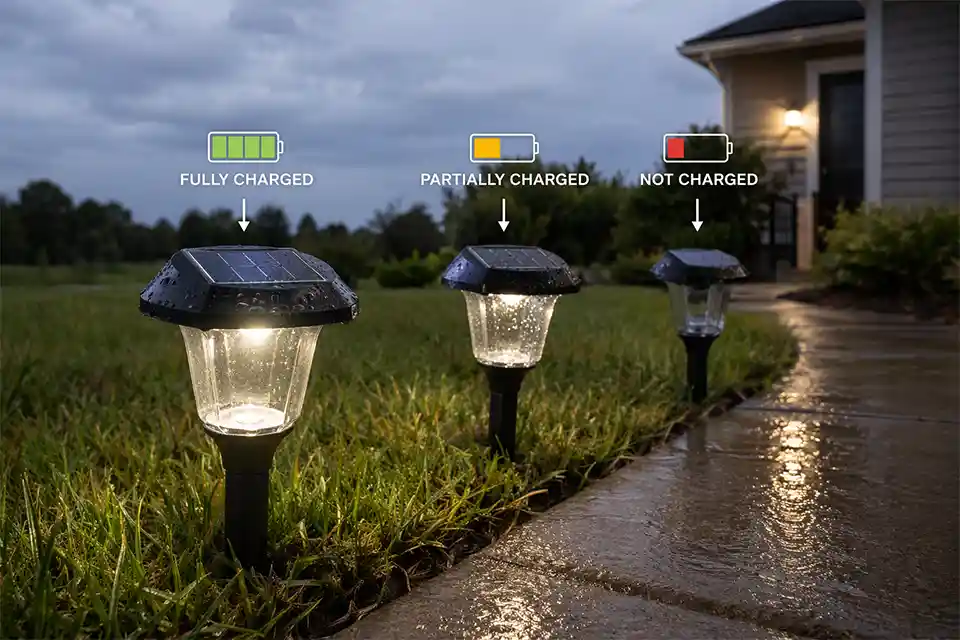
Weather affects solar lighting in a predictable order. Clouds and short winter days reduce charging first. Cold reduces nighttime battery output next. Rain only becomes a real damage issue when moisture gets past weak seals. Heat shortens battery life slowly, even when the light still appears to work.
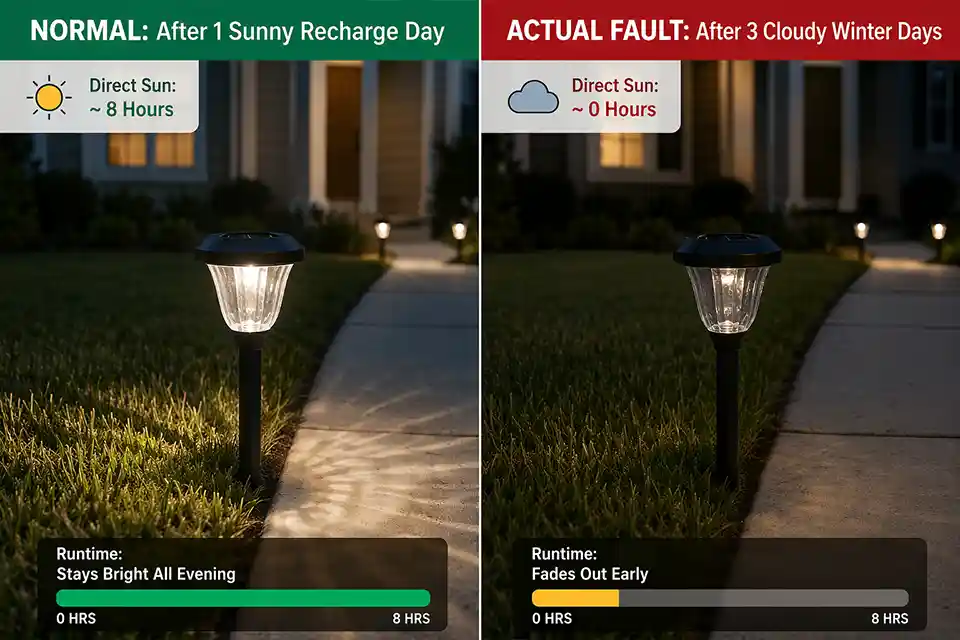
That is the distinction most people miss. If a solar light weakens after 2 to 3 cloudy days but returns to normal after one clear day, that is usually a weather-limited charging problem. If it still runs for less than about 4 to 6 hours after a full sunny recharge day, weather is no longer the whole story.
Start with three checks that actually separate normal behavior from failure: how many hours of direct sun the panel gets, whether there is condensation inside the fixture head, and whether the runtime drop is temporary or now consistent even in good weather.
The main weather effect is reduced charging, not instant failure
Most solar lights do still work in cloudy weather. They just do not collect enough energy to perform like they do in strong direct sun. That matters because people often interpret “dim tonight” as “broken,” when the more accurate diagnosis is “undercharged.”
Cloudy weather lowers runtime before it causes a full outage
A decent solar light can usually absorb one poor-weather day without becoming obviously unreliable. The bigger drop shows up after several low-production days in a row.
A fixture that normally gets 6 to 8 hours of direct sun in summer may only get the equivalent of 3 to 4 useful charging hours during overcast spells, short winter days, or when the sun angle shifts behind trees and fences.
The result is familiar: the light still turns on at dusk, but it fades early, sometimes within 1 to 3 hours instead of running most of the night. That is not the same thing as a failed battery. It is often just a weak daily energy budget.
Many homeowners misjudge this because the location still looks bright during the day. Sun Exposure Issues With Solar Lights matters here because “bright yard” and “direct charging light” are not the same condition.
Winter creates a different kind of performance drop
Winter does more than bring clouds. It shortens charging time, lowers the sun’s angle, and extends how long the light needs to run overnight. That combination can make a perfectly healthy fixture look weak. In northern states, a solar light that performs well in June can struggle in December without having any failed parts at all.
One condition people usually overestimate is rain itself. One condition they usually underestimate is the combination of short daylight plus longer night length. That pairing does more real-world damage to runtime than a single wet day.
Cold weather affects the battery more than the panel
If a solar light behaves worse in winter, the battery is usually the first place to look conceptually, even before you inspect it physically.
Cold reduces usable nighttime capacity
A solar panel can still collect energy on a cold clear day. The larger problem is what happens after sunset. Battery chemistry becomes less efficient in low temperatures, so a light that runs 7 to 8 hours at 70°F may drop closer to 4 to 5 hours around 32°F, even when the panel got decent sun earlier in the day.
That does not automatically mean the battery is bad. It means cold weather reduced how much stored energy the battery could actually deliver. If the light rebounds when temperatures rise, replacement was probably never the right first move.
A short glow at dusk is a symptom, not a diagnosis
When a solar light comes on normally and then fades within 30 to 90 minutes, many people jump straight to “the battery is dead.” Sometimes that is true, but not often enough to make it the first assumption. That same symptom can come from weak winter charging, lower cold-weather battery output, a dirty panel, or real battery aging.
That is why Why Your Solar Outdoor Lights Aren’t Charging and How to Fix It is often more useful than replacing batteries first. The visible symptom happens at night. The real mechanism usually starts during the day.
Rain becomes a damage problem only when the fixture was already vulnerable
Rain gets blamed too quickly because the timing is obvious. It rains, and the lights look worse. But rain creates two very different outcomes.
One weak night after rain is usually a charging issue
Storm weather usually means thick cloud cover, lower light intensity, and a poor charging day. If the light is weak that same night but recovers after the next sunny day, the weather mostly reduced charging. That is annoying, but it is not a structural failure.
Condensation and corrosion are the real warning signs
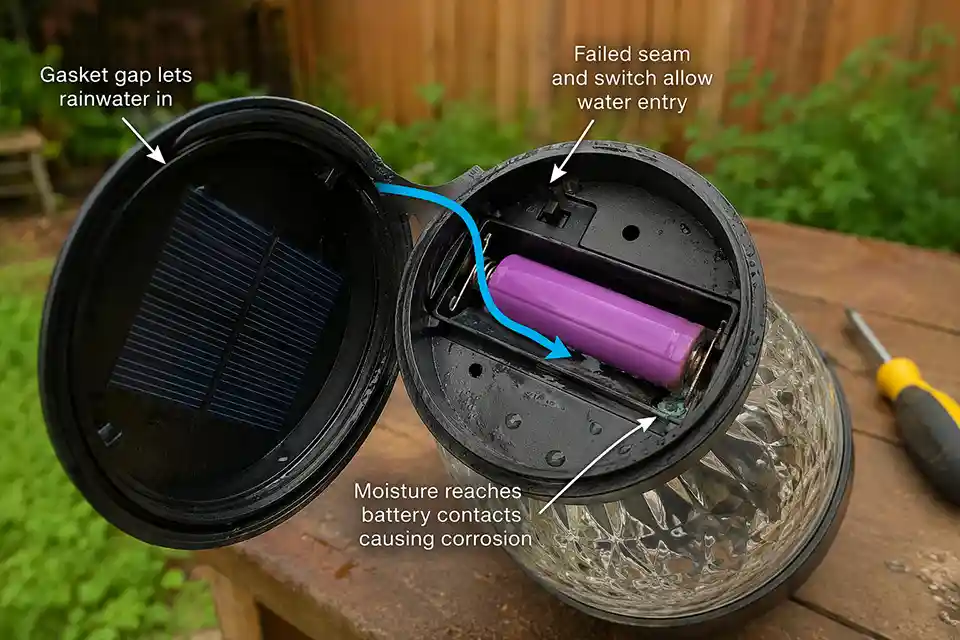
If you see fogging under the lens, droplets inside the housing, or white-green corrosion on contacts within 24 to 48 hours after rain, the problem is no longer “bad weather.” It is moisture intrusion. That is a much more useful threshold than simply noticing dim output.
A basic wipe-down often wastes time here. Cleaning can help with panel efficiency, but it does nothing for a leaking seam, weak switch boot, or bad cable entry. Why Water Gets In Through Cable Entry Points matters because the failure path is often small, hidden, and repeatable.
What many buyers underestimate: weather resistance is also a quality issue
A lot of outdoor solar lights are sold as if all weather exposure were equal. It is not. Better weather sealing, stronger housings, and more stable battery compartments do not make a light brighter on day one, but they often determine whether rain causes one weak evening or a permanent decline six months later.
This is also where people commonly overestimate maintenance. Not every weather-related performance drop can be “fixed” with cleaning, resetting, or swapping in another low-cost battery.
Heat does quieter damage than rain, but often costs more over time
High heat is one of the least dramatic and most expensive weather effects on solar lights.
Heat shortens battery life slowly
In hot climates, the light may still seem normal while battery capacity declines month by month. That makes heat easy to dismiss because it does not create one obvious failure moment. But repeated exposure to housing temperatures above roughly 95°F to 104°F can shorten battery life, especially in lower-cost fixtures with minimal thermal protection.
In places like Arizona, inland California, or sun-baked stone patios anywhere in the South, a solar light may still charge well during the day and still lose runtime season by season. That is why Why Are My Solar Light Batteries Dying So Quickly belongs in the diagnosis path once a light stops recovering even in strong summer sun.
Battery type matters, but fixture quality still matters more
NiMH batteries are common in garden lights and often tolerate routine use reasonably well, but they are still vulnerable to repeated heat and cold cycling. Integrated lithium-based designs can perform very well, yet their real-world durability depends heavily on charging control, sealing, and build quality.
In practice, the battery label matters less than whether the whole fixture was built with enough reserve capacity and weather protection to begin with.
The fastest way to tell normal weather effects from a real failure
A compact checklist works better than guessing.
Quick diagnostic checklist
- Give the light one full clear day to recharge before judging it.
- Check whether runtime is still below about 4 to 6 hours that night.
- Confirm whether the panel receives at least 6 hours of real direct sun, not filtered brightness through branches.
- Inspect for condensation, droplets, or corrosion within 1 to 2 days after rain.
- Compare current runtime with last season. A drop of 50% or more in good weather points away from “temporary weather effect.”
- Watch the pattern: winter-only weakness is different from year-round decline.
Pro Tip: Test a questionable fixture after a fully sunny day in mild temperatures. That removes cloud cover and cold from the equation at the same time.
Cloudy weather, aging batteries, and blocked panels are common causes of outdoor solar light problems.
What changes under different weather patterns
The most useful comparison is not “good weather versus bad weather.” It is temporary weather limitation versus repeat performance collapse.
| Pattern | What it usually means | Best next step |
|---|---|---|
| Weak after 1 cloudy day, normal after sun | Normal charging dip | Do nothing yet |
| Weak after 2 to 3 cloudy days | Reduced energy harvest | Improve panel exposure |
| Weak only in freezing weather | Cold-limited battery output | Recheck in milder conditions |
| Weak after rain, then normal next day | Poor charging day, not damage | Monitor only |
| Weak after rain plus visible condensation | Seal failure or moisture intrusion | Inspect or replace fixture |
| Weak even after a clear day in warm weather | Aging battery or poor fixture quality | Stop blaming weather |
When the standard fix stops making sense
Routine fixes stop being efficient when the weather has already exposed a weak fixture.
Replace instead of repair when these signs appear together
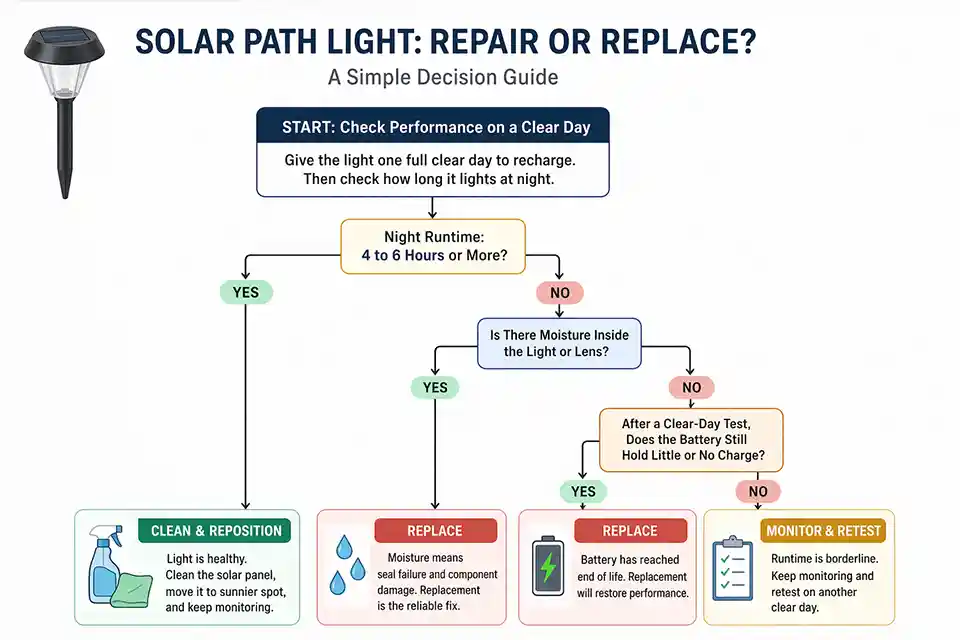
If a solar light shows all three of these, replacement is usually smarter than another round of maintenance:
- It still runs for less than 4 to 6 hours after a clear recharge day.
- There is visible internal moisture or corrosion.
- A fresh battery only helps briefly, or barely helps at all.
At that point, the battery is no longer the only issue. The system itself is declining. Best Solutions for Solar Lights Not Turning On at Night and Why Solar Outdoor Lights Fail So Quickly and What’s Really Causing It both support the same conclusion: once poor charging margin, weather intrusion, and short-lived battery fixes start stacking together, replacement usually beats tinkering.
Pro Tip: If a fixture cannot produce reliable nighttime runtime after 6 to 8 hours of direct sun in mild weather, stop optimizing the setup and start questioning the light.
Weather affects solar lighting in a clear order: clouds and short days reduce charging, cold lowers usable nighttime output, rain exposes weak sealing, and heat accelerates battery aging.
The biggest mistake is treating those as one problem. The best fix usually comes from identifying which one is actually happening before buying parts or replacing a fixture too early.
For broader official guidance on how sunlight, clouds, seasonal conditions, and storage affect solar performance, see the U.S. Department of Energy solar energy basics page.