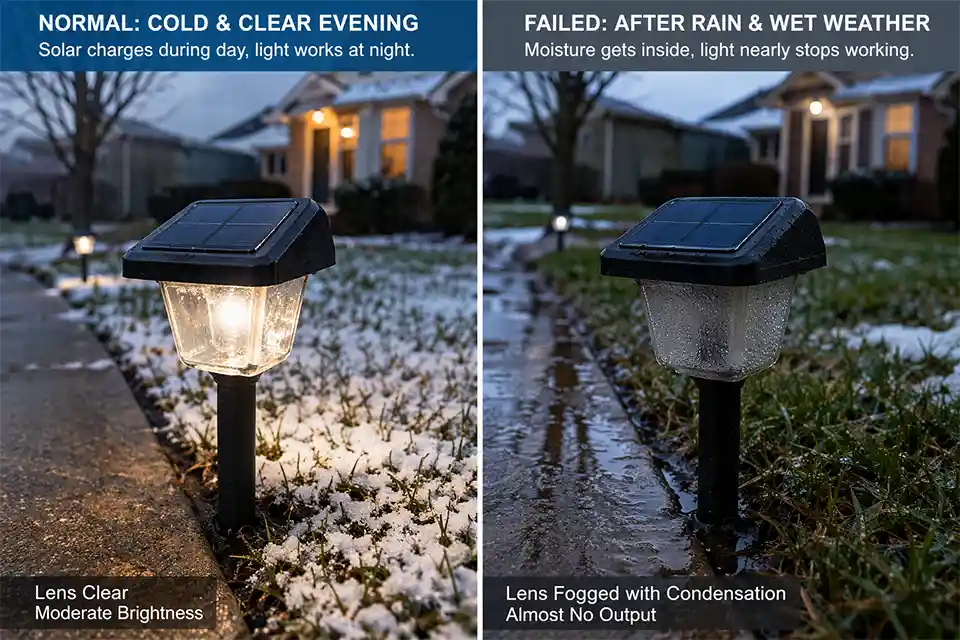
Solar lights do work in winter, and that is the first thing most people get wrong. What usually changes first is runtime, not whether the fixture is “broken.” A light that stays on 8 to 10 hours in summer may only manage 4 to 6 hours in winter because the charging window is shorter and the night is longer.
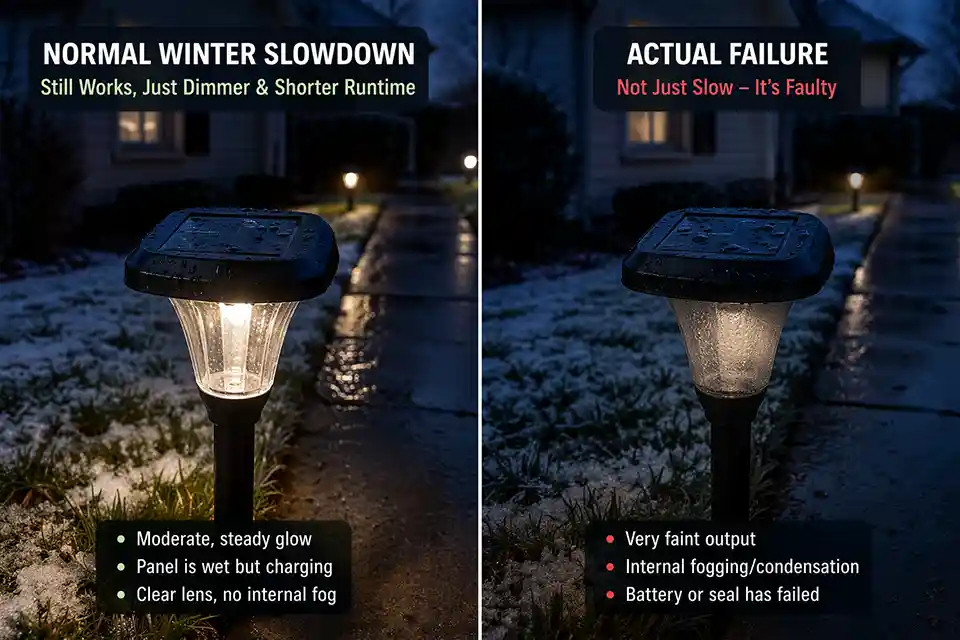
That drop is normal. What is not normal is a light that falls to 1 to 2 hours after a clear day, develops condensation that stays longer than 24 to 48 hours, or collapses after rain and never really recovers.
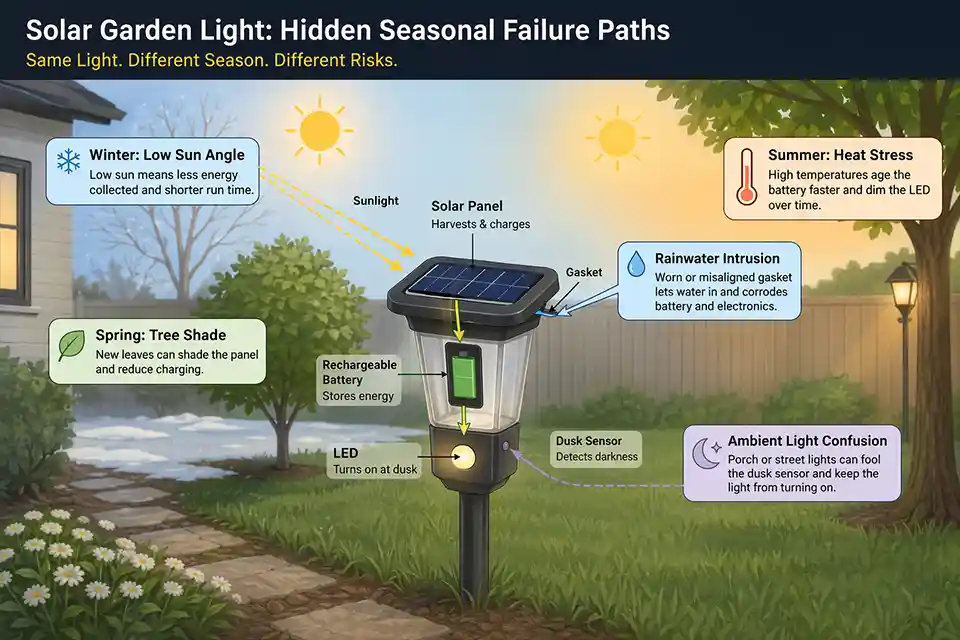
Seasonal problems with solar lights usually follow four patterns: winter reduces charging, summer shortens battery life, rainy periods expose weak seals, and spring or fall changes shade enough to make a healthy-looking light underperform.
Before doing anything else, check whether the panel gets at least 4 to 6 hours of direct sun, whether the light still runs 3 to 5 hours after a bright day, and whether moisture is trapped inside the lens or battery compartment.
The fastest way to separate normal from faulty
What seasonal slowdown actually looks like
A normal seasonal slowdown is predictable. The light still turns on at dusk, still looks reasonably stable, and simply runs fewer hours than it did in peak summer. This is especially common from late fall through winter, when lower sun angle cuts charging efficiency even on bright days.
Cloudy stretches can do the same thing temporarily. Two or three overcast days in a row can leave smaller pathway lights noticeably weaker, and some units need 24 to 36 hours of decent charging conditions to get back to their usual pattern. That is performance loss, not automatic evidence of failure.
What points to a real problem instead
A real fault usually leaves a sharper pattern:
- under 2 hours of runtime after a clear charging day
- one light in a matching set failing badly while the others stay usable
- condensation, droplets, or corrosion inside the housing
- random shutoff after rain, sprinkler spray, or freeze-thaw weather
- no meaningful improvement after a panel cleaning and full-day charge
This is where people waste the most time. They blame “bad winter weather” when weather is only exposing an older battery or a weak enclosure. If rain seems to be the trigger, the more useful question is where water is getting in, which is why Why Outdoor Lights Fail After Rain is often more useful than generic maintenance advice.
What usually fails first in each season
Winter: less charging, then battery weakness
Most winter complaints are charging complaints first and battery complaints second. Cold matters below 32°F, but reduced charging time is usually the bigger issue. If the panel only sees 2 to 3 hours of direct winter sun, the light may never fully recharge even if nothing is technically broken.
Snow and frost matter too, but they get overstated. Snow on the panel can block charging almost completely. Frost or grime can reduce it enough to matter. But if you clear the panel and the light is still dying in 90 to 120 minutes after one bright day, the problem is usually not snow anymore. At that point, battery age is the more likely cause.
Spring: recovery season that exposes hidden damage
Spring is when weak lights separate from healthy ones. Some units bounce back after a few clear days. Others stay weak, and that usually means winter revealed a battery or moisture problem instead of causing a temporary slowdown.
Spring also changes shade faster than many homeowners expect. Trees that were harmless in January can steal the key 10 a.m. to 2 p.m. charging window by late April. That is one reason seasonal complaints often turn out to be placement complaints, and Solar Outdoor Lights Not Charging Under Tall Trees often fits the real problem better than a broad “not charging” guide.
Summer: good runtime can hide a dying battery
Summer is easier on charging and harder on battery health. Long days can make a weak battery look acceptable because the light starts the evening with more energy. But repeated heat above 95°F, especially on dark housings in direct sun, speeds up battery wear and dries out seals.
This is one of the most underestimated patterns. Heat damage often appears later, not during the hottest week. A light may seem fine in July, then fade badly in August or early fall because usable battery capacity has already dropped. That is when Why Are My Solar Light Batteries Dying So Quickly? becomes the better diagnosis than more panel cleaning.
Fall: shorter days and new shade patterns
Fall usually causes a quiet decline, not a dramatic failure. Day length drops, leaf cover changes, debris builds up on panels, and path lights begin losing runtime earlier in the season than people expect.
This is where people overestimate dirt and underestimate fixed shade. A dirty panel can cut performance. It usually does not explain a collapse from 6 or 7 hours of runtime to about 1 hour. More often, the real cause is reduced sun exposure plus battery age, or early moisture intrusion showing up as cooler, wetter weather returns.
If your lights charge during the day but do not turn on at night, there may be several reasons solar lights won’t turn on.
Quick micro-checks that catch what people miss
Use the same-set comparison
If five matching lights are installed in similar conditions and only one is failing badly, the season is probably not the main cause. Local moisture entry, one weak battery, or one bad contact is more likely than a yard-wide environmental issue.
Test the sensor before assuming the battery is dead
A solar light that refuses to turn on at night is not always out of charge. In some yards, nearby porch lights, garage lights, or streetlights confuse the dusk sensor. Cover the panel or sensor area to simulate darkness. If the light turns on, the problem may be ambient light interference rather than battery failure.
Check midday shade, not just morning or evening
A panel can look “sunny enough” at 8 a.m. and still miss the most valuable charging hours. What matters most is whether it gets direct sun around midday for at least 4 to 6 hours total. This is why Sun Exposure Issues With Solar Lights often explains seasonal decline better than weather alone.
The repairs that help, and the ones that waste time
Cleaning is maintenance, not a cure-all
A dusty or pollen-covered panel absolutely reduces performance, especially in dry climates and during spring pollen season. But cleaning is one of the most overused fixes because it feels productive even when the real problem is battery age or moisture.
If one full bright day after cleaning still results in under 2 hours of runtime, surface maintenance has stopped being the main answer.
Pro Tip: Clean the panel with water and a soft cloth only. Abrasive pads can haze the cover and reduce charging permanently.
A battery swap makes sense sooner than people think
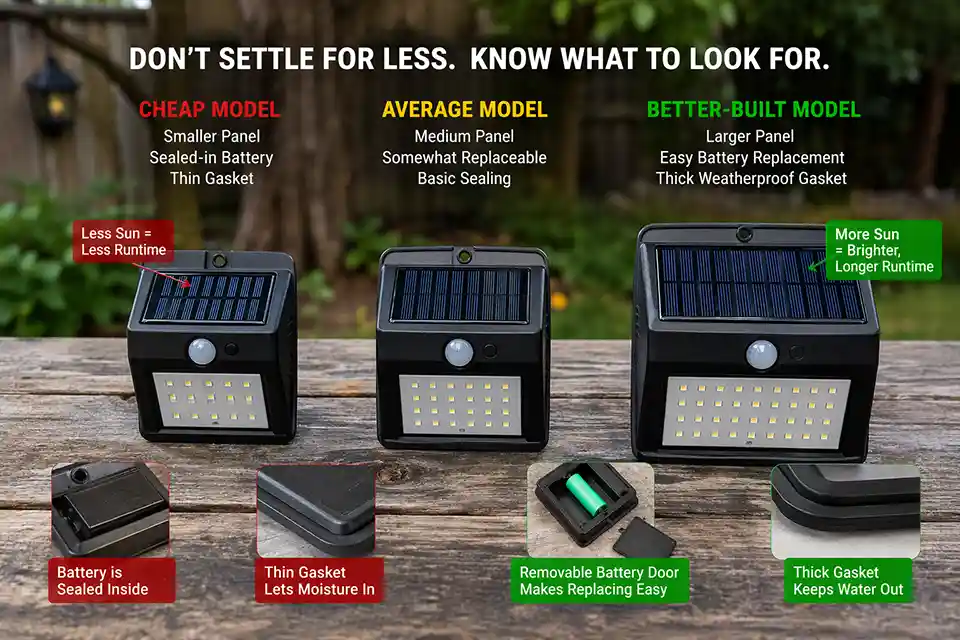
Rechargeable batteries in many solar lights start showing real decline after about 18 to 24 months outdoors. If the housing is dry, the panel is intact, and the contacts are not badly corroded, replacing the battery is usually the best next move.
This is the point where repeatedly moving the light a few inches or wiping the panel again stops making sense. A fresh battery changes the outcome. Cosmetic cleaning usually does not.
Repeated water intrusion is often the replacement line
Once water keeps returning after rain or irrigation, the repair boundary is close. A light with recurring internal moisture, corroded spring contacts, or a flattened battery-door gasket may work briefly after drying, then fail again on the next storm.
One practical detail changes the outcome more than people expect: where the light sits. Fixtures installed in mulch, dense planting beds, or soggy soil can stay damp for 2 to 3 days after rainfall.
That does more damage than the rain event itself. Weather Effects on Solar Lights Runtime helps frame that difference, because weather changes performance, but poor sealing turns weather into damage.
Seasonal diagnosis table
| Season or trigger | More likely mechanism | Usually normal | Problem threshold | Best next step |
|---|---|---|---|---|
| Winter short days | Reduced charging window | 4 to 6 hours runtime | Under 2 hours after clear sun | Check sun exposure, then battery |
| Snow or frost on panel | Charging blocked | Temporary weak output | Still weak after panel is cleared and recharged | Retest after one bright day |
| Spring leaf growth | Lost midday sun | Mild gradual decline | Sharp drop once trees fill in | Relocate or trim for more direct sun |
| Summer heat | Battery capacity loss | Bright at dusk | Fades in 1 to 3 hours despite good charging | Replace battery if older than 18 to 24 months |
| Rain or irrigation | Moisture intrusion | Exterior wetness only | Internal condensation beyond 24 to 48 hours | Dry, inspect seals, replace if recurring |
What to look for if you replace them
A lot of articles stop at “replace the fixture,” which is not enough. If seasonal failure keeps repeating, the next purchase matters.
Features that usually hold up better
Look for a larger panel, replaceable standard rechargeable batteries, and a housing that feels solid at the battery door and switch area. In wetter climates such as coastal California or humid parts of Florida, better sealing matters more than decorative styling. In hotter places like Arizona or inland Texas, battery access matters more because high heat speeds up wear.
When separate-panel designs make more sense
If the light location is perfect but the sun exposure is bad, an integrated all-in-one fixture may never solve the problem. A separate-panel design lets the panel sit in full sun while the light goes where illumination is actually needed. That is a better fix than forcing the fixture to live in permanent seasonal shade.
When motion mode beats steady-on mode
In winter, lights that stay on at a dim standby level and brighten with motion often perform better than lights expected to run at full brightness all night. That is not because they are more powerful. It is because they use limited winter charge more efficiently.
Pro Tip: If several inexpensive lights from the same batch start failing within one season, replace the set instead of rebuilding each unit around aging housings.
Seasonal problems with solar lights get easier to solve once you stop treating every weak light as the same failure. Winter usually means less charging, summer usually means faster battery wear, rainy periods usually expose sealing weaknesses, and spring or fall often changes the site more than the fixture.
The useful question is not whether the weather caused the problem. It is what the season exposed first.
For broader official guidance on home solar basics, see the U.S. Department of Energy.