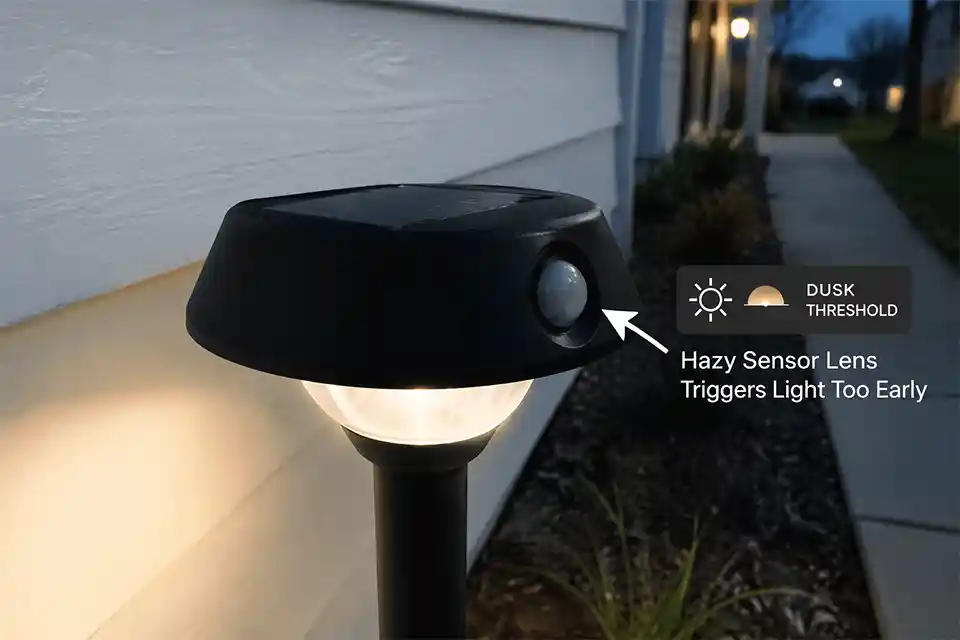
A solar light with a sensor problem usually does not fail the way a weak battery does. A weak battery still lets the light make the right decision, but it cannot hold that decision for long. A bad sensor, or a sensor being fooled by its surroundings, creates the wrong decision in the first place: the light stays off after sunset, turns on too early, cycles at dusk, or behaves differently from matching fixtures only a few feet away.
The first checks that actually matter are narrow and fast. Cover the sensor for 5 to 10 seconds after dark. Compare its turn-on timing with a nearby matching unit.
Ask whether the behavior changed within 12 to 48 hours after rain, irrigation, or condensation. Those three checks separate most real sensor cases from broad solar charging problems. That distinction matters because people often replace batteries first, even when the light is really misreading darkness.
The real diagnosis is not “dead or working”
The first mistake is treating every sensor issue as a failed part. In solar lights, wrong on/off behavior usually falls into one of three buckets:
- the sensor is reading through dirt, haze, or moisture
- the sensor is being fooled by nearby light or reflection
- the sensor or control circuit is actually drifting or failing
Those should not be diagnosed the same way, and they should not be repaired in the same order.
True sensor failure vs false sensor readings
A true sensor failure keeps acting irrational even after obvious variables are removed. The light may stay on in daylight, ignore a full cover test after dark, or keep switching badly after cleaning, drying, and relocation.
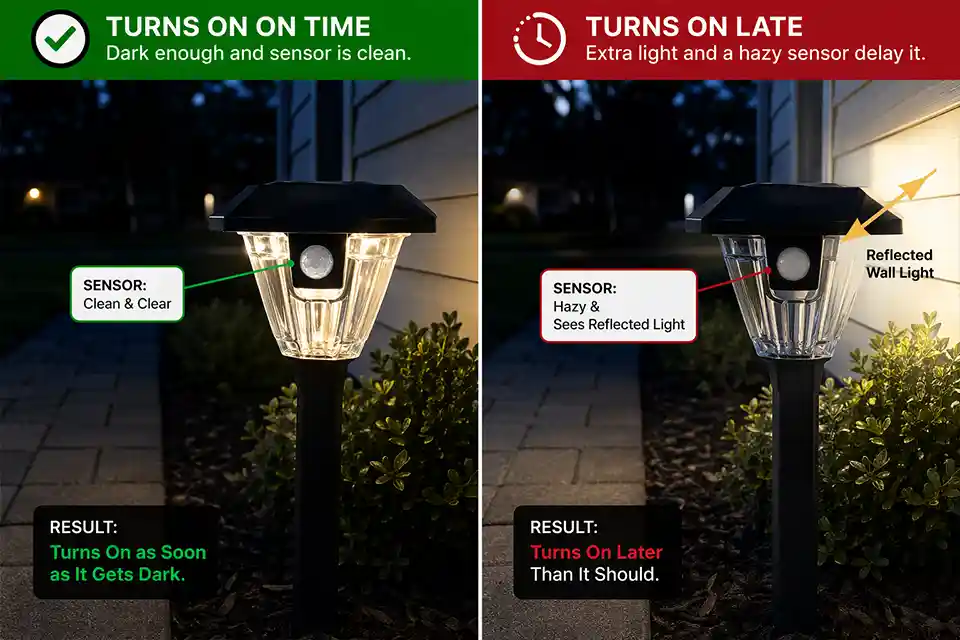
A false sensor reading is different. The electronics may still be alive, but the sensor is seeing the wrong environment. That can happen when a white garage door, pale stucco wall, pool deck, or porch light keeps the fixture in a “daytime” reading longer than it should. It can also happen when the head tilts 10 to 20 degrees and starts reading reflected light instead of open sky.
What is more likely first
Most of the time, the first suspect should not be a failed chip. It should be a bad reading. Dirt, UV haze, moisture film, and stray ambient light are earlier and more common than full sensor-circuit failure. What people overestimate is electronic death. What they underestimate is how little reflected light it takes to confuse a cheap integrated solar fixture.
When your outdoor solar lights fail after a few months, this article on solar light troubleshooting can help narrow down the problem.
The signals that matter most
Not every symptom has the same diagnostic value. Some are strong evidence for a sensor problem. Some only look like one.
Strong evidence
These clues move sensor trouble high on the list:
- the light turns on when the sensor is fully covered for 5 to 10 seconds after dark
- it activates 30 to 90 minutes later than matching units nearby
- it flickers for 10 to 60 seconds around dusk, then shuts off
- it works in a test location but fails in its normal spot
- it behaves worse within 12 to 48 hours after rain or sprinkler exposure
- one fixture fails in a row of otherwise similar lights
That last point matters more than it seems. A true sunlight shortage usually affects a group. A sensor-path problem often shows up as one irrational fixture among otherwise normal ones.
Medium evidence
These clues support a sensor diagnosis, but they do not prove it alone:
- the light turns on too early in deep shade before nearby units do
- the fixture angle has shifted after yard work or freeze-thaw movement
- the sensor window looks dull, yellowed, or lightly clouded after 12 to 24 months outdoors
- the light improves after drying out for a day, then becomes erratic again
Weak evidence
These clues often waste time when taken alone:
- the housing looks old
- the panel has light dust on it
- the battery is more than a year old
- the light is dim but still switching at the correct time
Dim output without wrong switching is usually not the best sensor clue.
What actually causes the sensor to read wrong
The sensor path fails in predictable ways. The useful question is not “what could be wrong?” but “what changes the on/off decision?”
Dirty or UV-hazed sensor window
A solar light can look fine from 3 feet away and still have a sensor opening that has gone dull. This is common in high-UV exposure, especially in places with long hot summers. Once that cover starts clouding over, the threshold becomes less stable. The light may turn on late, hesitate at dusk, or react differently night to night.
Reflected light and nearby fixtures
This is one of the most misread causes. A porch light, garage light, bright soffit light, or pale wall can keep the sensor from seeing real darkness. Even a small change in placement can matter. A fixture that used to face open yard space may now be reading a reflective fence, driveway, or white post.
In that situation, the sensor is not necessarily bad. It is just being given bad visual information. That is why topics like Outdoor Lights Working in Day, Shutting Off After Dark and Outdoor Lights Not Turning On After Timer or Photocell are good adjacent reads even though those systems are not solar.
Moisture at the sensor or board
This is where a reading problem starts turning into a hardware problem. If behavior changes sharply within 12 to 48 hours after rain, sprinkler overspray, or heavy humidity, moisture becomes a stronger lead than battery age. You may not see obvious water inside the head. A thin film, internal condensation, or corrosion around the sensor path can be enough to create unstable switching. That overlap is one reason Why Outdoor Lights Fail After Rain is a strong internal fit here.
Control-board drift
This is the closest thing to a true built-in sensor failure in cheap sealed units. The control board no longer interprets light levels consistently. That is when you start seeing irrational behavior across several clear nights even after the fixture has been cleaned, dried, and tested in a different location.
| Symptom | Best first explanation | Evidence strength | First move |
|---|---|---|---|
| Turns on when covered after dark | Wrong light reading | Strong | Relocate and retest |
| Turns on late versus identical nearby units | Sensor threshold issue or reflected light | Strong | Compare location and angle |
| Changes after rain within 12–48 hours | Moisture in sensor path or board | Strong | Dry fully and inspect |
| Runs only 15–30 minutes | Battery fade or low stored charge | Weak for sensor | Check battery condition |
| Works in one spot but not another | Ambient light interference | Strong | Leave in darker test spot overnight |
| Turns on in daylight | Threshold drift or failed control logic | Medium to strong | Clean, dry, then retest |
How to test it without turning this into a weekend project
A good sensor diagnosis should be fast. It should also move from strongest proof to weakest proof, not the other way around.
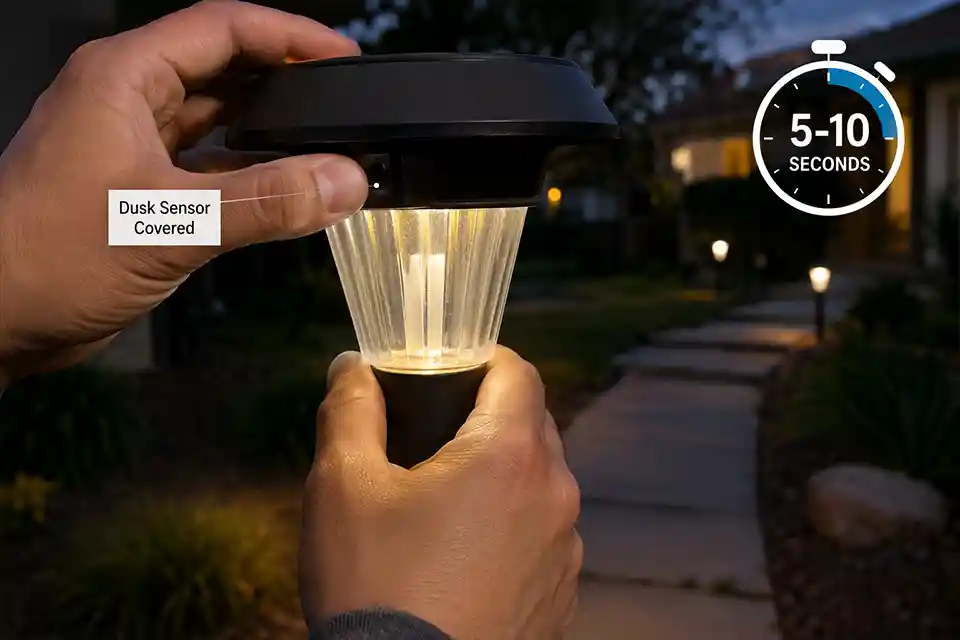
1. Cover test
After sunset, cover the sensor completely for 5 to 10 seconds. If the light turns on, that is one of the strongest signs that the light can still operate and the bigger issue is what the sensor is reading. It does not prove the sensor is healthy, but it strongly suggests the battery is not the first problem to chase.
2. Relocation test
Move the fixture 8 to 15 feet away for one full night. Keep it away from porch lights, garage lights, pale walls, glossy fencing, and reflective concrete. If the light works there, the sensor was likely being fooled rather than dying.
Pro Tip: One overnight relocation test usually tells you more than swapping batteries “just in case.”
3. Matching-unit comparison
If you have a matching fixture, compare turn-on timing. A healthy light should not lag 45 to 90 minutes behind an identical unit under similar dusk conditions. When the bad behavior follows the head instead of the location, hardware drift becomes more likely.
Where people lose time
The most common wasted fix is the easiest one.
Random battery replacement
A battery swap makes sense when runtime fades but switching stays normal. It is a detour when the main symptom is wrong on/off behavior. If the light never decides correctly when darkness starts, a new battery may do nothing.
Cleaning only the panel
Panel cleaning helps charging. It does not tell you whether the sensor is seeing darkness properly. If the sensor window is still hazed or reading reflected light, the root cause remains.
Sealing a damp head with household caulk
This often creates false confidence. Once moisture has affected the board, a few dry days can mimic recovery. Then the erratic switching comes back after the next rain cycle or irrigation run. That temporary improvement fools people into believing the repair worked.
When the standard fix stops making sense
This is where the article needs to make a judgment. Some solar light sensor problems are not worth extending.
Replace instead of repair when these stack up
Replacement is usually the smarter move when several of these are true together:
- the light is already 2 to 3 years old
- the sensor lens is visibly hazed, cracked, or yellowed
- the behavior worsens after moisture exposure
- relocation and cover testing do not stabilize it
- the fixture is a low-cost sealed path light with no serviceable sensor assembly
At that point, you are no longer doing diagnosis that changes the outcome. You are trying to rescue a sealed unit whose switching threshold is already drifting.
Cheap path lights vs larger solar fixtures
This replace-not-repair line is much firmer with low-cost path lights than with larger solar wall fixtures. Cheap path lights often combine the dusk sensor, control logic, and switching on one small sealed board. Once haze, moisture, and unstable switching show up together, repair usually stops making financial sense.
Motion-sensor solar lights are a different case. They can look like a dusk-sensor problem when the real issue is motion mode, PIR behavior, or sensitivity settings. For simple dusk-to-dawn stake lights, though, persistent wrong on/off behavior usually comes back to the sensor path or the light environment around it.
Quick diagnostic checklist
Use this before buying anything
- Cover the sensor after dark for 5 to 10 seconds
- Compare turn-on timing with a matching nearby light
- Move the light to a darker test location for one night
- Check whether behavior changed within 12 to 48 hours after rain or sprinklers
- Look for haze, film, or cracking over the sensor area
- Decide whether the main problem is wrong switching or short runtime
That last distinction saves the most time. Wrong switching points toward the sensor path. Short runtime points toward stored power, sunlight deficit, or battery decline. If the issue turns out to be broader charging instability rather than sensor behavior, Weather Effects on Solar Lights Runtime and Seasonal Problems With Solar Lights are better next reads.
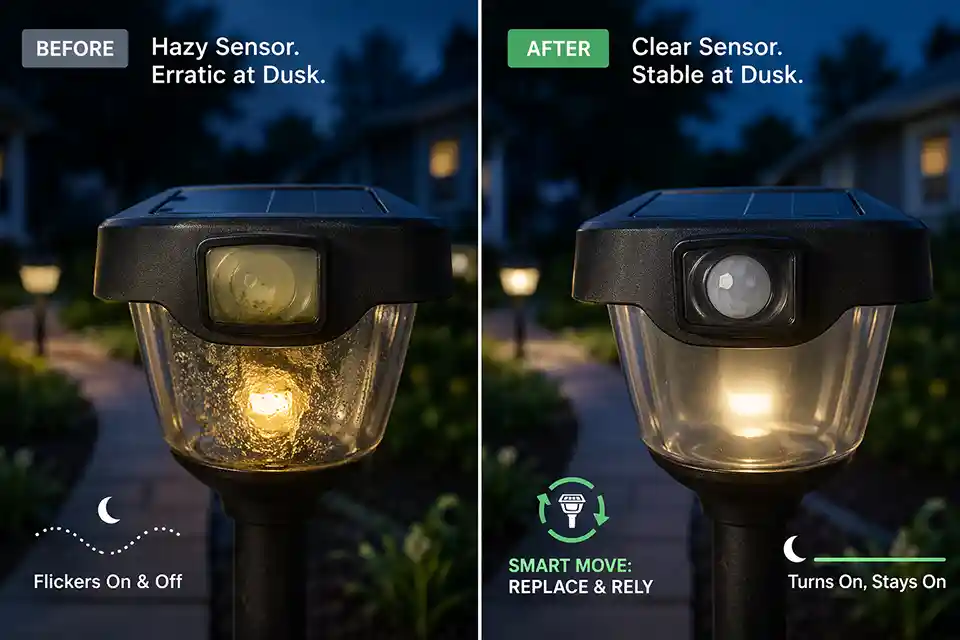
Sensor failures in solar lights are usually not about total power loss. They are about bad darkness decisions. Start by ruling out dirt, reflection, angle shift, and moisture. Then decide whether the fixture is being fooled or whether the sensor-control path has actually degraded.
That difference tells you whether to clean, relocate, retest, or stop spending time on a sealed unit that is already past a sensible repair point. For broader official guidance on outdoor lighting, see the U.S. Department of Energy.