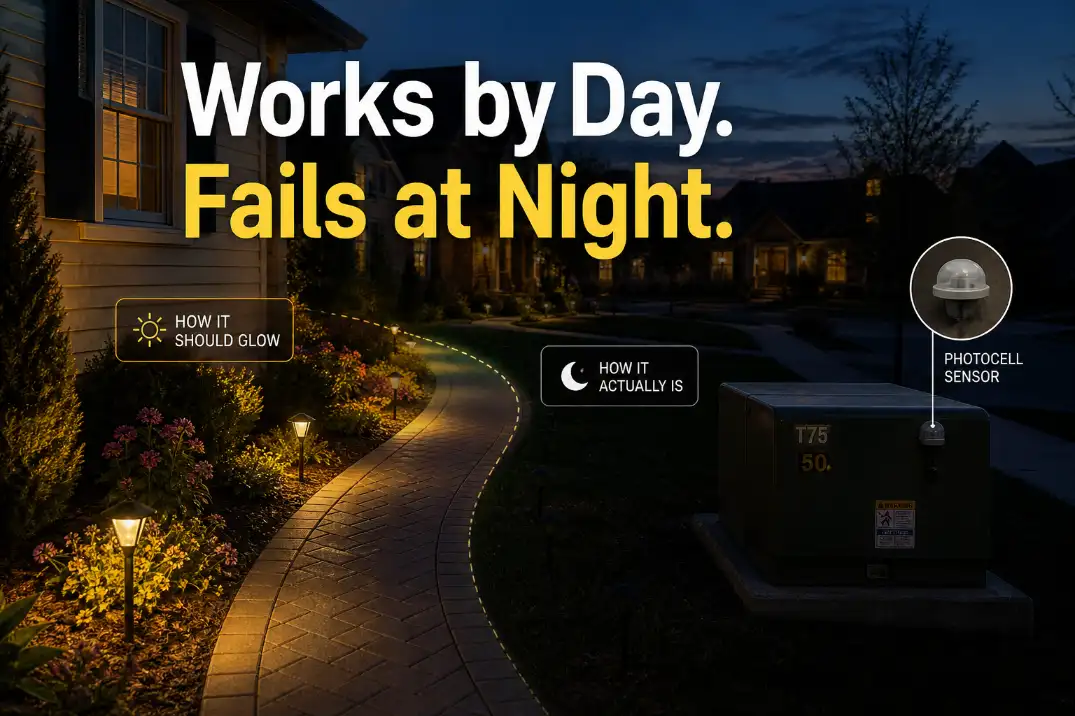
If your outdoor lights work during the day but shut off at night, the daytime test is not proving as much as it seems. It only proves the lights can turn on briefly.
It does not prove the system can survive the real nighttime condition: automatic control, full load, cooler or wetter air, longer runtime, and every fixture drawing power together.
Start by identifying what kind of system you have. A hardwired porch or security light points toward a photocell, dusk-to-dawn bulb, switch, GFCI, breaker, or fixture wiring issue.
A low-voltage landscape system points toward transformer load, cable voltage drop, wet splices, or a failing control. A solar light points toward battery charge, panel exposure, or a sensor being fooled by nearby light.
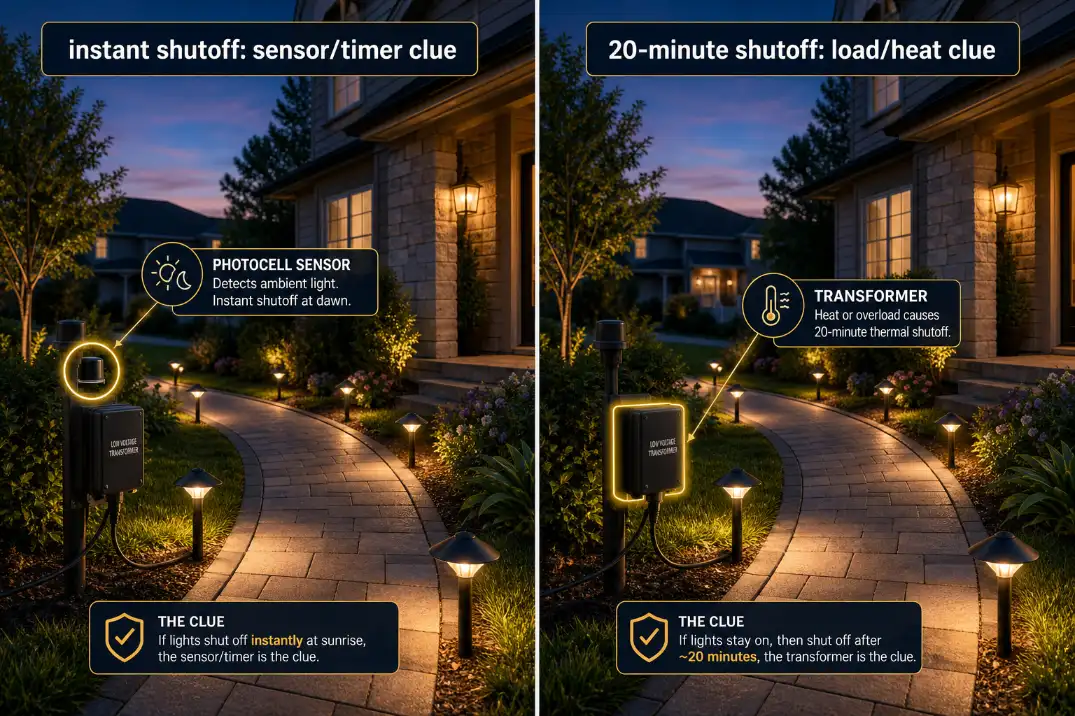
The timing matters most. Instant shutoff at dusk usually means control confusion. Shutoff after 5–30 minutes usually means heat, load, moisture, or voltage loss. If the system works again after cooling for 20–60 minutes, do not keep blaming the bulb.
First, Identify Which Outdoor Lighting System You Have
Different outdoor lights fail in similar-looking ways. The fix changes depending on whether the light is hardwired, low-voltage, or solar.
Line-voltage porch, wall, or security lights
These are usually 120-volt fixtures connected to house wiring. They may be controlled by a wall switch, photocell, motion sensor, dusk-to-dawn bulb, smart switch, or timer.
If one hardwired fixture works during a daytime test but shuts off at night, look first at the photocell, motion sensor settings, dusk-to-dawn bulb, GFCI protection, or loose fixture wiring. If several hardwired exterior lights lose power together, check the breaker and any upstream GFCI outlet before assuming every fixture failed.
For line-voltage fixtures, keep homeowner checks to the switch, breaker, GFCI, bulb type, and visible fixture condition. If the issue points inside a junction box, hardwired photocell, damaged cable, or repeated breaker/GFCI tripping, that is where a licensed electrician makes more sense.
Low-voltage landscape lights
Low-voltage systems usually run from a transformer and feed pathway lights, garden lights, step lights, or accent lights. These systems can pass a daytime manual test but fail at night when the photocell, timer, transformer, and full fixture load all operate together.
This is where voltage drop and load problems become more important. A 12-volt system that looks fine with one short test may struggle when the farthest fixtures are active. If the far end drops into the 8–9 volt range under full load, the issue is no longer just “the lights turn on.” The system is not delivering healthy power where it is needed.
For a deeper look at that pattern, Voltage Drop in Outdoor Lighting Systems explains why the last fixtures on a run often expose the problem first.
Solar outdoor lights
Solar lights can work in a daytime button test and still fail after dark. That test usually proves the LED and switch can operate briefly. It does not prove the panel charged the battery enough to run for several hours.
If a solar light turns on at dusk and dies within 1–2 hours, suspect charging or battery capacity before blaming the sensor. A solar light that receives less than 4–6 hours of direct sun may still pass a daytime button test but fail soon after dark, especially in winter, under trees, or beside north-facing walls.
If it never turns on near a porch light, streetlight, garage light, or bright window, the sensor may think it is still daytime.
Use the Shutoff Timing as the Diagnostic Map
The easiest mistake is treating every nighttime failure as the same problem. Timing separates the likely causes quickly.
| What happens at night | Most likely area | First useful test |
|---|---|---|
| Lights shut off immediately at dusk | Photocell feedback or timer conflict | Cover the sensor for 60–90 seconds |
| Lights run 5–30 minutes, then shut off | Transformer heat, overload, weak connection | Run manual ON under full load |
| GFCI trips after dark or watering | Moisture leakage or ground fault | Stop resetting and inspect wet areas |
| Far lights dim before shutdown | Voltage drop or long cable run | Measure voltage at farthest fixture |
| Solar lights work briefly, then die | Weak charge or battery failure | Check sun exposure and runtime |
| Lights work in manual mode but not AUTO | Control logic issue | Reset timer and test photocell |
Instant shutoff usually points to control, not power
If the lights turn on at dusk and immediately shut off, the photocell may be seeing light from the fixtures themselves. This happens when the sensor is too close to a wall light, aimed at pale siding, under a reflective soffit, or facing glass.
The sequence is simple: dusk arrives, the photocell turns the lights on, the fixtures brighten the sensor area, and the sensor thinks daylight has returned. That is not a bad bulb. It is bad information reaching the control.
When testing a photocell, do not expect an instant reaction. Many sensors have a built-in delay. Cover the sensor completely for at least 60–90 seconds before deciding the test failed.
Delayed shutoff points away from the photocell
If the system runs for 10, 20, or 30 minutes and then shuts down, the photocell is less likely to be the main cause. Delayed failure usually means something changes after runtime: the transformer heats up, a weak connection expands, a fixture begins drawing abnormally, or moisture leakage becomes active.
This is the point where replacing the photocell often wastes time. A control problem usually appears at the control moment. A delayed shutdown is more often a load or condition problem.
If your lights consistently turn off after a short run window, Outdoor Lights Turning Off After a Few Minutes is a closer match than a basic dusk sensor issue.
The Photocell Problem People Miss
Photocells are simple, but their placement matters more than most people expect. They do not understand “night.” They only respond to the light reaching the sensor.
The sensor may be seeing its own fixture
A photocell mounted near the fixture it controls can create a short cycle. The light turns on, spills light onto the sensor, shuts itself off, then repeats after the sensor darkens again.
This is common on porch lights, pole lights, landscape transformers mounted near bright fixtures, and exterior walls with reflective paint or trim. A sensor can also be fooled by headlights, neighboring security lights, patio string lights, or nearby streetlights.
The fix is not to cover the photocell permanently. That may keep the lights on, but it removes automatic daylight control and can leave the system running 12–16 hours during long winter nights. Move the sensor, shield it from direct fixture glare, or adjust the fixture direction instead.
Pro Tip: Test the photocell at night by shielding it from the fixture’s own light, not just by covering it during the day. The real question is whether the sensor can stay dark while the controlled lights are on.
Timer conflict can look like a bad sensor
Some systems use both a timer and a photocell. That setup can work well, but it can also create confusing failures after a power outage, daylight saving change, or seasonal schedule shift.
A timer that is 12 hours off may treat evening as morning. The photocell turns the lights on at dusk, then the timer shuts them off because it believes the off schedule has arrived. If the lights work in manual ON but fail in AUTO, the timer and photocell should be tested before replacing fixtures.
For systems where the automatic control itself is the main suspect, Outdoor Lights Not Turning On After Timer or Photocell is the most relevant next diagnostic path.
Smart bulbs and dusk-to-dawn bulbs can confuse the diagnosis
If the fixture uses a dusk-to-dawn bulb or smart bulb, the sensor may be built into the bulb rather than the fixture. In that case, the wall switch and fixture may be fine while the bulb’s internal photocell reacts to nearby light, fixture orientation, or a shaded lens.
For testing, temporarily try a standard bulb of the correct type, or rotate the dusk-to-dawn bulb if its sensor window is directional. If the problem disappears with a standard bulb, the fixture wiring was probably not the real failure point.
When the Transformer or Load Is the Real Issue
A low-voltage transformer can look fine during a quick daytime test and fail during the night cycle. The difference is load and runtime.
A 5-minute test is weak evidence
If you switch the transformer to manual ON during the day and the lights come on, that is only the first test. Leave the full system running for at least 30 minutes. If it fails after warming up, the transformer may be overloaded, poorly ventilated, failing internally, or reacting to a downstream fault.
A transformer that shuts off, cools for 20–60 minutes, and then works again is showing a heat-related pattern. That is different from a bad photocell.
Do not load the transformer to the edge
If a transformer is rated for 120 watts, running it at or near 120 watts is not a great target. A safer practical ceiling is about 80% of the rating, especially in hot climates, enclosed boxes, or older systems where additional fixtures were added over time.
LED conversions can also create odd behavior if the transformer, timer, or photocell was designed around older halogen loads. The fix may not be “more power.” It may be correcting compatibility, reducing load, separating runs, or replacing a failing transformer.
Voltage drop shows up at the far end first
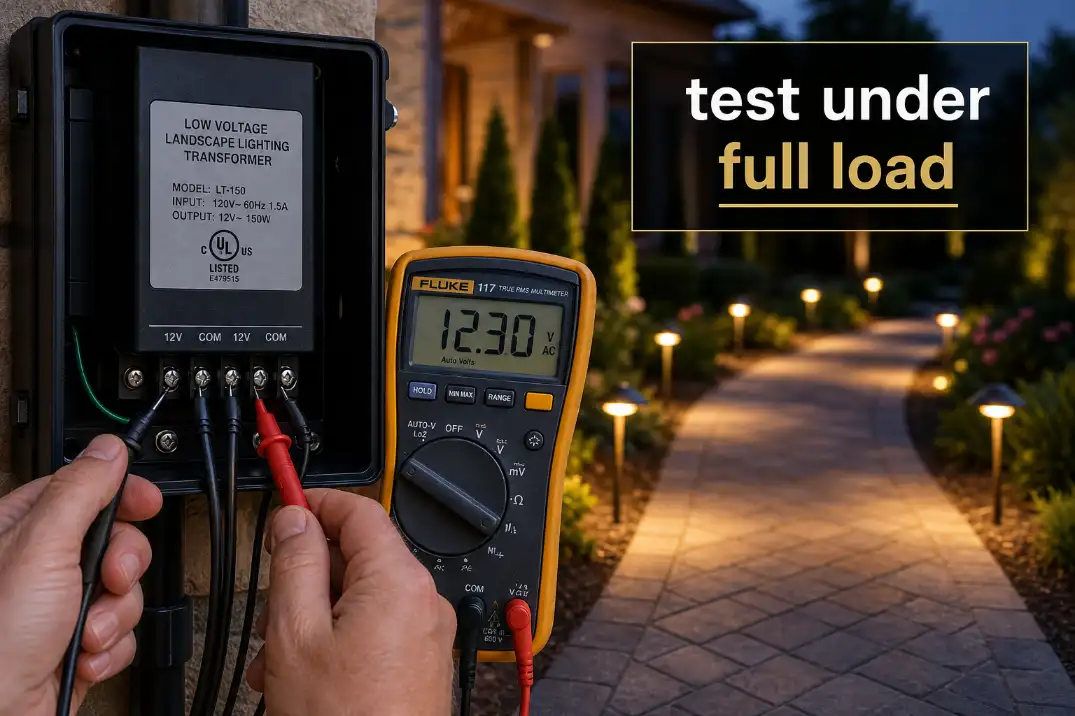
If the closest lights are bright but the last lights dim, flicker, or shut down, the issue may be cable length, wire gauge, connection quality, or fixture load. The healthier comparison is not “the lights turn on near the transformer.” It is whether the farthest fixture still receives usable voltage while every light is running.
That is why testing at the farthest fixture under full night load is more useful than testing only at the transformer terminals.
Moisture and GFCI Problems Get Worse at Night
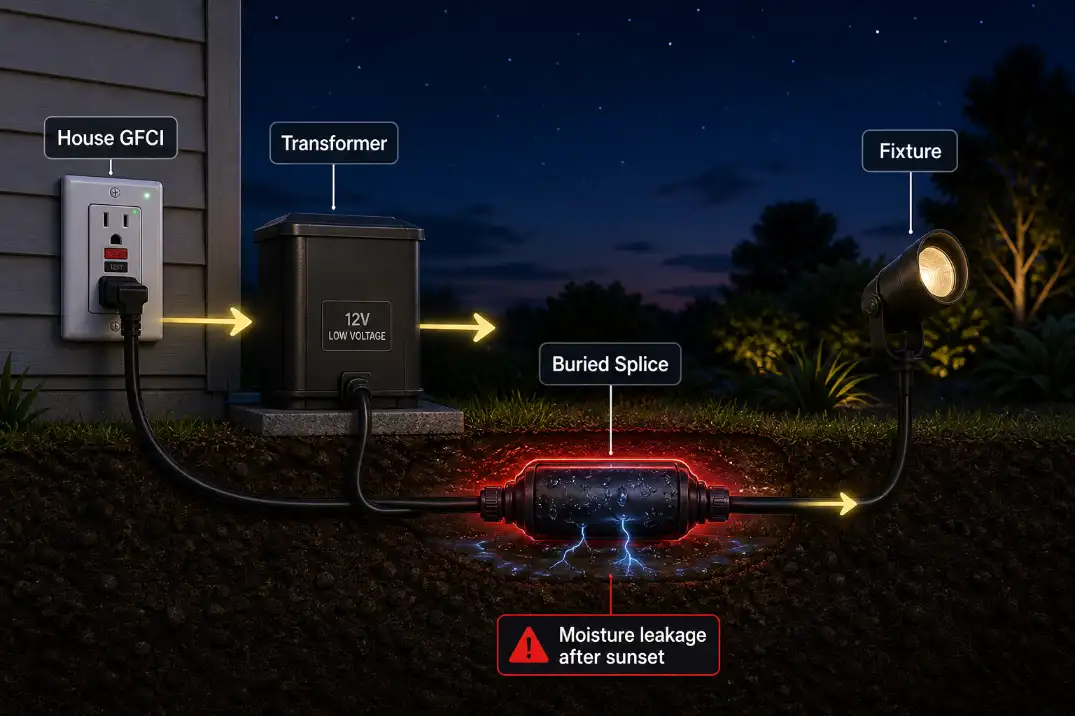
Outdoor lighting often fails after dark because evening conditions are different. Dew forms, irrigation may run, soil cools, and fixtures stay energized longer. A splice that looked harmless at 3 p.m. can become a fault path after moisture settles.
This is especially common in humid regions, coastal areas, shaded garden beds, and systems with splices buried in mulch. The fixture does not have to be visibly full of water. Damp wire connections, cracked insulation, failed gaskets, or water at a cable entry point can be enough to trip protection or drag down the system.
If a GFCI trips after rain, sprinklers, or nighttime operation, do not keep resetting it and calling the problem random. Repeated GFCI trips mean the protection device is reacting to leakage current. The repair should focus on wet fixtures, damaged cable, bad splices, or water entry.
For that failure pattern, Outdoor Lights Tripping GFCI Outlets is more useful than another photocell reset.
What Not to Replace First
This is where a lot of repair time gets wasted. The part that is easiest to replace is not always the part that explains the pattern.
Do not start with bulbs when several lights shut off together
One failed bulb affects one fixture. A whole zone or entire system shutting down usually points upstream: transformer, control, GFCI, shared wiring, or a main cable problem.
Do not replace the photocell if the system runs for a while first
A bad or poorly placed photocell usually causes trouble right when dusk control begins. If the lights run normally for 20 minutes and then die, look at heat, load, moisture, and connections.
Do not keep resetting a tripping GFCI
A GFCI that trips again after nightfall or after watering is giving you useful information. Resetting it repeatedly does not dry a splice, repair damaged insulation, or fix a wet fixture.
Do not assume solar sensor failure when runtime is short
If a solar light turns on at dusk but fades after 1–2 hours, the sensor probably did its job. The battery or charge level did not. Poor sun exposure, aging batteries, dirty panels, and winter shade matter more than the sensor in that case.
If the solar light is near artificial light at night, Solar Lights Not Turning On Near Streetlights explains why the fixture may never receive a true darkness signal.
A Smarter Test Sequence
Use this order before buying parts. It separates control failure from load failure without making the troubleshooting process bigger than it needs to be.
1. Test manual ON under full load
Turn the system on manually and leave every fixture connected for at least 30 minutes. If it fails, you are probably dealing with load, transformer, wiring, heat, or moisture—not just the automatic setting.
2. Test AUTO separately
Switch back to AUTO and cover the photocell fully for 60–90 seconds. If the lights respond correctly in a controlled test but fail at real dusk, suspect sensor placement, reflected light, or timer conflict.
3. Watch where the failure starts
If the farthest fixtures dim first, test voltage at the far end. If one branch dies while another stays on, inspect the shared splice or cable feeding that branch. If everything shuts off together, move upstream to transformer, GFCI, breaker, timer, or photocell.
4. Inspect the connections that move, heat, or get wet
Loose outdoor connections can pass a quick test and fail once the system is under real load. Look for green corrosion, brittle insulation, loose pierce-point connectors, wet wire nuts, or splices sitting directly in soil or mulch.
If touching a connector makes lights flicker, stop treating the issue as a control problem. The repair boundary has moved to wiring. Loose Outdoor Wiring Connections covers that kind of failure more directly.
When to Stop Troubleshooting and Call an Electrician
Call a licensed electrician if the fixture is hardwired to 120 volts and you suspect a junction box, buried cable, damaged house wiring, or a failing breaker. Also stop if a GFCI trips repeatedly, a fixture smells hot, the breaker will not hold, or there is visible melting, sparking, or water inside a line-voltage fixture.
For low-voltage landscape lighting, homeowner checks are usually safer at the transformer output, fixture connections, and visible cable runs. But if the transformer is fed by a questionable outlet, the GFCI keeps tripping, or the system connects to hardwired controls, the power source side should be handled properly.
The key is not to keep swapping parts until something works. Nighttime shutoff has a pattern. Immediate failure points toward control. Delayed failure points toward load, heat, moisture, or voltage. Solar failure points toward charging, battery life, or sensor confusion. Once you match the timing to the system type, the repair path gets much shorter.
For broader official guidance on lighting controls, see the U.S. Department of Energy.