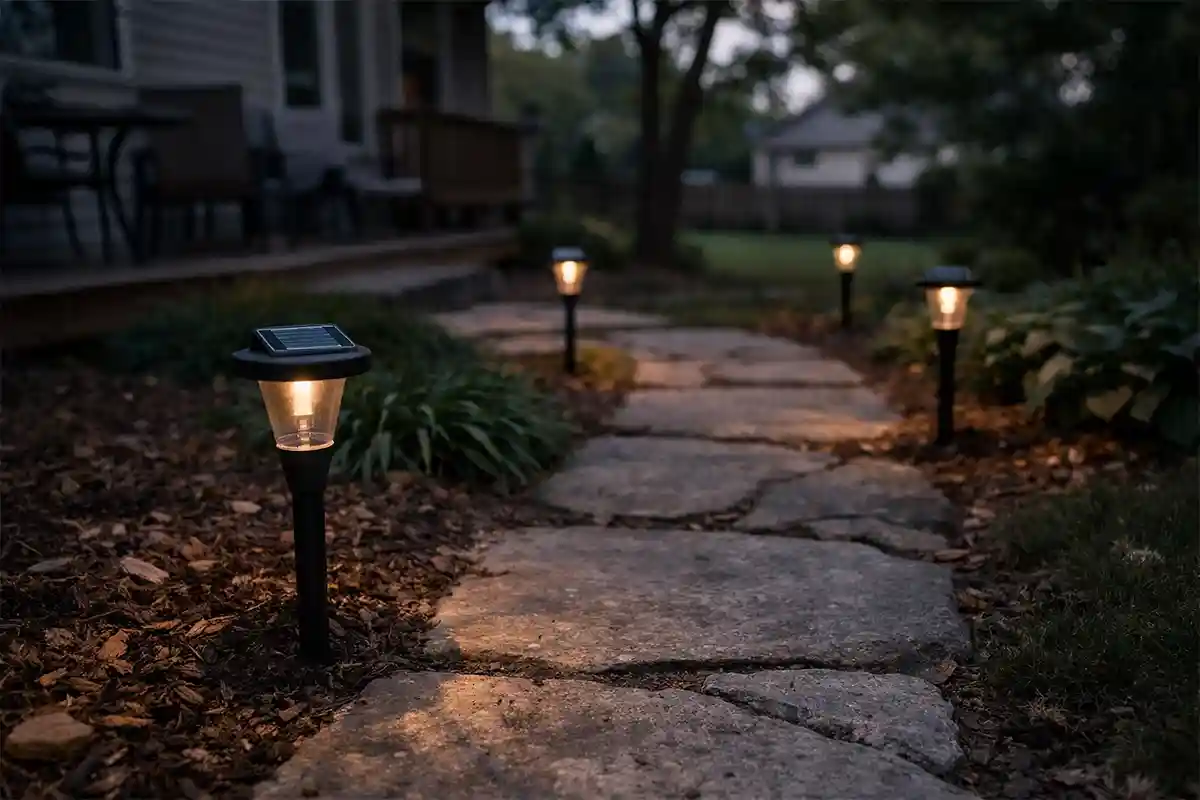
A typical installation places solar path lights 12 to 24 inches apart along a walkway, with panels mounted horizontally about 18 inches above ground. On paper, that spacing seems adequate for full daylight exposure. In practice, nearby shrubs, fence lines, and even the angle of the house can block critical afternoon sun.
The issue often becomes noticeable at dusk rather than during the day. Lights that once stayed bright for six to eight hours now fade after two or three, especially following days with partial cloud cover. When this shortening runtime repeats over several evenings, it signals a pattern rather than an isolated fluctuation.
Not every dim night points to internal failure. The key question is whether the change reflects temporary surface interference or a deeper structural imbalance in charging, storage, or transfer.
I initially assumed the shorter glow was just weather-related. After a few evenings of the same early shutdown, it became clear the problem wasn’t random. That shift from occasional dip to consistent underperformance is the moment evaluation becomes necessary.
An early assessment should compare actual sunlight exposure hours against expected battery capacity before considering component replacement.
Insufficient Direct Sunlight During Peak Hours
Solar panels require concentrated midday sun to reach full charge. Morning brightness alone is not enough if trees or structures cast shadows between 11 a.m. and 3 p.m., which is the most productive charging window in most U.S. regions. A panel that receives filtered light during that period may only store a fraction of its designed capacity.
The problem typically surfaces after landscaping changes or seasonal sun-angle shifts. A fixture that performed reliably in July may undercharge in October when shadows extend several feet farther across the yard. This creates a directional pattern, where only certain lights along the path begin fading early.
The distinction here is important. A single cloudy day rarely causes long-term decline, but repeated partial-charge days gradually reduce usable battery reserve.
Solar Panel Surface Contamination
Panels mounted flat on top of fixtures collect more than sunlight. Dust, pollen, and sprinkler spray leave a thin film that reduces light absorption even when the surface still looks clear. Over time, mineral deposits create a hazy layer that subtly blocks efficient energy transfer.
This condition usually appears after weeks of dry weather or irrigation cycles. The effect is cumulative rather than immediate, which makes it easy to overlook. A panel does not need visible grime to experience measurable efficiency loss.
A common mistake is assuming brightness issues must mean battery exhaustion. In many cases, the battery remains functional but never receives a complete charge due to surface interference.
Battery Capacity Degradation Over Time
Rechargeable batteries gradually lose their ability to hold a full charge after repeated cycles. Cold winters and hot summers accelerate this decline, especially in fixtures exposed directly to temperature swings. What once delivered eight hours of runtime may now sustain only half that duration under identical sunlight.
The change often feels subtle at first. Lights still turn on, so the assumption is that everything works. The difference lies in how long they sustain output before dimming.
For a deeper breakdown of lifespan factors and failure patterns, this detailed guide on Why Are My Solar Light Batteries Dying So Quickly? explains how environmental stress and improper charging cycles compound over time.
Internal Moisture Interference
Moisture can enter through small seal gaps or temperature-driven condensation. Once inside, it increases electrical resistance at contact points, reducing charging efficiency even if the panel output remains stable. This effect often follows heavy rain or prolonged humidity.
The pattern usually repeats after specific weather events rather than continuously. Lights may function normally during dry weeks but dim prematurely after storms. That weather-linked repetition suggests structural exposure rather than random malfunction.
Panel Orientation and Installation Angle
Most homeowners install fixtures vertically for aesthetic alignment, not solar optimization. Panels positioned flat capture less direct light during early morning and late afternoon compared to slightly angled surfaces facing south in North America. Even a small tilt adjustment can increase daily charge intake.
Height and placement also influence results. Units placed near thick ground cover or mulch may receive reflected shading that limits effective exposure. Over time, plant growth can further restrict sunlight without obvious visual change.
Gradual System-Wide Decline Patterns
When multiple fixtures installed at the same time begin fading unevenly, the issue often reflects layered stress factors. Slight differences in exposure, contamination, and battery wear combine to create varied performance across the same row.
In cases where performance inconsistencies expand beyond charging behavior, broader structural failure patterns may be involved. This comprehensive analysis of Why Solar Outdoor Lights Fail So Quickly (And What’s Really Causing It) outlines how early charging instability can evolve into full fixture deterioration.
Not every repeat requires the same level of intervention. Some conditions resolve with surface correction, while others indicate progressive internal decline. The difference becomes clearer once the exposure pattern, repetition cycle, and structural signals are evaluated together.
Partial Charging vs. Full Charge Saturation
A solar light mounted 18 inches above ground along a straight concrete edge may appear fully exposed during midday. Yet if a nearby fence casts a 6-inch shadow across the panel between 1 p.m. and 3 p.m., the battery may never reach full saturation. Partial charging is not the same as failed charging. The light still turns on, but it draws from a half-filled reserve.
The difference shows up at night. Instead of staying bright until midnight, the glow weakens by 9 p.m., especially after back-to-back cloudy afternoons. This repeated early fade suggests incomplete energy storage rather than instant component breakdown.
A common belief is that “if it lights up, it charged enough.” That assumption overlooks the difference between activation threshold and full capacity. Evaluation means comparing how long it runs now versus how long it ran when first installed along the same walkway.
Charge Controller Irregularities
Inside the top housing, just beneath the small plastic lens, sits a controller that decides when to store power and when to release it. If that controller activates too early—while there is still ambient light reflecting off siding or a white garage door—the battery begins discharging before true darkness arrives.
You may notice lights flicking on while the sky is still pale blue. That premature trigger shortens usable runtime by one or two hours. Over several weeks, the pattern becomes consistent, especially if the sensor sits at an angle facing reflective surfaces.
Some homeowners assume the panel is weak. In reality, the charge controller may be misreading environmental light due to positioning. When evaluating this issue, look at the angle of the sensor relative to house walls, driveway edges, or metal railings that bounce light back toward the fixture.
Temperature Extremes and Thermal Cycling
A light installed 12 inches from a snowbank behaves differently than one mounted near dry grass. Frost on the panel blocks light entirely until it melts, which may not happen until noon in colder states. That delayed exposure cuts several charging hours.
In summer, the opposite occurs. A fixture placed two inches above dark mulch absorbs reflected heat, raising internal temperature inside the plastic housing. Heat stresses battery chemistry and can reduce storage efficiency even if sunlight is strong.
Many people believe cold alone kills the battery. In truth, repeated freeze-thaw cycles expand and contract internal contacts, which weakens long-term stability. Evaluation should consider how close the fixture sits to soil, snow, or heat-retaining surfaces.
Inconsistent Performance Across Multiple Fixtures
If five lights line a 15-foot path and only two dim early, placement differences usually explain it. One might sit closer to a shrub that leans 4 inches over the panel. Another may be tilted slightly toward the house instead of open sky.
That uneven behavior is often the first structural clue. It shows the system is not failing uniformly but responding to local exposure differences. Observing shadow lines at 2 p.m. or 4 p.m. helps confirm whether sunlight distribution is consistent across all units.
When runtime irregularities begin overlapping with flickering or unpredictable shutoffs, broader instability may be forming. This deeper evaluation of Outdoor Lights Working Intermittently explains how uneven charging patterns can evolve into inconsistent activation cycles.
Solar Panel Microfractures and Aging
Hairline cracks often start near the panel’s top edge, especially if struck by debris or exposed to hail. From a standing height of 5 or 6 feet, the surface may look intact. Up close, faint lines disrupt the dark photovoltaic grid.
These fractures reduce electrical flow across the panel surface. The effect is gradual. The light still charges, but maximum voltage drops below design capacity.
A frequent misconception is that visible cracks must be dramatic to matter. In reality, even fine fractures reduce efficiency enough to shorten runtime over several weeks.
Soil Conditions and Ground-Level Heat Reflection
Lights installed along a driveway edge experience different conditions than those in open lawn. Concrete reflects both light and heat upward. While extra reflected light might seem helpful, increased heat accelerates battery wear.
Moist soil after heavy rain creates another layer. When the ground remains damp within a 2-inch radius around the base, internal humidity levels rise inside the housing. Over time, that moisture interferes with contact points.
Evaluating ground conditions means checking drainage slope and soil type. Clay holds moisture longer than sandy soil, which increases recurrence risk.
Structured Assessment Grid
| Approach | Structural Impact | Recurrence Risk | Longevity |
|---|---|---|---|
| Raise fixture height 2–3 inches | ▲ Improves light angle | ○ Low if sun path stable | ◆ Medium |
| Adjust tilt toward south | ◆ Optimizes exposure | ○ Low | ▲ High |
| Clean panel surface | ○ Surface-level | ◆ Moderate if sprinklers continue | ○ Short-term |
| Improve drainage slope | ▲ Reduces humidity load | ○ Low | ◆ Medium |
| Replace battery only | ○ Minimal structural change | ◆ Higher if exposure unchanged | ○ Limited |
Micro Evaluation Questions
Is the light receiving at least four uninterrupted hours of direct sun between late morning and mid-afternoon?
If shadows cross the panel during peak hours, partial charging is likely.
Does the fixture activate while the sky is still bright?
Early activation often signals sensor misalignment rather than weak batteries.
Are certain lights along the same 10-foot path dimming sooner than others?
Uneven performance usually points to placement differences.
Has the runtime dropped gradually over several months instead of suddenly?
Gradual decline suggests layered stress rather than sudden component failure.
Is moisture visible inside the lens after heavy rain?
Condensation indicates humidity exposure that can affect charging transfer.
Three core solution layers help clarify effectiveness.
Placement Adjustment:
Raising the fixture or tilting the panel changes how sunlight strikes the surface. Structural change leads to stronger daytime intake, which increases nighttime runtime. When sun access is the main issue, this approach offers high stability and low recurrence risk.
Flow Control:
Cleaning panels and redirecting sprinkler spray improve energy transfer. This alters surface behavior, not core structure. The impact is immediate but may require repeated maintenance if irrigation patterns stay the same.
Entry Plane Balancing:
Improving drainage slope or repositioning near less reflective surfaces stabilizes internal temperature and humidity. This deeper environmental correction reduces stress on batteries and controllers, supporting longer-term stability.
Not every situation demands full replacement. Sometimes a two-inch height shift or a slight tilt toward open sky provides more durable improvement than swapping parts repeatedly.
Stabilizing Sun Exposure Before Replacing Components
A light installed 20 inches from the driveway edge may look fine during midday, yet if a garage roofline casts a shadow across the panel at a 30-degree angle after 2 p.m., the battery never reaches full capacity. A stable solution means correcting that exposure pattern, not just restoring brightness for a night or two. Raising the fixture by 2–3 inches or shifting it 12 inches toward open sky changes the charging window in a measurable way.
Temporary relief, such as swapping batteries without adjusting placement, often creates a short burst of improvement. The glow returns for a week, then fades again because the afternoon shadow still cuts off peak sunlight. A stable correction alters the physical relationship between panel height, angle, and light path so the energy intake pattern actually changes.
Many homeowners believe battery replacement is the main fix. In reality, when shadow lines consistently cross the panel between noon and 3 p.m., exposure adjustment provides longer stability than component swaps.
Addressing Surface and Contact-Level Interference
Panels positioned flat on top of a fixture 18 inches above mulch collect dust, pollen, and sprinkler spray that settles in a thin layer. Cleaning the surface improves light penetration immediately. However, if the sprinkler head sits 24 inches away and sprays directly across the panel every evening, buildup returns quickly.
That is the difference between surface cleaning and structural adjustment. Redirecting water flow or angling the panel slightly away from the spray path changes recurrence risk. The physical cue here is water direction and residue line on the plastic lens.
Inside the housing, corrosion at the battery terminals—often visible as a dull gray or green film—reduces current flow. Cleaning contacts restores conductivity, but if the fixture base sits in soil that remains damp after rain, moisture will re-enter. A stable fix may require improving drainage slope or elevating the base slightly above soil grade.
Battery Reset vs. Structural Reset
Testing voltage at the battery terminals with a multimeter while the panel sits in direct sun provides a clearer evaluation. If the panel produces steady voltage yet nighttime runtime remains short, the issue may lie in storage capacity. If voltage output itself drops when the panel faces south at a 20-degree tilt, generation limits are likely involved.
A battery reset replaces stored capacity but does not change the angle of sunlight hitting the panel. A structural reset alters panel direction, height relative to shrubs, or distance from reflective siding. The behavior change follows the physical change.
When the wrong solution is chosen, it can backfire. Replacing batteries repeatedly while leaving the panel under partial shade accelerates cycling stress. The new batteries enter the same incomplete-charge pattern and degrade faster.
Preventing Recurring Undercharge Cycles
Undercharging builds gradually. A fixture that receives only three hours of direct sunlight instead of five may still work for months before decline becomes obvious. Interrupting that cycle requires restoring adequate charging hours measured across a full afternoon, not just one bright day.
Escalation should be based on repeat patterns. If early shutoff occurs after every cloudy afternoon but corrects after full sun exposure, intervention may remain minor. If runtime shortens even after two clear days with panels fully exposed, deeper battery or panel aging may be present.
Lowering intervention makes sense when performance rebounds after cleaning or repositioning. Escalating to replacement is appropriate when structural adjustments fail to restore consistent runtime over several cycles.
Long-Term Stability Indicators
Stable performance can be measured. The light should remain bright for a consistent number of hours when placed 12 inches from obstructions and angled toward open sky. Shadow lines should not cross the panel during peak sun. Condensation should not appear inside the lens after rain from a specific wind direction.
Below is a practical evaluation checklist:
-
Runtime remains within 10–15 percent of original duration after three consecutive clear days.
-
Panel receives at least four uninterrupted hours of direct sunlight between late morning and mid-afternoon.
-
No visible condensation inside the lens 24 hours after rainfall.
-
Battery voltage, measured in full sun, matches manufacturer rating within normal range.
-
No recurring mineral haze forms within two weeks of cleaning.
-
Activation begins only after the sky is fully dark, not during twilight reflections from siding or driveway surfaces.
-
Fixtures along the same 15-foot path perform evenly without one dimming significantly earlier.
When these conditions remain consistent across multiple weeks, the solution is likely stable rather than temporary.
For broader renewable energy standards and safety references, consult guidance from the U.S. Department of Energy.