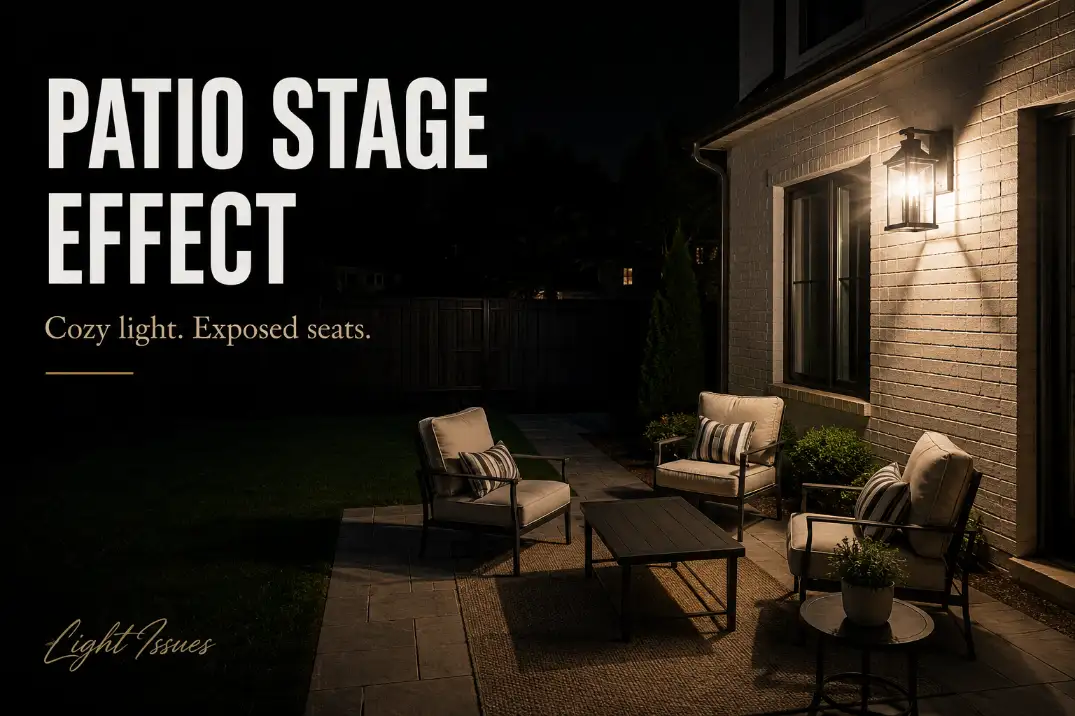
Patio lighting feels like a stage when the brightest light lands on people instead of the patio. The usual cause is not simply “too much light.” It is a bad combination of visible bulbs, face-level glare, and a dark yard edge that makes the seating area look like the only thing on display.
Start with three checks: can you see the glowing bulb or lens from a chair, does the seating area look roughly three or four times brighter than the fence or planting edge, and does the main fixture sit around 5–8 feet high while aiming across the patio?
If yes, dimming alone will probably disappoint. A dim patio lacks usable light; a staged patio has light, but the light is aimed at the wrong subject.
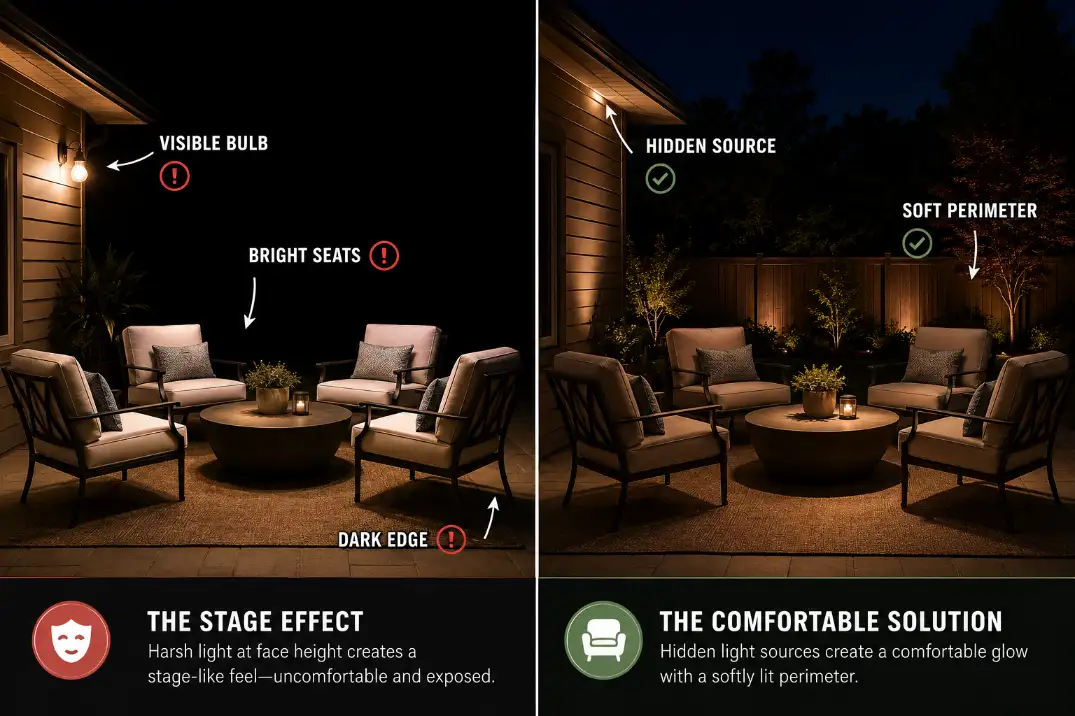
The Patio Stage Triangle: Bulb, Face, Dark Edge
The stage effect usually comes from three conditions working together. One may be tolerable. Two can feel awkward. All three make a patio feel exposed even when the actual light level is not extreme.
The bulb is visible from the chair
The first problem is direct source visibility. If someone sitting at the table can see the glowing LED board, clear bulb, glass lens, or bare string-light filament, the eye keeps returning to that bright point.
That bright point also changes how the rest of the patio feels. Your eyes adapt to the lamp, not the table, the steps, or the people around you. This is why a modest 400–600 lumen fixture can feel harsher than several lower fixtures spread around the space.
The seating area becomes the brightest object
A patio should light surfaces first: the table, step edges, walking path, grill counter, or floor plane. When faces and chair backs become the brightest objects, the scene starts to feel performative.
As a practical starting point, relaxed patio seating often feels better with low ambient light and slightly brighter task surfaces. A table or grill counter can take more light than a person’s face. The same brightness that feels useful on a tabletop can feel like a spotlight when it crosses seated eye level.
The yard edge disappears
The third part is contrast. When the patio is bright and the yard beyond it goes black, the seating area becomes a lit island. This is the part many people underestimate.
Lowering the main fixture from full output to a middle dimmer setting may help, but it does not fix the contrast if the perimeter remains invisible. A few soft edge cues can make the patio feel more private than one bright central fixture ever will.
What People Usually Misread First
The most common mistake is treating this as a style problem. Homeowners blame the fixture design, the string lights, the wall sconces, or the bulb color. Those can matter, but they are rarely the root issue.
Fixture style is not the main diagnosis
A lantern, cylinder sconce, pendant, floodlight, or string-light run can all create the same problem if the light source is visible and aimed into the seating zone. The category of fixture matters less than whether it controls glare.
That is why “buy warmer bulbs” is an incomplete fix. Warm light can make a patio feel less harsh, but it cannot make a visible bulb disappear from someone’s sightline. If the beam still crosses seated eye level, the patio may remain uncomfortable even with a warm 2700K bulb.
This is also why the issue overlaps with Why Outdoor Lights Create Glare. Glare is not just brightness. It is brightness in the wrong place, seen from the wrong angle.
Brightness is often overestimated
People often assume a patio needs more output because the edges feel dark. Then they add a stronger bulb or another string of lights over the table. The patio gets brighter, but not more comfortable.
On a small 10-by-12-foot patio, even 800–1,200 total lumens can feel like too much if most of that light lands at eye level. A larger patio can feel calmer with more total lumens when the light is shielded, spread lower, and aimed at surfaces.
Color temperature still matters
Color temperature is not the first lever, but it does shape the mood. For social patios, 2200K–2700K usually feels softer and more residential. Above 3000K, light often starts to feel sharper, more task-oriented, or more like security lighting.
In places with pale hardscape, stucco, or concrete, such as many dry Southwest yards, cooler light can look even more exposed because those surfaces bounce brightness back into the scene. In humid or coastal regions, wet pavers and glass doors can create the same problem after rain or evening moisture.
Pro Tip: Choose beam control before bulb warmth. A shielded 400-lumen downlight usually feels better than an exposed 250-lumen decorative bulb.
The Decision Table: What the Symptom Usually Means
This is the fastest way to separate a cosmetic lighting issue from a real placement or glare problem.
| What you notice | What it usually means | First fix | What not to do |
|---|---|---|---|
| You can see the bulb from most chairs | Direct glare is driving discomfort | Hide or shield the source | Keep lowering wattage only |
| Faces are brighter than the table | Beam is aimed too high | Redirect below seated eye level | Add more overhead light |
| Patio is bright but yard edge is black | Contrast is too strong | Add low perimeter cues | Flood the whole yard |
| String lights look festive but tiring | Too many visible points | Use dimmer, warmer, diffused bulbs | Add another string |
| Wall light reflects in glass doors | Bounce glare is amplifying light | Change angle or fixture type | Blame bulb color alone |
| Motion floodlight hits the patio | Security light is doing social-light work | Separate security and patio zones | Shorten the timer only |
The most useful clue is not whether the patio looks bright in a photo. It is whether the space feels fine when you first switch the lights on but tiring after 20–30 minutes of sitting. Glare fatigue often shows up after the eye has been adapting for a while.
Fix the Stage Effect in This Order
The order matters. Many fixes fail because they start with mood before correcting the beam path.
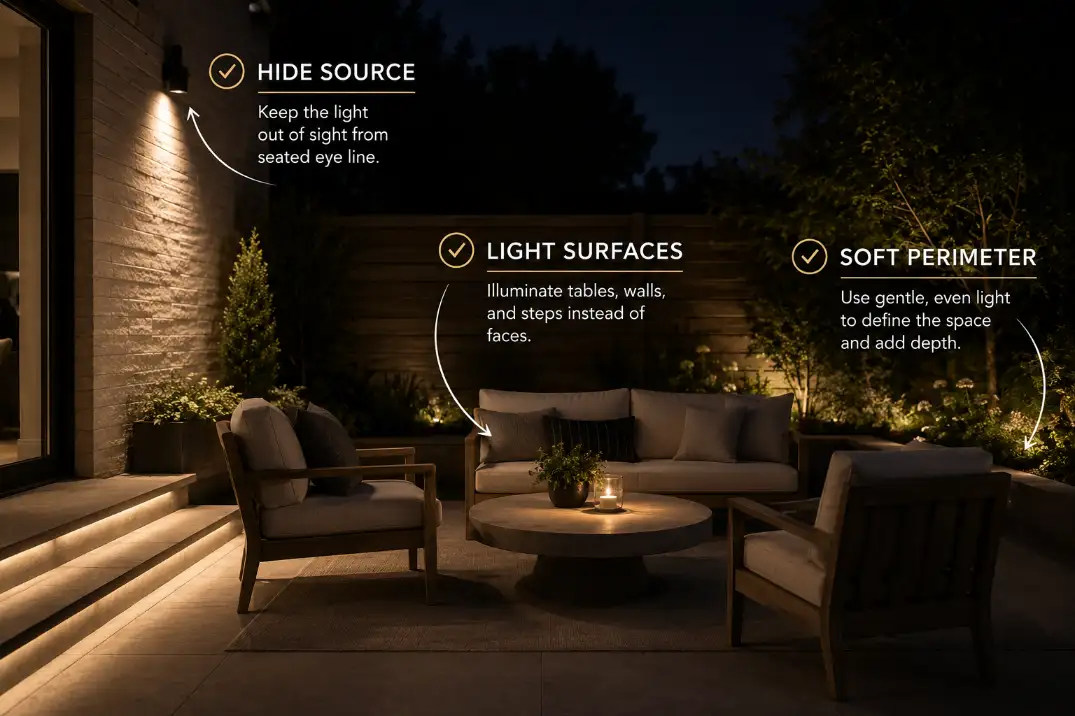
1. Hide the light source first
Sit in the actual chairs after dark and look toward every fixture. If the glowing lamp, LED board, or lens is visible, fix that before changing anything else.
Use shielded wall lights, frosted lenses, opaque bulbs, downlight-style sconces, or lower mounting positions where appropriate. A full-cutoff fixture that sends light downward will usually outperform a clear decorative lantern near a seating area, especially beside a sliding glass door.
This is where the routine bulb swap stops making sense. If reducing output by about a quarter still leaves the lamp visible, the fixture is probably the problem, not the wattage.
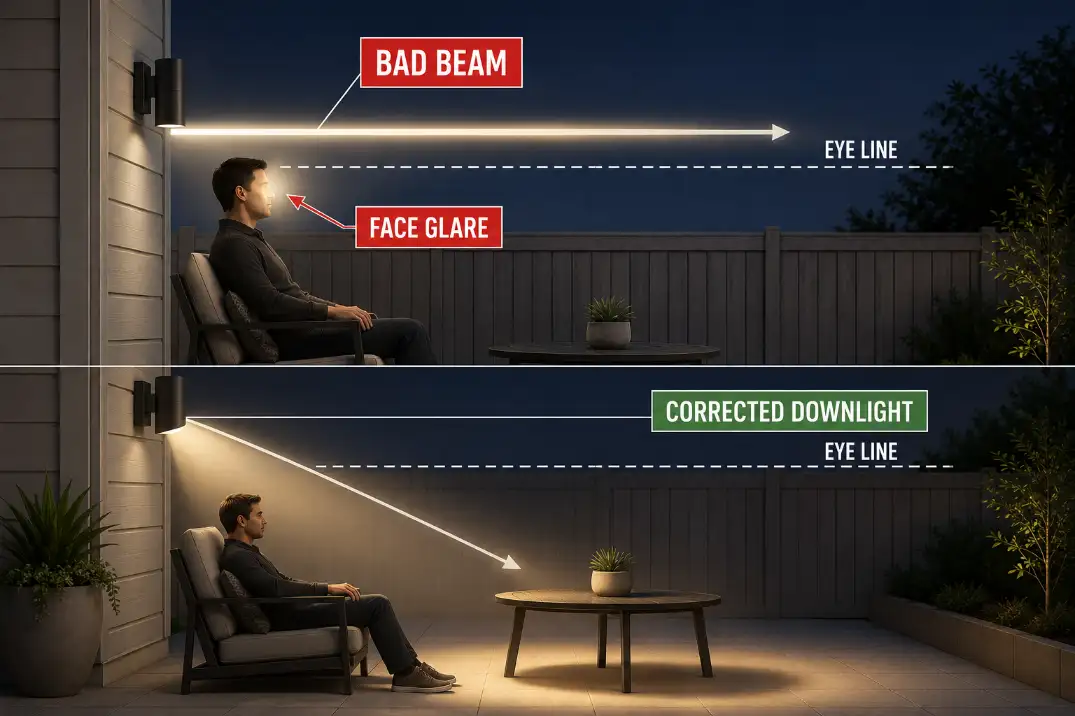
2. Aim light below seated eye level
The best patio light usually lands on the table, floor, steps, or planting edge. It should not cross directly through people’s faces.
A wall fixture mounted at 6–8 feet can work if it is shielded and aimed downward. The same mounting height becomes uncomfortable when the beam projects across the seating area. This is one reason poor placement can make even expensive fixtures feel wrong, as explained in How to Fix Poor Outdoor Light Placement.
For overhead fixtures, diffusion matters. A pendant, canopy light, or string-light setup should soften the source enough that people are not staring at bright points all evening.
3. Add a soft background layer
Once glare is controlled, reduce the hard edge between the patio and the dark yard. This does not mean lighting the whole backyard. It means giving the eye a few quiet reference points beyond the seating area.
A path light near a step, a shielded accent on a planting bed, or a soft fence-line cue in the 100–200 lumen range is often enough. The goal is not drama. The goal is to keep the patio from feeling like the only visible object outside.
This is where privacy and comfort meet. A patio often feels exposed because attention is concentrated on the people sitting there. A softer background layer spreads attention across the space, which is also a key idea in How to Light a Backyard Without Losing Privacy.
4. Keep security lighting out of the social zone
Security lighting and patio lighting should not share the same job. A motion floodlight is designed to reveal movement quickly. A patio light is supposed to support comfort for long periods.
When a floodlight hits a seating area every time someone walks near the house, the patio takes on a surveillance mood. Even a 30-second trigger can feel abrupt if the beam crosses the table or faces. Shortening the timer helps less than narrowing the detection zone, redirecting the fixture, or using a separate lower-output patio layer.
If the same light also spills toward a shared fence or neighbor’s window, the issue is no longer just comfort. It becomes light trespass, which is handled more directly in How to Stop Outdoor Lights From Shining Into Neighbor’s Windows.
5. Use dimming after beam control
Dimmers are useful only after the light is controlled. They fine-tune a good setup; they do not rescue a bad one.
Once the fixture is shielded and the beam lands on surfaces, dimming to roughly 50–70% can make the patio feel relaxed without making steps unsafe. Before that, dimming often just creates a weaker version of the same glare pattern.
Better Fixture Choices for a Patio That Feels Private
The best choice depends on what is causing the stage effect, but some fixture types are consistently easier to control.
Shielded wall downlights
These work well near doors and seating areas when the lamp is hidden and the beam points down. They are better than clear glass lanterns when the patio is small or when seating is close to the wall.
Look for fixtures that hide the bulb from the side. If the fixture looks beautiful in daylight but exposes the lamp at night, it may still create the same problem.
Low step and edge lighting
Step lights, under-cap lights, and low path lights help define movement without putting brightness into faces. They are especially useful on patios with elevation changes, outdoor kitchens, or dark transitions to the yard.
A step edge may need only a small amount of light to be readable. Making it much brighter than the surrounding patio can start to pull attention away from the seating area.
Diffused string lights
String lights can still work if they are treated as atmosphere, not the main lighting system. Warm, dimmable, diffused bulbs are usually better than clear bulbs. Wider spacing often feels calmer than dense rows over the table.
The mistake is using string lights to solve every job: mood, dining, security, path safety, and yard definition. They are good at atmosphere. They are not good at hiding glare unless the bulbs are carefully selected and dimmed.
Quick Diagnostic Checklist
Use this from the actual seating positions, not while standing near the switch.
- You can see a bare bulb, LED lens, or glowing panel from a chair.
- The seating area looks roughly three or four times brighter than the patio edge.
- The main light hits faces before it hits the table, floor, or steps.
- The patio feels acceptable at first but tiring after 20–30 minutes.
- Glass doors, white siding, pale pavers, or glossy tables reflect the light back.
- Dimming helps slightly, but the space still feels exposed.
- A motion or floodlight covers the patio as if it were a driveway.
If three or more are true, the problem is not mainly décor. It is light direction and contrast.
When a Patio Still Feels Like a Stage
If the fixture is shielded, the bulbs are warm, and the patio still feels exposed, look at reflection and layout.
Reflections may be doing more than the fixture
Sliding glass doors, glossy tables, light-colored pavers, white privacy screens, and pale siding can bounce light back into the seating zone. This is easy to miss because the fixture itself may not look very bright.
A useful test is to turn off one fixture at a time and watch what happens to the reflections, not just the direct beam. If the glare disappears from a glass door or tabletop before the patio itself goes dark, the reflection was part of the problem.
The seating may be in the wrong light pocket
Sometimes the light is not terrible; the furniture is simply placed in the brightest pocket. Moving chairs 2–4 feet away from a wall light or out from under a string-light run can change the feel without buying anything.
This is especially true on narrow patios, townhome yards, and small decks where the fixture, seating, glass door, and fence are all close together. In those spaces, small placement changes matter more than more powerful fixtures.
The Best Patio Lighting Pattern
A comfortable patio usually uses fewer dominant lights and more controlled cues. The goal is not to make everything visible equally. The goal is to make the right things visible without turning people into the brightest feature.
Use one soft anchor, such as a shielded wall downlight, dimmed pendant, or diffused string-light layer. Then add only the support lights that solve a real problem: a step, a grill counter, a side path, or a dark planting edge.
The best test is simple: when someone sits down, the patio should feel easy to use without making them feel watched. If the table, floor, and path read clearly while faces stay softly lit, the stage effect is gone.
For broader guidance on responsible outdoor lighting principles, see DarkSky International’s lighting principles.