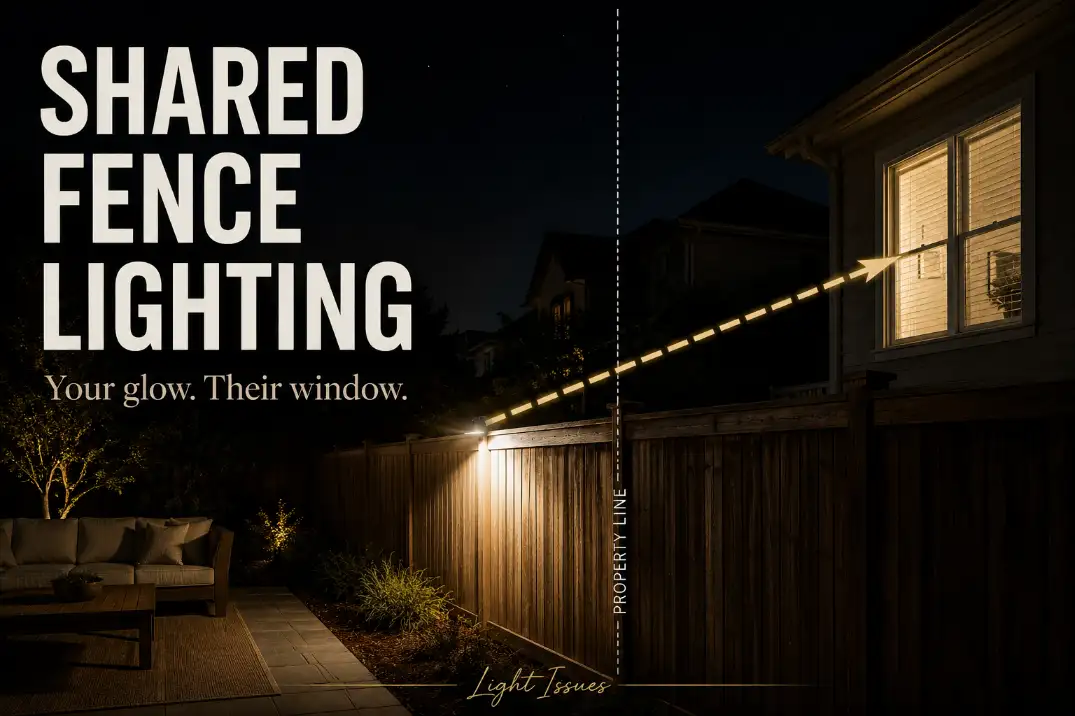
Shared fence lighting usually creates privacy problems for three reasons: the light source is visible, the beam travels sideways, or the fence becomes the brightest surface in the yard.
The first check is not wattage. Stand 10–15 feet from the neighbor-facing side of the fence after dark and ask: can you see the bulb, does the brightest patch sit above about 4 feet, and does the beam touch a window, deck, or seating area?
If yes, the issue is not simply “too much light.” It is uncontrolled direction. Bad shared-fence lighting can expose your own patio while also spilling into the neighbor’s private space.
That differs from a normal dark-yard problem, where the light fails to reach a path or step. Here, the light reaches too far, at the wrong height, toward the wrong viewer.
The Shared Fence Privacy Trap
A shared fence feels like a natural place to add lighting because it marks the edge of the yard. That is exactly why it is risky. A fence is not just a surface; it is a boundary between two private spaces. When lighting treats that boundary as a display wall, both yards can feel more exposed.
The fence is a boundary, not the target
The biggest mistake is aiming at the fence face instead of lighting the usable surface inside the yard. A fixture that creates a soft glow on mulch, steps, or a walkway can be helpful. A fixture that turns the fence into a bright vertical panel often creates glare and silhouettes people sitting nearby.
Light-colored vinyl, pale painted wood, and glossy composite fencing make this worse. They reflect more light than weathered cedar or dark-stained boards. In winter, snow near the fence can bounce light upward and make a modest fixture feel much stronger than it did in October.
Privacy can be lost in both directions
Most homeowners think about whether their light bothers the neighbor. That matters, but it is only half the issue. If the fence is bright and the patio behind it is dark, people sitting in your yard may become more visible from the other side.
This is why more light does not always mean more privacy. A brighter fence can create the feeling of a stage: your seating area, grill zone, or hot tub edge becomes easier to read from outside the yard.
The better privacy move is usually lower, shielded light that reveals ground edges without lighting faces.
A broader version of this same problem appears in Outdoor Lighting Privacy Problems, but shared fences need stricter beam control because the neighboring viewer is often only a few feet away.
The Mistakes That Cause Most Shared-Fence Complaints
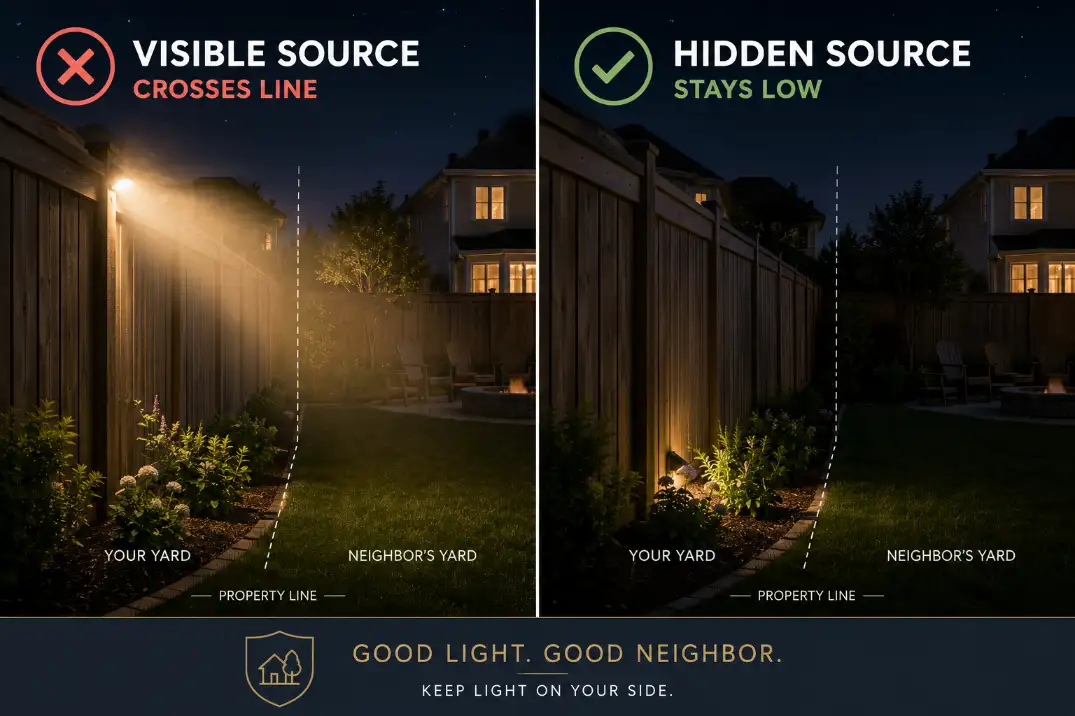
Most shared-fence lighting complaints do not come from one extremely bright fixture. They come from ordinary lights placed at the wrong height, aimed in the wrong direction, or left on too long.
Mounting lights at eye or window height
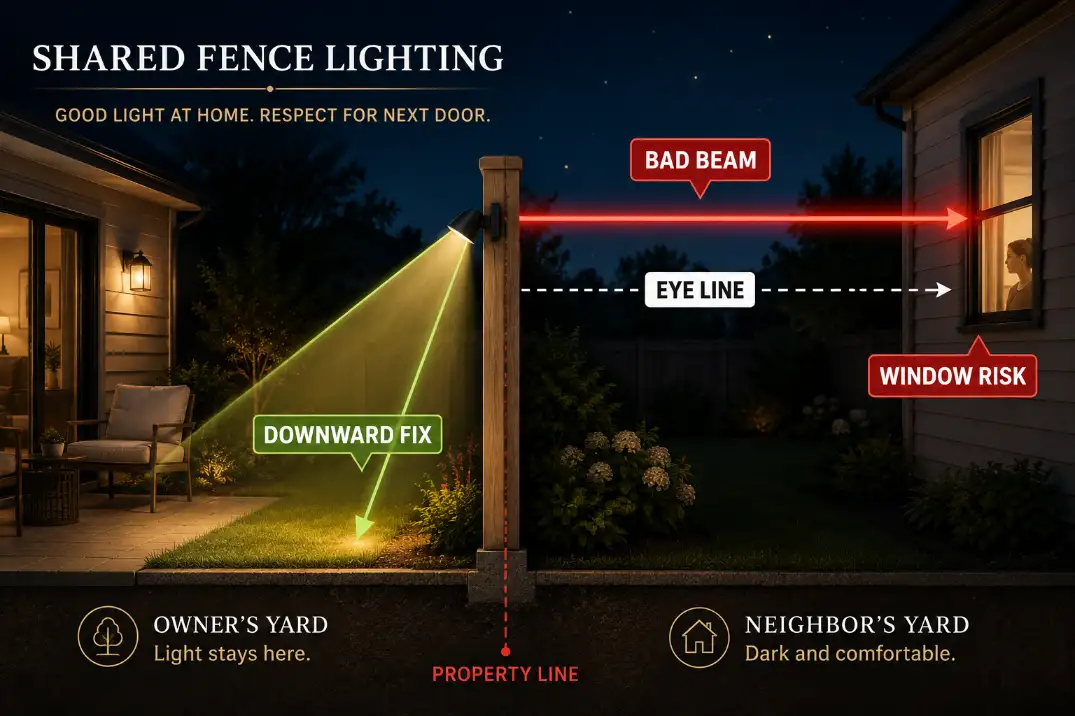
Fence-mounted lights around 5–6 feet high often sit in a common glare zone: standing eye level, seated patio view, deck railing height, or lower window line. That height feels practical during installation, but it is often the worst height for privacy.
Lower fixtures are usually safer. A shielded light placed around 18–30 inches above grade can mark a path, planting bed, or step edge without putting the LED source in someone’s face. Higher lights can still work, but only when the source is deeply recessed and the beam points down into your own yard.
Letting post-cap and string lights face both yards
Solar post-cap lights and fence-top string lights look harmless because they are small. The problem is their position. They often sit at the top of the boundary where both yards can see them.
Post-cap lights are best when the glow is soft and downward, not when the cap itself becomes a bright visible dot every 6–8 feet. String lights are better over a patio zone than stretched directly along a shared fence, especially near bedroom windows or raised decks.
Using motion floodlights near shared corners
A motion floodlight near a fence corner can feel more intrusive than a steady low light because it changes suddenly. If it snaps on at 11:30 p.m. and stays on for 5–10 minutes, the neighbor experiences it as an event, not background lighting.
For shared fence areas, a 30–90 second hold time is usually enough for movement and safety. If the light needs to stay on longer, the beam should be tightly aimed and shielded. Otherwise, motion control only limits how long the bad aim lasts.
If sudden activation is the main problem, Why Motion Sensor Lights Annoy Neighbors at Night goes deeper into repeat triggers, sensor angle, and timing errors.
Pro Tip: Do the first test from the worst viewing angle, not the best one. Stand where the neighbor would stand or where their window faces, then judge the fixture.
Quick Shared-Fence Night Test
Use this after dark, with the fixture running as it normally does.
- From 10–15 feet away, the bulb or LED chip is directly visible.
- The brightest fence patch sits above about 4 feet.
- The beam reaches a window, deck, gate, or seating area across the boundary.
- The fence looks brighter than the path, step, or planting bed it is meant to support.
- A motion light stays on longer than 90 seconds for routine movement.
- Fence-post shadows stretch into the neighboring yard.
If three or more are true, dimming alone is unlikely to solve the problem. The fixture needs better shielding, aiming, placement, or timing.
Better Fixture Choices for Shared Fences
The best shared-fence lighting is quiet. It helps people move, marks the edge of the yard, and then disappears. The fixture category matters less than whether the source is hidden and the beam lands on your side.
| Fence lighting choice | Privacy risk | Best use | Avoid when |
|---|---|---|---|
| Solar post-cap lights | Medium | Soft boundary glow | Caps are bright dots visible from both yards |
| Fence-top string lights | Medium to high | Patio atmosphere away from windows | Bulbs face a neighbor deck or bedroom |
| Exposed puck or sconce lights | High | Rarely ideal on shared boundaries | LED source is visible from 10–15 feet away |
| Shielded downlights | Low | Steps, planting edges, inner fence line | Mounted high and angled outward |
| Low-voltage path lights inside fence line | Low | Ground-level movement and edge marking | Spacing creates harsh bright/dark stripes |
| Motion floodlight near fence corner | High | Short security events only | It triggers repeatedly or stays on over 90 seconds |
For shared fences, a lower-output exposed light is usually worse than a higher-output shielded light aimed downward. The source matters because people do not only see brightness; they see the sharp point of light, the beam direction, and the surface being overlit.
For more on why broad beams often reduce comfort instead of improving it, Why Floodlights Are Bad for Backyard Privacy explains how wide-area brightness can make a backyard feel more exposed.
Why the Obvious Fix Often Fails
The most common weak fix is lowering the brightness without changing the beam path. That can reduce irritation, but it does not correct the privacy mechanism.
Dimmers do not hide a visible source
A dimmed exposed LED is still visible. If the neighbor can see the source directly, the light may continue to feel sharp even at lower output. This is especially true with small high-intensity LED points, where the glare comes from source visibility as much as total brightness.
Dimming is useful after the fixture is aimed and shielded. It is a poor substitute for shielding.
Warmer bulbs help, but they do not fix bad aim
A warm 2700K lamp usually feels calmer than a cool 5000K lamp. But color temperature is often overestimated. A warm beam pointed at a neighbor’s window is still trespass. A cooler light aimed safely downward may cause less privacy conflict than a warm exposed light at eye level.
Use warmer color as a refinement, not the main repair.
Plants are not the first repair
Planting can soften a boundary, but it should not be used to hide a bad beam. If the light still travels horizontally, shrubs only block the problem from one angle. They may also create harsh shadows, uneven glare, or a maintenance issue when branches grow into the fixture.
Fix the light first: aim it down, hide the source, reduce output, shorten the timer, and only then use planting to soften the view.
What to Fix First
Shared-fence lighting should be corrected in order. Skipping the order is why many fixes disappoint.
1. Move the beam off the boundary
The beam should land on your side of the yard, ideally on the ground, step edge, planting bed, or path within about 1–3 feet of the fence. The fence can catch a little reflected glow, but it should not be the primary target.
If the fence is still the brightest surface, the aim is probably wrong.
2. Hide the source from normal view
A fixture is not truly privacy-friendly if the LED chip is visible from the neighbor-facing side. Choose recessed, louvered, hooded, or full-cutoff designs where the source sits behind the housing.
This is also where better placement matters. Sometimes moving a light 12–24 inches lower solves more than replacing the bulb.
3. Limit runtime
For decorative or comfort lighting, use timers so shared-fence lights do not run all night without a reason. For motion lights, shorten the hold time first, then narrow the sensor zone. A 30–90 second activation is usually enough for gates, side yards, trash paths, and quick movement.
Longer timing may be justified for security, but then the beam needs stricter control.
4. Reduce output only after direction is fixed
Lower wattage is useful once the light is already aimed properly. It is not the first move when the source is exposed or the beam crosses the fence line.
This is the difference between treating a symptom and correcting the mechanism. The symptom is “too bright.” The mechanism is light landing where it should not.
The same surface-first logic applies to broader backyard lighting plans: How to Light a Backyard Without Losing Privacy focuses on lighting usable surfaces instead of faces, windows, and boundaries.
Before Mounting Lights on a Shared Fence
A shared fence is not the same as a wall you fully control. Before attaching fixtures, check fence ownership, HOA rules, and any local lighting limits. This is a practical check, not a reason to overcomplicate a simple lighting project.
If the fence is jointly owned, sits on the property line, or belongs to the neighbor, avoid drilling, wiring, or mounting without permission. Freestanding low-voltage path lights placed inside your side of the yard are often safer than hardware attached directly to the fence.
Narrow side yards need stricter control
Side yards under 6 feet wide are especially unforgiving. There is not enough distance for a beam to soften before it reaches the neighbor’s wall, gate, or window. In these spaces, avoid outward-facing wall packs, exposed sconces, and bright fence-top fixtures.
Use low, shielded lights aimed along the ground instead.
Moisture and surface changes can make glare worse
In humid Florida yards or coastal California conditions, lens haze, corrosion, and moisture film can scatter light within 6–12 months in harsh conditions. A fixture that looked controlled when new may become blurrier and more irritating later.
In northern states, snow can reflect light upward and make the same fixture feel noticeably brighter. If complaints appear only in winter, seasonal dimming or shorter timer settings may fix more than a full replacement.
Questions People Usually Ask
Can I mount lights directly on a shared fence?
Sometimes, but confirm ownership, HOA rules, and local restrictions first. Even when mounting is allowed, the light should stay visually contained on your side. If the source or beam is obvious from the neighbor’s side, the installation can still create a privacy problem.
Are solar fence lights better for privacy?
Only when they are shielded and low-glare. Solar lights are often lower output, but many have exposed LEDs. A small exposed light at eye height can still be annoying if it faces the wrong direction.
Is it better to dim the light or move it?
Move or re-aim it first if the beam crosses the fence line. Dimming helps after the light is already controlled. A weaker bad beam is still a bad beam.
What if a neighbor complains after installation?
Check the light from their likely viewing angle before defending the setup. Take a quick photo from the neighbor-facing side if you can do it from your own property. If the bulb is visible, the fence is the brightest surface, or the beam reaches their window or seating area, adjust shielding and aim before debating brightness.
Final Takeaway
Good shared-fence lighting is low, shielded, inward-facing, and brief when it uses motion. Bad shared-fence lighting turns the boundary into a bright object and makes someone else look at your fixture.
Before adding brighter lights, taller screens, or more devices, test the source visibility and beam path after dark. If the fence is glowing harder than the ground, the design is telling you what to fix.
For broader official guidance on responsible outdoor lighting, see the U.S. Department of Energy.