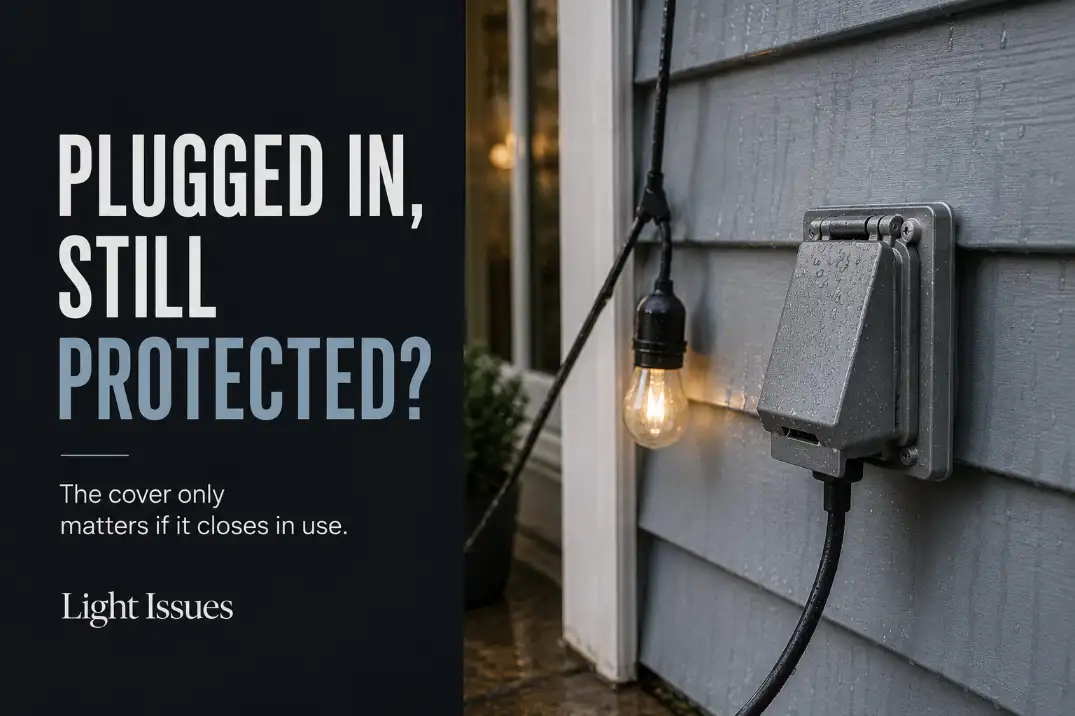
An outdoor outlet cover is only doing its job in the condition you actually use it.
That sounds obvious, but it is the point that fails with plugged-in outdoor lights. A flat cover may close perfectly when the outlet is empty. Add a string-light plug, timer, smart plug, or low-voltage transformer, and the same outlet may now have an open face, a lifted lid, a pinched cord, or a gap pointed toward water.
For lights that stay plugged in, the useful test is not “does the outlet have a cover?” It is whether the cover still closes, latches, holds its gasket line, clears the plug body, and lets the cord exit without creating a water path. If that cannot happen without force, the setup should not be treated as weather-protected.
In-Use Cover Role
An in-use cover is meant to protect the outlet after the plug changes the shape of the problem. It creates space around the plug body and gives the cord a controlled exit path, instead of relying on a flat flap that only works when the receptacle is empty.
That matters because outdoor lighting often stays connected longer than a temporary tool. Patio string lights may remain plugged in overnight. Holiday lights may run through a timer. Low-voltage landscape lighting may use a transformer plug that is bulkier than a standard cord end.
The cover has to work with that real shape. It should close around the plug, latch without pressure, keep the gasket seated, and let the cord leave through the intended opening. If the cord has to twist sideways to make the cover close, the weak point is already showing.
This is a fit-and-exposure decision, not a decorative cover choice. A cover that looks sturdy from the front can still fail if the plug inside changes the way it closes.
Flat Cover Problem
A flat cover fails the moment the plug keeps it from returning to its protected position. The outlet may still look “covered” because a weatherproof flap is present, but the working connection is now exposed.
Once a plug stays inserted, that cover may hang open above the cord, rest partly against the plug, or leave the receptacle face uncovered. In dry weather, that can look harmless. In real outdoor use, the plug body, outlet face, and cord connection are now sitting in the path of rain, mist, splash, and debris.
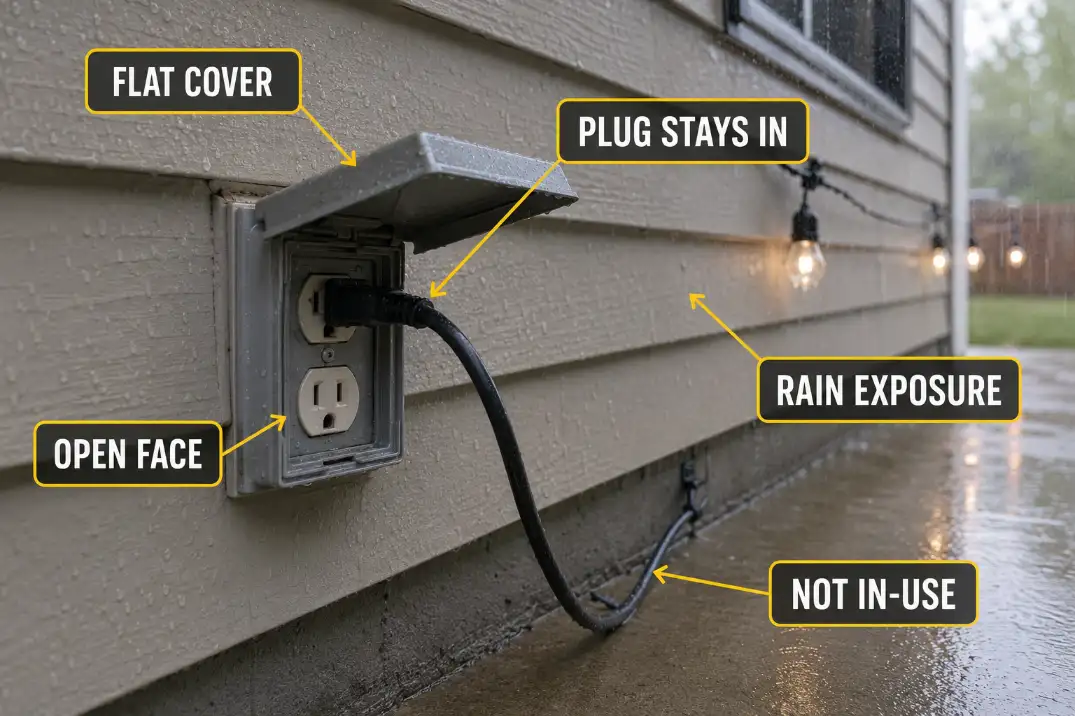
This failure is easy to miss because the outlet may have looked correct during installation. With no plug inserted, the cover closes. With the light plugged in, it does not. That is why outdoor lighting problems often seem to appear only after wet weather, especially when the weak point is not the fixture itself but the exposed power connection.
A similar pattern shows up when outdoor lights work fine until it rains: the system looks normal in dry conditions, then the real failure path appears when water reaches the connection.
Field judgment:
The real test is not how the cover looks empty. It is how it closes around the exact plug, timer, transformer, and cord that will stay there.
Cord Exit Gap
The cord exit is where a closed-looking cover can still become vulnerable. If the cord does not leave through the designed opening, it can lift the lid, cross the gasket, or pull one side of the cover out of alignment.
A small gap at the bottom or side can catch wind-driven rain, sprinkler mist, or water running down the cord. Thick outdoor cords, stiff cold-weather cords, angled plugs, timers, and transformer leads can make this worse because they add pressure inside the cover.
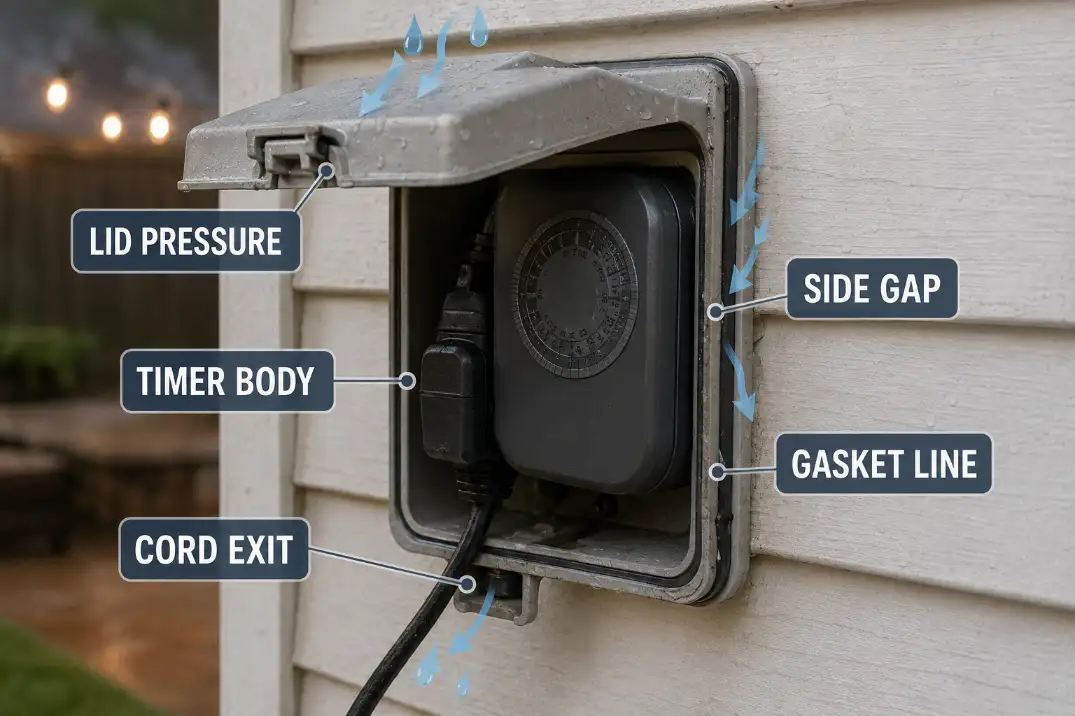
Do not solve this by shaving plastic, cutting the gasket, taping the edge, or forcing the lid. Those fixes usually create a less predictable water path. If the cord cannot exit through the designed opening while the latch closes normally, the cover, plug shape, timer position, or cord route needs to change.
The same water-path logic matters anywhere cable openings face weather. If you are already seeing moisture problems around lighting connections, the diagnosis in why water gets in through cable entry points follows the same basic idea: water often enters through the small directionally exposed gap, not the largest visible surface.
Check the drip direction too. The cord should not guide water toward the cover opening. If water can run down the cord and straight into the outlet cover, the cord route is part of the problem.
Timer Plug Clearance
Timer clearance should be checked with the actual timer, not with a simple test plug. A cover that works with a slim cord end may fail as soon as a bulky timer, smart plug, adapter, or transformer is added.
The most common clue is pressure. The cover closes only if you push it. The latch catches, but the lid bows slightly. Or the timer body forces the cord into a sharp sideways bend. That is not a clean fit. The cover may be closed, but the gasket is no longer seated evenly.
Side-facing plugs can be just as awkward. They may aim the cord across the gasket path instead of down through the exit opening. Stacked adapters are worse because each added piece increases depth, movement, and leverage inside the cover.
The correct test is the full plugged-in arrangement: timer, light cord, plug angle, and cord route. A smart plug may fit alone but fail once the light cord is attached. A transformer plug may fit in one outlet orientation and not the other.
Avoid treating a latched cover as automatic proof. If the timer presses against the lid, the lid may shift during heat, cold, or cord movement. For lights that stay plugged in, the cover needs relaxed clearance, not a barely forced closure.
Sprinkler Direction
Water direction can defeat a cover that otherwise fits. Rain usually falls from above or at an angle. Sprinkler spray can hit from below, from the side, or straight toward the cord opening.
An outlet near a garden bed, foundation planting, patio edge, or walkway may receive a direct spray pattern every morning. The cover may handle ordinary rainfall but still be vulnerable when a sprinkler head sends water toward the hinge, underside, wall seam, or cord exit.
Watch the outlet during a normal sprinkler cycle from a safe distance. The important question is not whether water touches the cover. Outdoor covers are expected to face weather. The question is whether water is being aimed into the opening, behind the cover, under the lid, or along the cord.
If irrigation spray is part of the problem, redirecting the water may matter as much as changing the cover. This is especially relevant when sprinkler spray damages outdoor lights in the same zone, because the outlet and the fixture may be sharing the same exposure pattern.
Do not rely on the cover to solve a bad spray angle by itself. A better setup pairs a protected outlet connection with water that is not repeatedly aimed at the weakest side of the cover.
Rain Fit Test
The final test is the actual operating condition: real plug, real timer, real cord route, real water direction. Anything else is only a partial check.
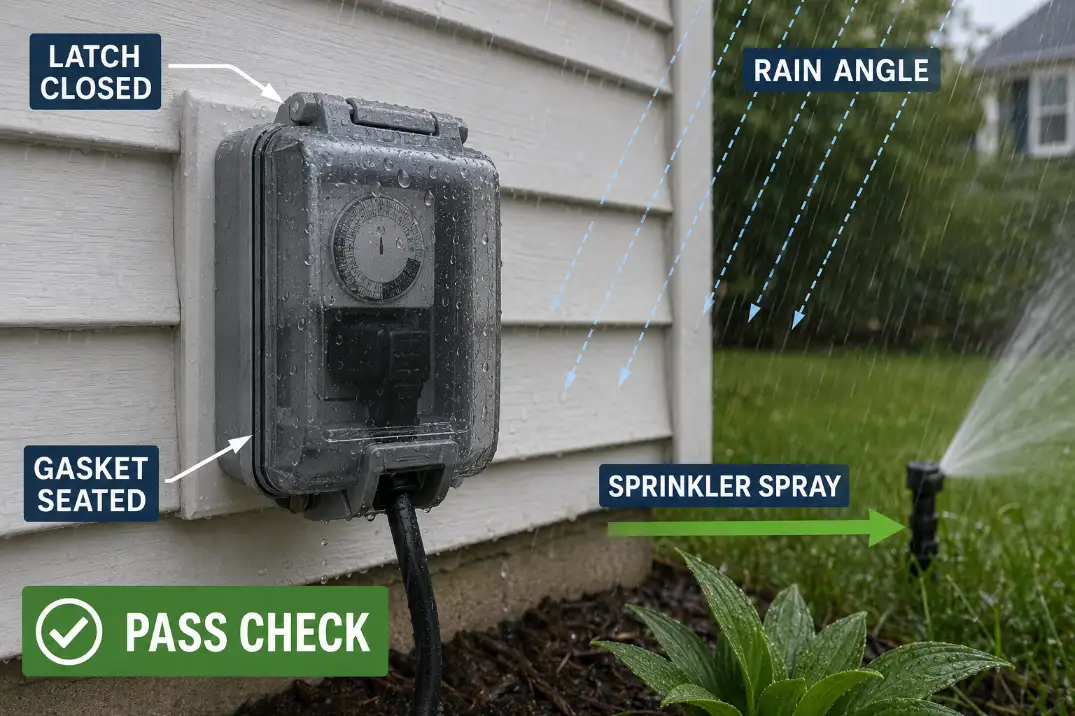
Use this compact check before trusting lights that stay plugged in:
- The cover closes without force and the latch engages normally.
- The gasket line sits evenly with no lifted side or twisted lid.
- The cord exits through the designed opening without being pinched.
- The timer, smart plug, or transformer does not press against the cover.
- Rain, runoff, and sprinkler spray are not aimed into the cord opening.
Look from below and from the side, not only from the front. Many weak fits look fine head-on. The side view often reveals the lifted lid, bent cord, or gap at the port.
After rain or a sprinkler cycle, check the area around the cover without touching wet electrical parts. Look for trapped water, dampness inside the cover area, a shifted cord, or a lid that no longer sits the way it did when dry.
GFCI protection is an important safety layer for outdoor outlets, but it does not make a poor cover fit acceptable. If outdoor lights are already tripping a GFCI, the cover and cord path may be only one part of the diagnosis, and outdoor lights tripping GFCI outlets should be treated as a separate warning pattern rather than ignored.
If the outlet box is loose, the cover is cracked, the gasket is missing, the receptacle is corroded, the GFCI will not test/reset properly, or the setup feels improvised, stop using that plugged-in arrangement and have an electrician inspect it.
The pass/fail standard is not whether the lights turn on. It is whether the outlet remains protected while the exact light plug, timer, and cord stay connected in real weather.
For general outdoor electrical safety, ESFI recommends GFCI protection, weatherproof covers, and outdoor-rated extension cords for exterior use: Electrical Safety: Think Outside the Home