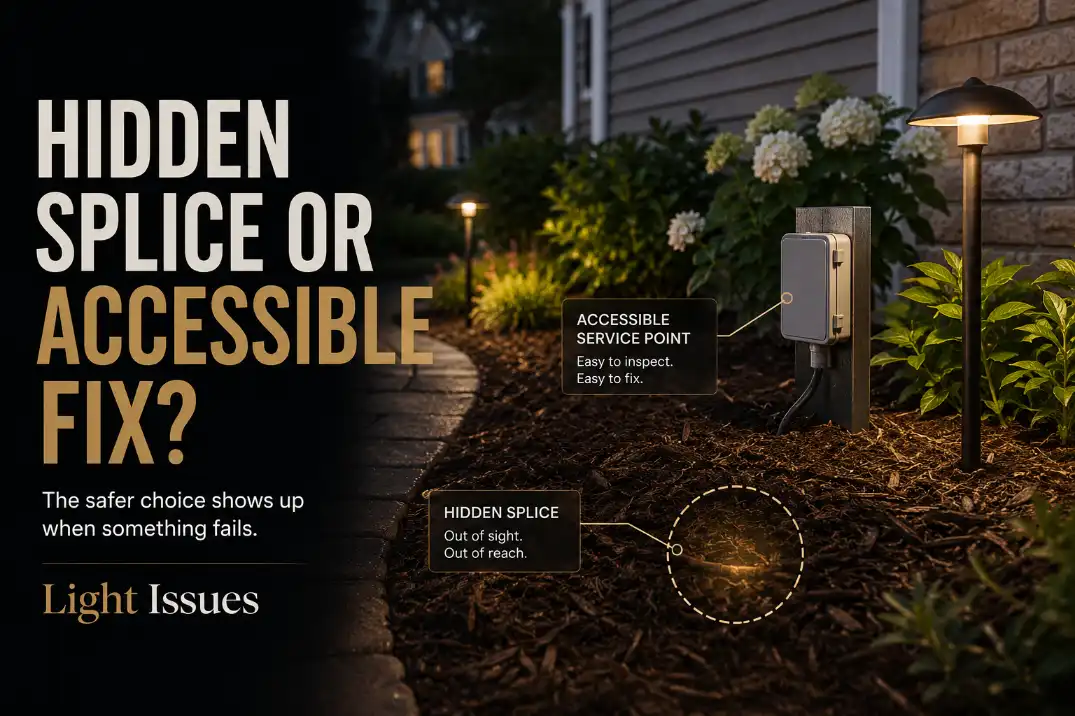
An outdoor light splice has two jobs. It has to make the connection work today, and it has to remain safe enough, dry enough, and findable enough when the yard changes around it.
That is the real difference between direct-burial connectors and above-ground junction boxes. A buried connector can be the right choice when the connector is rated for burial and the splice belongs below grade.
An accessible junction box can look less invisible, but it gives you something buried splices do not: a known place to inspect, test, dry out, and repair.
The mistake is treating this as a neatness decision. It is really an exposure and service decision. Outdoor light splices live near wet soil, shifting mulch, sprinkler spray, roots, edging, and future fixture changes. A connection that looks clean on installation day may become the hardest part of the system to find later.
For safety-sensitive outdoor wiring, use parts listed for the location. UL explains that ordinary wire connectors are not automatically evaluated for environmental exposure, while sealed wire-connector systems cover direct burial, below-grade use, and similar damp or wet locations.
UL code authority guidance also separates ordinary wire connectors from sealed connector systems intended for harsher locations.
Direct-Burial Role
A direct-burial connector earns its place underground only when it is actually designed for that condition. It is not a normal wire nut hidden under soil because the bed looks cleaner without a box.
This approach makes sense where the splice belongs in a stable low-voltage landscape lighting run, the connector is rated for direct burial, and the connection is not expected to change often. In that setting, the buried splice keeps the lighting run visually clean and avoids placing visible boxes near small path lights or planting edges.
The trade-off is access. Once mulch, roots, edging, and soil movement change the area, a buried splice can be difficult to locate. If one light stops working, the first repair problem may not be the failed connection. The first problem may be finding the connection without tearing apart the bed.
That is why “buried” should mean “protected for burial,” not simply “covered.” A connector that is acceptable inside a dry enclosure is not automatically acceptable below grade.
Direct-burial also does not erase the difference between low-voltage landscape lighting and line-voltage outdoor wiring. Low-voltage lighting systems are more common in homeowner landscape runs, but household-voltage splices carry a different safety burden.
When the splice involves line voltage, local code, box access, cable type, and a qualified electrician matter more than keeping the connection invisible.
Above-Ground Access
An above-ground junction box is usually the stronger choice when the splice may need to be found again. Its value is not that it is above the soil; its value is that the protected connection remains locatable and serviceable.
Above-ground does not mean exposed, sloppy, or unprotected. A proper outdoor box still needs the right cover, fittings, mounting, and location for the wet or damp condition it faces. The point is to keep the splice protected while also keeping it reachable.
This matters most near fixtures that may be replaced, planting beds that change seasonally, and lighting runs with several possible failure points. If a path light stops working, a visible junction point lets you narrow the problem faster. If a fixture is changed later, the connection point is not buried under years of mulch.
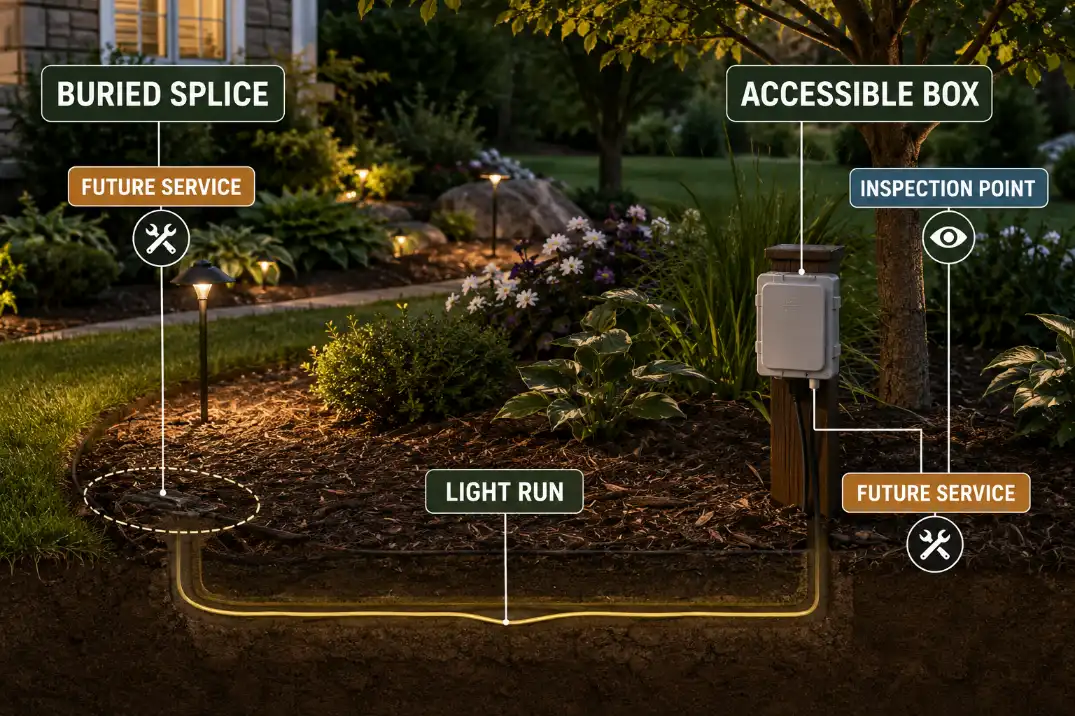
A junction box is usually the better fit when the splice is part of a larger lighting circuit, sits near the house, connects to a fixture that may be replaced, or belongs in an area where moisture problems have already appeared. It gives the homeowner or electrician a controlled place to inspect the connection instead of guessing under soil.
The weak point is placement. A junction box that starts above ground but slowly disappears behind plants or mulch loses much of its advantage. If it cannot be opened, seen, or reached without digging, it has drifted toward the same service problem as a buried splice.
Soil Moisture
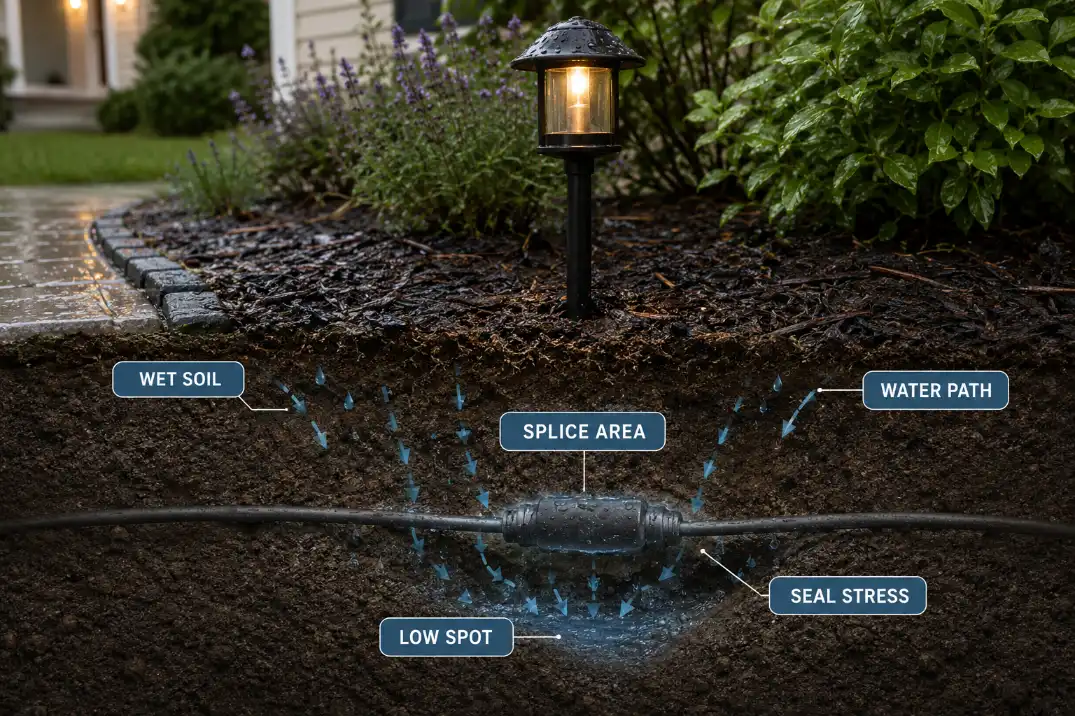
Soil moisture is the condition that makes hidden splices less forgiving. The surface can look dry while the connection area below grade remains damp after rain, irrigation, snowmelt, or drainage from a roof edge.
That repeated wet-and-dry cycle is the pressure on direct-burial connectors. If the connector is truly rated for that environment and installed correctly, that is the condition it is meant to handle. If the connector is not rated for burial, or if the seal is damaged, loose, undersized, or poorly closed, water has more time and contact than it would in a visible service point.
Low spots make the choice stricter. A splice in a bed that collects water after storms has a different risk profile than one in a raised, well-drained edge. Clay-heavy soil, sprinkler overspray, downspout discharge, and compacted planting beds can all keep moisture around the connection longer.
Above-ground boxes reduce direct soil contact, but they are not automatically dry. Rain, splashback, condensation, and irrigation can still reach a poorly chosen box location. Boxes and fittings in damp or wet locations must be placed or equipped to prevent moisture from entering or accumulating, and wet-location boxes must be listed for that use; EC&M’s overview of NEC Article 314 explains this wet-location box requirement in plain code terms. EC&M NEC Article 314 overview
The real comparison is this: direct-burial connectors depend on the sealed splice surviving below grade, while above-ground boxes depend on a suitable enclosure staying accessible and protected. Both can fail when the wrong parts are used. The difference is that an above-ground connection is easier to check before the failure turns into guesswork.
For deeper moisture-related failure patterns, a related issue is corrosion in outdoor light connections, especially where water reaches metal contacts before anyone notices.
Field check:
Hidden and protected are not the same thing. A splice can be invisible and still be poorly protected if the connector was not intended for burial or the location keeps it wet.
Mulch Bury Risk
Mulch creates a quiet service problem because its depth changes over time. Beds get topped up, edging shifts, plants spread, and a box that was visible in spring can be half buried later.
This is how homeowners accidentally turn an accessible junction box into a hidden connection. The box may be mounted low near a bed edge, then mulch slowly builds around the cover. Once the cover is surrounded, it becomes harder to open, easier to forget, and more likely to sit in a moisture-holding pocket.
Mulch can also hide clues. If an outdoor light starts flickering or fails after rain, the connection point may be under fresh mulch, behind ornamental grass, or buried along the path edge. The splice has not changed electrically, but the yard has changed around it.
Direct-burial connectors should not be confused with “anything hidden under mulch.” A burial-rated connector is designed for that exposure. A standard connection covered because it looks cleaner is just a concealed weak point.
Common mistakes to avoid:
- Burying an above-ground junction box under mulch to make it disappear.
- Treating a weather-resistant cover as permission to block access.
- Using mulch to hide a splice that should have stayed inspectable.
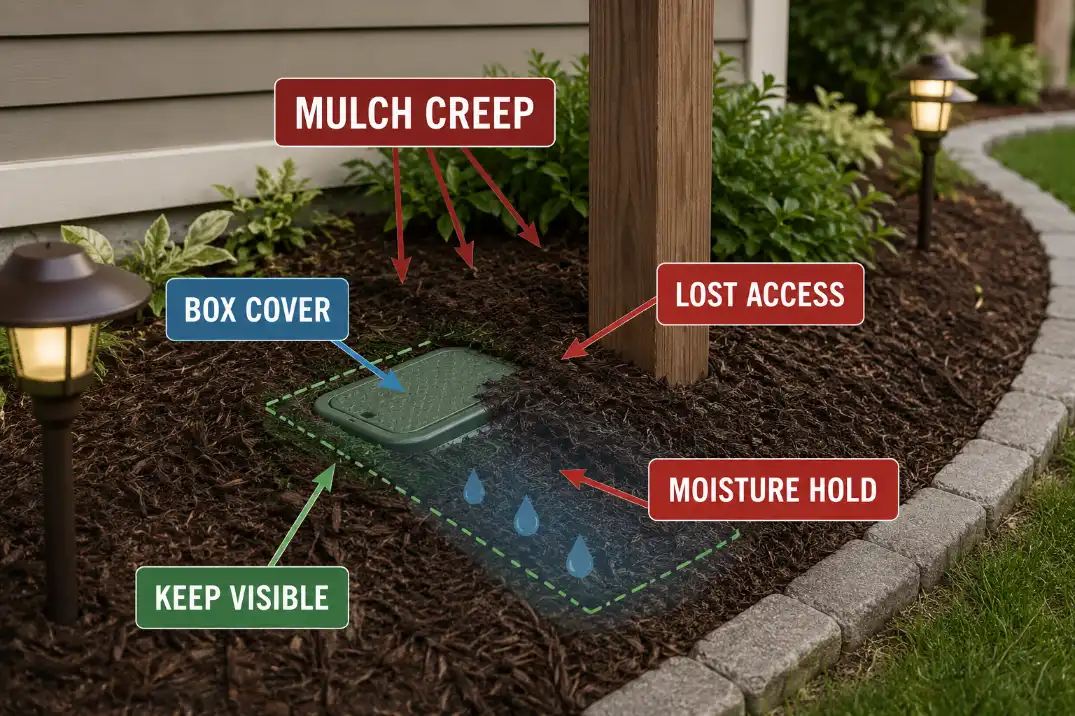
The practical rule is simple: if the box is chosen because access matters, keep it visibly accessible. If the splice is meant to disappear below grade, use a method actually listed for that exposure rather than burying a normal connection under mulch.
Serviceability
Serviceability is the part of the decision that usually matters later, not on installation day. The connection that looks cleanest may become the one that takes longest to find.
A buried connector can be clean and low-profile, but it becomes a weaker choice when the lighting run is likely to change. Homeowners move path lights, add fixtures, replace damaged stakes, change plantings, edge beds, and adjust irrigation. Every change increases the value of a splice that can be found without digging.
An above-ground junction box is easier to inspect when one fixture stops working. It gives a clear place to check for a loose connection, moisture, corrosion, damaged insulation, or a failed fixture lead. It also helps separate a splice problem from a transformer, breaker, GFCI, fixture, or cable-run problem.
This does not mean every outdoor light splice needs a visible box in the middle of the bed. It means service access should be part of the original decision. If the splice is in a stable, simple, low-voltage run with a burial-rated connector, burial may be reasonable.
If the splice is near a high-change area, near irrigation, under mulch that gets refreshed, or part of a line-voltage circuit, access becomes more valuable.
A hidden splice can also slow down troubleshooting. When lights fail after rain or one section goes out, the yard may force the repair path: first find the splice, then expose it, then test it, then restore the bed. A visible junction point shortens that path.
If the symptoms later move beyond one failed fixture and into circuit behavior, a separate troubleshooting path may be needed when an outdoor lighting circuit starts tripping.
Safer Splice Choice
The safer splice choice is the one that matches both the exposure and the future service need. Direct-burial connectors can be the right answer when the connector is listed for burial, the splice belongs below grade, and the area is stable enough that limited access is acceptable.
Above-ground junction boxes are usually the safer fit when moisture, mulch movement, inspection, future fixture changes, or uncertainty are part of the site.
| Choice | Works when | Avoid when |
|---|---|---|
| Direct-burial connector | The connector is listed for direct burial and the splice belongs in a stable buried low-voltage lighting run. | The connector is ordinary, the soil stays wet, the splice may need frequent service, or the work involves uncertain line-voltage conditions. |
| Above-ground junction box | The splice should remain visible, inspectable, and easier to repair later. | The box will be hidden under mulch, blocked by plants, or placed where water can sit around the cover. |
| Buried hidden splice for appearance | Only works when the splice method is actually rated for below-grade exposure. | Avoid hiding a standard connector just because the bed looks cleaner without a box. |
| Low-mounted box near mulch | Works only if the cover stays clearly visible and reachable. | Avoid where seasonal mulch top-ups will bury the cover or trap moisture around it. |
| Accessible service point | Best when the lighting run may change, fail, or need testing later. | Avoid only when the box location would be more exposed, vulnerable, or visually intrusive than a proper buried splice. |
The cleanest decision is not always the safest one. A buried splice may look better on day one, but it has to earn that hidden location with the right connector and the right site condition.
An above-ground junction box may be more visible, but it gives you a future service point when moisture, corrosion, or a failed fixture turns the splice into the next thing that has to be checked.
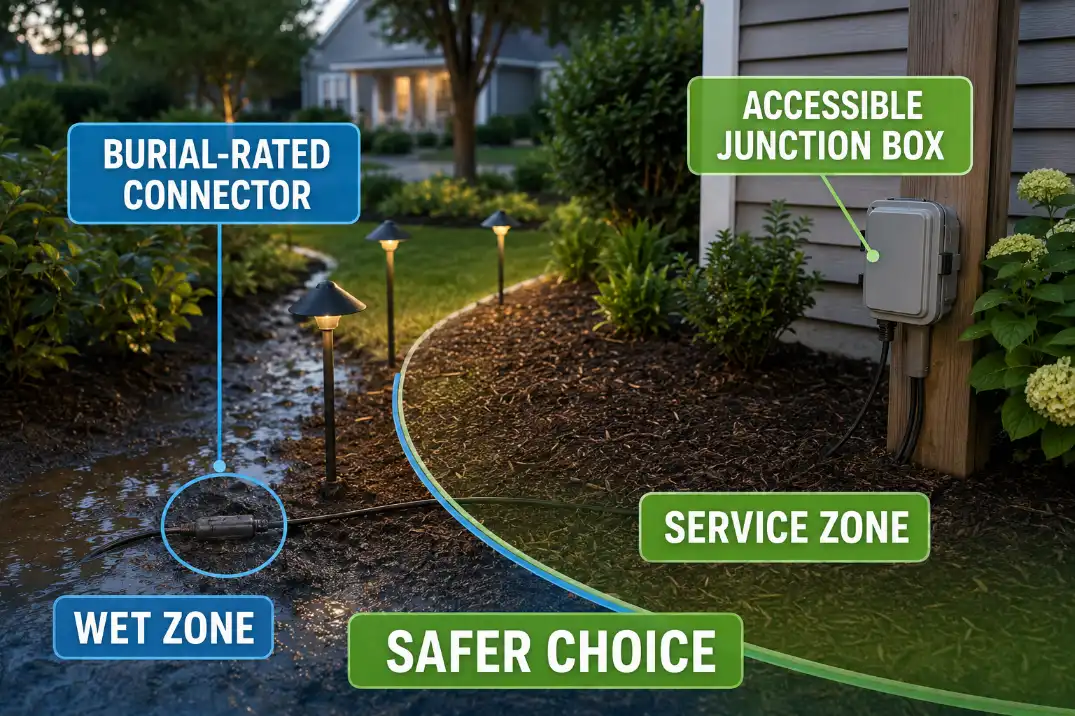
A good field rule is to favor access when the condition is uncertain. Wet soil, mulch creep, fixture changes, irrigation, repeated failures, and line-voltage work all push the decision toward an outdoor-rated, inspectable junction point.
Use a direct-burial connector only when it is truly rated for burial and the buried location is part of a controlled, stable lighting run. Do not bury an above-ground junction box just to hide it. Do not treat a normal connector as a direct-burial connector.
When the splice affects household voltage or you are not sure what the existing wiring is, the safer move is to stop guessing and have the connection checked by a qualified electrician.