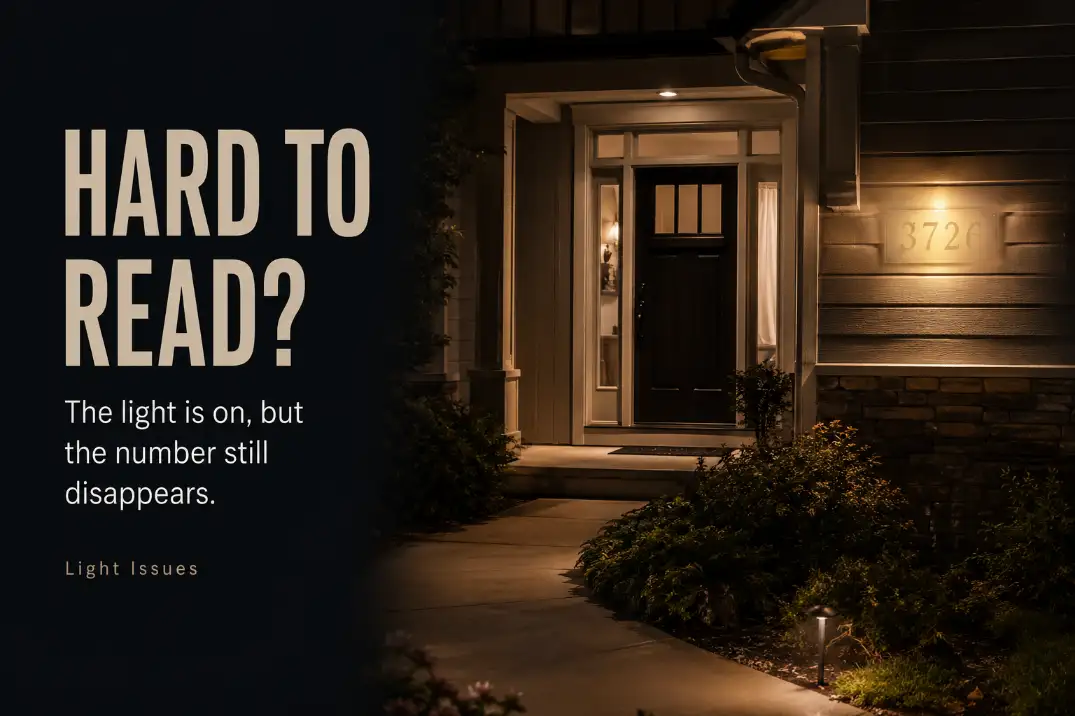
House number lights fail when they light the plate without preserving the number shape. The entry may look finished from the porch, the plaque may glow, and the fixture may be working, but the address still may not read from the curb.
That is the real diagnosis: this is not mainly a brightness problem. It is a legibility-chain problem. The viewer needs a clean angle, intact digit shape, enough contrast, and no glare source competing with the numbers.
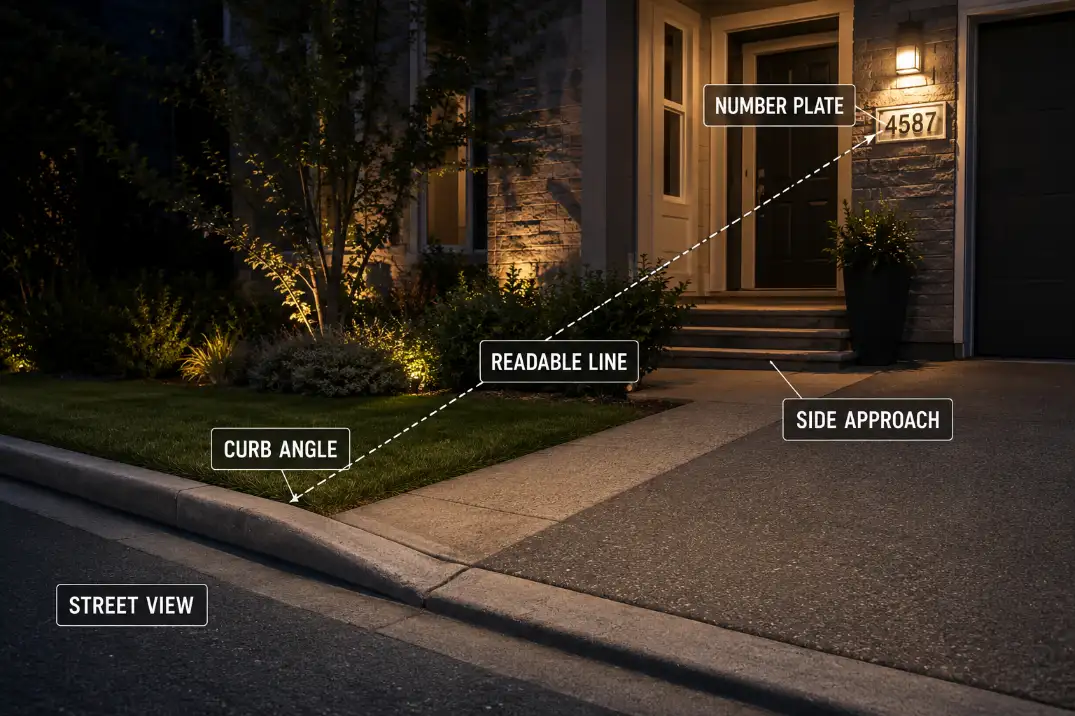
Before replacing the sign or adding more light, test the address from the position where someone first tries to identify the house: the curb, driveway mouth, sidewalk approach, or seated car height. If the digits lose shape from that position, the failure is usually angle, shadow, backlight washout, weak contrast, or glare near the plate.
Street Viewing Angle
The first decision is whether the numbers face the viewer who actually needs to read them. A plate that looks clear from the doormat can fail from the street because the approach angle compresses the digits or hides part of the plaque behind trim.
Most people do not read the address while standing squarely in front of the door. They read it while slowing down from the street, turning into the driveway, walking from the side, or looking past parked cars and porch details.
A flat number plate mounted beside the entry may face the porch more than the curb. From straight on, the numbers look clean. From a diagonal approach, the same digits can flatten visually, reflect unevenly, or disappear into the wall. If the plate is set too far back under a porch, mounted low behind railing lines, or placed tight against door casing, the readable window gets even smaller.
Do not start the diagnosis from the porch. Start where guests and drivers start.
Look from the curb, then from the driveway mouth, then from the sidewalk side if your approach is diagonal. If the numbers are readable from only one position, the light may not be the main issue. The plate may need a clearer face angle, a more open background, or a location visible before someone reaches the door.
This is the same visibility logic used when checking where exterior lights should be aimed. A fixture can shine, but if the usable viewing line is wrong, the target still fails.
Number Shadow
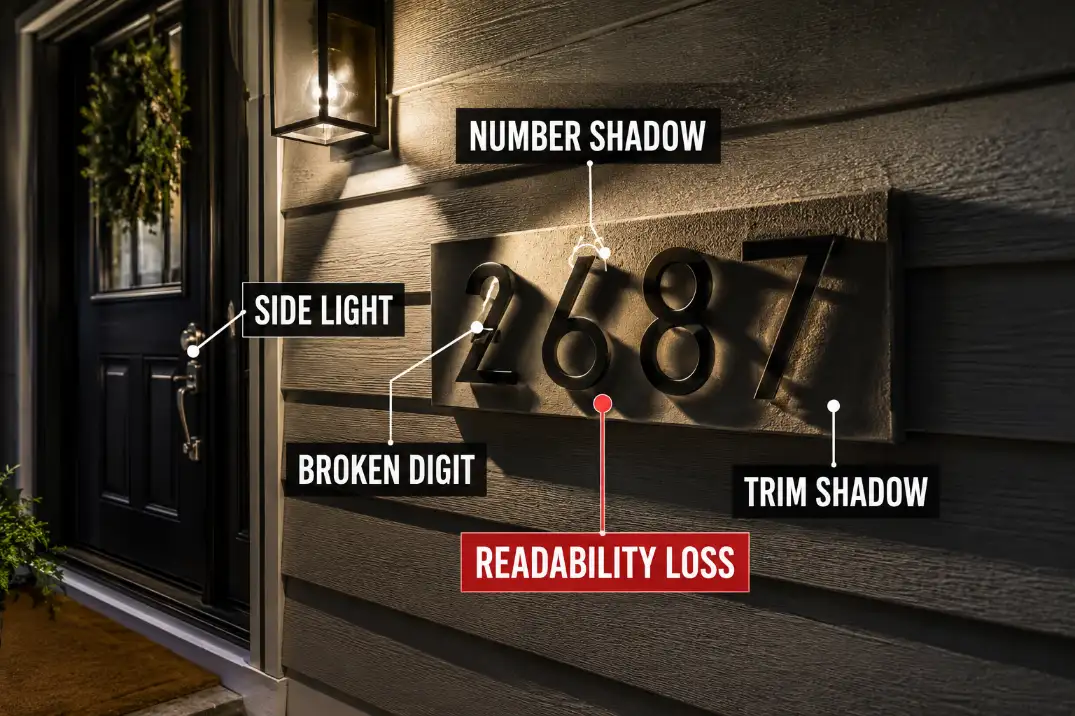
The next check is whether the light is breaking the digit instead of revealing it. Shadows from raised numbers, plaque edges, siding grooves, porch trim, plants, or a nearby fixture can cut through the shape that makes the address readable.
A little relief shadow can help raised numbers stand out. The problem starts when the shadow crosses the digit. A 3 can look like an 8. A 5 can look incomplete. A 6, 8, or 9 can lose the opening that makes it identifiable. From the curb, the viewer may not notice a “shadow problem.” They only see a number that takes too long to decode.
The shadow source is not always obvious close up. Stand beside the plate and the digits may look dimensional. Step back to the street and the same shadow can merge with the dark wall behind it. Side-mounted lanterns are especially likely to do this when the bulb sits forward of the plaque and throws light across raised numbers at a steep angle.
Test the shadow at night with the normal house-number or porch light on. Do not use a phone flashlight as the main test because it changes the light direction. Look for dark bars across the digit, heavy shadow under raised numbers, trim lines crossing the plate, or plant shadows moving across the address.
If the number shape improves when you temporarily block a side light or shift your viewing position, the issue is not simply “not enough light.” It is light direction breaking the address.
Backlight Problem
Backlit numbers should separate the digits from the wall. They fail when the glow becomes more visible than the number shape.
This is why backlit house numbers can look premium up close but soft from the street. The halo may outline the plaque, brighten the siding, and blur the edge of each digit. The viewer sees the glow before reading the address.
The failure is usually contrast disguised as a lighting upgrade. The backlight may be strong enough to glow, but not controlled enough to keep the digits crisp. Pale stucco, glossy siding, reflective stone, wet surfaces, and uneven backing can all spread light in ways that reduce readability from a distance.
Stronger backlight is not automatically the fix. More glow can make the address area more noticeable while making the actual digits harder to read. A bright rectangle with soft edges can perform worse than a simpler plate with sharper contrast.
Check the numbers in full dark and again at early dusk. If they look clearer at dusk than they do at night, the backlight may be overpowering the digit edges once the surrounding wall goes dark. If the wall glow is more obvious than the number face, the fixture is lighting the background more than the address.
Contrast Around Numbers
The contrast test is simple: can the digit separate from its background after dark, not just in daylight? If the answer is no, the light may be working but the address is still failing.
Light numbers on light siding can fade once the porch light brightens the wall. Dark numbers on a dark plaque can disappear under an overhang. Bronze numbers on brick may look warm during the day but muddy at night. Polished metal can reflect the fixture instead of showing a clean digit edge. Black numbers can read well on a bright wall in daylight, then vanish when the same wall falls into shadow.
The useful question is not whether the numbers match the house. It is whether the digits still read as separate shapes from the curb.
A small backing field can help more than extra brightness. A darker plate behind light numbers, a lighter plaque behind dark numbers, or a less reflective finish gives the eye a cleaner edge. If the surrounding wall is very bright, the numbers may need a more controlled background. If the wall is dark, the digits may need a lighter face or a directed light that does not wash evenly over everything.
If you can find the plaque but cannot read the digits quickly, the contrast field is weak. The address is visible as an object, but not legible as information.
Glare Near the Plate
Glare is the counterintuitive failure: the light meant to help the address becomes the brightest thing in the scene. From the curb, the eye lands on the glare source before it can read the numbers.
That glare can come from a clear-glass wall lantern beside the plate, an exposed bulb above it, a shiny plaque, glossy paint, wet siding, polished metal numbers, or a light aimed outward toward the street. The number does not have to be dark to be unreadable. It only has to sit next to something brighter and more distracting.
If the glare source is visible from the curb, the eye adapts to that bright point. The digits nearby lose contrast. This is why a brighter bulb can make the address worse. It increases competition around the number instead of improving the number shape.
A useful field test is to stand at the curb and shield the light from the street-view side without touching the fixture. If the numbers become easier to read when the direct glare is blocked, the fix path is glare control, not more light. That may mean shielding the source, softening the lamp, changing the angle, reducing reflection, or choosing a less glossy plaque surface.
The same pattern appears with clear-glass entry lights that glare at the door: the visible bulb becomes the brightest object in the scene, so nearby details are harder to see. Around house numbers, that detail is the address itself.
Hardwired fixture changes should be handled safely and within local requirements. But the diagnosis can happen before any work is done: stand at the curb and ask whether the bright source is easier to see than the number.
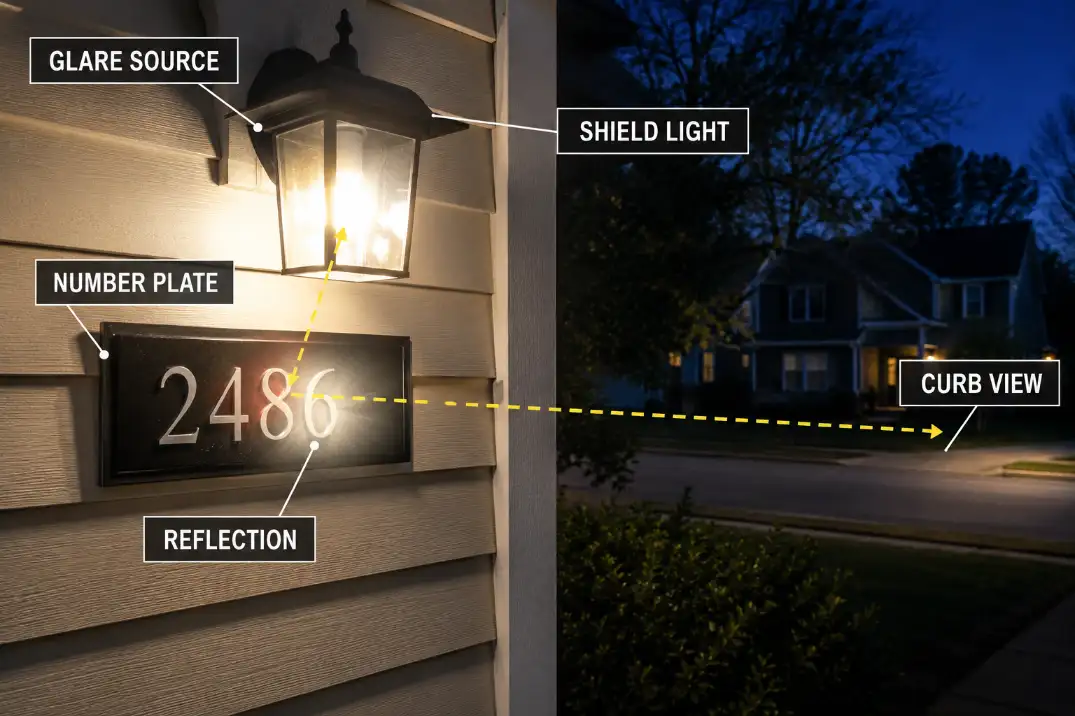
Glare also explains why some homes feel brighter but not clearer at night. When the light source dominates the scene, the eye loses detail in the area that matters. That is the same visibility failure covered in when outdoor lights reduce visibility, narrowed here to the address plate.
If glare is the cause, do not start by increasing wattage or adding another fixture. First reduce the visible source from the street-view line. A shielded source, softer lamp, less reflective plate, or better angle can make the same number easier to read without making the entry harsher.
Readability Test From the Curb
The final test should happen from the place where the address has to perform. A house number light is not solved when it looks good beside the door. It is solved when the digits can be read quickly from the curb, driveway approach, sidewalk, or seated car height.
Run the test after dark with the normal lights on. Do not stand directly in front of the plaque unless that is the real arrival path. If your street has parking, test from the likely gap between vehicles. If your driveway curves, test from the first point where someone would try to identify the house.
Use this compact curb-readability check:
- Stand at the curb or driveway approach.
- Look from the angle guests and drivers actually use.
- Check whether glare appears before the numbers.
- Confirm the number shape stays clear without walking closer.
- Recheck after adjusting light, shadow, or contrast.
A smartphone photo can reveal glare bloom, reflection, and weak contrast, especially from the street rather than close to the door. But the eye test matters most. If you have to walk closer, tilt your head, block a glare source, or already know the address to read it, the setup is not doing its job.
The fix order should stay practical: angle first, then shadow, backlight, contrast, and glare. Replacement only makes sense once you know which part of that chain is failing.
Light alone does not make house numbers readable. The number shape has to stay clear from the street view. If it does not, the lighting setup has not solved the problem yet.
For visibility context, the U.S. Fire Administration says house numbers should be visible from the road: USFA house number guidance.