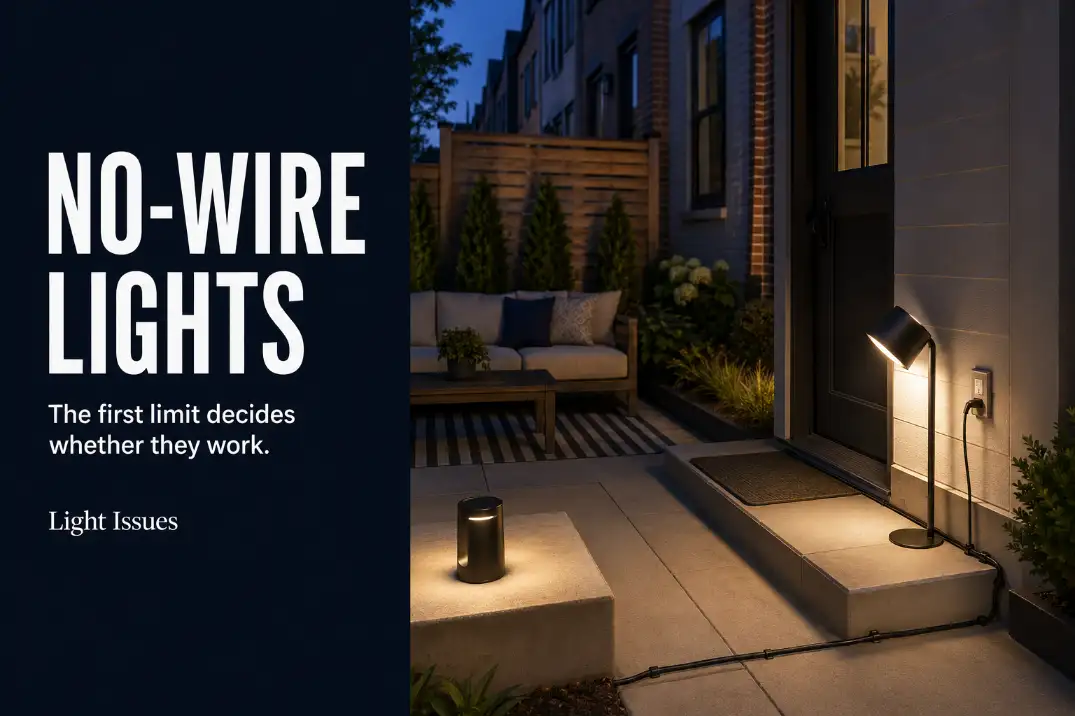
A no-wire outdoor light works only when its first hard limit appears after the zone has finished its job. With battery lighting, that limit is usually runtime or sustained output. With a temporary plug-in setup, it is more often outlet reach, cord routing, or connection exposure.
That makes “no wire” a misleadingly broad promise. A battery light is genuinely cordless, while a plug-in light simply avoids permanent wiring. Both may suit renters and no-drill setups, but they solve different placement problems.
The useful question is not whether the fixture turns on. It is whether the step, lock, path, seating edge, or other target remains visible for the required period without creating glare, unstable mounting, weather exposure, or a cord hazard.
No-Wire Limits
Start by deciding whether being completely cord-free is nonnegotiable or whether avoiding permanent installation is enough.
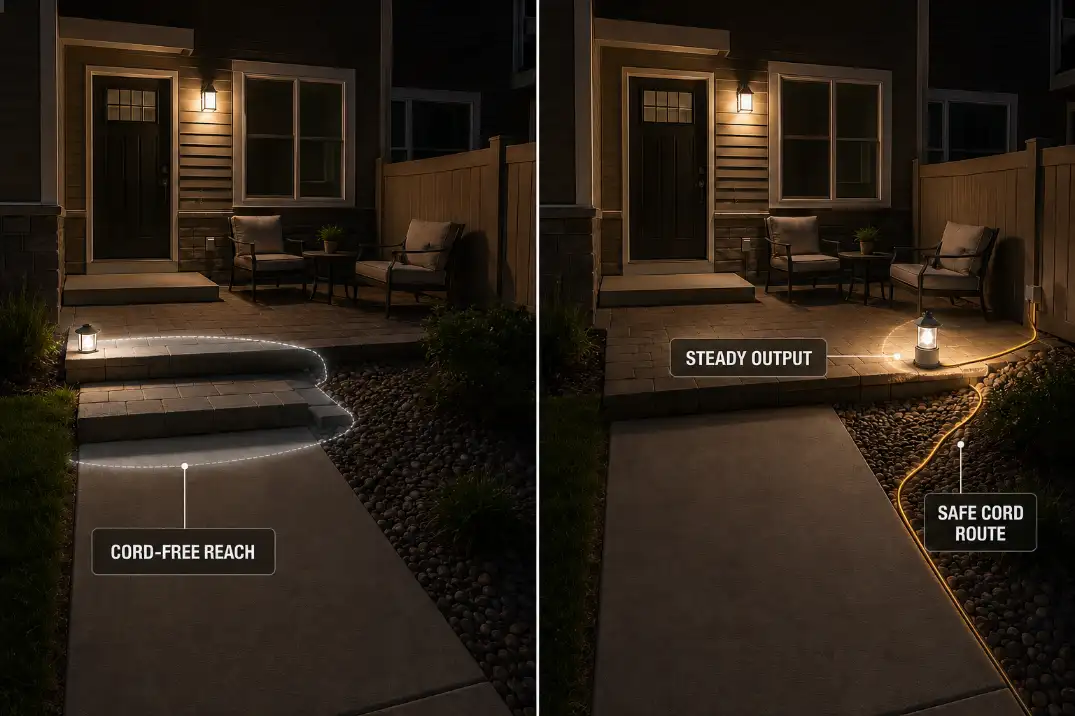
A battery-powered light can reach a detached seating edge, short path, gate, trash route, or entry area without depending on an outlet. That freedom matters when no protected cable route exists.
Temporary plug-in lighting is not cordless, but it may still fit a renter or no-drill setup. Its placement freedom ends wherever the cord can no longer follow a protected perimeter without crossing a doorway, step, walkway, or active patio area.
Each approach has a different first limit:
- Battery lighting is limited by stored energy, sustained output, and charging frequency.
- Plug-in lighting is limited by outlet position, cord reach, connection exposure, and route safety.
- Both can fail when no stable mounting position provides the required height and aim.
A fixture attached wherever it is convenient may light the siding, railing, or fixture housing while leaving the working surface dark. Judge success at the target—not at the light source.
Setup Note: “No permanent wiring” does not always mean “no cord.” Keep those conditions separate before comparing positions.
Battery vs Plug-In
The central choice is which inconvenience can remain outside the active zone: charging and limited runtime, or a physical cord route.
Battery lighting is stronger when freedom from a cord determines whether the target can be reached at all. Plug-in lighting is stronger when the area needs steady output for longer use and a protected route already connects it to a suitable outdoor receptacle.
Choose battery when placement freedom matters most
Battery power is usually the simpler choice when:
- The target is isolated from the nearest usable outlet.
- Lighting is needed for short visits or occasional movement.
- The setup must be moved or removed easily.
- No acceptable perimeter route exists for a cord.
- A stable no-drill position is available near the target surface.
The trade-off is energy management. A light may work well for brief motion-triggered use but become frustrating on a patio that must remain illuminated throughout an evening. A stated runtime is meaningful only if useful output lasts through the expected use period.
Avoid battery lighting when frequent charging, declining output, or short activation would undermine the reason for adding the light.
Choose plug-in when steady output matters most
Temporary plug-in lighting fits areas that need consistent output and already have a suitable outdoor receptacle within safe reach. It can work well on a covered patio or entry where the cord remains against a protected edge.
The constraint is physical routing. A dependable light is still the wrong choice if its cord must pass through a doorway, beneath furniture, across a step, or through the center of an activity area. Plug-in power solves runtime; it does not solve poor access.
| Approach | Works best when | Main strength | First likely limit | Avoid when |
|---|---|---|---|---|
| Battery | The zone is isolated or used briefly | Cord-free placement | Runtime or sustained output | Long use or frequent charging makes it impractical |
| Temporary plug-in | An outdoor receptacle and protected edge route are available | Steady output | Cord reach or connection exposure | The route crosses a door, step, walkway, or wet area |
Brightness Expectations
Choose brightness at the target surface, not by how intense the fixture appears when viewed directly.
Rated output does not reveal how clearly the light will define a step, lock, table, or walking surface. Distance, beam spread, mounting height, aiming, nearby reflections, and background darkness all change how much of that output becomes useful.
This matters especially with compact battery lights. Some preserve runtime by limiting sustained output or activating briefly with motion. That may be enough for a lock or short approach but too little for a seating area. Plug-in power can maintain output more consistently, yet poor placement may still throw most of it into open space or toward the viewer.
Field note: A glaring fixture can look powerful while the ground below it remains difficult to read. The stronger result is usable outdoor light without direct glare.
Do not force one lumen threshold onto every location. An entry lock, narrow path, seating edge, and small patio demand different coverage. The final judgment belongs on the actual surface after full darkness.
Mounting Limits
A light without a secure, effective mounting position is not a workable option, regardless of its power source.
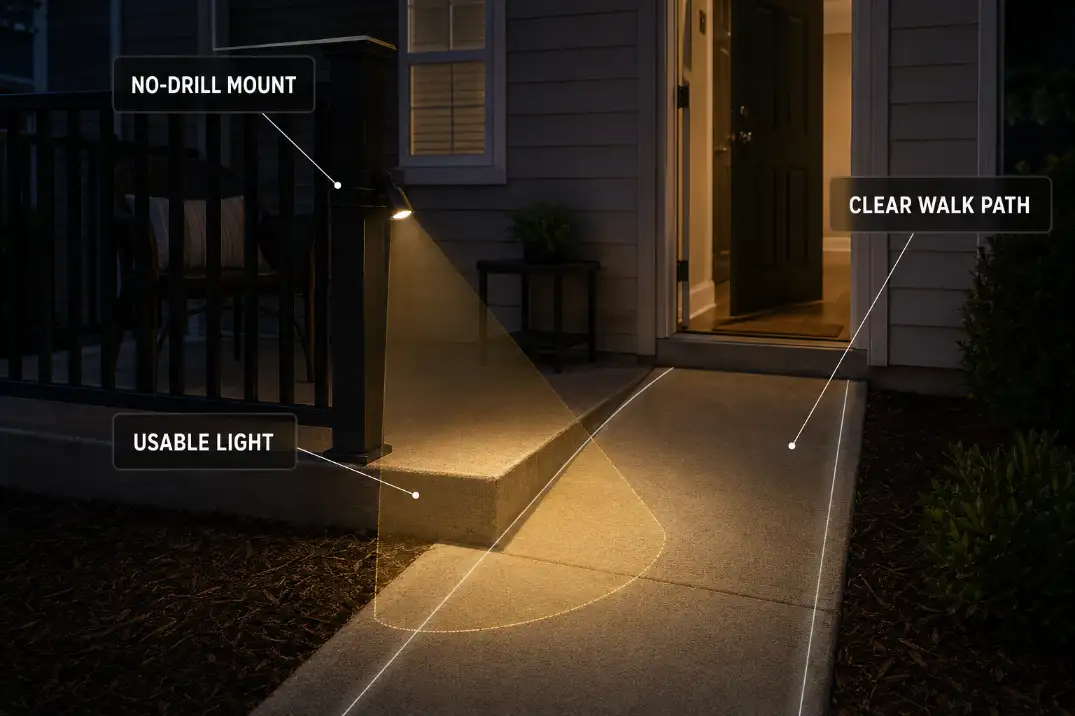
Renters often have to use railings, posts, manufacturer-approved removable mounts, weighted bases, or freestanding supports instead of drilled wall locations. Each alternative changes height, aiming freedom, stability, and coverage.
A low railing may place the source directly in the viewer’s eyes. A tall stand can spread the beam beyond the target. A convenient post may sit too far away to reveal a step clearly. An exposed removable mount may also become unstable in wind.
The chosen position should:
- Hold the light securely during normal use and expected conditions.
- Direct illumination toward the working or walking surface.
- Keep the fixture outside head, shoulder, and door-swing space.
- Keep any cord against a protected perimeter.
- Avoid sending excessive light toward windows or neighboring property.
Higher is not automatically better. The purpose of aiming light toward the working surface is to reveal the zone without placing a bright source in the normal sightline.
Weather Exposure
Exposure can veto an otherwise good lighting choice. Evaluate the complete setup, not only the lamp housing.
Battery compartments, charging ports, controls, removable mounts, bases, adapters, cord connections, and receptacle covers may have different exposure limits. A weather-resistant fixture does not automatically make its temporary connection or mounting method suitable for the same conditions.
Wind can destabilize a clipped or freestanding light before water reaches it. Plug-in arrangements require additional restraint because a suitable outdoor fixture does not make an exposed connection suitable.
Use only equipment intended for outdoor use and follow its instructions. The Electrical Safety Foundation International advises using outdoor-rated cords, keeping them out of water and high-traffic routes, avoiding doorway or window routing, and treating extension cords as temporary power. Its extension cord safety guidance also calls for matching the cord rating to the connected equipment.
Remove the setup when forecast conditions exceed its intended exposure. Temporary convenience is not a reason to leave a light, adapter, mount, or connection outside beyond its designed limits.
Zone Test
The zone test is where a plausible setup either becomes useful or exposes its first real limitation.
Test one defined area rather than trying to illuminate the whole property. Good candidates include an entry, short path, set of steps, seating edge, grill approach, or trash route.
Use the actual mounting position and power arrangement. A test performed indoors, during dusk, or while holding the light by hand cannot reveal the final beam, shadows, stability, or route conflicts.
- Define the pass condition. Decide which surface must remain visible and how long the light must serve it.
- Place the complete setup. Use the intended no-drill support, battery mode, outlet, and cord route.
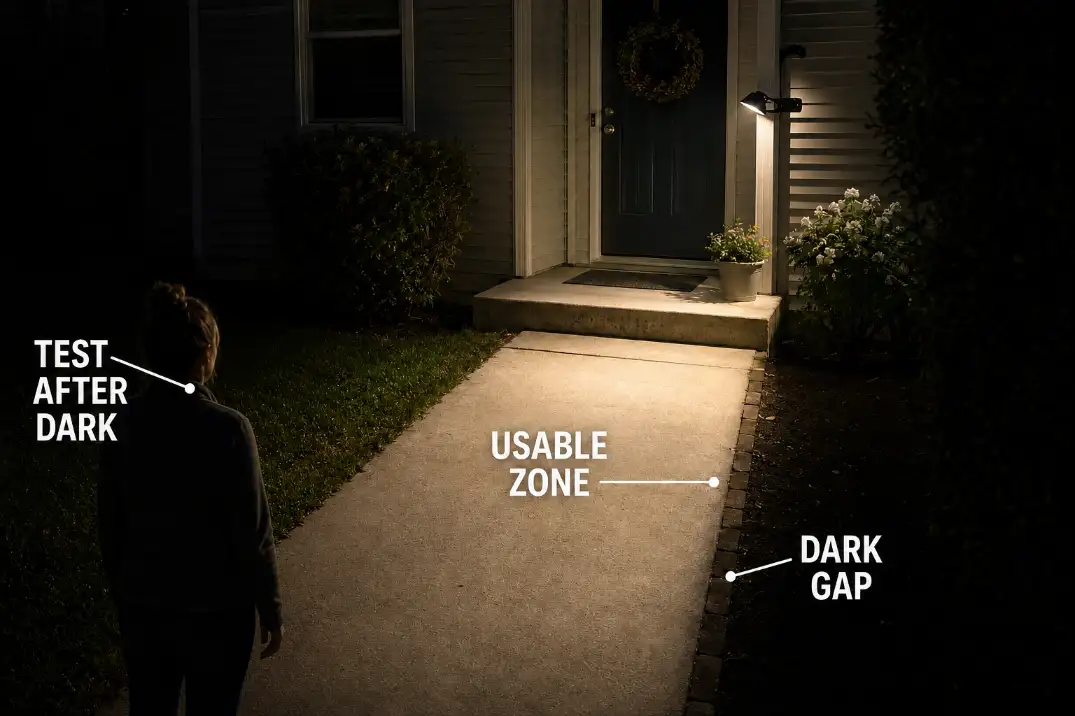
- Test after full darkness. Approach and use the area from the direction a resident or guest normally would.
- Run it for the expected period. Confirm that useful output, mounting stability, and route safety remain acceptable before changing the position once.
For motion-activated lighting, trigger it from the actual approach rather than by waving near the fixture. This is the same distinction involved in testing whether motion light reaches the actual walk path.
Five checks before the setup passes
- The intended ground, step, lock, or activity surface is clearly visible.
- The source does not create direct glare from the normal approach.
- Shadows and dark gaps do not hide the most important edge.
- The mount remains stable without altering or damaging the property.
- No cord, adapter, or connection occupies an exposed or active route.
Battery lighting is the stronger fit when a safe cord route cannot reach the target and dependable runtime covers the expected use.
Temporary plug-in lighting wins when longer, steadier output matters and a protected perimeter route already exists.
Move the light before adding another fixture. If repositioning cannot push the first limit—runtime, reach, mounting, exposure, or coverage—beyond the required use period, the power path is wrong for that zone.