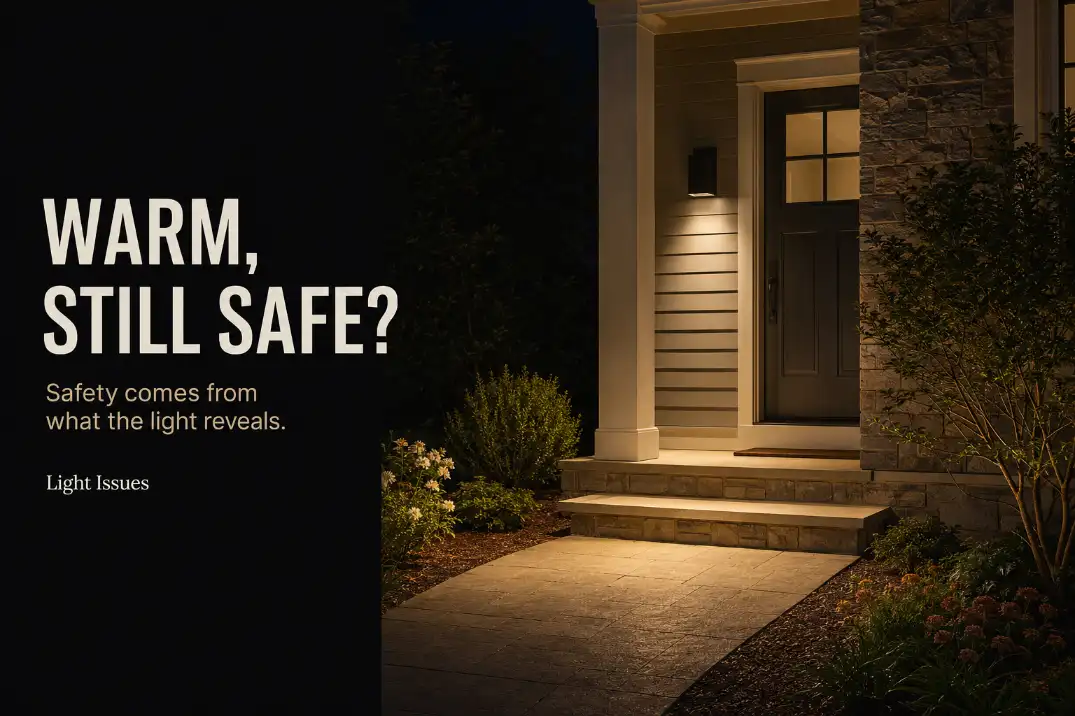
2700K outdoor lighting is often judged by how warm it looks rather than by what it lets someone see. Because it appears softer than 4000K or 5000K light, homeowners may assume it is dimmer, weaker, or less credible for security.
That assumption confuses color temperature with lighting performance. Kelvin describes the apparent color of the light. It does not determine how much output reaches the ground, where the beam lands, whether the source is shielded, or whether a step remains visible.
The better decision model has four tests: edge detail, facial visibility, route coverage, and camera detail. If controlled 2700K light preserves all four without making the lamp visually dominant, it is doing the safety job. If one fails, identify the failed mechanism before replacing warm light with a cooler color.
Warm Does Not Mean Dim
The first filter is not how white the light appears. It is whether the intended surface becomes readable without forcing the eye to fight the source.
Two lamps can produce similar output while looking noticeably different. Cool light often appears sharper against a dark residential background, but that impression of intensity can be mistaken for better visibility. A controlled 2700K fixture may place more useful light across a landing than a colder exposed lamp that creates one aggressive hot spot.
Judge the scene before judging the lamp
Look away from the fixture and examine what it is meant to reveal. Can you distinguish the walkway from the planting bed? Does the door hardware remain visible? Can you see where the landing ends?
Shade the fixture with your hand. If the scene becomes easier to read, glare—not warm color—is reducing visibility. This is the same distinction behind why brighter outdoor light can reduce visibility: increasing output can enlarge the brightest patch without repairing the darker transition around it.
Warm color is still only one part of the setup. A 2700K source can be underpowered, blocked by a railing, aimed above the task, or exposed directly to the eye. Keep the warmth when it is comfortable, but judge its performance through distribution, contrast, and source control.
Step Visibility
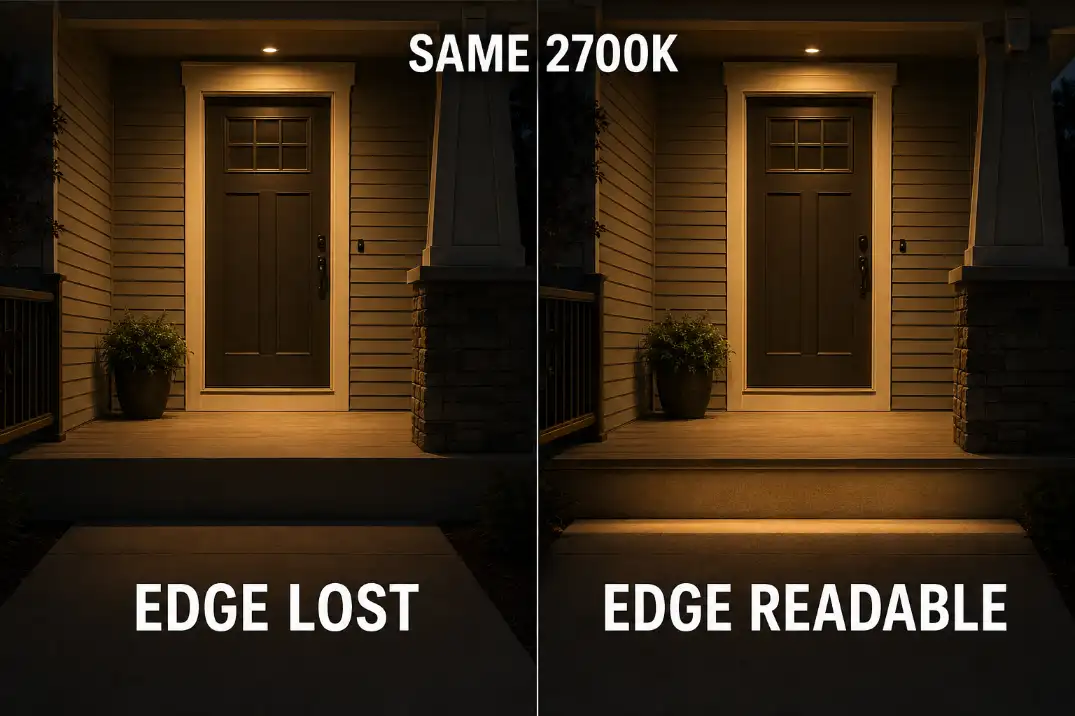
A step passes the visibility test only when the change in elevation is readable before the foot reaches it. A bright landing with an indistinct edge is not a safe result.
The useful information is the line where the landing ends, the front edge begins, or the next tread drops away. Warm light reveals that line when it crosses the surface from a useful direction. It hides the line when most of the beam lands on the door, wall, or flat center of the porch.
Test the edge before increasing output
Stand approximately 6–8 feet away, or two to three walking steps before the elevation change. You should be able to identify the edge without looking toward the fixture or slowing down to search for it.
Then check the route for railing shadows, planters, columns, and deep overhangs. One obstruction can create a dark band across the exact point where contrast is needed. A stronger lamp from the same direction may brighten the obstruction while leaving the hidden edge unchanged.
When the wall and landing look bright but the elevation change still disappears, the failure resembles porch lights that hide the steps. Correct the beam direction or add controlled supporting light before rejecting 2700K.
Face Comfort
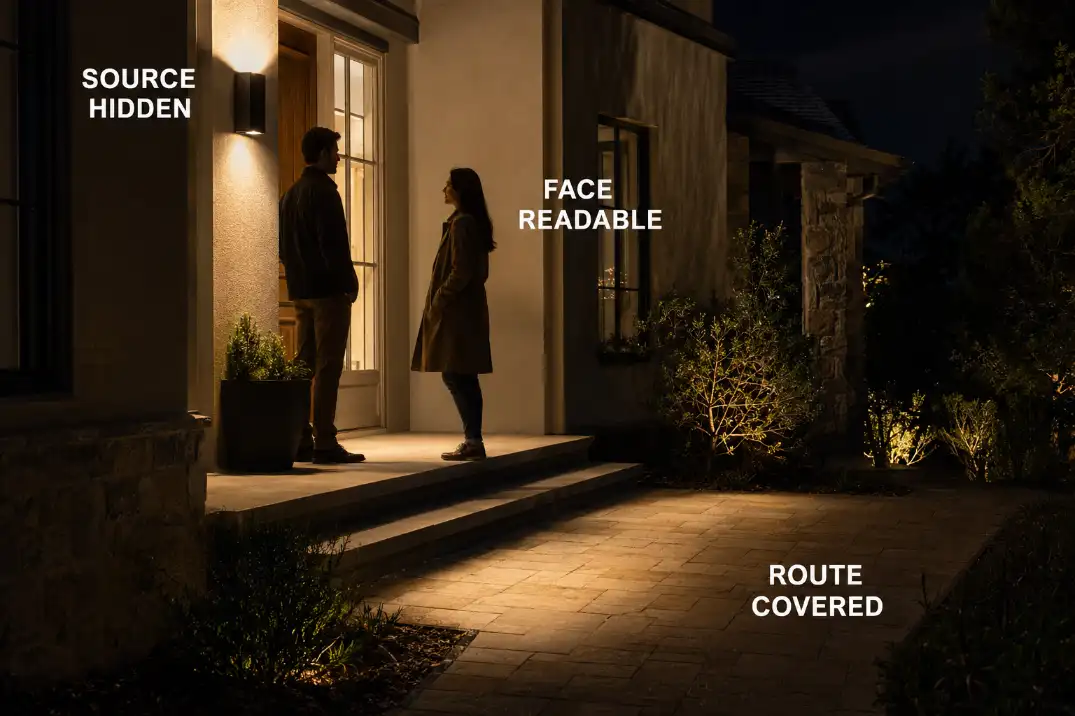
Facial visibility fails at both extremes: too little vertical light leaves a visitor in silhouette, while direct eye-level light causes squinting and hard shadows.
A fixture behind the visitor can make the doorway look active while keeping the face dark. An exposed source aimed toward the approach creates the opposite problem—the face receives light, but the visitor must look through glare.
The stronger arrangement provides modest vertical illumination from above or slightly to the side while keeping the lamp surface concealed. At normal conversation distance, facial expression, clothing color, and carried objects should remain readable without the fixture becoming the brightest object in either person’s view.
Color quality also matters independently of Kelvin. Two 2700K lamps can reproduce skin, fabric, painted doors, and packages differently. Warmth improves comfort only when useful facial detail survives.
Security Zone Balance
A residential security zone should reveal the next place where a person must move, turn, or identify something. Lighting the entire property evenly is neither necessary nor automatically safer.
The priority may be a threshold, gate latch, driveway-to-walkway connection, car-door step-out area, or turn beside the garage. One intense fixture can make that zone look highly illuminated while producing deeper shadows behind bins, shrubs, railings, and parked vehicles.
Changing the fixture to 2700K may soften its appearance, but it will not repair uneven coverage. The beam must reach the active route, and movement should remain visible before a person enters the brightest patch.
When the existing fixture cannot conceal its source or cover the route without flooding windows and neighboring property, fixture form becomes the limitation. Low-glare outdoor security-light options help distinguish recessed or shielded forms from exposed fixtures that depend on visual intensity.
A wide driveway or detached garage may require more output than a compact porch. Even there, an additional controlled lighting point often preserves route visibility better than one colder, broader floodlight. The test is not whether the property looks bright from inside; it is whether the active zone remains readable from the route itself.
Camera Color Shift
Camera footage gets its own pass-or-fail test because a security camera does not interpret 2700K light exactly as an adapted human eye does.
A person may perceive the entry as comfortably warm, while recorded footage retains a stronger yellow or amber cast. Automatic white balance can reduce that cast, exaggerate it, or shift colors when warm exterior light mixes with cooler garage, street, or neighboring light.
Review recorded clips instead of relying only on the live view during installation. Use familiar references—a painted door, vehicle, jacket, delivery box, or planter—to determine whether important colors remain distinguishable. The goal is usable recognition, not perfect photographic color.
A washed-out face, white package, or reflective pavement patch usually points to direct light entering the lens or overwhelming a nearby surface. Backyard camera lighting without glare is the more useful test when detail disappears even though the scene looks bright.
Do not blame 2700K until beam angle, camera exposure, mixed light, source visibility, and the amount of light reaching the subject have been separated. Color temperature should not become a convenient explanation for an optical problem.
Night Color Test
Approve 2700K only after full darkness. Dusk fills shadows and softens contrast, making weak coverage appear more complete than it will during actual nighttime use.
Run the test from the routes people use, including the direction facing back toward the fixture. A light can appear controlled from the porch yet become uncomfortable from the sidewalk, driveway, or side gate. Broader dark-sky-friendly outdoor lighting follows the same practical rule: limit light to the place, time, and amount that serves a real task.
Run the test in this order
- Start from the real approach. Walk toward the entry without staring at the fixture. The path and step edge should register before the lamp does.
- Check the arrival zone. At normal conversation distance, confirm that a face, door handle, package, and landing remain readable without squinting.
- Walk the security boundary. Check the gate, driveway connection, route turn, and spaces behind common obstructions from both directions.
- Review recorded footage. Watch an actual motion event or short recording and inspect color, facial detail, reflective surfaces, and the transition into darkness.
Change one variable at a time. Start with aim, shielding, or an obstruction, then evaluate output and distribution. Altering several settings together hides which change actually improved the scene.
Five checks that decide whether 2700K passes
- The step edge is visible two to three walking steps before contact.
- An arriving face is readable without direct light entering the eyes.
- The active security route remains visible beyond the brightest patch.
- The lamp or LED surface does not dominate the normal approach view.
- Recorded footage retains useful detail and distinguishable reference colors.
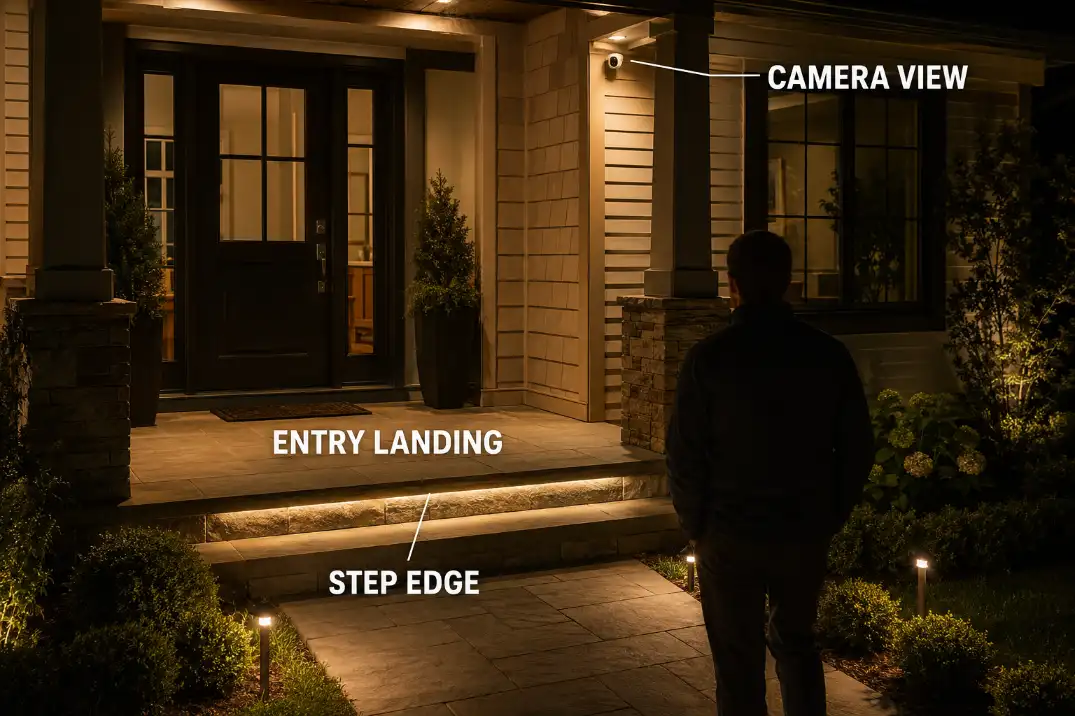
Keep 2700K when all five conditions hold. The scene does not need to resemble daylight; it needs to reveal the correct information before someone reaches the point where that information matters.
When a condition fails, correct the mechanism in order: beam direction for a hidden step, source exposure for squinting, distribution for a broken route, or camera angle and exposure for damaged footage. Change color temperature only when color remains the verified limitation after those corrections.
For broader homeowner guidance on warm color, shielding, and responsible nighttime use, see DarkSky’s Home Outdoor Lighting Assessment.