
Temporary outdoor lights rarely look unfinished because they are portable. They look unfinished when each fixture announces itself before the patio, deck, or seating area registers as one illuminated space.
One lantern may brighten the table, another mark the steps, and a portable lamp help near the chairs. Each can work well on its own while the combined view still feels random. Hiding every cord or making removable fixtures resemble permanent ones will not correct that fragmentation.
The stronger approach is to control the illuminated field: repeat a limited fixture language, keep adjacent light reasonably close in warmth, anchor the layout with a few stable positions, and give the light a believable place to end.
Start from the back door or primary seat rather than beside the fixtures. If your eye jumps between isolated bright objects, the first move should be to edit their relationships—not add another light.
Scattered Light Problem
Decide first whether the space lacks usable light or merely lacks visual continuity. Adding brightness to a fragmented layout usually produces brighter fragments.
A genuinely underlit zone fails at a particular task: a step edge disappears, the serving surface cannot be read, or faces are difficult to see across the table. A scattered layout may handle those tasks while still presenting isolated pools, competing fixture heights, and dark gaps that divide one outdoor area into unrelated pieces.
Test the scene from the back door, primary seat, and normal yard approach. The door view reveals whether the patio reads as a destination. The seated view exposes glare and awkward height differences. The approach shows whether the lighting leads toward the occupied area or leaves it visually detached.
Darkness between distinct zones is not automatically a flaw. It becomes a problem when it cuts through a zone that should feel continuous or when a fixture appears brighter than the surface it serves.
Broader outdoor lighting placement problems often begin with this same object-by-object approach.
A useful correction is to remove the most isolated light temporarily. If the remaining scene becomes calmer and easier to read, the problem was not insufficient fixture count. That light either needs a closer relationship to the main field or a clearly separate job.
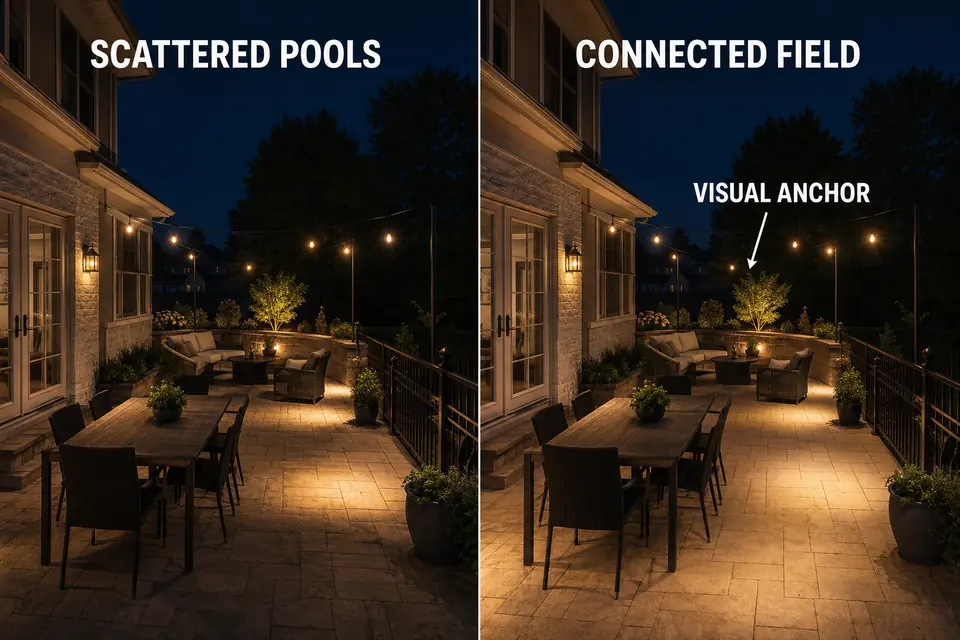
Repeated Fixture Style
Choose the visual traits that will repeat before deciding where every secondary light belongs. Otherwise, each new fixture introduces another shape, finish, or direction that the layout must absorb.
The fixtures do not have to be identical. Repeat one or two characteristics that remain noticeable after dark: a dark metal finish, a simple cylindrical silhouette, a similar shade scale, a shared height family, or light directed downward rather than outward. Two consistent traits usually create more cohesion than an exact product match placed without rhythm.
Establish a dominant family
Let one fixture family form the visual anchors, then use quieter support lights where a different function demands them. Repeated dark lantern forms might establish the patio edge while a low portable lamp serves the table. The table lamp can differ in shape if its scale, finish, or light direction still relates to the anchors.
Several unrelated statement pieces create the opposite result. Each asks to be noticed, making the arrangement feel collected one object at a time. If one light is ornate, oversized, or unusually bright, assign it a clear focal role rather than answering it with more competing fixtures.
A finished arrangement can remain visibly removable. Coordination matters more than pretending the installation is permanent.
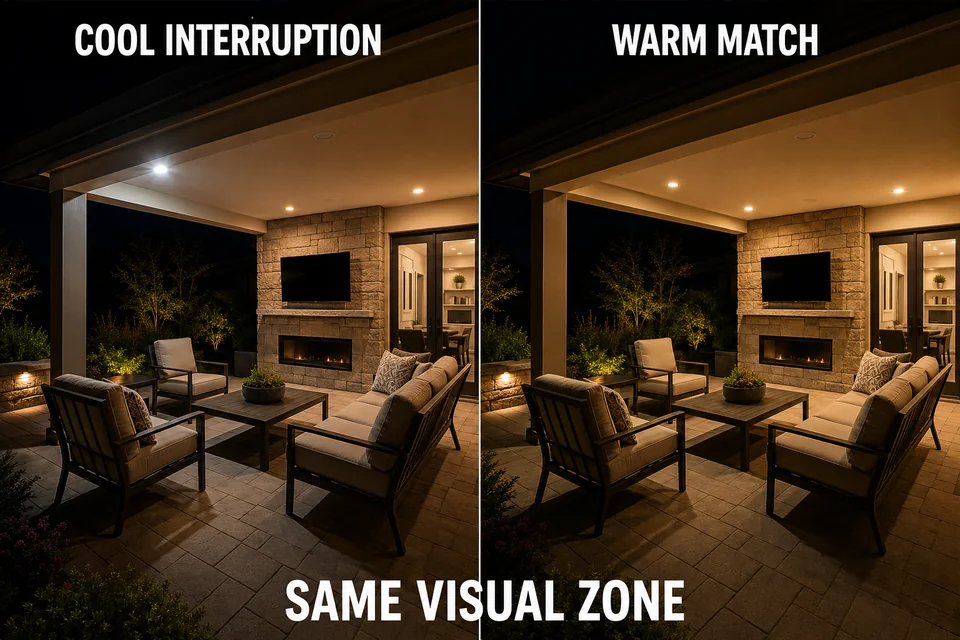
Warm Color Match
Match light by the surfaces it shares, not simply by the specification printed on each package. Fixtures illuminating the same table, wall, planting bed, or seating group must look compatible when seen together.
Judge that relationship by eye under normal nighttime conditions. Two products with the same nominal color temperature may still differ because of their lenses, dimming behavior, output, or the color and texture of the illuminated surface.
Noticeably cool-white light placed beside amber decorative light will interrupt one visual zone even when the cool fixture is not especially bright. Guidance on using 2700K outdoor lights after dark can establish a warm starting point, but the actual side-by-side view should make the final decision.
A distinct task light may remain when distance, shielding, or a change in zone separates it from the warm composition. A utility light beyond the entertaining area does not have to match perfectly; it does have to avoid spilling across the patio and competing with it.
Movable Zones
Keep part of the composition stable even when the activity moves. If every portable light follows the furniture, the patio loses its visual structure whenever dinner becomes conversation or a serving area is cleared.
Use one or two consistent anchor positions—perhaps near the back door and at the far seating or railing edge. Smaller fixtures can then move between dining, conversation, serving, and temporary activity zones without making the entire layout appear displaced.
Give movable lights a home position
Assign every movable fixture a normal return point. That position should restore the everyday composition after the table moves, guests leave, or an activity ends. Without it, portable lights accumulate wherever they were last useful, creating a bright cluster on one side and a gap on the other.
Allow a restrained overlap where stable and movable zones meet. A portable dining light can sit within the outer reach of an anchor so that shifting it slightly does not detach the table from the patio. The overlap should connect the zones, not flatten them into uniform brightness.
Movement must also remain physically credible. Bases belong outside chair pullback and normal walking lines, while power paths should follow inactive edges. If plug-in fixtures are involved, routing patio-light cords without clutter should be resolved before a visually attractive position becomes a daily obstruction.
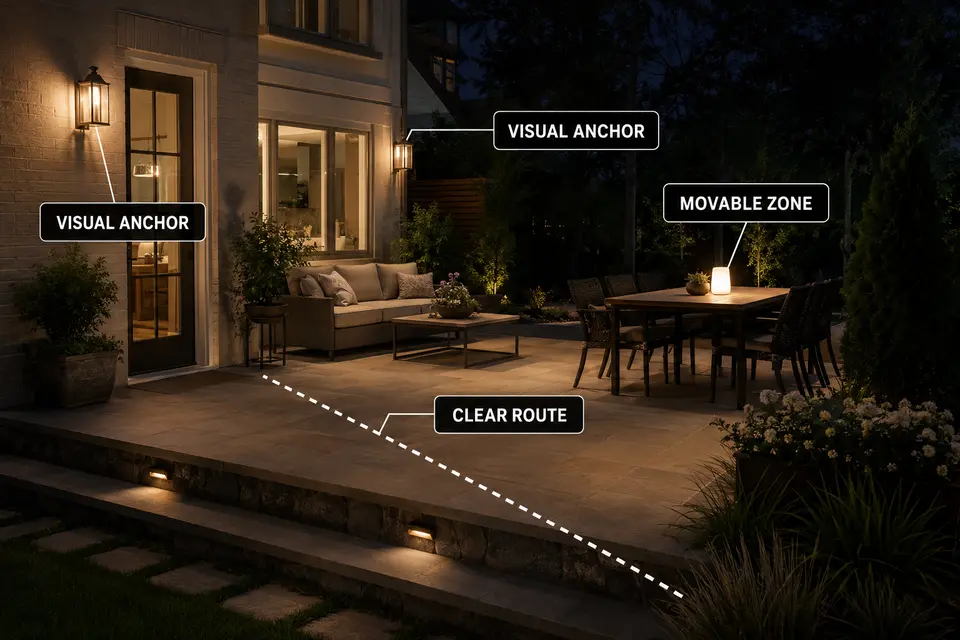
Clean Edges
Choose where the illuminated composition will stop. A defined edge makes a modest temporary arrangement look more deliberate than weak light distributed across every available corner.
Use a wall, railing, planting line, path turn, or furniture boundary as the outer limit. The shape does not need to be perfectly geometric, but the final fixture should relate to a visible site feature. A lantern at the end of a railing can complete the patio; the same lantern several feet beyond it may look stranded.
Accept darkness outside the selected footprint. Weakly lighting every corner often reduces clarity because the main composition fades into disconnected outer points. A lone fixture beyond the seating area should either mark a necessary destination or return inside the boundary.
Cords and excess cable affect this edge during daylight as well as after dark. Keep them along walls, railing bases, or inactive perimeter lines without turning the visual layout into a wiring project.
For positions that change frequently, battery outdoor lighting for movable zones can preserve the boundary without adding a cord across the route.
The approach should remain easy to read even when the illuminated footprint is compact. A person arriving from the yard should understand where the occupied area begins and how to enter it without being pulled toward a stray fixture beyond the composition.
Finished Look Test
Test the normal layout, not its best possible version. Wait until full darkness, allow your eyes several minutes to adjust, and switch on only the fixtures ordinarily used together.
View the scene from the doorway, primary seat, and main approach. At each position, identify the first fixture that attracts attention for the wrong reason. If it appears too cool, too bright, too isolated, or unrelated in form, remove it temporarily before adding anything else. Subtraction often reveals the composition more clearly than another fixture can.
Move portable lights through their common use positions and then return them home. The arrangement passes only if that flexibility preserves the stable anchors and keeps circulation clear.
- Does the outdoor area register before any individual fixture?
- Do adjacent lights appear close in warmth?
- Are one or two stable visual anchors still evident?
- Does every movable light have a clear return position?
- Does the illuminated field end at a believable physical edge?
A temporary layout looks finished when its removable parts still support one readable field. If it continues to feel improvised, do not expand it first.
Remove or reposition the fixture that breaks the composition, then repeat the test from the doorway.