
A pergola can look evenly illuminated while leaving the outdoor kitchen difficult to use. Light reaches the beams, floor, and cabinet fronts, yet the cutting board disappears into shadow as soon as someone stands at the counter.
The common mistake is treating the pergola’s framing grid as the lighting plan. A fixture centered neatly between two beams may sit behind the cook, miss the active counter, or face directly toward nearby seats. Structural symmetry does not guarantee useful light below it.
Plan from three places instead: the work plane under the cook’s hands, the route through the kitchen, and the seated sightline looking back toward the fixtures. The counter needs light that reaches it without traveling through the cook’s body. The route needs enough definition for movement, while the seating area should not receive the full task beam. Those jobs usually require controlled layers rather than one brighter overhead source.
Overhead Shadow
Judge overhead lighting with someone standing at the counter, not while the kitchen is empty. An unoccupied counter may look adequately illuminated because nothing interrupts the path from the pergola to the work surface.
Once the cook steps into position, a fixture directly above or behind the shoulders can cast a shadow over the cutting board, tools, and ingredients. The surrounding kitchen remains bright, so the failure can look like insufficient output even though the real issue is direction.
Judge the work plane, not the pergola
Place a cutting board on the counter and stand where preparation normally happens. Move both hands across the surface. If the darkest area follows the head and shoulders, the work plane needs light from another direction.
This is why broader outdoor lighting placement problems cannot be judged by fixture symmetry alone. A light centered within a pergola bay may be poorly positioned for the activity below it.
The same conflict occurs at a grill. A source behind the standing position may illuminate the closed lid but leave the controls, side shelf, and open cooking surface partially blocked. Increasing output brightens the surroundings without changing the shadow path.
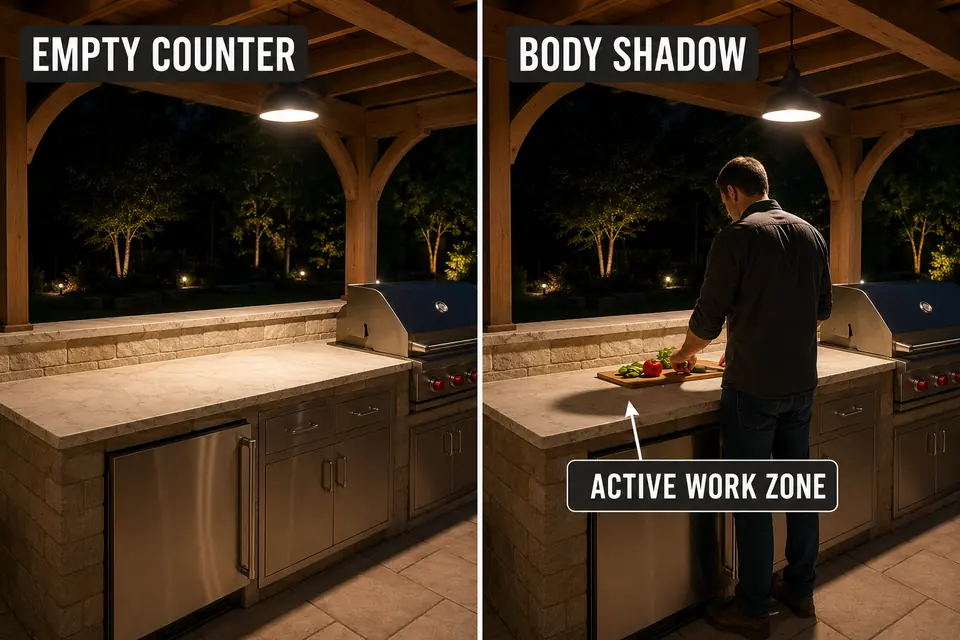
Do not add another overhead fixture until this test establishes where the existing beam is being blocked. If the shadow moves with the cook, placement—not general brightness—is the first correction.
Pendant Limits
Assign a pendant to one surface, not the entire outdoor kitchen. A pendant centered over an island may support plating or serving while doing little for a wall counter or grill several feet away.
Shade shape also controls how much of the surface is usable. A downward pendant may create a strong pool directly beneath it but leave the ends of a long island dim. Raising it can broaden the visible pool while exposing more of the source to people seated nearby.
Hanging position introduces physical limits. The fixture must remain clear of heads, raised serving trays, open grill lids, and normal movement. Beneath an open-sided pergola, wind can also make a suspended light an unreliable source for precise task coverage.
A pendant is useful when its hanging point matches a fixed island or serving position. It should not be expected to cover a separate grill, wall counter, and circulation route simply because it occupies the visual center of the pergola.
Counter Beam
Place the task beam for the counter’s active area, not for the full cabinet run. Cutting, seasoning, plating, and tool handling usually happen within a smaller central work zone; that surface deserves priority over the backsplash and cabinet faces.
Trace the light backward from that work plane to a practical pergola mounting point. The source should approach from slightly in front of or beside the cook so the beam reaches the hands before the body can interrupt it. The workable position will change with counter depth, pergola framing, fixture optics, and whether the kitchen follows a wall or island layout.
Aim across the active surface
A modest forward or side offset is usually more useful than a source placed directly behind the cook. The objective is not dramatic cross-lighting. It is to move the beam path out of the standing body.
Check where the brightest area lands. If it strikes the backsplash, upper cabinet face, or narrow rear edge of the counter, the fixture reaches the kitchen but misses the surface that controls visibility. Similar lights that miss their target area can produce a bright setting with weak detail where work happens.
Keep the source outside the cook’s direct eye line. A fixture aimed too far back toward the standing position may remove the body shadow but replace it with glare. Reflective grill lids, control panels, and polished counters can redirect the light, so test with the equipment in its normal operating position.
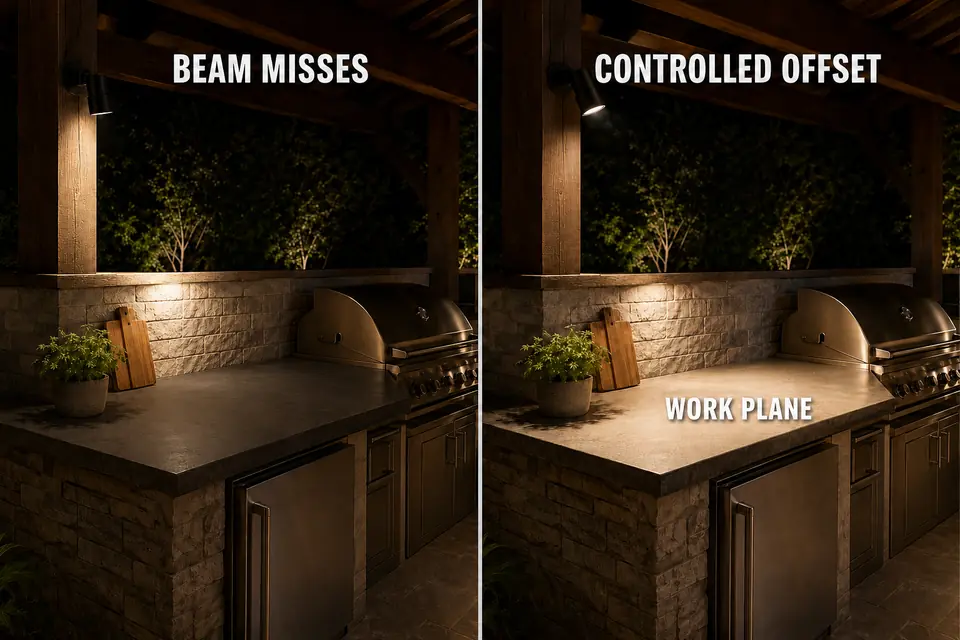
Move hands between the cutting board, grill tools, and nearby plates during the test. The outer edges do not need identical brightness, but the cook should not have to lean or relocate preparation items to keep them visible.
Seating Spill
Approve the task-light angle only after checking it from the seats. A beam that feels controlled at standing height can expose the lamp or lens directly to someone sitting across an open pergola bay.
Sit in each primary dining or lounge position and look back toward the kitchen. Lower eye height changes which fixtures and reflections are visible. Seating directly across from the counter is particularly vulnerable because guests naturally look toward the cook during conversation.
Some ambient light can connect the kitchen and dining zones. The failure begins when the concentrated task beam crosses the table, strikes faces, or puts an exposed source in the normal field of view.
This follows the same mechanism behind harsh outdoor lighting glare: brightness within the sightline can cause more discomfort than general illumination on the ground. Shielding, tighter aiming, a revised mounting position, or separate controls can protect the seats without sacrificing the counter.
The seating zone does not need to match the kitchen’s brightness. Keeping the task layer close to the work surface creates a more comfortable transition and prevents the entire pergola from feeling like one exposed stage.
Layered Task Light
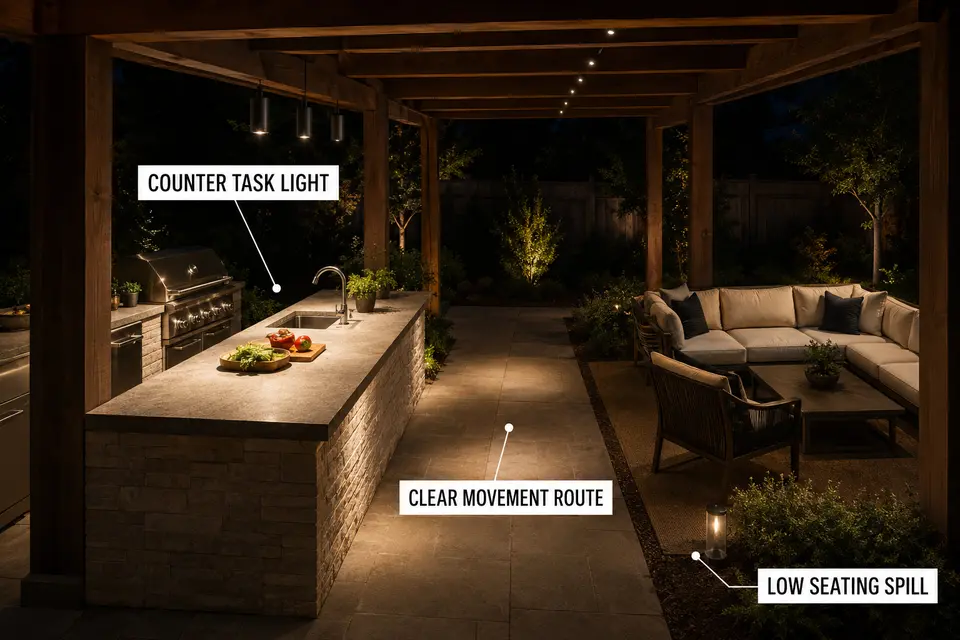
Build the lighting in order of consequence: active counter first, movement route second, atmosphere third. If the preparation surface is not clear, decorative balance elsewhere cannot rescue the kitchen.
Give each layer one primary job
Use a directional task source for the main counter or grill work plane. This is where body shadow is most disruptive and where hands, controls, and tools require clear visibility.
Let the general overhead layer define the kitchen footprint and support orientation. It can reveal cabinet edges and soften transitions without becoming the brightest source under the pergola. A pendant may supplement an island or serving surface when its hanging point matches that specific job.
Route lighting should identify steps, level changes, and the path between the counter and seating. It does not need to eliminate every dark patch. Excessively bright foreground light can make the surrounding yard appear darker and draw attention away from the route itself.
Independent controls preserve these roles. The stronger task layer can operate during preparation and cleanup, while softer overhead or seating light remains on afterward. This avoids sending working-level output across the patio for the rest of the evening.
A roofed or slatted mounting position does not automatically protect a fixture from outdoor exposure. Open sides, roof gaps, condensation, and wind-driven rain can still reach electrical components. Check the actual location against appropriate outdoor light weatherproof ratings instead of treating every point beneath the pergola as dry.
Allow enough overlap to avoid black gaps between the counter, grill, and route, but do not erase the layers’ separate jobs. The cook should move between work points without losing visibility, while seated guests remain outside the concentrated task beam.
Night Prep Test
Test the completed layout during full darkness and with the kitchen occupied. Dusk can conceal weak coverage because remaining daylight fills the shadows that will become obvious later.
Place a cutting board, plate, utensils, and several objects on the counter. Stand in the normal preparation position and move both hands across the work plane. Then shift to the grill or secondary surface without changing the lighting.
Open the grill lid during the test. The raised lid may block an overhead source or return a reflection toward the cook. Check the controls, side shelf, and usable cooking surface instead of judging the grill by its closed exterior.
Next, sit in the adjoining dining and lounge positions. Look toward the kitchen as someone would during conversation. If a source or concentrated reflection becomes uncomfortable, revise its shielding or aim without giving up necessary counter coverage.
Night prep checklist
- The cook’s head and shoulders do not cast a persistent shadow over the cutting board.
- Hands and tools remain visible across the main preparation surface.
- The open grill lid and reflective finishes do not return glare toward the cook.
- The route between the kitchen and seating remains readable without a harsh floor wash.
- Seated viewers do not face an exposed source or concentrated task beam.
Change one angle, layer, or control setting at a time and repeat the same movements. Adjusting several elements together makes it difficult to identify which change corrected the shadow or created new spill.
A pergola does not need equal brightness from beam to beam. The layout is finished when the work plane stays clear with a cook in position, the route remains readable, and the task light disappears from the seated sightline.
For electrical protection around outdoor receptacles, see the U.S. Consumer Product Safety Commission’s GFCI fact sheet.