
If the table is dim but the bulbs still hurt your eyes, the pergola is not simply overlit. The light is occupying the wrong part of the view.
A small exposed bulb can become the brightest object in an otherwise dark backyard. Lowering its output may help, but it does not move that bright point away from someone’s face. Continue dimming and the table, floor edges, and steps may disappear before the glare does.
That is why the correction should follow a firm order: test the lights from the chairs, identify the bulbs that cross normal sightlines, correct the hanging route, and use the dimmer only for final balance. The pattern comes first because direct exposure—not total brightness—is usually controlling the discomfort.
Make the first check after dark from the seats people actually use. Look toward the other chairs, the yard, and the back door rather than deliberately looking up. The bulbs that interrupt those natural views are the ones the layout needs to address.
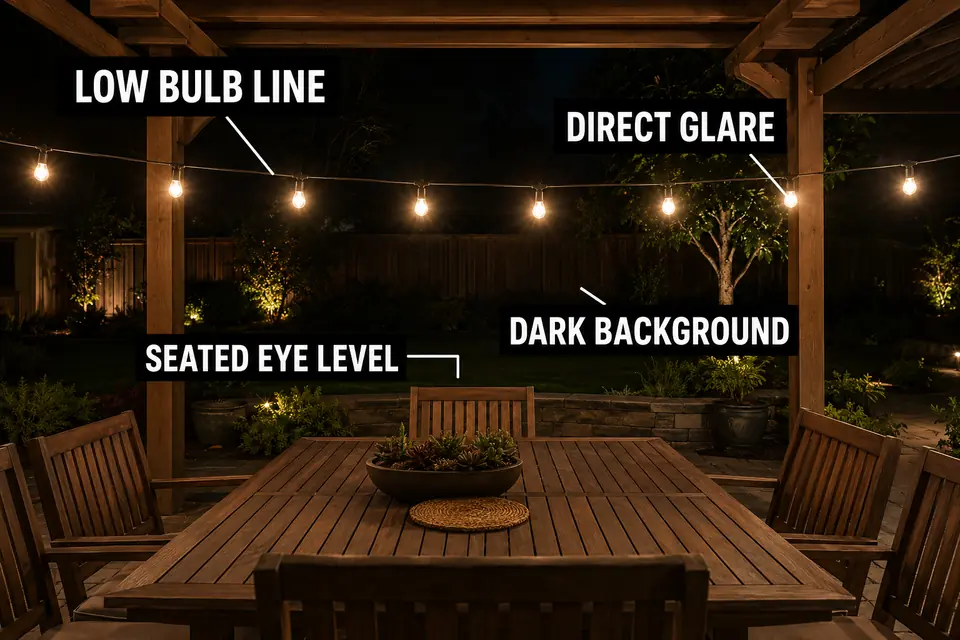
Bulbs Too Close
Treat the closest low bulb as the first suspect, not automatically the bulb with the highest output. Proximity and viewing angle can make a modest bulb feel much harsher than a brighter source positioned above or outside the forward view.
The problem often begins where a string sags near the edge of the table. The bulb may technically remain overhead, yet sit close enough to seated eye level that someone must look past it during conversation. Light reaching the table can be weak while light reaching the eye remains intrusive.
The dark background makes this contrast stronger. A clear bulb suspended against an unlit yard appears more dominant than the same bulb viewed against a softly illuminated ceiling or wall. Bulb size by itself therefore says little about comfort; the meaningful relationship is between the bulb, the seated eye, and whatever lies behind it.
From each chair, look toward the places that normally hold attention. If a single bulb repeatedly becomes the brightest feature in that view, raising or shifting that section is more useful than dimming the entire string.
Repeating Bright Dots
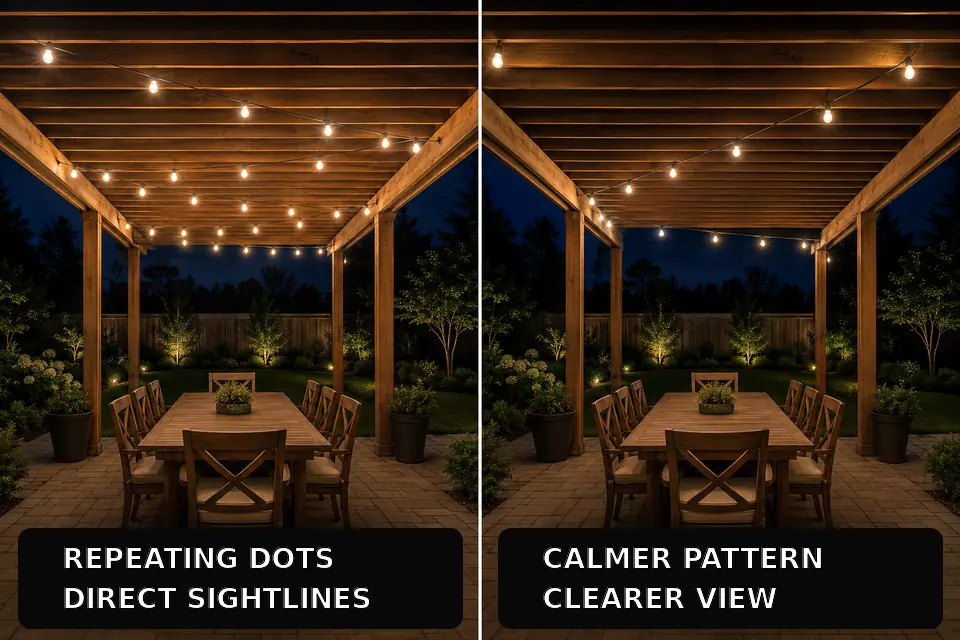
If correcting one low bulb barely changes the experience, inspect the repetition across the whole pergola. Several individually modest bulbs can form a bright visual field that is much harder to ignore than a single isolated point.
Dense zigzags are especially prone to this effect. From directly below, each run may appear appropriately spaced. From a chair, however, bulbs on several runs can overlap or align into bright rows above the opposite seats.
The result is not always excessive general illumination. Instead, the eye keeps returning to a sequence of high-contrast dots while the table, structure, and people remain comparatively subdued. The pergola can feel both dim and glaring at the same time.
Judge the pattern from the full seating area rather than inspecting individual bulbs from a ladder or from the patio entrance. If nearly every chair faces multiple rows of exposed points, the problem belongs to the route and density of the string—not one defective section.
Hanging Pattern
Do not rehang the strings according to how the pergola looks from outside. Map the important seated views first, because an attractive overhead pattern can perform poorly once someone looks horizontally through it.
A tight central zigzag usually creates the most trouble when its runs cross the main viewing direction. Someone looking toward the opposite side of the table then sees one bulb line after another. Low sags make the effect worse, but even higher strings can create a crowded ceiling when too many runs occupy the center.
The stronger correction reduces how often the string crosses important sightlines. That may mean raising a central sag, removing an unnecessary crossing, shifting part of the route toward the perimeter, or turning a run so the viewer looks alongside it instead of through several rows.
Moving everything to the perimeter is not automatically better. That can clear the view while leaving the table and walking area underlit. Retain enough light over the surfaces people use, but keep the central forward view from becoming a grid of bright points. Functional balance matters more than perfect symmetry.
Dimmer Balance
Use the dimmer after correcting the hanging geometry, not as the first repair. A dimmer changes intensity, but every poorly positioned bulb remains in the same sightline.
Starting with the dimmer creates a predictable trade-off. As the setting falls, direct points become softer, but useful visibility at the table, floor transitions, and pergola entrance also decreases. The space may become impractical before the exposed pattern becomes comfortable.
After raising, simplifying, or redirecting the intrusive runs, bring the output down until the bulbs stop competing with the surfaces they are meant to illuminate. Faces, table items, and changes in floor level should remain readable without the string becoming the main visual subject.
Uniform brightness is not the target. Some darkness beyond the pergola gives the setting depth. The useful balance is enough light for the activity, with no exposed row repeatedly pulling attention away from it.
Chair Position
Use the chairs as diagnostic positions. A lighting pattern that looks controlled while standing can become uncomfortable as soon as the eye moves down to seated height and looks across the space.
Check every chair that is used regularly. One seat may face along a string and experience little direct glare, while the chair opposite it looks across three or four runs. Corner positions can reveal low sags and overlapping bulbs that remain hidden from the center.
Look in the directions people use during an ordinary evening: toward other guests, the back door, the yard, or an outdoor screen. Deliberately staring upward does not reproduce the real problem. The relevant bulb is the one that intrudes while someone is trying to use the space normally.
A slight chair-angle change can sometimes clear an isolated point. That is a reasonable correction when it preserves conversation, table access, and circulation. If several chairs must be turned awkwardly or pushed out of position, the string route—not the furniture—is wrong.
Photographs can disguise this distinction. A wide image taken from the entrance may make a dense canopy appear orderly and atmospheric. It does not show what someone faces for two hours at the table.
Better Pattern
The better pattern is the one that becomes visually quiet when people sit down. It does not need to conceal every bulb, but it should keep repeated bright points away from the views used most often.
Begin at the primary chair after dark and identify the bulbs that dominate the forward view. Repeat the test from the remaining seats before changing the route. This separates one low section from a pattern-wide problem and avoids rehanging strings that were not causing discomfort.
Make the smallest geometry change that fixes the diagnosed failure. Raise an intrusive sag, eliminate an unnecessary central crossing, simplify parallel runs, or redirect part of the string away from the seating axis. Preserve useful light over the table and walking surface rather than moving every bulb blindly toward the perimeter.
Set the dimmer only when the route is stable. Begin with enough output to reveal faces, table items, and floor transitions, then lower it until the bulbs stop competing with those surfaces. Retest each chair because a corrected route may still leave one bright point exposed at the end of the table.
Success is not the most elaborate or perfectly symmetrical canopy. It is a pergola that remains usable while the string lights recede into the setting. If the bulbs still command attention, correct the view before sacrificing more useful light.
This approach also follows DarkSky and the Illuminating Engineering Society’s principle that outdoor light should be targeted and kept no brighter than necessary, outlined in their Five Principles for Responsible Outdoor Lighting.