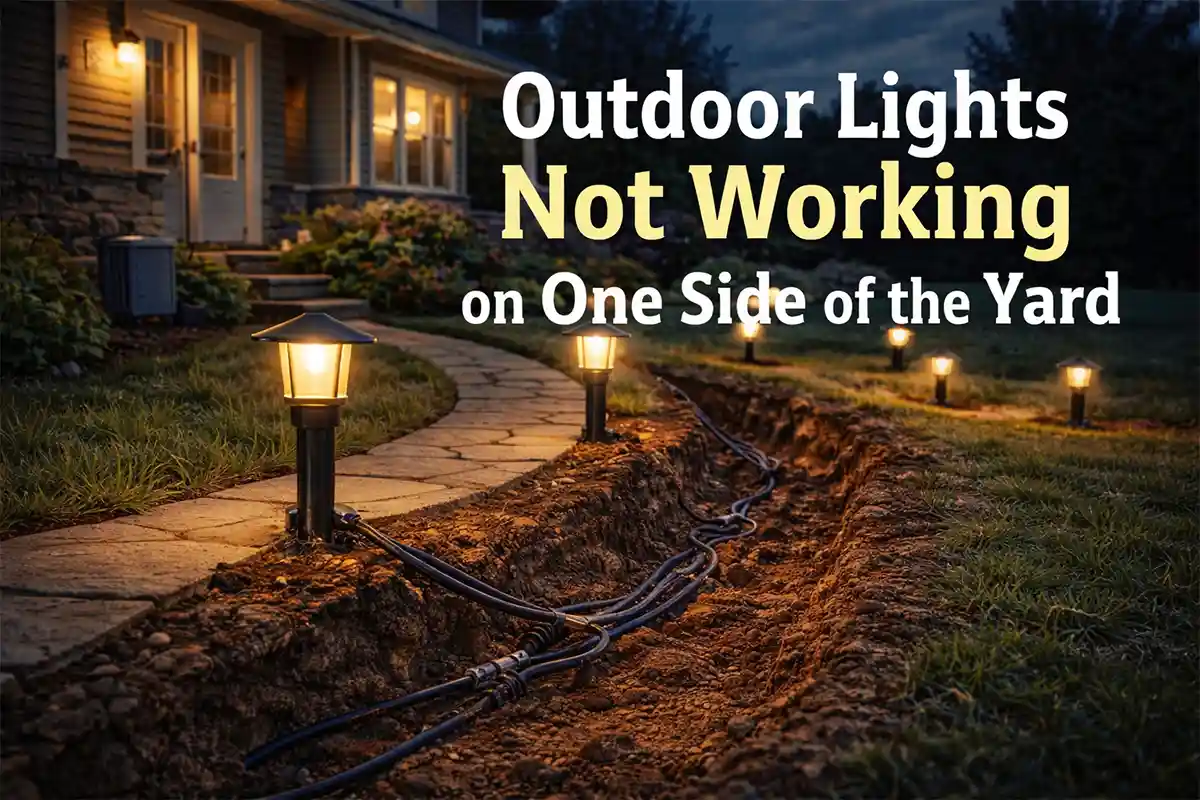
When a section of yard lighting suddenly stops working, the first explanation often seems obvious. A burned-out bulb, a faulty transformer, or a damaged fixture are common assumptions. However, outdoor electrical systems rarely behave that simply. The same visible symptom—lights failing on one side of a yard—can result from several very different conditions inside the wiring network.
Landscape lighting systems distribute electricity through long cable runs that branch across different areas of a property. Because these systems operate outdoors, electrical components are constantly exposed to moisture, soil chemistry, temperature shifts, and physical disturbance from landscaping activity. Small changes in electrical resistance, connector quality, or wiring integrity can interrupt power to one section while the rest of the system continues working normally.
This pattern often leads to incorrect conclusions. A homeowner might replace several fixtures only to discover the lights still do not turn on. In reality, the underlying cause frequently lies somewhere along the wiring path that feeds that side of the yard.
Understanding the difference between common myths and the actual electrical mechanisms behind the problem makes troubleshooting much easier and prevents unnecessary repairs.
Common Myths About the Issue
Many explanations circulate about why lights stop working in one section of a yard. While these ideas sometimes contain partial truth, they rarely represent the full technical picture.
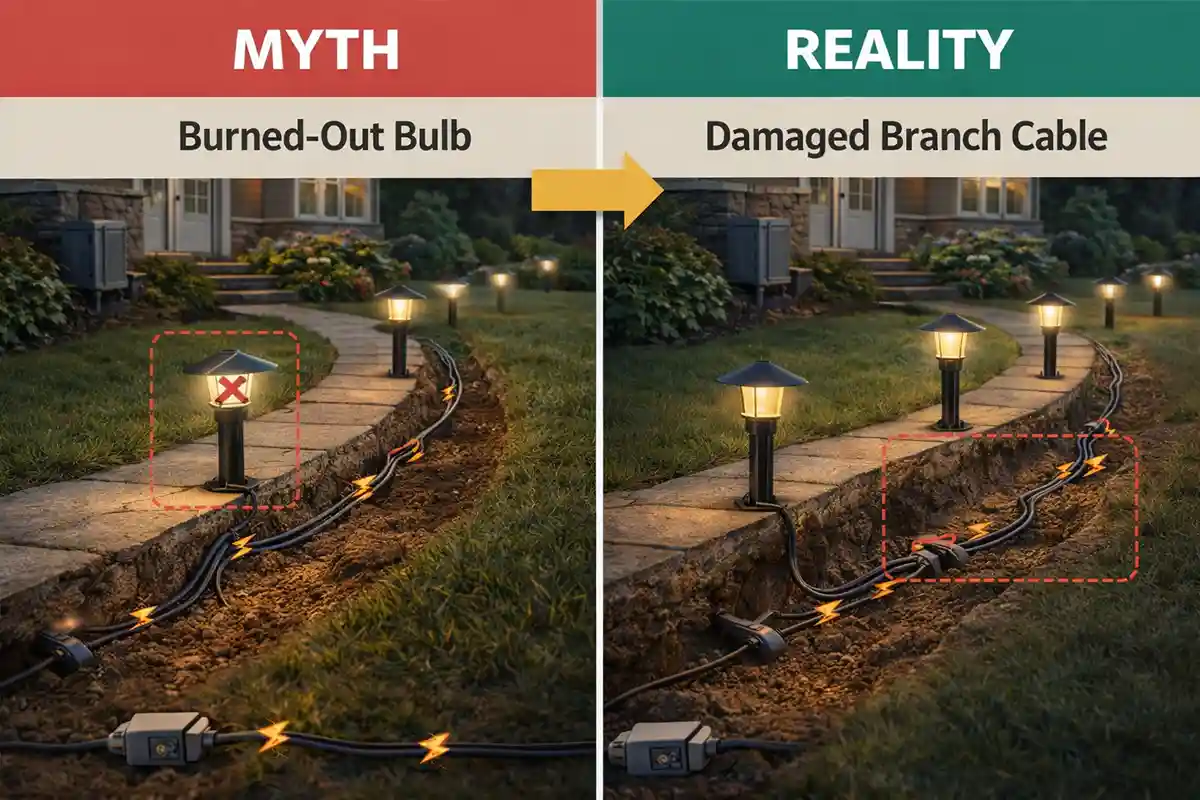
One of the most common beliefs is that a burned-out bulb must be responsible whenever a group of fixtures stops working. Modern landscape lighting systems typically use LED fixtures rated for 20,000 to 50,000 operating hours. Because of that long lifespan, multiple fixtures failing at the same moment is statistically unlikely.
Another assumption is that the transformer must be defective if half the yard goes dark. In most installations, the transformer feeds several wiring branches simultaneously. When lights on only one side stop working, the transformer is usually functioning normally while the issue occurs somewhere along the wiring path.
Environmental conditions are also frequently blamed. Rainfall, temperature swings, or damp soil often appear around the same time lighting problems occur. These factors rarely create the failure directly. Instead, moisture or temperature changes typically expose weaknesses that already exist within connectors or cables.
Some homeowners assume the issue must involve a single loose connector. In reality, outdoor lighting failures often result from a combination of factors such as resistance buildup, corrosion, or voltage loss across a branch circuit.
Finally, a sudden outage may seem like permanent damage. Electrical interruptions can actually begin intermittently before becoming constant, particularly when connectors gradually degrade or when wiring insulation weakens.
If your exterior fixtures worked yesterday but will not turn on today, there may be several reasons outside lights stop working.
The Real Causes Behind the Problem
Outdoor lighting systems are usually divided into separate wiring branches that extend from the transformer in different directions across the yard. One cable may supply lights along the left side of a pathway while another feeds fixtures along the opposite side. When power fails along one branch, every fixture beyond that point stops receiving electricity even though the rest of the system continues operating.
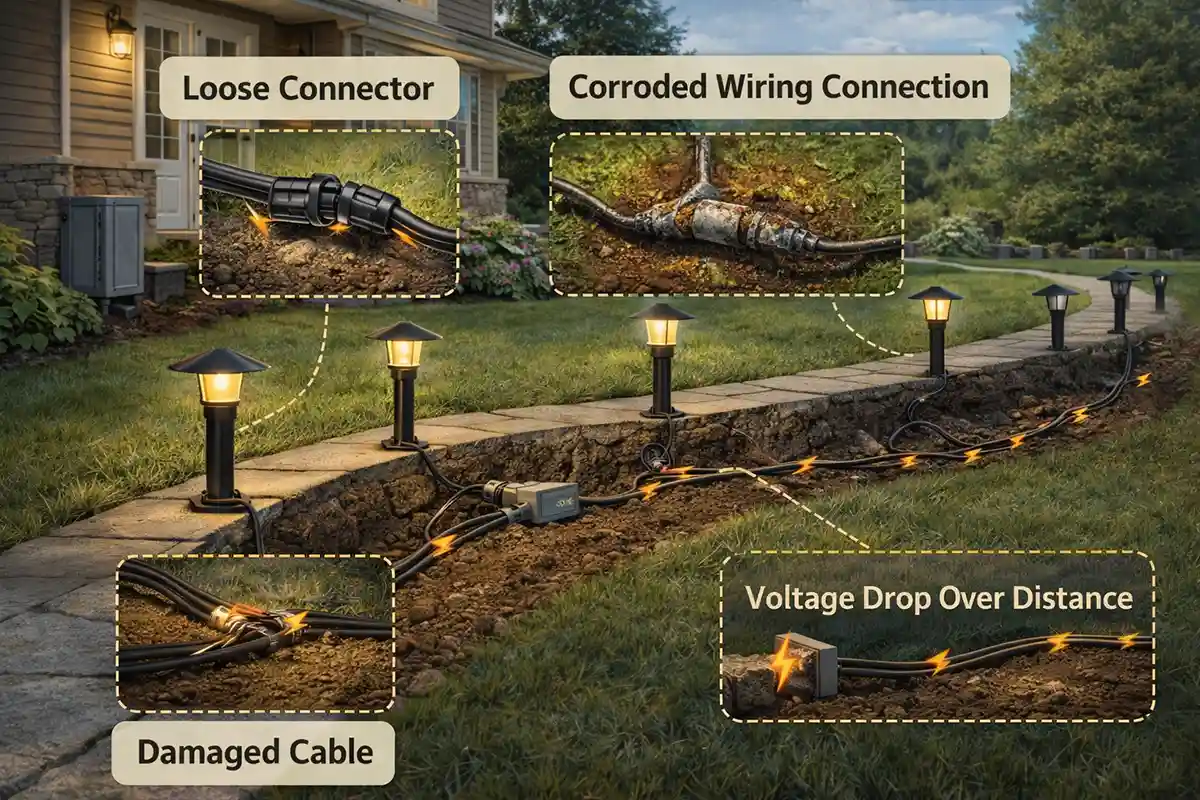
One frequent cause involves cable damage along the branch circuit. Landscape lighting cables are typically buried just a few inches below the soil surface. Garden tools, edging equipment, or burrowing animals may accidentally cut or crush the wire. When this happens, electricity cannot travel past the damaged section, leaving all fixtures beyond that point dark.
Another important mechanism involves voltage drop across long wiring runs. Electrical resistance inside copper conductors gradually reduces voltage as electricity travels through the cable. If the lighting system uses long runs of small-gauge wire, the voltage reaching fixtures at the far end of the branch may fall below the operating threshold required by LED drivers. This electrical behavior is discussed in detail in Outdoor Lights Losing Power at the End of the Line, where resistance across extended circuits weakens electrical output.
Connector corrosion is another major contributor. Landscape lighting connectors often sit directly in soil or mulch where moisture and oxygen accelerate oxidation. Engineering studies show that corrosion can increase contact resistance by 20–30 percent, which may interrupt electrical flow to downstream fixtures.
Electrical load distribution can also affect system stability. If many fixtures are connected along one branch of the circuit, the increased current flow raises electrical stress on connectors and cable insulation. Over time this may create resistance points that reduce or interrupt voltage delivery.
Lighting failures may also appear intermittent before becoming permanent. Systems experiencing unstable electrical flow sometimes flicker or shut off unpredictably, a behavior often associated with the conditions described in Outdoor Lights Working Intermittently.
Material aging also plays a role. Outdoor wiring insulation gradually deteriorates due to ultraviolet exposure, moisture absorption, and soil chemicals. Over several years these environmental effects can weaken electrical connections and cause partial circuit interruptions. Aging components are one reason outdoor lighting reliability gradually declines, a pattern explored in Why Outdoor Lights Stop Working Over Time.
Quick Diagnostic Checklist
Identifying the underlying cause usually begins with observing how the lighting failure appears within the system layout.
-
Lights operate normally near the transformer but stop at a specific fixture along the cable run
-
All fixtures beyond a certain point remain dark
-
The opposite side of the yard continues working normally
-
A connector near the transition point shows corrosion or loose wiring
-
Recent digging, landscaping, or edging occurred near the cable route
-
Lights previously flickered before shutting off completely
-
Soil around connectors remains damp or compacted
These signals help identify whether the problem involves cable damage, resistance buildup, or branch circuit interruption.
Myth vs Reality Comparison
Common Myths and Scientific Reality
| Myth | Reality | Scientific Explanation |
|---|---|---|
| A burned-out bulb shuts down an entire row of lights | Multiple fixtures failing at once is rare | LED lamps typically operate for tens of thousands of hours, making simultaneous failure unlikely |
| A faulty transformer causes one side of the yard to go dark | Transformers usually supply multiple independent wiring branches | A break or resistance point along one branch stops electrical flow beyond that location |
| Rain or cold weather directly breaks outdoor lighting | Environmental changes reveal existing wiring weaknesses | Moisture increases electrical conductivity and exposes corroded connectors or insulation damage |
| Replacing fixtures fixes most lighting failures | Wiring connectors and cables are often the real issue | Electrical current cannot reach downstream fixtures when resistance or breaks occur |
| Lighting failure always indicates permanent damage | Electrical interruptions may begin intermittently | Loose connectors or unstable voltage can temporarily disrupt power delivery |
Practical Ways to Solve the Issue
Effective troubleshooting focuses on the wiring path that feeds the affected side of the yard.
Start by locating the first fixture that no longer receives power. The problem often exists near that point because the cable feeding downstream lights passes through that connection.
Inspect connectors around this transition area. Replacing corroded connectors with waterproof gel-filled connectors can restore proper electrical contact and prevent moisture intrusion.
If the cable appears cut or crushed, repair the damaged section using outdoor-rated splice connectors. In cases where insulation is brittle or cracked, replacing the affected wire segment ensures long-term reliability.
Evaluating circuit layout can also help prevent future failures. Splitting fixtures across multiple wiring branches reduces electrical stress on individual cables.
In larger installations, upgrading to thicker wire—such as replacing 16-gauge cable with 12-gauge cable—can reduce electrical resistance by as much as 40 percent, allowing more stable voltage delivery across the system.
Routine inspection of connectors and wiring paths also helps prevent gradual degradation caused by soil moisture, temperature shifts, and environmental exposure.
Myth Clarification Questions
Can one burned-out light shut down an entire yard lighting circuit?
Most landscape lighting systems wire fixtures in parallel, so a single lamp rarely interrupts power to other fixtures.
Why would lights stop working on only one side of the yard?
Outdoor lighting systems usually divide wiring into branches. A break or resistance point along one branch stops power from reaching the fixtures beyond it.
Do weather conditions directly cause lighting failures?
Weather usually reveals existing weaknesses such as corrosion or damaged insulation rather than creating the failure itself.
Is the transformer usually responsible when part of the yard goes dark?
Transformers generally affect the entire system. Localized outages are more often related to wiring or connectors.
Can lights begin working again without replacing fixtures?
Yes. Cleaning or tightening connectors can sometimes restore electrical flow if resistance or loose connections caused the interruption.
Final Clarification
Outdoor lights failing on one side of the yard often lead to incorrect assumptions about burned-out bulbs or defective transformers. In reality, most partial lighting failures originate within the wiring branch that feeds that section of the landscape. Cable damage, connector corrosion, voltage drop, and aging insulation can all interrupt electrical flow along a specific circuit path. Identifying these underlying mechanisms makes it possible to restore reliable lighting without unnecessary fixture replacement.
For additional technical guidance on outdoor electrical wiring and landscape lighting installation standards, resources from the National Electrical Code (NFPA) provide widely recognized safety and electrical design guidelines.