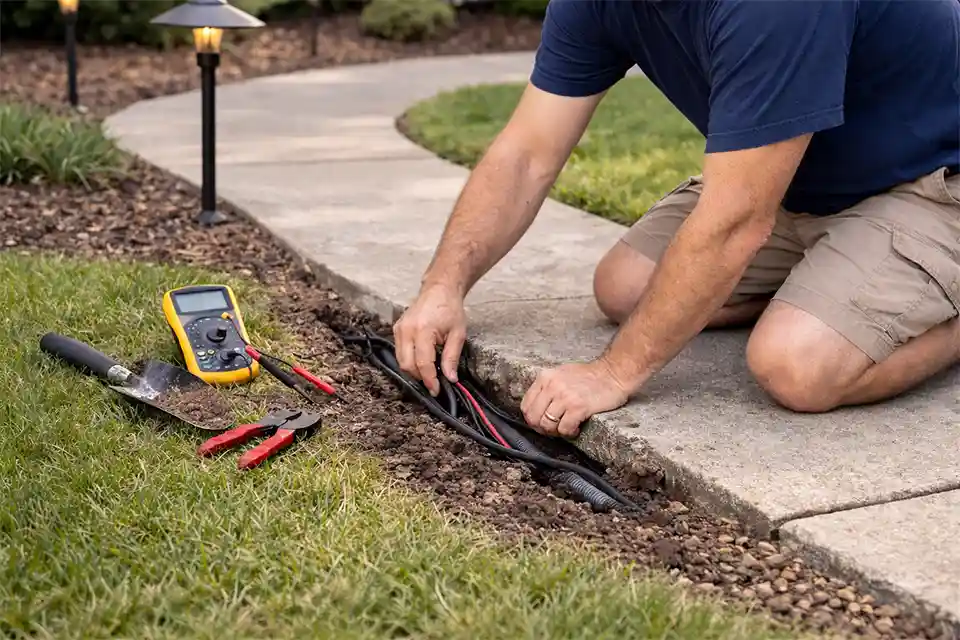
Quick Solution Summary
When outdoor lights lose power exactly where the wiring passes under a walkway or driveway, the issue usually comes from cable damage, compression, or moisture intrusion at that crossing point.
Hard surfaces like concrete, pavers, or asphalt create pressure zones beneath the soil. Over time, the weight from foot traffic, vehicles, and soil compaction can flatten insulation or fatigue the copper conductors inside landscape lighting cables. Even a partial break can reduce voltage enough to shut off lights further down the circuit.
Most residential landscape lighting systems run on 12–15 volts, so even small resistance changes in the cable can reduce available power by 20–40%.
The typical fix involves locating the exact crossing point, confirming voltage loss across the walkway area, and replacing the damaged section of cable. For a long-term solution, the wiring should be routed through protective PVC conduit beneath the hard surface to prevent future compression damage.
This problem is especially common in colder northern states where frost heave shifts soil several inches each winter, placing stress on buried wiring.
Why Power Problems Often Appear Where Wires Cross Hard Surfaces
Outdoor lighting wires are designed to run through soil, mulch beds, or planting areas where the ground remains relatively flexible.
Walkways and driveways change those conditions dramatically.
Hard surfaces create pressure zones beneath them. Soil becomes compacted, water drains differently, and the ground loses its ability to flex naturally. If the cable was installed only 2–4 inches below the surface, the insulation can gradually weaken under repeated pressure.
Over time this may cause:
-
cracked insulation
-
copper strand fatigue
-
moisture penetration
-
corrosion inside the conductor
Eventually the electrical resistance increases enough to cause voltage loss beyond the crossing point.
This type of underground degradation often mirrors the problems explained in Underground Lighting Cables Damaged: Causes, Signs, and How to Fix Them, where gradual environmental stress weakens buried wiring over several years.
Quick Diagnostic Checklist
If your landscape lights stop working past a walkway or driveway, look for these indicators.
Common signs of cable damage at the crossing point:
-
Lights before the walkway work normally
-
Fixtures beyond the walkway are dim or off
-
Voltage readings drop sharply after the crossing
-
Lights flicker when stepping near the walkway edge
-
The issue appeared after landscaping or paving work
-
System fails more often after heavy rain
In a typical low-voltage system, testing with a multimeter might show 12–14 volts before the walkway but only 6–9 volts afterward, indicating high resistance or a partial conductor break.
For lights controlled by a timer or photocell, understanding why outdoor lights won’t turn on is the first step toward a proper fix.
Common Causes of Wiring Failure Beneath Walkways
| Cause | What Happens | Typical Fix |
|---|---|---|
| Soil compression | Cable insulation flattens over time | Replace cable and install conduit |
| Frost heave | Ground expansion stretches the wire | Reinstall cable deeper |
| Moisture intrusion | Water enters cracked insulation | Replace damaged section |
| Shallow installation | Cable sits in pressure zone | Reroute under conduit |
| Root or rodent pressure | External stress damages insulation | Relocate cable path |
In clay soils common throughout the Midwest, heavy rainfall can cause soil expansion that compresses buried wiring. These environmental stresses often explain why outdoor lights fail after storms or seasonal rain cycles similar to the issues discussed in Why Your Outdoor Light Works Fine Until It Rains.
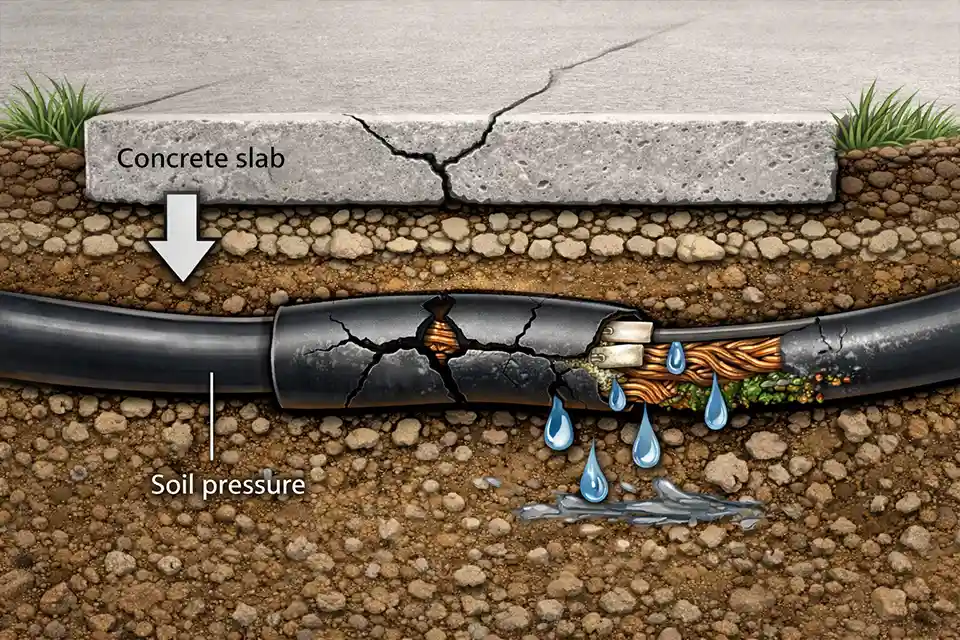
How Walkways and Driveways Damage Lighting Cables
Several mechanical and environmental factors combine to stress buried wiring beneath hard surfaces.
Soil Compression
A residential driveway supporting vehicles can compress soil 10–15% over time. That pressure gradually flattens the cable jacket and weakens the copper strands inside.
Concrete Expansion and Contraction
Concrete expands during summer heat and contracts during winter cold. In northern climates where temperatures swing between 20°F winter lows and 95°F summer highs, small slab movements can pinch buried wiring.
Water Channeling
Walkways frequently redirect rainwater along their edges. This concentrates moisture where cables enter and exit the slab area, increasing corrosion risk.
Corrosion often begins at connectors or splices, a problem similar to those explained in Corroded Wire Splices Outdoors.
Construction Disturbances
Driveway installation, patio expansion, or irrigation trenching often damages buried lighting cables.
Homeowners frequently discover failures only after noticing that Pathway Lights Not Receiving Power After Yard Work stopped functioning days or weeks after landscaping changes.
Can Landscape Lighting Wire Safely Run Under Concrete?
Yes, outdoor lighting wire can safely run beneath concrete walkways or driveways—but only when installed correctly.
Direct-burial landscape wire placed directly under a slab may function for several years, but long-term reliability decreases significantly because of soil compression and slab movement.
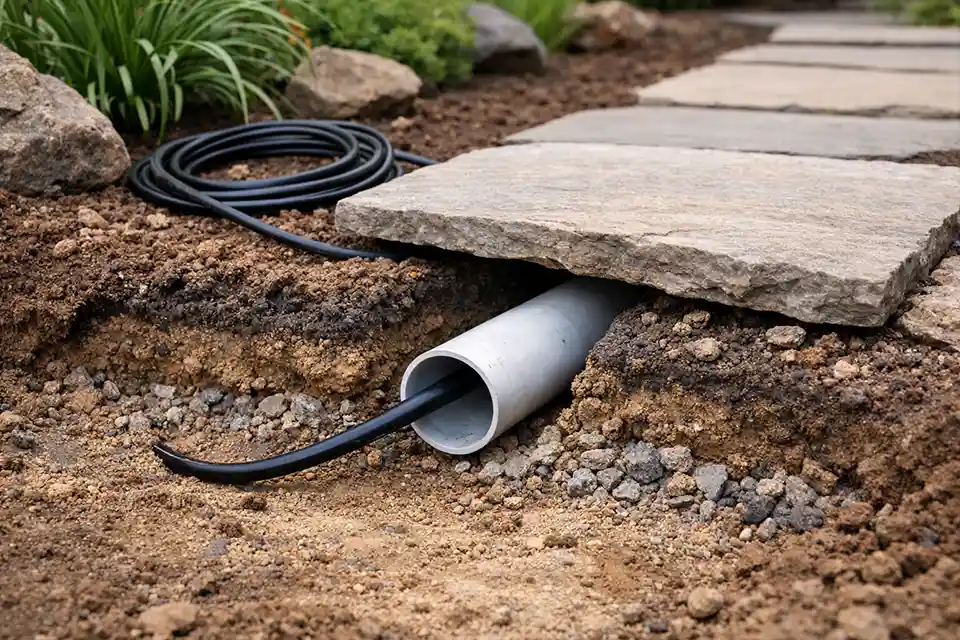
Professional installers typically run wiring through ¾–1 inch PVC conduit beneath the hard surface.
Conduit provides several important protections:
-
prevents cable compression
-
shields insulation from soil movement
-
blocks moisture intrusion
-
allows easier replacement later
In most installations, the conduit is placed 8–12 inches below grade before the walkway or driveway is installed.
Without this protection, cables placed directly under concrete often fail within 5–8 years, depending on climate and soil conditions.
Step-by-Step Method to Locate the Failure
Identifying the exact failure point prevents unnecessary digging.
Step 1: Identify the Last Working Light
Turn on the lighting system at night and determine the last fixture that still works.
Step 2: Measure Voltage Before the Walkway
Use a multimeter at the last working fixture.
Typical readings:
-
12–15 volts for low-voltage systems
-
110–120 volts for line-voltage systems
Step 3: Measure Voltage After the Walkway
Test the first fixture beyond the crossing.
If voltage drops more than 3 volts in a low-voltage system, the cable likely has high resistance or internal damage.
Step 4: Inspect Entry and Exit Points
Most failures occur within 6–12 inches of where the cable enters or exits the walkway.
Look for:
-
cracked insulation
-
exposed copper
-
loose connectors
-
water accumulation
If connectors appear unstable, the issue may actually involve problems described in Loose Outdoor Wiring Connections: How to Fix Them Safely and Permanently.
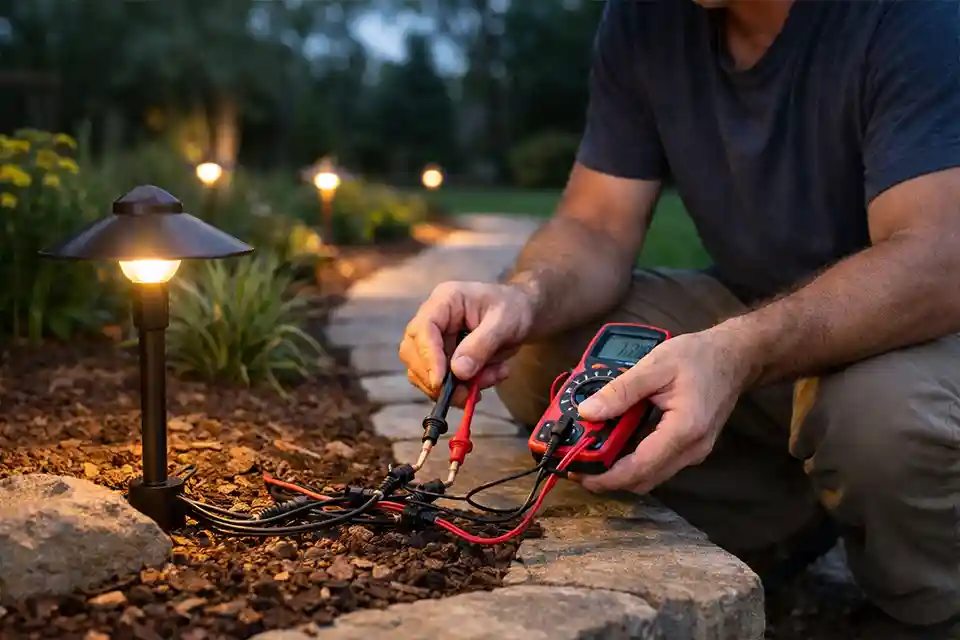
Voltage Drop vs Cable Damage: How to Tell the Difference
Sometimes lighting systems lose brightness because of voltage drop rather than cable damage. Understanding the difference can save time during troubleshooting.
Voltage drop occurs when the total lighting load is too large for the cable length or gauge. In that case, voltage gradually decreases along the entire run.
Cable damage behaves differently.
| Condition | Signal | Action |
|---|---|---|
| Normal voltage drop | Gradual dimming across many fixtures | Upgrade wire gauge |
| Cable damage under walkway | Sudden voltage loss after one point | Replace damaged cable |
| Loose connector | Intermittent flickering | Reconnect or replace splice |
| Transformer overload | Entire system dims evenly | Reduce load |
If voltage measures 12–14V before the walkway but drops below 9V immediately afterward, the problem almost always indicates cable damage rather than normal voltage drop.
The Best Permanent Fix
Temporary repairs rarely last in areas exposed to compression and soil movement.
The most reliable solution is to replace the damaged cable section and protect it with conduit.
Recommended Installation Method
-
Dig on both sides of the walkway
-
Remove the damaged cable segment
-
Install PVC electrical conduit (¾–1 inch) beneath the walkway
-
Feed new landscape lighting cable through the conduit
-
Seal conduit ends with weather-resistant fittings
-
Reconnect using waterproof gel connectors
This approach isolates the wiring from soil pressure and prevents future mechanical damage.
Professionally installed systems typically place cables 8–12 inches deep for long-term durability.
Preventing Future Failures
Proper installation practices dramatically extend the life of outdoor lighting systems.
| Prevention Method | Impact | Difficulty |
|---|---|---|
| Install conduit under hard surfaces | Prevents compression damage | Moderate |
| Bury cables deeper (8–12 in.) | Reduces soil pressure | Moderate |
| Use direct burial rated wire | Improves insulation durability | Easy |
| Avoid sharp bends near slabs | Prevents conductor fatigue | Easy |
| Seal all splices with gel connectors | Stops moisture corrosion | Easy |
In humid regions such as Florida or coastal California, properly sealing connectors is especially important because humidity accelerates copper oxidation.
Environmental Conditions That Accelerate Cable Damage
Certain climates increase the likelihood of buried cable failure at walkway crossings.
Freezing Northern Winters
In states like Michigan or Minnesota, frost heave can move soil 1–3 inches each winter, stressing buried cables beneath rigid slabs.
Desert Soil Expansion
Dry desert soils in Arizona can expand rapidly after rare rainfall, placing tension on underground wiring.
Coastal Moisture
Salt-laden air and high humidity increase corrosion rates by 15–30% when insulation becomes compromised.
Heavy Midwest Rainfall
Clay soils common in Midwest states swell when saturated, which can compress cables against concrete edges.
These environmental pressures explain why wiring often fails first where it crosses hard surfaces rather than where it runs through garden beds.
Frequently Asked Questions
Why do lights before the walkway still work?
Outdoor lighting circuits run sequentially. If the cable breaks beneath the walkway, only fixtures beyond that point lose power.
Can a partially damaged cable still carry electricity?
Yes. A cable with broken strands may still carry reduced voltage, which causes dim or flickering lights.
How deep should outdoor lighting cables be buried?
Most low-voltage systems bury cables 6–12 inches deep. Under walkways or driveways, the wiring should run through conduit for protection.
Is conduit always necessary under a driveway?
While not always required for low-voltage systems, conduit significantly increases cable lifespan and simplifies future repairs.
For additional electrical installation safety guidance, see the National Electrical Code resources from the National Fire Protection Association (NFPA):
https://www.nfpa.org
Key Takeaways
Outdoor lights that lose power where wiring runs beneath walkways or driveways typically indicate cable compression, insulation failure, or moisture intrusion at the crossing point.
Testing voltage before and after the walkway quickly reveals whether the cable is damaged. A sharp voltage drop across the crossing almost always confirms conductor failure rather than normal voltage drop.
Replacing the damaged cable and routing it through protective conduit beneath the hard surface provides the most durable repair.
With proper installation depth, sealed connectors, and conduit protection, outdoor lighting systems can operate reliably for 10–15 years or longer even in challenging climates.