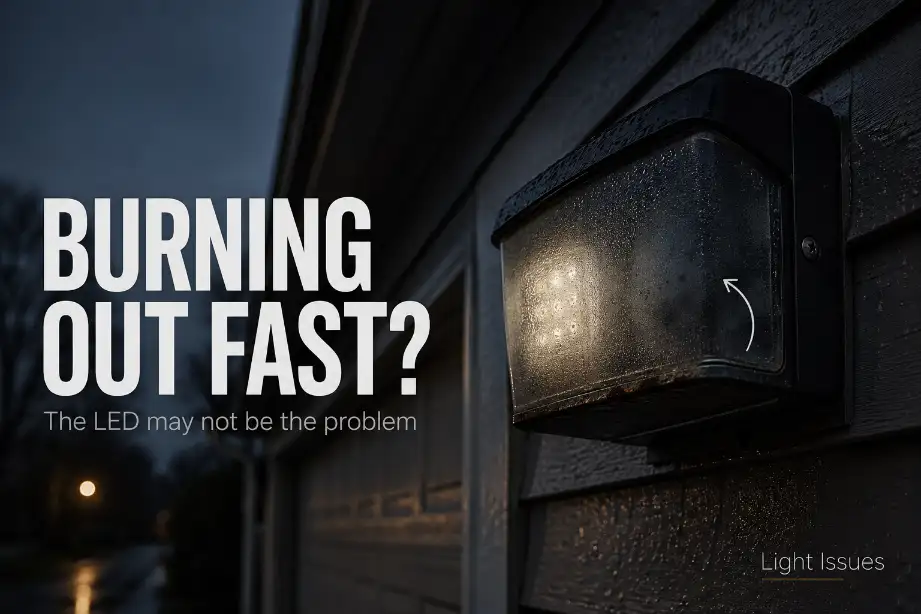
Outdoor LED lights usually burn out fast because the electronics around the LED fail first: the bulb driver, integrated fixture driver, wet splice, weak connection, or control circuit.
Before replacing anything, identify what kind of outdoor LED is failing. A screw-in LED bulb inside a sealed porch lantern has different risks than an integrated motion light or a 12-volt landscape fixture.
Fast failure is not the same as normal aging. A quality LED product may run for years, but a stressed outdoor light can start flickering, dimming, cycling off, or dying completely in 6–18 months.
Start with three checks: whether the light is rated for the location, whether the fixture gets too hot after 30–45 minutes, and whether moisture or corrosion appears inside the lens, socket, box, or splice.
First Identify What Kind of Outdoor LED Is Failing
The phrase “outdoor LED light” hides several different products. Treating them all the same is why many people replace the wrong part.
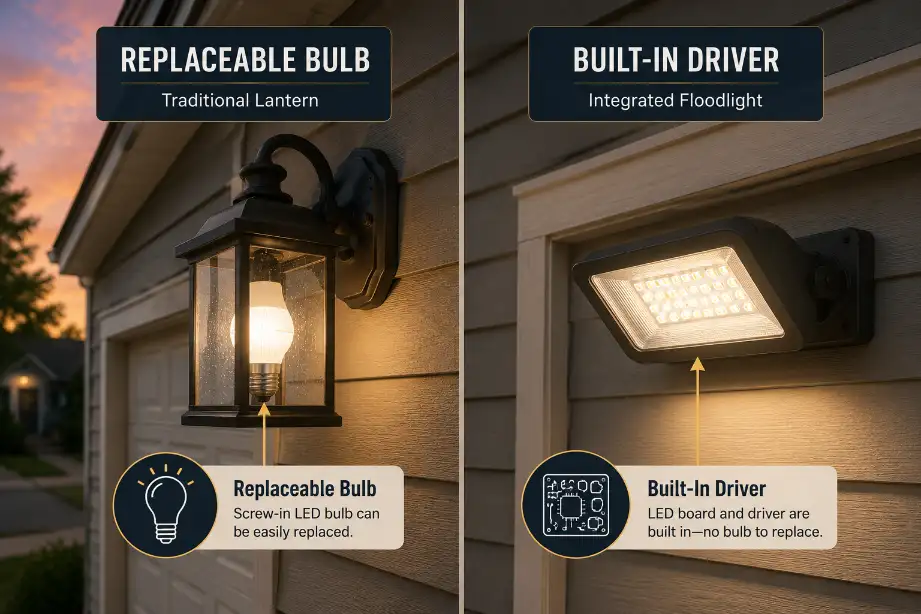
Screw-in LED bulbs
If you have a standard LED bulb inside an outdoor porch light, wall lantern, globe, or jelly-jar fixture, the most important questions are simple: is the bulb rated for outdoor use, and is it rated for enclosed fixtures?
A sealed glass or plastic fixture traps heat. An LED bulb that works fine in an open indoor lamp can fail quickly inside a tight outdoor housing. If the bulb label says “not for enclosed fixtures,” using it in a sealed porch light is a common reason for early failure.
Integrated LED fixtures
Integrated LED floodlights, wall packs, step lights, and motion lights usually do not have a replaceable bulb. The LED board and driver are built into the fixture. When these fail, the problem is often heat, moisture, driver quality, or sensor/control behavior.
If one integrated fixture fails once, replacement may be reasonable. If the same location kills a second fixture, the location deserves more suspicion than the brand.
Low-voltage landscape LEDs
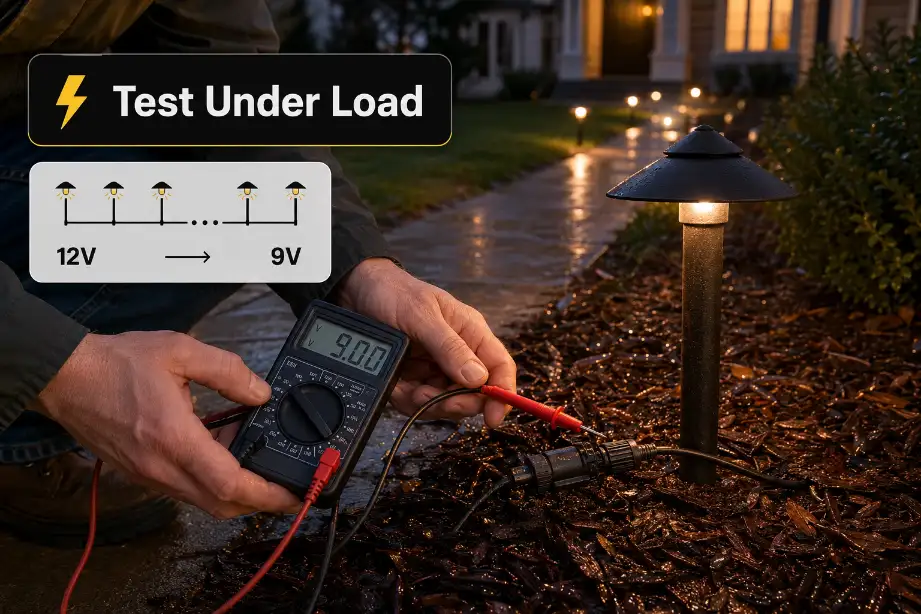
Path lights, garden lights, and accent lights on a 12-volt transformer fail differently. The fixture may not be “burned out” at all. It may be underpowered at the far end of the cable run, sitting in wet soil, attached to a corroded connector, or sharing an overloaded transformer.
A healthy low-voltage system should deliver enough voltage under load at the farthest fixture. If the first light reads close to 12 volts but the last fixture is down near 9–10 volts while the system is on, voltage drop is more useful to diagnose than another lamp replacement.
Check the Rating Label Before You Replace It
The rating label is not a formality. It tells you whether the product belongs in the place where it is being used.
Wet-rated and damp-rated are not interchangeable
Damp-rated lights are meant for protected locations where moisture or condensation may be present, such as covered porches. Wet-rated lights are built for direct rain, sprinkler spray, exposed posts, open walls, and wind-driven water.
This is where homeowners often overestimate the word “outdoor.” A covered entry light in a dry overhang is not under the same stress as a driveway post light, fence light, or wall fixture hit by sideways rain.
If a fixture dies after storms, the problem may be closer to Why Your Outdoor Light Works Fine Until It Rains than ordinary LED lifespan.
Enclosed-rated bulbs matter in porch fixtures
For screw-in LED bulbs, “outdoor rated” is not enough if the bulb sits inside a sealed housing. Heat has to leave the bulb base, where the driver electronics are located. A bulb that is not rated for enclosed fixtures can cook itself in a tight lantern even on a mild evening.
This is one of the most common wasted fixes: replacing a failed LED bulb with a brighter version of the same wrong bulb. More lumens often means more heat, and more heat inside the same enclosed fixture can shorten life even faster.
Dimmers, timers, sensors, and photocells must match
Outdoor LEDs are often controlled by motion sensors, photocells, timers, smart switches, or dimmers. Those controls can make a good LED behave like a failing one when they are incompatible.
Flicker only on a dimmer is usually not LED burnout. Repeated on-off cycling every few seconds or minutes is more likely a control, sensor, or photocell issue.
If the light keeps cycling, the pattern overlaps with Outdoor Motion Light Turning On and Off, especially when the LEDs still work during test mode.
What Looks Like Burnout but Usually Is Not
The visible symptom is simple: the light stops behaving normally. The useful clue is how it fails.
| What you see | More likely than “burned out” | First check |
|---|---|---|
| Shuts off after 10–30 minutes | Driver overheating | Fixture body temperature and trapped heat |
| Works after dry weather | Moisture intrusion | Lens, gasket, wall box, cable entry |
| Fails after rain | Wet connection or GFCI path | Outdoor box, splice, and seal points |
| Flickers only on dimmer | Dimmer or bulb mismatch | LED-rated dimmer and bulb label |
| Farthest landscape lights are dim or dead | Voltage drop | Voltage at first and last fixture under load |
| Turns on and off repeatedly | Sensor or photocell problem | Motion range, photocell aim, and test mode |
The key distinction is symptom versus mechanism. A dim LED section is a symptom. The mechanism may be heat damage to the board, corrosion at an internal contact, a failing driver, or unstable input power. Replacing the visible light does not help much unless the mechanism is corrected.
The Causes That Shorten Outdoor LED Life the Fastest
Not every cause deserves equal attention. Start with the ones that can kill a good LED product early.
Heat trapped inside the fixture
Heat is usually more important than brightness. A bright LED fixture can last if it sheds heat well. A modest LED bulb can fail quickly if it sits inside a small sealed globe with no airflow.
After the light has been on for 30–45 minutes, the housing should be warm, not painfully hot. If you cannot comfortably keep your hand on the outside for more than a few seconds, heat stress is a strong suspect.
This is especially common with small high-lumen fixtures, sun-baked west-facing walls, and hot desert climates in states like Arizona and Nevada.
Integrated LEDs are vulnerable because the driver and LED board are often packed into the same housing. When the driver overheats, the fixture may flicker, dim, shut off after warming up, or fail outright.
Pro Tip: When replacing an integrated outdoor LED, do not choose by lumens alone. A slightly larger fixture with visible heat-sink mass is often a safer choice than a smaller, brighter one.
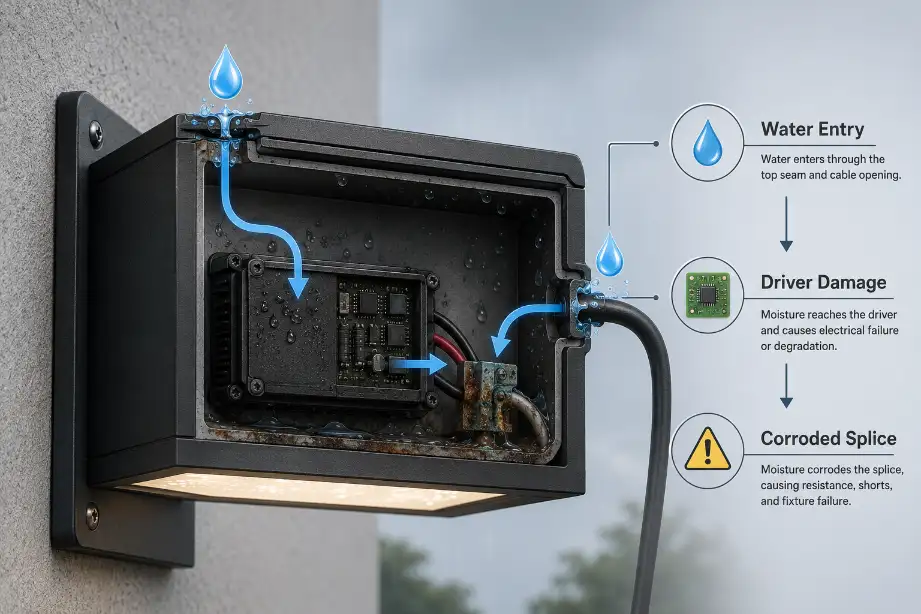
Moisture reaching the driver or splice
Moisture damage is often slow before it is obvious. A little haze inside the lens, rust near a screw, or green-white residue at a connection can be enough to explain repeated failures.
In humid areas such as Florida and the Gulf Coast, moisture may stay inside a fixture long after the rain stops.
In northern states, trapped moisture can freeze, expand, and open small gasket gaps wider over one winter. In coastal areas, salt air speeds up corrosion at terminals, screws, and splices.
If the lens fogs for more than 24 hours after rain, leaves mineral marks, or appears with flickering, treat it as a failure clue, not a cosmetic issue.
Broader moisture patterns are easier to separate in Moisture Damage in Outdoor Lighting Explained, especially when the fixture still works intermittently.
Voltage drop, overvoltage, and surges
Power problems do not all behave the same way. Low voltage usually shows up as dimming, flicker, uneven brightness, or far-end landscape lights failing first.
Overvoltage and surges are more likely to damage electronics suddenly. Loose connections can do both: create heat, flicker, and intermittent shutdown.
For low-voltage landscape lighting, measure while the system is running. A no-load reading can look fine and still collapse when the lights turn on.
If the farthest fixture is several volts lower than the first fixture, the cable run, wire gauge, transformer tap, or splice quality needs attention.
Voltage Drop in Outdoor Lighting Systems is the better diagnostic path when the end of the run keeps failing first.
Storm-prone regions add another layer. Long outdoor cable runs, detached garages, exterior posts, and landscape transformers can all be exposed to damaging voltage spikes.
A surge will not always leave dramatic burn marks; sometimes the driver simply dies early.
Cheap drivers and undersized housings
The LED chips may be capable of a long service life, but the driver, gasket, housing, and connections decide whether that life is realistic outdoors.
Very compact high-output fixtures are often less forgiving because there is little room for heat dissipation or moisture separation.
This is why the cheapest replacement often repeats the same problem. If a fixture offers high lumens, a tiny body, limited weather rating, and a short warranty, the risk is not just cosmetic quality.
The electronics may be operating close to their limits from the first night.
A Practical Test Order Before Buying Another Light
Use this sequence before spending money on another fixture:
- Identify whether it is a screw-in bulb, integrated LED fixture, low-voltage landscape light, or motion/security light.
- Check the label for wet location, damp location, enclosed fixture rating, dimmability, and operating temperature.
- Inspect for moisture: lens fog, mineral trails, rust, green corrosion, wet splices, or water inside the box.
- Run the light for 30–45 minutes and check whether the fixture body becomes excessively hot.
- For low-voltage systems, measure voltage at the first and last fixture while the lights are on.
- If the issue involves flicker or cycling, isolate the dimmer, timer, photocell, or motion sensor before blaming the LED.
- Replace the light only after the stress pattern has been corrected.
This order matters because it avoids the most common waste: replacing the visible LED while leaving the heat, water, control, or voltage problem untouched.
When Buying Another LED Light Is the Wrong Fix
Buying another light is reasonable when one old product fails after years of service. It becomes a poor fix when the same location keeps killing new lights.
Stop replacing and inspect the location
If two fixtures fail in the same spot within a couple of years, the location is telling you something. Look for heat pockets under soffits, direct sprinkler spray, water running down siding into the backplate, poor wall-box sealing, loose wire connections, or a control that cycles the light repeatedly.
A routine swap stops making sense when the failure pattern repeats. New fixtures do not fix wet boxes. New LED bulbs do not fix enclosed-fixture heat. New path lights do not fix a weak far-end voltage reading.
Repair the system when symptoms spread
When several outdoor lights fail together, the individual fixtures are less likely to be the root cause. Multiple failures point toward the circuit, transformer, timer, photocell, GFCI, cable run, or shared connections.
Loose or corroded connections are especially deceptive because they can make LEDs look defective.
If failures move around, change after rain, or respond when wires are touched, Outdoor Lights Working Intermittently fits the pattern better than normal burnout.
For 120-volt exterior lights, stop DIY troubleshooting if you see char marks, smell burning plastic, hear buzzing, find water inside an electrical box, or have repeated GFCI trips.
Those are electrical safety issues, not ordinary LED lifespan problems.
Questions People Usually Ask
Do outdoor LED lights really burn out faster than indoor LEDs?
They can, but usually because outdoor conditions are harder. Heat, moisture, UV exposure, insects, vibration, freezing weather, and long nightly run times all add stress.
A light running 10 hours per night logs about 3,650 hours per year, so a weak fixture or bad installation shows up sooner than it would indoors.
Is condensation inside an outdoor LED light normal?
Brief condensation that clears the same day may not mean failure. Fog that lasts more than 24 hours, leaves mineral marks, appears repeatedly after rain, or comes with flicker is more concerning.
That suggests moisture is staying near electronics, contacts, or splices.
Should I replace the bulb or the whole fixture?
Replace the bulb if it is a screw-in LED and the fixture, socket, gasket, and wiring are sound. Replace the fixture if it is an integrated LED with a failed sealed driver, cracked housing, hardened gasket, or repeated internal moisture.
If the second fixture fails in the same place, inspect the installation before buying a third.
Bottom Line
Outdoor LED lights burn out fast when the LED product is exposed to the wrong stress: trapped heat, water intrusion, weak connections, unstable power, incompatible controls, or poor fixture design.
The fastest way to stop repeat failures is to identify the product type first, then check rating, heat, moisture, voltage, and controls in that order.
If the same location keeps killing lights, the fixture is usually the victim, not the full cause.
For broader official guidance on LED lighting efficiency and use, see the U.S. Department of Energy.