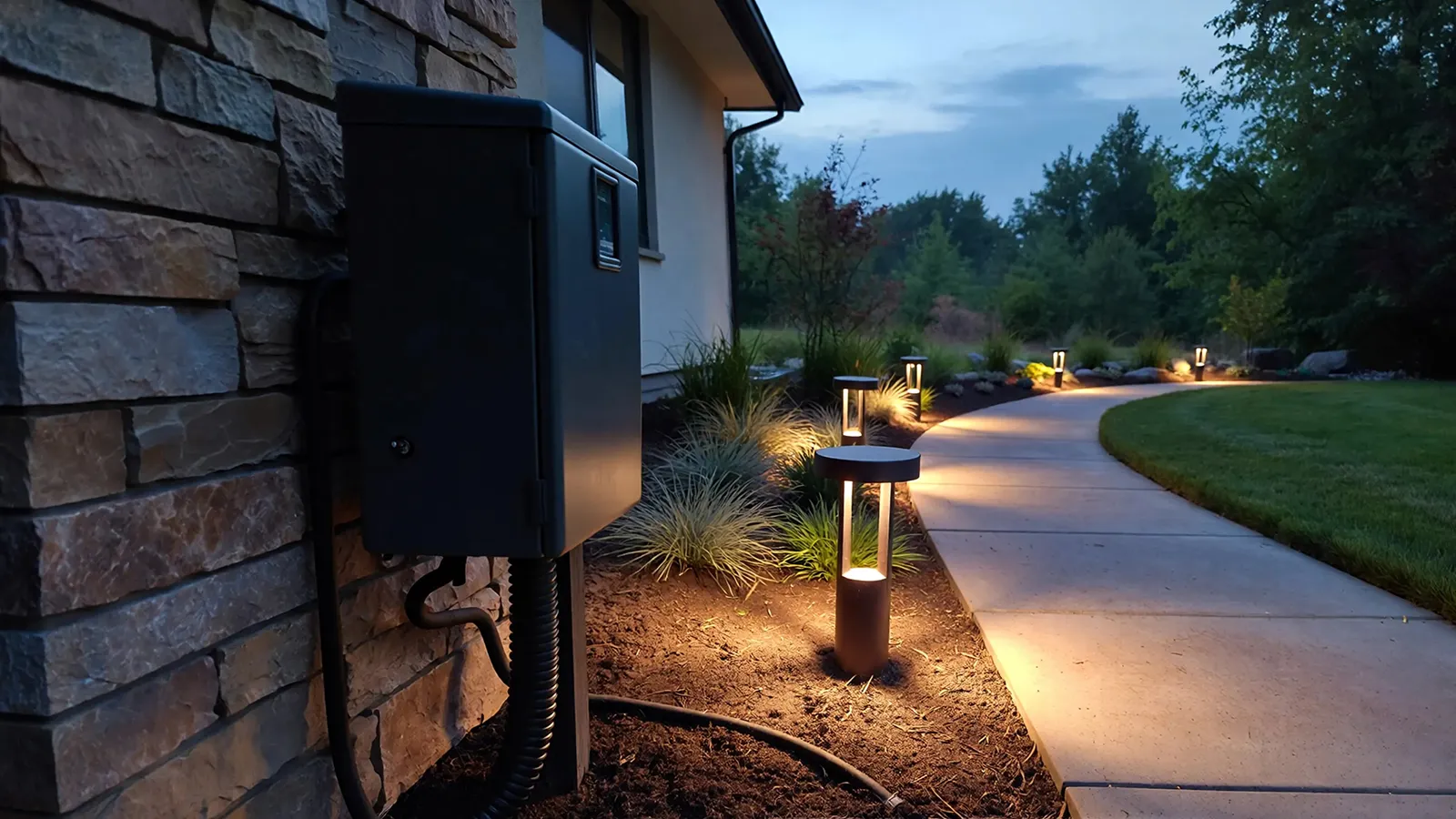
Outdoor lighting rarely fails all at once. It fades unevenly. One path light looks steady. The next looks softer. The far end looks tired.
Most people assume this is fixture aging. Or weather damage. Or bulb quality.
The system is not losing information. It is losing voltage across distance.
The Brightness Difference That Feels Accidental
The yard is not randomly dim. The voltage is thinning along the run.
Homeowners usually notice it while walking. The first few fixtures look clean and defined. By the time they reach the end of the path, the light feels weaker, almost dusty.
What gets misread:
-
“The bulbs at the end must be lower quality.”
-
“Maybe that fixture is defective.”
-
“It’s just normal aging.”
The brightness difference is not random decay.
It is electrical pressure reducing across wire length.
That reduction is gradual. It does not trigger alarms. It does not shut the system down. It simply reduces intensity in ways that look natural.
The misunderstanding happens because the system still works.
Why the Problem Hides in Plain Sight
The system is not underpowered. It is unevenly distributed.
Low-voltage lighting runs on narrow margins. A small voltage drop matters more in a 12-volt system than in a 120-volt circuit. Losing one volt is not theoretical. It shows up visually.
You feel it while turning at a corner of the walkway.
You see it when pausing at the entry and looking back down the path.
The foreground feels crisp. The distance feels flat.
What makes this easy to misread:
-
The fixtures still turn on.
-
The color temperature looks similar.
-
Nothing appears “broken.”
Nothing dramatic happens.
The energy simply arrives weaker at the far end.
A tripped breaker, bad bulb, or wiring issue could all explain why your outdoor lights stopped working unexpectedly.
The Length Miscalculation
The yard is not too large. The cable path is longer than assumed.
People think in straight lines. The transformer to the last fixture looks like 60 feet. The actual electrical loop is double that because the current travels out and back.
That invisible doubling shifts everything.
Common spatial misreadings:
-
Measuring only visible distance.
-
Ignoring branch splits.
-
Adding fixtures later without recalculating.
The voltage drop is not a surprise. The length was underestimated.
The misreading is about distance, not equipment.
Wire Gauge and Visual Weight
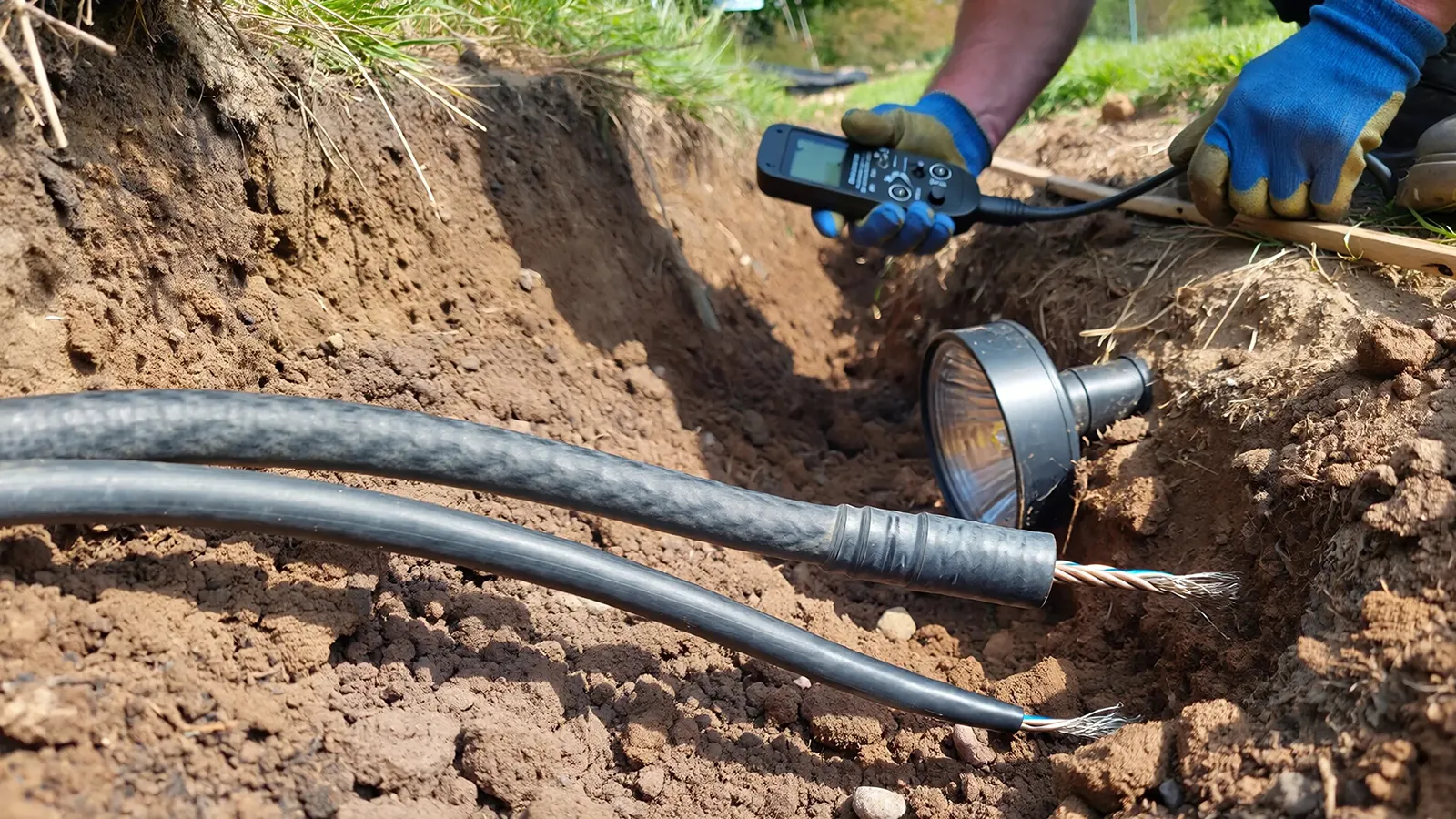
The cable is not invisible in effect. Its thickness determines resistance.
A thinner gauge wire carries more resistance across distance. That resistance converts voltage into heat before it reaches the fixture. The fixture does not fail. It simply receives less pressure.
This becomes noticeable when:
-
Walking from bright entry lights toward backyard accents.
-
Reaching across a patio table where perimeter lighting feels softer.
-
Standing at the driveway and noticing uneven edge definition.
The yard does not feel darker overall.
It feels uneven in weight.
That unevenness is electrical loss translated into perception.
Parallel Misreadings That Create Friction
The transformer is not too small. The load is uneven.
Voltage drop often appears after expansion. A few additional fixtures get tapped into the nearest line. Nothing seems overloaded. The lights turn on.
But spatial friction increases.
You notice:
-
Bright zones near the house.
-
Softer zones farther away.
-
Subtle shifts when additional fixtures activate.
It feels like inconsistency.
It is distribution strain.
| What You Think | What Is Actually Happening |
|---|---|
| “The last lights are aging faster.” | They are receiving lower voltage. |
| “That section must have moisture damage.” | The voltage has dropped across length. |
| “The transformer is failing.” | The load is imbalanced across runs. |
| “LED quality varies.” | Driver tolerance is reacting to voltage variance. |
The issue is not lack of information.
It is a misreading of what matters in the system.
When the System Appears to Be Aging
The fixtures are not deteriorating uniformly. The distribution is weakening.
Over time, connectors add resistance. Small corrosion points build. Expansion adds load. Each change is reasonable in isolation.
Walking through the yard months later, the difference feels like time.
It is not time alone.
It is accumulated resistance across distance.
This is why systems that “used to look fine” start feeling uneven without any visible breakage.
The real constraint is voltage delivered at the fixture.
And that constraint is rarely measured.
When Brightness Feels Like a Size Problem
The yard does not suddenly become larger at night. The distribution pattern changes how distance feels. When the first fixtures are bright and the last ones are soft, depth perception stretches unevenly. The space begins to feel longer than it actually is.
Walking down a lit path reveals this distortion clearly. The entry appears defined. The middle feels transitional. The far edge seems to recede more than it does in daylight.
This is where interpretation shifts. The assumption becomes spatial: “The yard might be too big for this setup.” But the footprint has not changed. The light pressure has.
The real constraint is voltage consistency across distance.
The space is not oversized. The illumination is uneven.
When the Layout Feels Off but Nothing Moved
The fixtures are not misplaced. The electrical balance is shifting.
A patio that once felt cohesive can start to feel segmented. The seating area looks well lit, but the perimeter appears softer. When adjusting a chair or reaching across a table, you notice subtle variation at the edges.
It is easy to attribute this to layout decisions:
-
“Maybe the fixtures are spaced too far apart.”
-
“Maybe we need more lights in that corner.”
-
“Maybe the transformer is aging.”
The friction is perceptual, not geometric.
The distribution has thinned along the run.
Why Does My Outdoor Lighting Look Uneven Even Though All Fixtures Work?
Why do my landscape lights get dimmer toward the end of the cable run?
The brightness difference often follows cable length rather than fixture quality. As voltage travels through wire, resistance reduces the pressure available at each downstream fixture. The last lights are not weaker by design. They are supplied differently.
This becomes more noticeable when:
-
The run exceeds the original plan.
-
Additional fixtures are added later.
-
Thinner gauge wire was used for convenience.
The assumption focuses on product quality.
The pattern points to distribution physics.
Can voltage drop make outdoor LED lights look different in color?
LED drivers attempt to regulate output within a voltage window. When supplied voltage approaches the lower edge of that range, the driver compensates. That compensation can subtly affect brightness and perceived tone.
The color difference is rarely dramatic. It appears as:
-
Slight warmth at one end.
-
Slight crispness at the other.
-
Uneven edge definition when viewed from a distance.
It looks like product inconsistency.
It is input variance.
Why do my pathway lights seem bright near the house but softer farther away?
This pattern reflects cumulative resistance along the cable. Each fixture draws current. As current increases, voltage drop increases. The system may still operate within functional limits, but perceptual balance changes.
Walking from the entry toward the yard edge reveals the gradient clearly. Pausing and looking back shows the front section feeling more defined.
The yard has not expanded.
The voltage has tapered.
Is my transformer failing if brightness changes when more lights turn on?
When additional fixtures activate, total load increases. Increased load raises current. Increased current increases voltage drop across the same wire length.
What appears as instability may simply be the system operating closer to its electrical margin. The transformer may still be functioning within specification.
The instability is not random.
It is load-sensitive distribution.
Diagnosing Without Replacing Fixtures
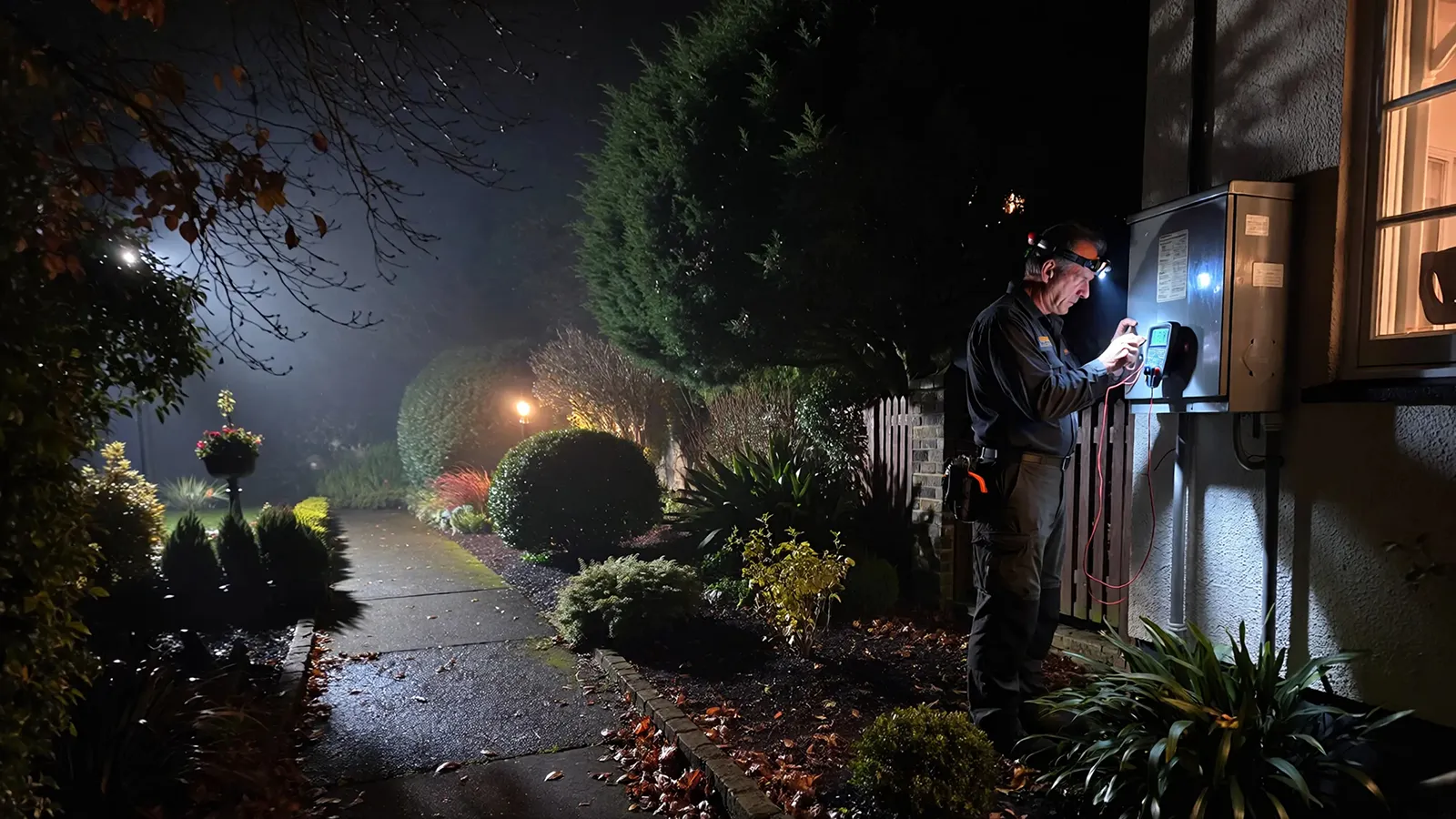
The fixtures are not necessarily defective. The system may be operating at uneven voltage levels.
Measuring voltage at the transformer and comparing it to readings at the farthest fixture reveals whether the brightness shift matches electrical drop. The numbers often explain what perception already sensed.
Multiple measurement points help clarify whether the drop is gradual or concentrated at a connection. If readings shift significantly between two adjacent fixtures, resistance may be localized.
The real constraint is delivered voltage under load.
Without that measurement, interpretation defaults to hardware replacement.
When Expansion Quietly Changes Everything
The system is not failing. It has been incrementally stretched.
Adding a few lights to an existing line seems harmless. Each addition increases load slightly. Over time, the accumulated demand narrows the voltage margin across distance.
You notice:
-
Subtle dimming at the far end.
-
Slight fluctuation when timers activate.
-
Increased contrast between zones.
Nothing dramatic signals overload.
The distribution is simply operating closer to its limit.
The pattern continues quietly until interpretation shifts again.
And that shift becomes sharper when environmental factors and long-term resistance build-up enter the picture.
Long-Term Material Degradation and Resistance Build-Up
Outdoor lighting systems do not lose balance suddenly. They settle into imbalance through repetition. What first appeared as slight variation begins to hold its shape across weeks and seasons.
Moisture exposure, soil chemistry, and temperature cycling gradually increase resistance at connection points. These influences do not fluctuate randomly. They accumulate and remain embedded in the system even when surface conditions change.
A colder evening may soften output slightly. A humid night may alter performance at the margins. When those shifts reverse with weather changes, the system is reacting to conditions.
When the dimming remains in the same fixtures across dry and wet cycles, across mild and cold temperatures, the pattern is no longer environmental. It is structural.
The constraint is cumulative resistance within the distribution path.
Driver Behavior and Persistent Imbalance
LED drivers attempt to regulate current within a defined input range. Minor voltage variation can produce temporary flicker or delayed startup. That behavior may seem inconsistent when tied to timer activation or load cycling.
But when the same fixtures repeatedly show compensation behavior while others remain stable, repetition replaces uncertainty. The variation is no longer random. It is position-dependent.
This persistence reveals the internal pattern. The fixtures are responding predictably to reduced delivered voltage. The distribution path defines the outcome.
Temporary fluctuation fades with changing conditions. Structural imbalance repeats regardless of them.
Zone Expansion and Load Memory
Expansion rarely feels dramatic. Additional fixtures are integrated into existing lines, and the system continues to function. No immediate shutdown occurs. The yard remains illuminated.
Over time, however, the system reflects its cumulative load history. The farthest fixtures consistently receive less voltage than before. The difference does not disappear on cooler nights or after rainfall.
What once appeared as occasional softness becomes a stable gradient. The system remembers its added demand.
The layout has not changed.
The electrical distribution has been stretched.
When Repetition Becomes a Threshold
Observation eventually reaches a limit. When instability persists across changing conditions, evaluation replaces assumption.
Certain markers indicate that the system is no longer operating within comfortable tolerance:
-
Noticeable heat at connectors or transformer housing.
-
Faint electrical odor near connection points.
-
Visible insulation discoloration or surface degradation.
-
Repeated interruption in the same fixtures despite stable weather.
-
Subtle structural displacement of buried wiring after seasonal shifts.
These are not dramatic failures. They are transition signals.
They mark the shift from perceptual variation to embedded strain.
Recognition Without Escalation
Structural voltage imbalance does not need urgency to be understood. It reveals itself through consistency. The same fixtures dim. The same positions flicker. The same gradient repeats.
Environmental fluctuation passes. Structural resistance remains.
The difference becomes clear not through instruction, but through pattern stability. When brightness variation persists independent of weather, load timing, or seasonal change, interpretation gives way to confirmation.
The system communicates its condition through repetition.
And repetition removes ambiguity.
electrical measurement standards: https://www.nist.gov/