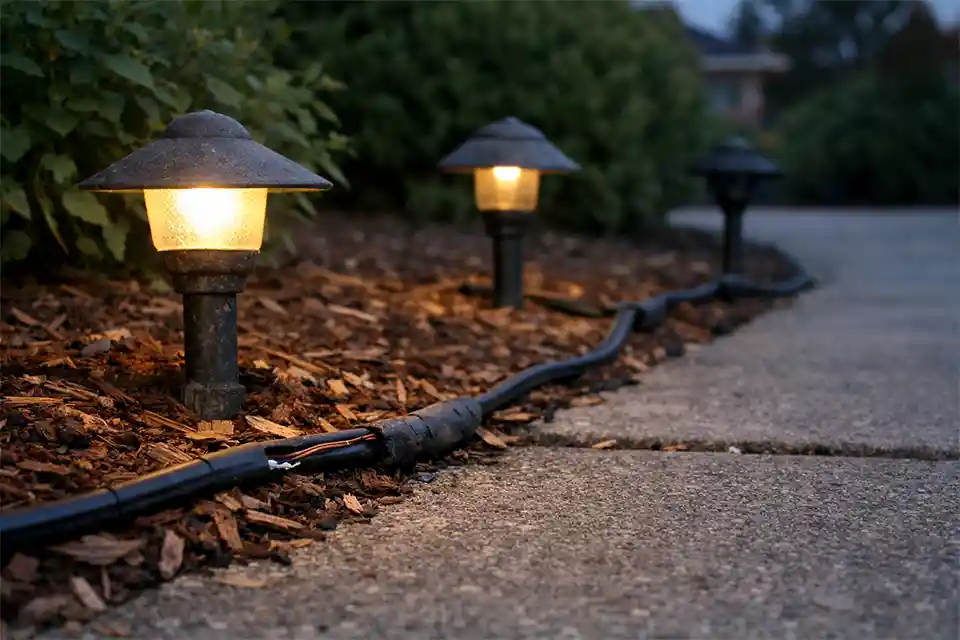
Aging outdoor wiring usually shows up as a pattern before it becomes a full outage. The last fixtures get weak first. Brightness changes after rain or irrigation. One repair seems to help, then another part of the same run starts failing a few weeks or months later.
If that has been happening over the last 6 to 18 months, the problem is usually not “a bad light.” It is usually resistance building through old cable, wet splices, or conductor damage that the system can no longer absorb.
The first checks should answer three questions fast. Is the weakness limited to one fixture or does it affect the run? Does fixture voltage stay in a usable range, or is the far end dropping below about 10.5 volts on a 12-volt system?
And are you looking at one damaged spot or a line that has started aging in multiple places? Those distinctions matter more than swapping bulbs. A timer or photocell fault tends to cut power cleanly. Aging wiring usually weakens the run unevenly first.
Quick Diagnostic Checklist
- The first fixture looks normal, but the last two or three are visibly dimmer
- Light output changes after rain, irrigation, or 24 to 48 hours of drying
- The system is roughly 8 to 15 years old with original buried splices
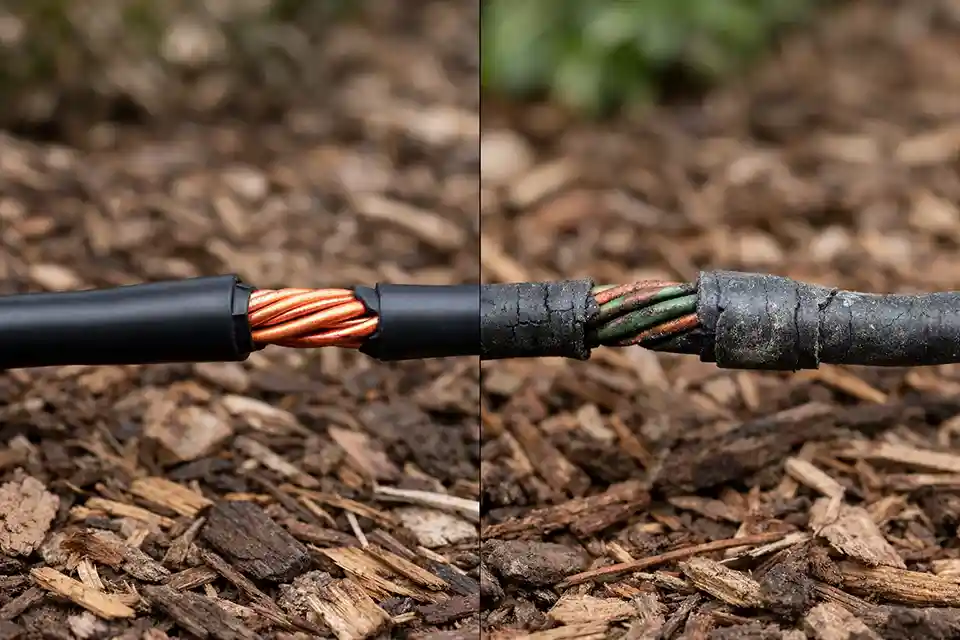
- Wire insulation feels stiff, cracks when bent, or looks faded and chalky
- Copper is dull, green, or blackened instead of clean and bright
- Transformer voltage looks acceptable, but end-of-line fixtures fall below about 10.5 volts
- One repair helps briefly, then another section on the same run starts acting up
What This Problem Usually Looks Like in Real Life
The fixture is often the first thing people replace because it is visible. That is also why it gets blamed too often. On older outdoor runs, the more useful suspicion is usually the hidden part of the system: buried splices, shallow cable, hardscape crossings, and any section that has spent years in wet soil.
There is a practical way to separate a local defect from a wiring problem. If one fixture is dead and the rest of the run is stable, that can still be a fixture issue. If several fixtures on the same path are weak, intermittent, or fading in order, wiring deserves priority over the fixture head.
Splices fail earlier than many people expect because they can still pass current after they have already become unreliable. That is what makes this problem easy to misread. The light still comes on, so the connection feels “basically okay.” But once corrosion reaches the contact area, resistance rises and the system starts losing margin.
That is why a run can look acceptable at turn-on, then fade after 10 to 20 minutes. If the trouble clusters around joins and buried taps, corroded wire splices outdoors is a more accurate diagnosis than replacing another fixture.
The Three Failure Patterns That Matter Most
Not every old outdoor cable fails the same way. That is where a lot of articles stay too vague. In practice, most aging wiring trouble falls into three buckets, and they do not deserve equal attention.
1. Moisture-accelerated decline
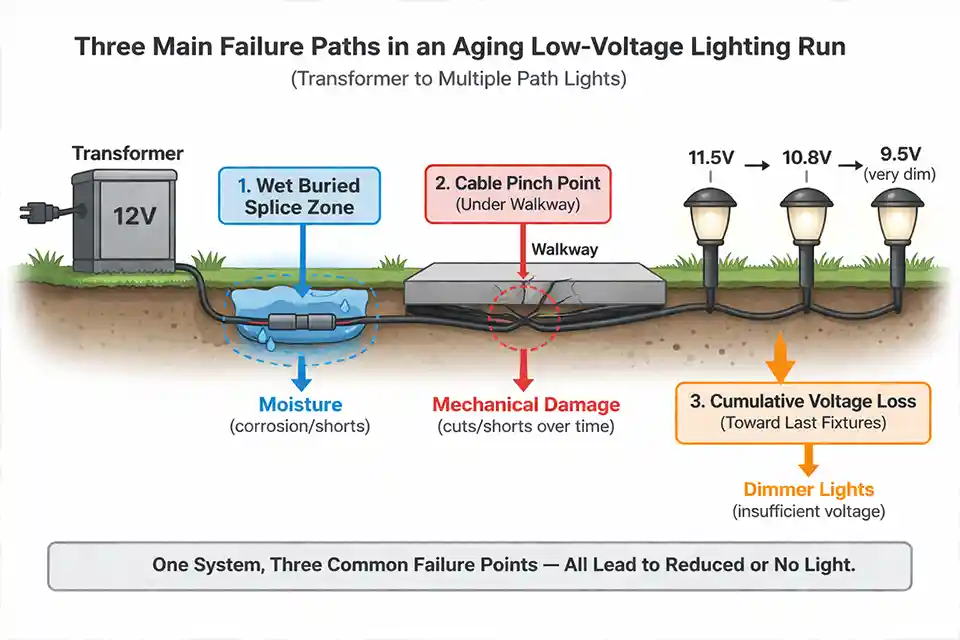
This is the most common pattern. A buried splice or cable entry point stays wet for 24 to 72 hours after rain, or gets regular irrigation on top of that. The line may still work in dry weather, then weaken again after the next wet cycle. People often treat that as a weather problem when it is really an aging connection that dry conditions temporarily hide.
2. Mechanical damage that aged into a bigger problem
This is the section that gets nicked by edging, squeezed under pavers, stressed by frost movement, or gradually disturbed by roots. The cable is not always cut. More often it is damaged enough to raise resistance over time.
If the weakness starts after a walkway crossing or one landscape zone, outdoor lights losing power under walkways and driveways is closer to the real cause path than a generic age diagnosis.
3. Cumulative voltage loss on a weakened run
This is where several small weaknesses start acting like one large one. A healthy 12-volt run can often tolerate modest drop and still look fine. An older run with two or three weak splices usually cannot.
Around 10.8 to 12 volts at the fixture is commonly workable. Once the far end is living near 10.5 volts or below, dimming becomes much easier to see. At that point, the issue is not just wire age. It is wire age plus reduced electrical tolerance.
The reason this ranking matters is simple: people often overestimate “old fixture failure” and underestimate how often aging splices and aging cable combine into one system-level problem.
Where Your System Probably Is Right Now
One thing this topic needs, and many articles skip, is a useful stage check. Aging wiring does not go from healthy to dead in one step.
| Stage | What you usually see | What usually makes sense |
|---|---|---|
| Early decline | Slight dimming at the far end, minor instability after rain, no full outage yet | Test voltage and rebuild obvious weak splices |
| Mid-stage decline | Repeated dimming, intermittent sections, visible corrosion or brittle insulation | Repair isolated damage only if the rest of the run still tests well |
| Late-stage decline | Multiple weak points, several repairs in one year, end-of-line voltage consistently too low | Replace main cable sections and rebuild taps |
This matters because readers often ask the wrong question. They ask, “Can this be repaired?” Almost anything can be repaired once. The better question is whether repair still changes the outcome. In early decline, it often does. In late-stage decline, it often does not.
That is the point where voltage drop in outdoor lighting systems stops being just a layout issue and starts reflecting deterioration. The line is not simply long. It is weaker than it used to be.
The Repair Order That Actually Saves Time
Start with loaded testing, not visual guessing. Measure transformer output with the lights on. Then check the first fixture, one mid-run fixture, and the last fixture. A drop of around 1.5 volts across a moderate residential run deserves attention. A drop of 2 volts or more usually matches visible dimming.
Next, inspect every accessible splice. Rebuild wet or corroded joins with direct-burial connectors rated for outdoor use. Taped connections are not serious outdoor repairs, even if they still look tidy. And do not mistake a cleaner-looking splice for a healthy one. The condition of the conductor where contact happens matters more than how neat the outside looks.
After that, move to the physical route. Focus on shallow burial, bed edges, root-heavy areas, and hardscape crossings. If one section is clearly compromised and the rest of the cable still behaves normally, replace only that section.
If you keep finding brittle insulation, weak copper, or unstable voltage in more than one place, stop patching. You are no longer fixing a defect.
You are managing decline. That is where loose outdoor wiring connections and how to fix them safely and permanently and underground lighting cables damaged: causes, signs, and how to fix them become useful in combination, because old wiring problems are often part connection issue and part cable-path issue.
Pro Tip: If one rebuilt splice improves brightness only a little, that often means you repaired the nearest weak point, not the only weak point.
When Repair Stops Being the Smart Answer
This is the part people usually resist. They assume replacement is the “expensive” answer and repeated repair is the economical one. With aging outdoor wiring, that flips faster than people expect.
| Condition | Smarter move | Reason |
|---|---|---|
| One known damaged section after digging or edging | Replace that section | The failure is still local |
| One failed splice, cable otherwise flexible | Rebuild the splice | The run may still have useful life |
| Several weak fixtures with normal transformer output | Trace and test the run | The loss is happening downstream |
| Brittle insulation in multiple exposed sections | Plan replacement | Insulation failure is no longer isolated |
| Multiple repairs on the same run within 12 months | Replace cable and taps | Labor is now chasing a pattern |
What people often overestimate is the value of one more patch. What they underestimate is how much old cable loses tolerance. Once the run has become sensitive to minor moisture, minor looseness, and normal weather swings, the system is already telling you that the margin is gone.
That same pattern sits behind why outdoor lights stop working over time. The issue is usually not one dramatic break. It is a run that can no longer carry the load cleanly from start to finish.
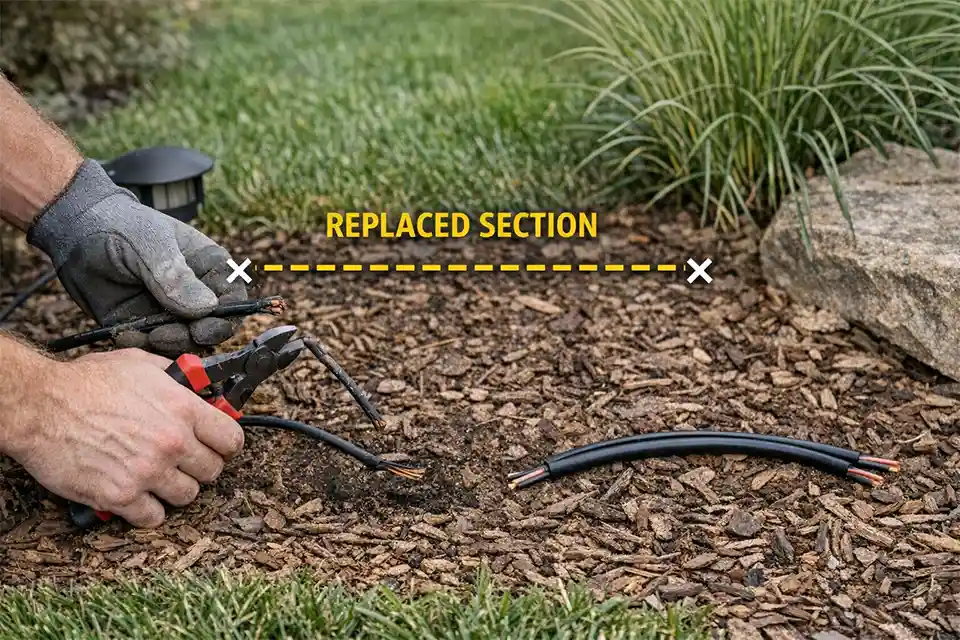
The practical answer is simple. Repair makes sense when you can still point to one real weakness. Replacement makes more sense when the same run has started producing several.
Once you are there, more patching usually feels productive for a short time, then costs more than it saves.