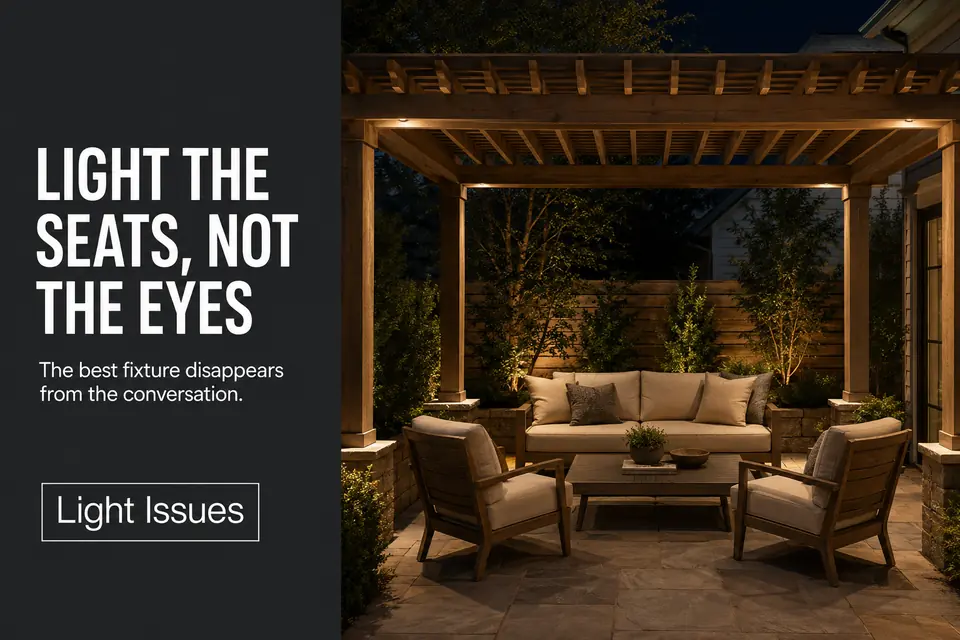
The best pergola lights for soft seating are not simply the warmest or least powerful options. They are the fixtures that reveal faces, drinks, cushions, and nearby walking edges without remaining conspicuous from the chairs.
The seating layout should determine the product category. String lights accommodate furniture that moves. A pendant makes more sense over a permanent table. Downlights suit a finished roof where light can be aimed between occupied positions.
Buying by style before resolving that relationship is how an attractive fixture becomes uncomfortable after installation.
A quick way to narrow the decision:
- Start with diffused string lights when the seating moves or needs broad ambient coverage.
- Consider a deep-shade pendant when the pergola has one permanent table or sectional arrangement.
- Use shielded wide-beam downlights when the roof, wiring, and furniture positions are fixed.
- Reject any option whose bulb, LED disk, or concentrated beam remains obvious from a normal chair.
Warm color and dimming improve these categories, but neither can correct the wrong fixture position.
Best String Lights
String lights are the strongest general-purpose option for informal pergola lounges. They spread modest light across a larger area and do not depend on a coffee table remaining directly beneath one fixture.
That flexibility matters when chairs move for parties, dining, or additional guests. A small furniture adjustment rarely takes the seats entirely outside the useful light. String lights can also follow the perimeter or upper beams, leaving the central view relatively open.
The buying risk is repeated glare. A dense zigzag may produce dozens of visible bright points against the dark yard. Even low-output bulbs become distracting when several runs cross between people seated opposite one another. Dimming lowers their intensity but does not remove them from the sightline.
For softer seating, filter potential sets by five characteristics:
- Frosted or diffused bulbs instead of clear exposed filaments
- Dimming compatibility
- Restrained output from each bulb
- Enough cable length for a perimeter-led route
- Outdoor-rated sockets, cable, controller, and connections
Spacing cannot be judged separately from mounting height. Tighter spacing can work when the entire run stays high above the chairs. A lower pergola usually needs a simpler path and fewer visible bulbs.
Sit in the principal chairs before selecting the length. Trace the proposed cable route and look toward the seats opposite. If the line would repeatedly cross that view, buying dimmer bulbs will not solve the basic layout problem.
The diagnosis of string lights under pergolas that glare explains why bulb position can matter more than total brightness.
If the pergola is open, the furniture changes position, and no single table needs concentrated light, diffused strings offer the most forgiving starting point. Clear bulbs and tightly packed decorative runs work against that advantage.
BEST FOR FLEXIBLE LOUNGE SEATING
Diffused Dimmable Pergola String Lights
Broad ambient coverage for open or medium-height pergolas where the cable can remain above seated views. Prioritize a calm routing path and modest individual bulbs rather than the densest available set.
🟦 SHOP outdoor-rated dimmable pergola string lights with diffused bulbs
Best Pendant Lights
Pendant lights make a stronger buying case when the pergola has a permanent center. A fixed dining table, coffee table, or sectional arrangement gives the downward light a useful surface to reach.
The decisive feature is shade geometry, not decorative style. A deep opaque shade hides the bulb from lateral views and directs more output toward the table. A diffused lower panel can soften the bright opening further. Clear glass and exposed filament designs do the opposite: they leave the lamp visible from almost every chair.
Mounting height must be assessed while sitting down. A pendant may provide sufficient standing clearance yet appear directly behind the face of the person across the table. Reclined lounge chairs make this problem more likely because their viewing angle rises toward the fixture.
Furniture movement is the main reason not to buy a pendant. Its pool of light remains fixed even when the table or chairs move. If the pergola changes regularly between dining, lounging, and open-floor use, broad string lighting is more adaptable.
A suitable pendant should provide:
- A deep shade that conceals the bulb from the side
- Downward distribution toward the table
- A diffused or recessed lower opening
- Dimming compatibility
- Proportions appropriate for the mounting height
- A damp- or wet-location rating suited to the actual exposure
A pergola roof does not automatically create an indoor environment. Open sides, roof gaps, condensation, and wind-driven rain may still expose the fixture and its electrical connections to moisture.
The decision threshold is straightforward: select a pendant only when its target surface and viewing positions will remain stable. When that condition is met, a deep shade supplies useful table light without placing an exposed lamp at the center of every conversation.
BEST FOR A PERMANENT TABLE OR SECTIONAL
Deep-Shade Outdoor Pendant Light
Controlled downward light for one fixed seating group. Check the shade from seated eye level and reject designs that reveal the bulb through clear glass or a shallow opening.
🟦 SHOP AFX Apex diffused pendant for covered pergolas

Best Downlights
Downlights suit roofed pergolas where an uncluttered ceiling matters and the furniture positions are predictable. They can support a coffee table, serving counter, entrance, or circulation point without adding hanging cables or decorative bulbs.
They become a poor seating choice when selected like architectural spotlights. A narrow beam centered over a chair can create a hard pool across someone’s head and shoulders. The tabletop may look bright while facial shadows become deeper and the surrounding seats remain disconnected.
Source depth is equally important. A deeply recessed LED is harder to see from an angle than a flush luminous disk. Wider distributions also create calmer transitions when adjacent beams overlap slightly. A ceiling filled with isolated narrow spots tends to resemble a retail display rather than a residential lounge.
Adjustable fixtures are helpful only when the available mounting positions allow the beams to miss faces. If every possible aim still lands on an occupied chair, adjustment is not a meaningful benefit.
Compare downlight categories using:
- A recessed or deeply shielded light source
- A wide or medium beam instead of a narrow spotlight
- Compatible dimming
- Glare-control trim or louvers
- An outdoor rating appropriate for the roof
- Replaceable components where practical
Beam angle must be considered with mounting height. A beam has more distance to spread beneath a tall roof. The same specification mounted close to the seats may still form a concentrated patch. Product diagrams therefore need to be compared with the real fixture-to-furniture distance.
The article on pergola downlights that hit faces covers the detailed relationship between beam angle and chair position. At the buying stage, reject narrow beams above occupied seats and shallow sources that remain visible when someone leans back.
Downlights become the strongest option when permanent wiring already exists, the ceiling is high enough for useful beam spread, and the furniture will not continually move beneath the fixtures.
BEST FOR A FINISHED ROOF AND FIXED LAYOUT
Wide-Beam Shielded Outdoor Downlights
Clean overhead lighting for predictable seating and table positions. Look for recessed source control and gentle beam overlap; avoid narrow spotlights centered over chairs.
🟦 SHOP Juno deep-regressed canless outdoor downlights
Best Warm Options
Warm color should refine the chosen fixture category rather than decide it.
For most residential pergola seating, approximately 2700K provides a familiar warm-white appearance. Products around 2200K create a more amber decorative effect and often suit string-light canopies. Neither value guarantees comfort.
A clear 2200K filament can remain harsh when it is directly visible. A shielded 3000K source may feel calmer because the bright component is concealed. Position and source control take precedence over the Kelvin number printed on the package.
Color consistency also matters when combining fixture types. Amber strings above substantially cooler downlights can divide the pergola into unrelated visual layers. A small deliberate difference may work, but mixing products without checking their appearance can make the seating area feel unsettled.
Dimming is more useful than elaborate color effects for most lounges. The output needed while food is being served may be excessive once guests settle into conversation. Confirm compatibility across the bulbs, fixture, driver or power supply, and dimmer—not just one component.
DarkSky’s home lighting guidance supports warm outdoor light alongside shielding, careful direction, and using only the amount required. Warm color supports a comfortable layout; it does not replace one.
Use this section as a final filter on the string, pendant, or downlight category already selected. It should not create a fourth buying path.
Best Low-Glare Fixtures
“Low glare” is not a dependable product category by itself. It is a claim that must be verified through the fixture’s physical design.
The most convincing options conceal or enlarge the bright source:
- Deep pendant shades block lateral views of the bulb.
- Recessed downlights lift the LED above the visible ceiling plane.
- Frosted string-light bulbs spread output across a larger surface.
- Louvers restrict light at uncomfortable viewing angles.
- Dimming reduces the installed output after the physical glare controls are in place.
Inspect side and underside product images. Lifestyle photography often shows a fixture from standing height or from outside the pergola. That view says little about what a person will see while leaning back in a lounge chair.
If the product images clearly expose a bare bulb, LED board, or small bright lens, assume it will attract greater attention against a dark evening background. Terms such as “soft,” “warm,” and “comfortable” should not outweigh visible evidence of poor source control.

The three recommended product paths remain different, but the low-glare test is the same for all of them: the useful surfaces should be easier to see than the lamps themselves.
What Not to Buy
Do not start with maximum lumen output. Pergola seating rarely needs a fixture intended to flood an entire backyard. Excessive central brightness can intensify table reflections, deepen the apparent darkness beyond the structure, and make every exposed source harder to ignore.
Clear-glass fixtures require particular caution. Their transparency may look visually light during the day, but it leaves the bulb fully exposed at night. Decorative filament bulbs are not automatically soft merely because they use warm light.
Avoid narrow architectural spotlights when the beams cannot miss occupied positions. A product designed to accent a column or tree can create a hard patch across a face, pale cushion, or reflective tabletop. An adjustable head adds little value when the mounting point still forces it toward a chair.
Do not rely on the word “dimmable” to rescue weak source control. Dimming can reduce intensity, but an exposed lamp may remain a conspicuous bright object against the darker yard.
Indoor-rated products should not be installed simply because part of the pergola has a roof. Fixtures, cords, connectors, controllers, and power supplies must all suit the moisture conditions they will actually encounter.
Finally, resist ordering a complete system before testing the main viewing positions. Reproduce the proposed height and direction temporarily where practical. Sit in every chair, look across the table, lean back, and approach from the yard.
If the furniture moves, diffused string lights provide the greatest tolerance. If the table remains fixed, a deep-shade pendant can put light where it is needed.
If the ceiling and seating positions are permanent, shielded wide-beam downlights offer the cleanest integrated result.
The correct category becomes apparent from the layout long before decorative style enters the decision.