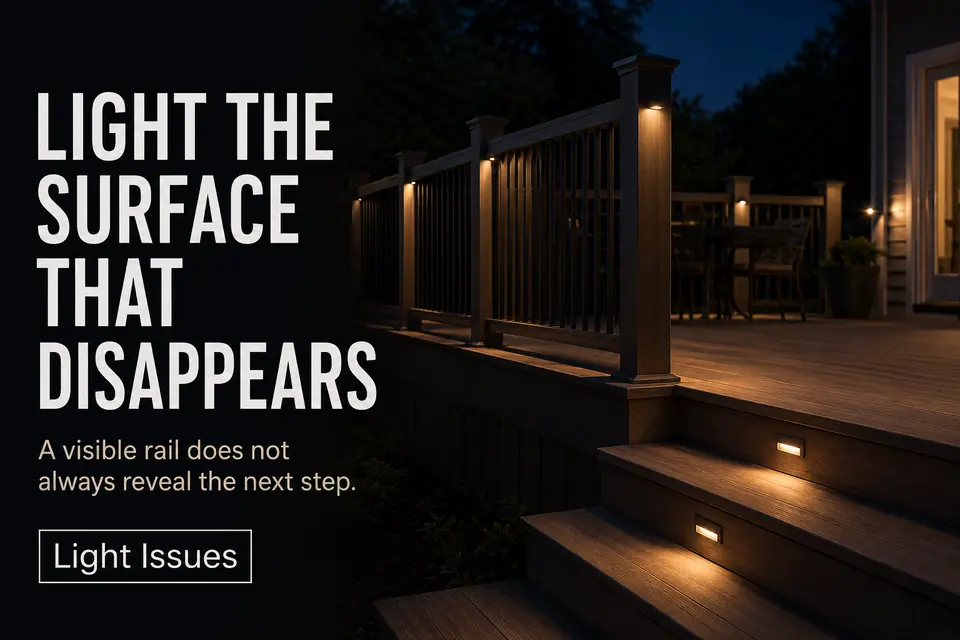
Deck rail lights and step lights can produce a similarly restrained glow while giving the eye completely different information. Rail lights generally define a guarded perimeter and part of the floor beside it. Step lights concentrate on elevation changes, landings, and the sequence of individual treads.
The useful comparison is therefore not which fixture looks more attractive. It is which necessary surface disappears after dark.
A glowing railing can locate the staircase without revealing the next tread. Clearly illuminated steps can reconnect an elevation change while leaving the circulation strip behind perimeter seating disconnected. Adding output from the wrong position usually makes the fixture more noticeable, not the missing surface more readable.
Choose rail lights when the unresolved problem follows the deck boundary. Choose step lights when it follows a change in level. Combine them only when the deck contains both problems as separate visibility jobs.
This surface-first decision also keeps a focused comparison from becoming a diagnosis of every possible patio and deck lighting problem. The question here is narrower: which low-level position reaches the surface that people need to recognize?
Rail Light Role
Choose rail lighting when visibility needs to follow the perimeter rather than descend the stair flight.
A functional rail light directs controlled light toward the deck from a railing post, rail assembly, or comparable elevated position. This is different from a decorative post-cap fixture that primarily makes the top of a post glow. Because the term “rail light” covers several fixture forms, the direction of the light matters more than the category name.
Seeing a luminous railing is not the same as seeing the floor beside it.
Light sent downward from railing height can spread across a broader section of deck than light mounted near a stair riser. That spread makes rail lighting useful along guarded edges, circulation routes beside railings, and seating positioned near the perimeter. It can visually connect the rail structure, deck boundary, and adjacent floor without making the entire yard uniformly bright.
The elevated position creates its main limitation. Posts and balusters can divide the spread. Chairs near the railing may block it at floor level, and wide fixture spacing can produce isolated pools that identify individual posts without connecting the perimeter between them.
A useful rail-light arrangement should therefore be judged from the route people use, not by whether every post looks evenly illuminated. If someone can move behind the chairs and follow the deck edge without passing through repeated dark gaps, the rail layer is doing useful work.
Its mounting height normally creates broader but less concentrated coverage than a riser-mounted light. Rail lighting may show where the staircase begins, where the guarded deck ends, and where the opening is located. It does not automatically reveal the horizontal surface of every tread below.

Rail lighting fits a perimeter problem. It becomes a weak substitute when the missing information is the shape and sequence of the steps.
Step Light Role
Choose step lighting when the person needs to read a change in elevation rather than a broad deck boundary.
Whether mounted in a riser or directed from the side, a step light has a narrower job: reveal the usable stair surface before a foot reaches it. Its proximity to the stairs gives it an advantage when the homeowner needs to recognize the rise, run, tread fronts, and transitions between landings.
The light does not need to make every stair equally bright. It needs to preserve a visually connected sequence.
A glowing step-light face is not proof that this has happened. A fixture mounted too low may illuminate the vertical riser while leaving the tread above vague. A deep nosing or overhang can cast a shadow across the intended foot-placement area. A source aimed outward instead of down can become an uncomfortable bright point when viewed from the bottom landing.
This is the same basic failure found when porch lights illuminate the door but hide the steps: a nearby vertical surface looks bright while the necessary horizontal transition remains difficult to read.
Excessive output can be equally unhelpful. When the visible source dominates the view, the eye is drawn toward the fixture instead of the stair geometry. Strong glare can also make the darker gaps between illuminated areas feel deeper.
Step lights usually contribute little to a distant seating perimeter, table route, or broad deck boundary. That limited role is not a weakness when the stair flight is the specific problem. It is the reason step lighting can be more precise than a higher rail-mounted source.
Exterior-stair requirements vary by jurisdiction. Fixture type and placement should be checked against current locally adopted building and electrical requirements rather than treated as automatically compliant.
Tread Edge Visibility
When successive tread edges disappear, the staircase needs local visual information—not merely a visible railing nearby.
The critical information is the sequence of horizontal treads, their front edges, and the transitions at the top and bottom landings. A rail light may wash across several steps from above or from the side. On a short, open stair flight, that may be sufficient, but the result depends heavily on the delivery angle.
Handrail posts, balusters, stringers, and the stair user’s own body can interrupt side-delivered light. The railing may remain clearly visible while alternating tread fronts merge into shadow.
Dedicated step lighting places the source closer to the missing information. Properly directed light can separate a tread surface from the riser below and maintain a readable rhythm down the flight. This becomes particularly useful when structural components block the rail light or when dark decking provides little natural contrast.
One bright pool at the top or bottom does not reconnect an entire flight. The top landing, intermediate treads, and bottom transition must read as one sequence. If the middle steps disappear, the person loses the visual pattern while the elevation is still changing.
That is why deck lights that cast shadows across steps should be treated as an angle-and-contrast problem before additional brightness is introduced.
NADRA’s explanation of exterior stair-lighting provisions distinguishes between providing a fixture at a required location and actually illuminating the stairway. Its discussion of the 2009 IRC notes that stairs, landings, and treads required a means of illumination, but it also demonstrates that adoption and amendments can differ by jurisdiction. Homeowners should verify the current locally adopted requirements with their building authority. Review NADRA’s deck stair-lighting explanation.
If the rail is obvious but the front edge of each tread still merges into shadow, the stair-lighting problem remains.

Seating Edge Visibility
When chairs occupy the main deck, the stronger option is the one that reveals the narrow floor zone beside the railing.
Someone pulling out a chair or walking behind a seating group needs to recognize the usable floor, the vertical boundary, and the outer edge. Step lights located on a distant stair flight contribute little to that zone.
Restrained downward rail lighting has the functional advantage here. It can connect the railing with the floor directly beneath it, helping a person recognize a circulation strip behind chairs without flooding the surrounding yard.
Placement should still be judged from a normal seated position. Bright post caps or exposed diodes may dominate the view across the table while delivering little useful light to the deck boards. Understanding why exposed outdoor lights create glare helps separate a visibly glowing fixture from a comfortably revealed perimeter.
The better rail layer remains below or outside the primary seated sightline where possible. Its output lands on the useful deck zone rather than projecting across faces or into the darker background.
Rail lights are not task lights for tables, grills, or reading. Their advantage in this comparison is specific: they can reveal a deck boundary and adjacent circulation area more effectively than step lights positioned elsewhere.
Best Use Case
Let the unresolved nighttime surface determine the choice.
Rail lights fit best when the main problem is perimeter awareness, circulation along a guarded edge, or floor visibility near seating. Their broader spread can connect these areas, but they are weaker when posts, furniture, or the stair angle interrupt delivery to individual treads.
Step lights fit best when the main problem is a dark stair flight, ambiguous tread edges, or landings that feel disconnected. Their focused coverage reveals elevation changes, but it does little for the wider deck perimeter.
A restrained combination is appropriate when the deck genuinely contains both conditions. The rail layer can define the seating edge while the step layer reveals a separate staircase. The two types should divide jobs instead of duplicating brightness on the same surface.
| Choice | Strongest Visibility Target | Main Limitation |
|---|---|---|
| Rail lights | Deck perimeter and floor near seating or circulation | May not reveal individual tread edges |
| Step lights | Treads, landings, and elevation changes | Offers little coverage across the wider deck |
| Restrained combination | Separate perimeter and stair visibility problems | Becomes excessive when both layers illuminate the same zone |
Evaluate the result after dark from more than one position. Stand along the normal approach route, pause at the top and bottom landings, and then sit in the main chair. A layout that appears successful beside the fixture may perform very differently from the bottom step or across the seating area.
Field judgment: Use the fewest fixture positions that make the required surfaces readable. Equal spacing and uniform brightness are not the objective.
Wrong Choice
The wrong choice is the one that makes its fixture visible while leaving its assigned surface unresolved.
Rail lights fail as the sole solution when the railing and posts create a clear glowing outline but tread edges disappear between their pools. The staircase has been located without being visually connected.
Step lights fail as the sole solution when the stair flight is clear but people still cross a dark strip behind perimeter seating or cannot distinguish the usable deck floor from its outer boundary.
Either choice fails when visible diodes, excessive output, or upward glare command more attention than the deck surface. Installing both also fails when the second layer merely brightens an area that was already readable.
Run the final test from the approach route, top landing, bottom landing, and normal seated position. Watch where the deck geometry becomes unclear—not where the fixtures appear dimmest.
Choose according to the darkest necessary surface, not the fixture that looks most attractive in daylight.