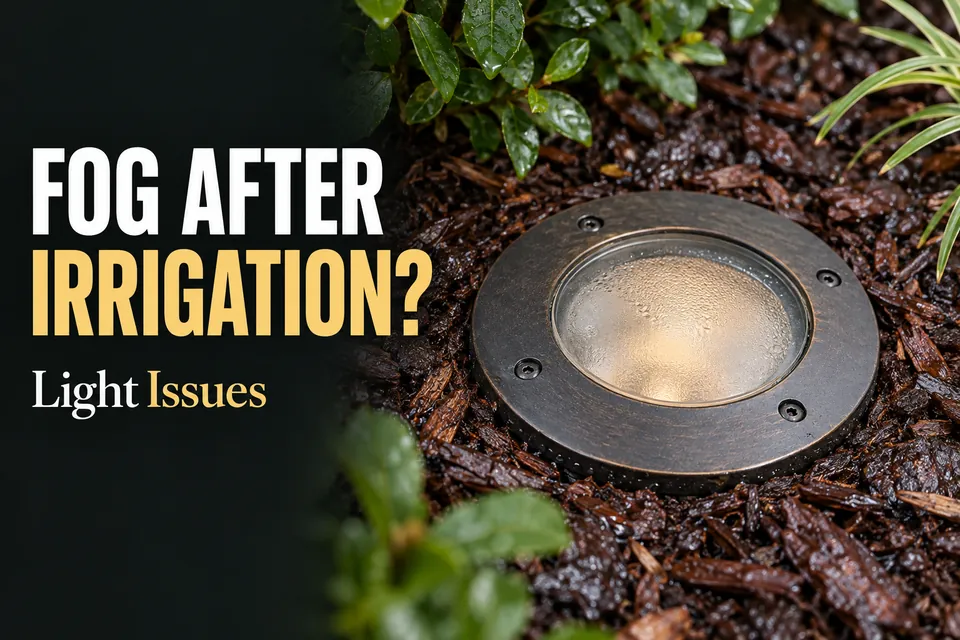
The sprinklers finish, an in-ground light’s lens looks cloudy, and the fixture still illuminates that evening. That combination does not tell you whether irrigation water entered the housing. It also does not establish that the fixture’s protection is intact.
Start by distinguishing moisture on the outside of the lens from haze beneath it and water collecting around the installation well. Those observations lead to different checks.
If water appears to have accumulated inside, the enclosure is damaged, or flickering or protective-device trips accompany the fog, shut off the appropriate supply from a safe, dry location. Do not handle the wet fixture to investigate.
Surface Cooling vs Water Inside the Housing
Irrigation can leave droplets directly on the glass and cool the lens. Cooling can also cause water vapor to condense when a surface falls below the dew point of the air touching it. These effects can occur together, making a cloudy lens difficult to interpret.
Exterior spray droplets do not establish that the inside is wet. Conversely, a fine film beneath the lens is internal moisture, but it does not prove that liquid sprinkler water just crossed the gasket. Moisture already present in the enclosure may become visible when the glass cools.
Look from another angle without opening or moving the fixture. Reflections, textured glass, and exterior droplets can obscure the location. If you cannot distinguish the surfaces, keep that uncertainty rather than calling it harmless dew. The broader diagnosis of water inside an outdoor light fixture becomes useful when the observation extends beyond a thin film.
Beads that enlarge, visible pooling, residual marks, or a pattern that becomes more pronounced deserve closer assessment. None identifies the entry route by itself, but each gives more reason to investigate than a single ambiguous photograph.
A lens becoming clear later establishes only that the visible film changed. Moisture may have evaporated into the enclosed air or moved to another surface; clearing does not certify a dry housing.
The Irrigation Timing Clue
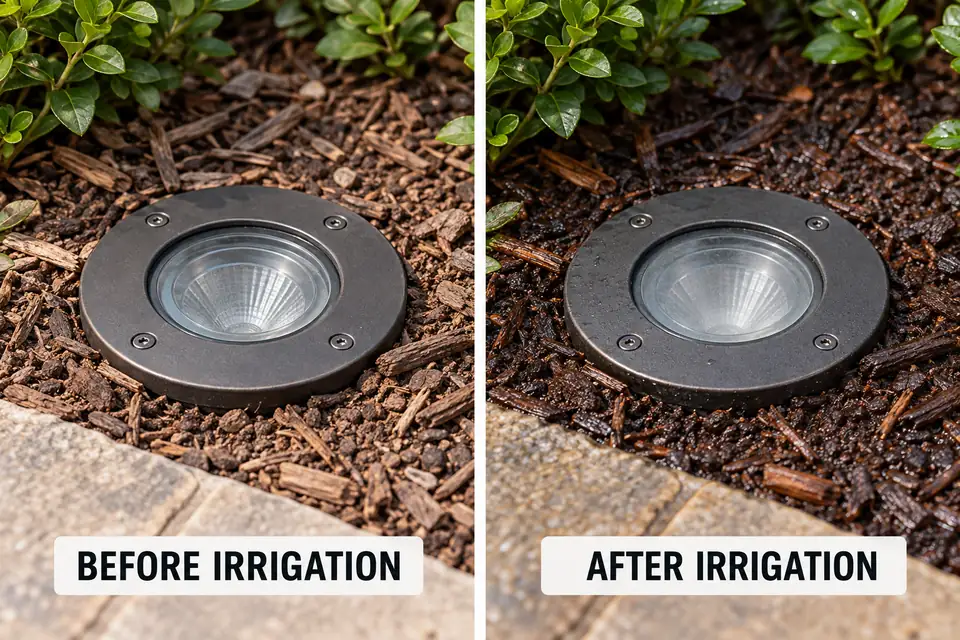
Separate “it formed after watering” from “I noticed it after watering.” A light may already be fogged before the sprinklers start, especially when irrigation coincides with dawn or the fixture’s normal shutoff.
Use observations already available: was the lens clear before irrigation, did spray reach it, and what did it look like afterward? Note whether the light had recently switched off and whether the surrounding ground remained wet. Those details help distinguish direct exposure from a temperature-related change.
If the same haze appears on mornings without irrigation, condensation that appears only at sunrise may better explain the timing. Irrigation could still contribute, but it is no longer the only plausible trigger.
A repeated association with watering supports checking exposure and enclosure condition. It does not prove that the lens gasket is the entry point. Do not run extra watering cycles or power a suspect fixture to reproduce the symptom, and do not postpone shutdown to complete an observation log.
Lens Seal and Drainage Around the Well
The Lens Closure
From outside the closed fixture, look for a cracked lens, displaced rim, visible damage, or debris packed against the perimeter. These are useful clues, but a tidy exterior cannot confirm the condition of a concealed gasket.
Assessment beneath the cover belongs to a safely isolated, dry fixture whose manufacturer permits servicing. A displaced or damaged gasket, contamination on its mating surface, or an incompatible replacement can prevent the intended closure. Detailed checks for a gasket that will not seat correctly belong after those access conditions are met.
Do not tighten screws harder simply because fog appeared. Additional force cannot correct every misfit and may damage the lens or sealing surface. The useful question is whether the specified parts can close as designed.
The Surrounding Well
The outer installation sleeve or well is not necessarily the fixture’s protected optical or electrical enclosure. Designs differ. Water visible around that outer structure does not establish that it has crossed into the light itself.
A shallow depression, accumulated debris, or water lingering against the rim after irrigation suggests checking the installation against its drainage requirements. The exposed top can look orderly while the surrounding installation retains water.
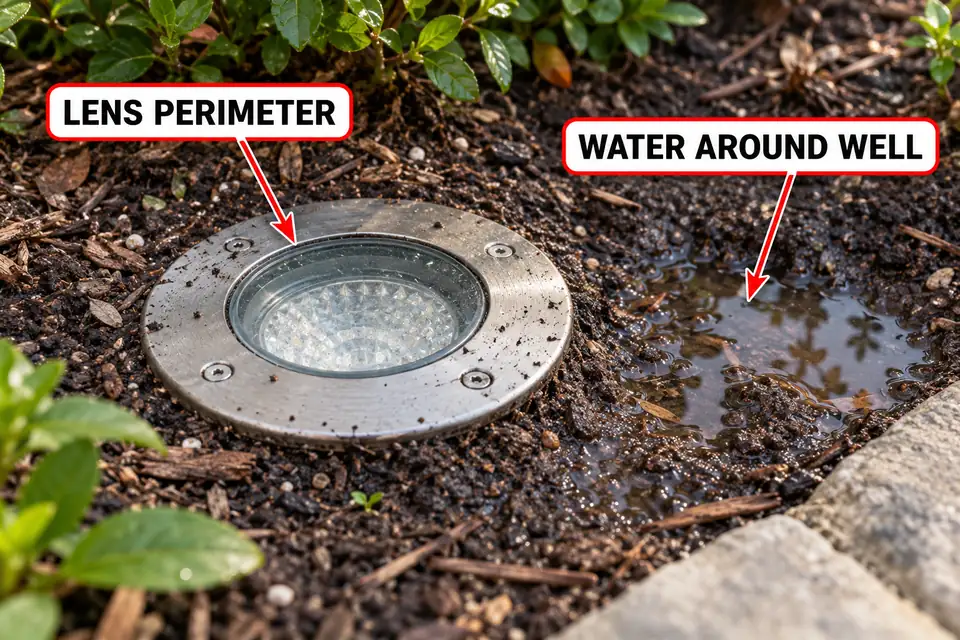
Drainage and sealing perform separate jobs. Improving water movement around the well does not repair a damaged enclosure, and replacing a gasket does not resolve an installation that holds water against the fixture.
Follow the actual model’s installation requirements. Do not assume a universal gravel depth, drill drainage holes, loosen the cover for ventilation, or cover every seam with sealant. Lifting the fixture or digging near its cable is not an initial observation check.
Why Continued Operation Can Hide Damage
A working light confirms that its light source receives usable power at that moment. It does not test the lens seal, cable entry, or condition of every internal component.
Moisture-related deterioration can develop before complete failure. Operating heat may also make fog less visible without establishing that moisture has left the enclosure. Turning the fixture on to “dry it out” therefore supplies neither a repair nor a reliable condition check.
Internal water, corrosion, damaged insulation, new flickering, or protective-device trips moves the decision toward keeping the supply off. The absence of those electrical symptoms does not cancel visible enclosure damage or accumulating moisture. Do not wait for a trip, and do not repeatedly reset a device that has already operated.
Dry Inspection and Replacement Boundary
Before handling the fixture, isolate its appropriate supply from a safe, dry location. A timer or photocell being off is not electrical isolation. For transformer-fed lighting, follow the manufacturer’s supply-disconnection method; do not separate wet connectors at the fixture.
If the supply is unidentified, household voltage is involved, or reaching the disconnect requires approaching water-affected equipment, use a qualified electrician. Allow the fixture to cool and the working area to dry. A dry exterior alone does not clear equipment with suspected internal water for use.
Keep any permitted inspection limited:
- Supply: Identified and safely isolated before handling.
- Access: Fixture cool, working area dry, and opening permitted by its instructions.
- Closure: Lens, rim, and accessible seal components checked for visible damage or misfit.
- Interior: Visible moisture, residue, or deterioration recorded without probing electrical parts.
- Installation: Surrounding well condition and approved service options checked against the manufacturer’s instructions.
An approved gasket replacement may be reasonable when the lens, sealing seat, housing, and relevant components remain sound. That is different from trying to rescue a distorted closure or water-damaged electronics. The broader repair-or-replacement boundary helps frame that distinction without assuming the whole lighting system needs renewal.
Damaged sealing surfaces, internal corrosion, water-affected electrical components, or a sealed assembly with no approved service access calls for manufacturer or professional assessment. Replacement may be necessary. Fog alone, however, is not enough to condemn every fixture.
Any replacement must suit in-ground installation, the actual water exposure, and the existing supply. “Outdoor” on a package is not sufficient. Resolve local water retention according to the installation requirements so the replacement does not inherit the same exposure.
Confirmed exterior wetness can remain an observation issue when the fixture is otherwise intact and used within its specifications. Recurring internal fog warrants timely assessment; accumulated internal water, damaged protection, or electrical symptoms warrants keeping it out of service. The decision should follow those conditions, not whether the light still shines.
For actual water damage, ESFI’s guidance on water-damaged electrical equipment explains why drying alone does not establish safe reuse.