
An outdoor light that looks fogged inside at sunrise and clear later may be following a daily temperature cycle. The important distinction is whether you are seeing a thin film that recedes or moisture that accumulates, leaves marks, or increases after rain.
Start with the timing: does the condensation actually form at sunrise, or is that simply when you first notice it? Moisture may have formed overnight, become easier to see in daylight, or appeared as the light cooled after its normal dawn shutoff. Following that sequence gives you more useful evidence than immediately blaming the lens seal.
Why Sunrise Creates a Rapid Temperature Change
Sunrise does not always cause a rapid temperature change at the fixture. A shaded porch light may warm gradually, while a fixture receiving direct morning sun can warm unevenly. Its housing, lens, and enclosed air do not necessarily respond at the same speed.
Condensation forms when an interior surface is cold enough for water vapor in the air touching it to condense. The relevant relationship is between that surface temperature and the dew point of the enclosed air—not simply whether the outdoor temperature is rising.
Overnight cooling can leave the lens cold before dawn. If the light operates through the night and switches off at sunrise, losing its operating heat can also contribute to cooling. How much that matters depends on the fixture’s construction and heat output.
Morning sunlight may then change the temperature balance and make the visible film evaporate. Warming alone does not establish why the moisture appeared.
Before interpreting the pattern, note whether the haze is already visible before normal shutoff and before direct sunlight reaches the fixture. That separates overnight formation from a change associated with the morning operating cycle.
Condensation vs Active Water Entry
First, look from another angle to establish whether the haze appears to be on the inside. Exterior dew can resemble internal fog through clear glass. If you cannot distinguish the two without opening the fixture, record that uncertainty.
For moisture that occurs beyond this narrow morning pattern, the broader diagnosis of water inside an outdoor light fixture provides the next context. Here, the useful question is how the visible moisture changes with temperature and water exposure.
| Observation | What it supports | What it cannot establish |
|---|---|---|
| Fine interior haze after a dry night that recedes later | A temperature-related condensation pattern | That the enclosure has no water-entry problem |
| More wetness after rain or morning irrigation | Possible exposure-related water entry | The exact entry point |
| Haze clears, then returns after another dry night | Moisture remains available to condense | That a gasket has failed |
| Droplets merge, liquid collects, or staining persists | A moisture problem needing assessment | Whether condensation, water entry, or both caused it |
A dry night is useful evidence, but it does not erase earlier rain. Water that entered previously may remain inside, evaporate as the fixture warms, and condense again when an interior surface cools.
Likewise, larger droplets do not automatically prove a leak. Fine condensation can merge into drops. The more meaningful change is increasing accumulation, especially when it follows a particular exposure.
Morning irrigation deserves attention because its schedule may coincide with sunrise. Where the surrounding wall is also wet, the diagnosis of water inside a covered-porch light becomes relevant even when the roof appears to shelter the fixture.
Treat exposure history and visible moisture as separate observations. Their relationship helps narrow the cause; neither a dry wall nor a clear afternoon lens rules out intermittent water entry.
Venting and Trapped Humidity
When fog disappears from the lens, the water may have evaporated into the enclosure’s air rather than escaped outside. That can leave enough moisture for another cycle the following morning.
Some fixtures incorporate factory pressure-equalizing membranes that allow gas and water-vapor transfer while resisting liquid entry. Other designs manage moisture differently. A pressure vent is not interchangeable with a drain, and an unfamiliar opening should not automatically be treated as either.
Recent opening also matters. If the pattern began immediately afterward, moisture that starts after a bulb change deserves its own diagnosis. The timing could reflect humid air enclosed during the work or a change in how the cover was seated; morning fog alone cannot distinguish those possibilities.
Check the model’s instructions for its intended mounting orientation and any identified factory vent or drainage provisions. A membrane is not a dehumidifier, and its presence does not guarantee that condensation will never occur.
Keep this check documentary and external. Do not drill openings, insert anything into a membrane, or seal an apparent gap based on appearance alone.
Observing Whether Moisture Clears
Keep the fixture closed while documenting the pattern. Opening it changes the enclosed air and interrupts the conditions you are trying to understand. Observe from a safe, accessible position without touching or moving the light.
- Record the first sighting. Photograph the lens and note whether the light has already switched off normally. Record whether direct sunlight has reached the housing.
- Record recent water exposure. Note overnight rain, wind-driven rain, and morning irrigation. Do not spray the fixture to reproduce the problem.
- Compare later views. Use the same viewing angle later in the morning. If moisture remains, take another photograph later in the day.
- Compare another suitable morning. If there is no pooling, damage, or electrical symptom, compare the pattern after a night without rain or irrigation.
Watch the moisture itself, not just the overall brightness of the glass. Is the haze thinning? Are individual droplets shrinking? Are they joining into larger drops while liquid remains along the bottom?
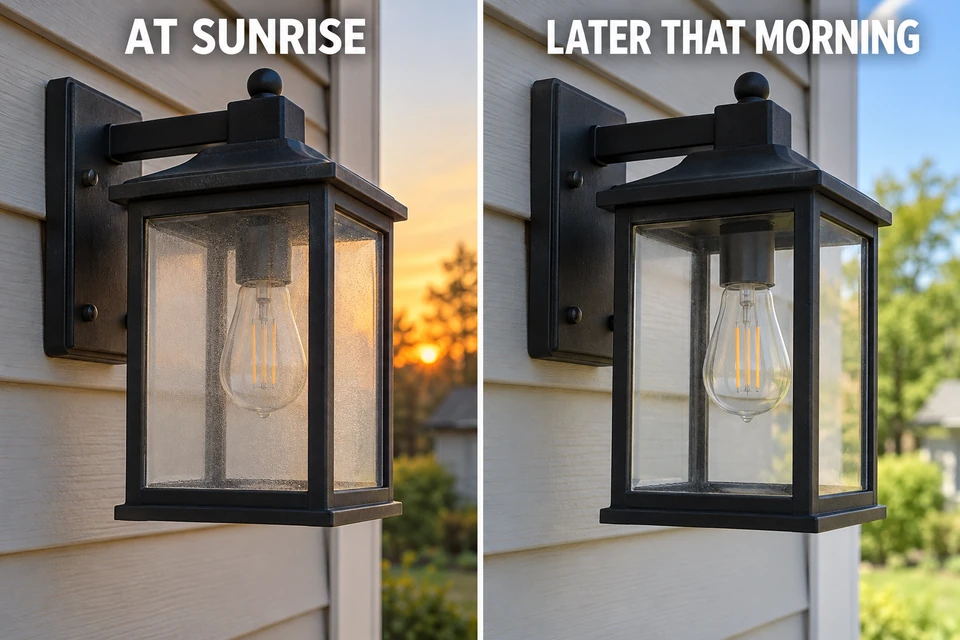
This comparison shows visible clearing, not proof that all moisture has left the enclosure. A lens can look clear while moisture remains elsewhere inside.
Record the actual elapsed time rather than using a universal deadline. Shade, humidity, construction, and operating history affect clearing. A cool, shaded fixture cannot be judged against a different fixture receiving direct sun.
Repeated photographs are most useful when conditions are comparable. If the same light develops progressively heavier droplets under similar conditions, that trend matters more than whether it happens to look clear by lunchtime.
Do not turn the light on to accelerate drying. If liquid collects or electrical symptoms appear, stop the observation sequence and arrange assessment.
When Repeated Morning Fog Means Seal Failure
Repeated morning fog alone does not prove seal failure. It becomes more concerning when accompanied by worsening accumulation, a clear relationship with rain or irrigation, visible cover damage, or persistent staining.
Those clues justify inspection, but they still do not identify a particular gasket. Moisture retention, an installation issue, or another entry path may produce a similar visible pattern.
Fixture suitability is a separate question. Check the actual environmental marking and approved orientation. Understanding outdoor-light weatherproof ratings helps distinguish a protected location subject to dampness from one exposed to dripping, splashing, or direct rain.
A suitable rating does not promise a condensation-free lens. It also does not excuse water accumulation or override the manufacturer’s installation instructions. A fixture’s appearance or “outdoor” description is not enough to establish suitability for its exact position.
If the pattern remains unresolved, send the manufacturer the model details, dated photographs, exposure history, and recorded clearing behavior. That gives them something specific to assess instead of a single photograph labeled “leaking.”
If water pools, the enclosure is damaged, the light flickers with moisture present, or a protective device trips, leave the fixture off and obtain qualified assessment.
A receding morning film supports a temperature-cycle explanation. Increasing wetness or damage changes the next step: the fixture needs assessment even if its lens becomes clear again each afternoon.
For the role of factory membranes, see Gore’s explanation of lighting-enclosure venting.