Most outdoor lighting power problems are not random fixture failures. They usually fall into one of three buckets: the system is not getting power at all, power is reaching the lights but dropping too far under load, or a safety or thermal device is shutting the system down.
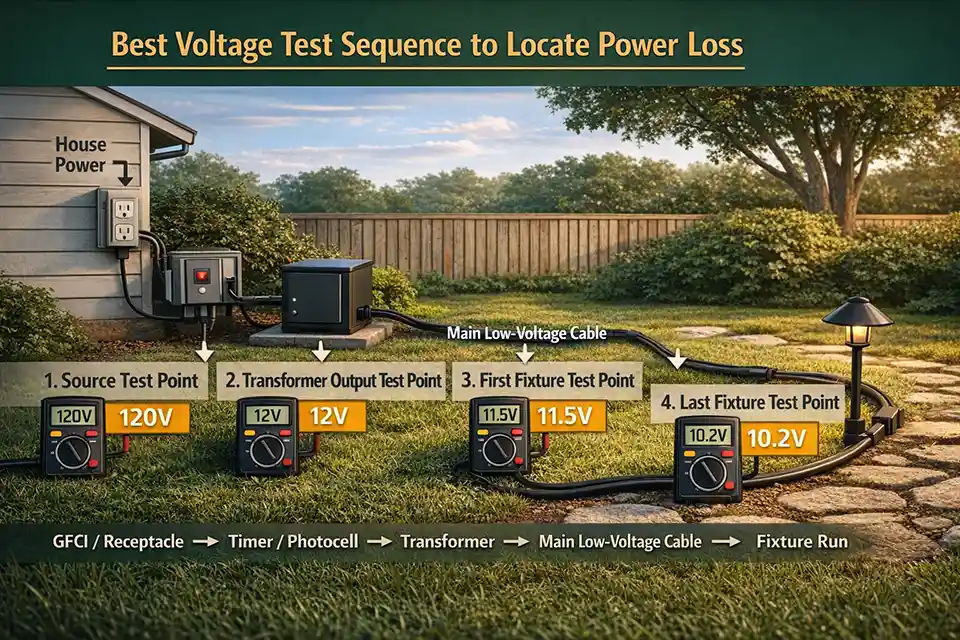
The first checks that actually save time are simple: verify input power at the source, verify output power with the system under load, and compare the first working fixture to the last weak or dead one.
Timing matters too. If the system is dead instantly, think breaker, GFCI, switch leg, timer, photocell, receptacle, or transformer. If it runs for 5 to 15 minutes and then cuts out, overload or thermal shutdown is more likely.
If it fails after rain, irrigation, or heavy dew within the next 30 minutes to 24 hours, treat moisture as a power problem, not a separate cosmetic issue.
The key distinction is this: dark lights are the symptom. Lost, unstable, or collapsing voltage is the mechanism.
Quick diagnostic checklist
- Everything is out at once: start upstream at breaker, GFCI, controls, receptacle, and transformer.
- Only the far end is dim or dead: suspect voltage drop, overload, or one failing downstream splice.
- One zone is out but another works: suspect a branch split, cable break, or open connection.
- The system shuts off after several minutes: check transformer load, heat buildup, and short-to-ground behavior.
- The problem follows rain or sprinkler cycles: check wet fixtures, wet cable entries, and ground-fault protection.
- A 12-volt fixture reads below about 10.5 volts under load: that is usually a real performance problem, not harmless variation.
Where power is usually being lost
The most common failure points are not evenly distributed across the system. They cluster at the source, at controls, at the transformer, and at splices. That matters because many homeowners start at the visible end of the problem, opening fixtures and swapping parts, when the actual failure is closer to the house.
A full-system outage is usually upstream. If the whole yard is dark, the most likely causes are a tripped GFCI, dead receptacle, failed timer handoff, bad photocell logic, transformer failure, or an open feed. That is why Outdoor Lights Not Turning On After Timer or Photocell is often a closer match than general fixture troubleshooting when nothing comes on at all.
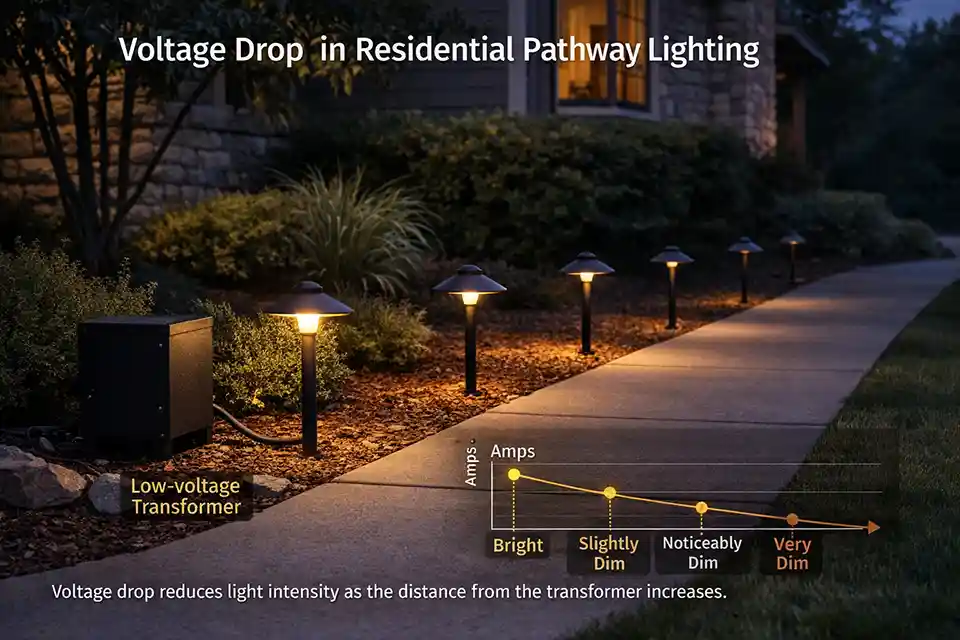
A partial outage works differently. If the first section is bright and the last section is weak, the issue is rarely “bad lights at the end.” It is usually one of two things: the circuit is losing too much voltage over distance and load, or power is being interrupted at a splice or damaged cable farther down the line.
Why “I still have voltage” can be misleading
One of the most common misreads is seeing voltage on a meter and assuming the supply is healthy. A weak transformer, overheated terminal, or corroded splice can still show voltage with almost no load attached. Then the reading collapses once the fixtures are actually connected and drawing current.
That is why loaded readings matter more than unloaded ones. In a typical 12-volt landscape lighting system, about 11.5 to 12.5 volts at the fixture under load is usually healthy. Around 10.5 volts, output often becomes uneven. Below 10 volts, LED drivers frequently dim, flicker, or shut down. That is where Voltage Drop in Outdoor Lighting Systems becomes the right lens, because the issue is no longer just “weak light.” It is a supply path that is no longer delivering usable voltage.
The causes that deserve the most attention
Not every possible cause should get equal space. The best diagnosis starts with what is most common, most measurable, and most likely to change the repair choice.
Source-side power loss
If everything is dead, start at the source. In line-voltage systems, that means checking for about 114 to 126 volts at the feed point. In low-voltage systems, it means checking that the transformer is receiving proper input power and producing stable output with the system connected.
This is where people lose time by assuming a whole-yard outage must be a buried wire issue. It usually is not. Multiple fixtures do not all fail at once very often. Source-side interruption is much more likely.
Voltage drop and overload
This is the leading cause when some fixtures still work and others fade with distance. Long runs, too many added fixtures, undersized cable, and a transformer running too close to capacity all make this more likely. If the last fixtures weaken after new fixtures were added, the new fixtures did not necessarily create a new problem. They may have exposed a system that was already close to its limit.
A practical threshold helps here. If your transformer is carrying more than about 80% of its rated load night after night, performance margin starts shrinking quickly. If a 150-watt transformer is supporting around 130 to 140 watts of actual connected load, dim far-end performance and nuisance shutdown are much more plausible than people think.
Splice resistance and connection failure
This gets underestimated constantly. A bad splice does not always fail cleanly. Often it adds resistance first. That can create dimming, intermittent performance, heat, and misleading meter readings before the connection fails completely.
If a system works near the source and dies after one point, a splice or branch split is usually more likely than multiple bad fixtures. Corroded Wire Splices Outdoors becomes the more useful comparison because it explains why a connection can look intact but still behave like a power supply problem.
Cable damage in one segment
Cable damage matters most when the outage is isolated to one side of the yard, especially after trenching, edging, driveway work, hardscape changes, fence installation, or aggressive planting. If the break appears after a walkway or driveway crossing, Outdoor Lights Losing Power Under Walkways and Driveways is usually the stronger diagnostic parallel than a general no-power guide.
What people usually get wrong first
People usually overestimate fixture failure and underestimate distribution failure.
A bad lamp or driver is believable when one fixture is acting up. It is much less believable when four fixtures in a row are weak and the fifth one after a branch split is fine. That pattern points to the path feeding those fixtures, not to four independent fixture failures.
People also overestimate the value of a reset. A GFCI that resets and trips again after the next watering cycle is not fixed. A transformer that cools down and powers back on after 20 minutes is not fixed either. Those are clues, not solutions.
The fix that wastes the most time
Replacing fixtures before checking load and voltage is one of the least efficient repairs in this category. If the problem is weak supply, new fixtures only make the system look more expensive while staying broken.
The second big time-waster is remaking one easy splice and stopping there. In older systems, one failed connector is often not the whole story. If the run has brittle insulation, greened copper, several old burial connectors, or prior patch repairs, the first obvious defect may just be the first one you found.
Pro Tip: Build a simple power map before replacing anything. Mark the source, the first good reading, the first weak reading, and the first dead point. That often narrows the fault faster than opening every fixture.
Low-voltage landscape lighting troubleshooting that actually changes the outcome
A lot of “outdoor lighting power supply issues” are really low-voltage layout and load issues in disguise. The most useful way to diagnose them is to test in order, not to inspect everything equally.
Start with the transformer under load
Check transformer output while the fixtures are connected and on. A transformer that looks fine with no load can still sag once the system is active. If output is already low here, nothing downstream will be reliable.
This is also the moment to compare connected load to transformer rating. Add up fixture wattage or VA as realistically as possible. If a 300-watt transformer is supporting roughly 260 to 280 watts on a long run, that is a much more valuable clue than whether one fixture looks slightly duller than the others.
Compare the first fixture to the last fixture
This is where the diagnosis becomes useful. If the first fixture reads 11.9 volts and the last fixture reads 9.9 volts, that is not normal drift. That is a 2-volt drop, and in a 12-volt system it is large enough to affect output, driver behavior, and reliability.
A simple field rule works well: if the last fixture is more than about 1.5 to 2 volts lower than the first fixture under load, stop treating it like a small adjustment. Cable size, run length, fixture count, or wiring layout now belong in the diagnosis.
Use the run itself as a decision tool
This is where many competing articles stop too early. It is not enough to say “check wire gauge.” You need a decision boundary.
- A short run with a small load can often be corrected with a remade connection or one replaced cable section.
- A long run with a heavy load and a large end-to-end voltage drop usually needs reconfiguration, not another patch.
- If the far end improves dramatically when half the fixtures are disconnected, the problem is load and layout before it is fixture quality.
That distinction matters because it tells you whether to repair locally or redesign the run.
The missing piece many articles skip: load layout, not just total load
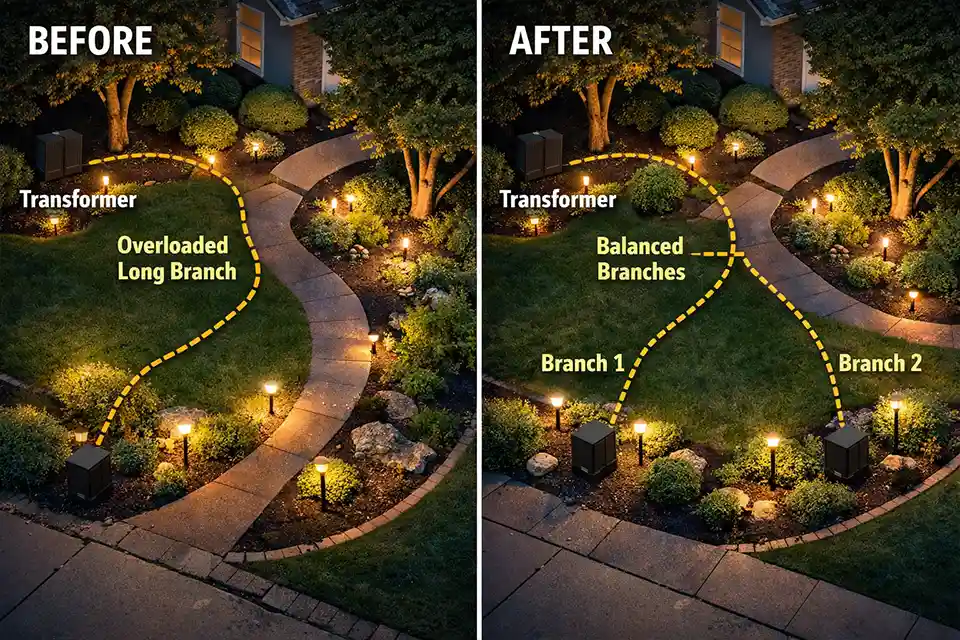
A system can be technically under transformer capacity and still perform badly because the layout is wrong. That is the part many simpler guides miss.
A 200-watt load on a 300-watt transformer sounds safe on paper. But if most of that load is pushed down one long run while another branch carries very little, the overloaded branch can still suffer major voltage loss. Total transformer capacity matters, but branch balance matters too.
Healthier layout vs failing layout
| System condition | Healthier setup | Failing setup | What it usually means |
|---|---|---|---|
| Transformer loading | under about 80% for long nightly use | near full rating for long runs | shrinking performance margin |
| End-to-end voltage drop | about 1 to 1.5 volts or less | more than about 1.5 to 2 volts | layout or cable issue, not just a fixture issue |
| Fixture brightness pattern | fairly even across the run | clear fade toward the end | voltage drop or one high-resistance point |
| Branch behavior | similar readings across branches | one branch much weaker | branch-specific overload, splice fault, or cable damage |
| Reset behavior | remains stable after reset | fails again after minutes or moisture | unresolved overload, heat issue, or leakage path |
The important point is that “too many fixtures” is not always the precise answer. Sometimes it is “too many fixtures on one run.”
When wire size starts to matter more than people expect
Wire gauge is easy to oversimplify, but it does matter once distance and load increase. If a longer branch is carrying a meaningful share of the system load, moving to heavier cable or splitting the run often changes the outcome more than replacing lights ever will.
This is one reason New Outdoor Lights Not Getting Power From the Main Line can be misleading if treated as just an installation mistake. Often the main line still has power; the real issue is that the distribution design is no longer suitable for what was added.
When moisture is the real power problem
Water-related problems get misclassified all the time. People treat them as fixture leaks or nuisance trips when the real issue is that moisture is changing the electrical behavior of the whole circuit.
If the outage follows rain, irrigation, or heavy dew, moisture should move high on the list immediately. That is especially true when the system works normally in dry weather, then starts tripping protection or going unstable once the soil, connectors, or enclosures stay wet for several hours.
This pattern is often more about leakage and fault protection than simple power loss. Outdoor Lights Tripping GFCI Outlets becomes relevant because the device cutting power may actually be doing its job. In humid climates like Florida, or in landscapes with frequent irrigation, this cause is often underestimated.
Pro Tip: When a moisture-related outage is suspected, inspect the lowest points in the run first. Water collects where the cable path dips, not where the fixtures look most exposed.
When repair stops making sense
There is a point where local repair becomes delay.
Repair still makes sense when
- one connector is clearly failed
- one recently damaged cable section explains the outage
- one branch is affected while the rest of the system measures normally
- loaded voltage is otherwise healthy once the failed point is corrected
Redesign or replacement makes more sense when
- the same run has multiple old splices
- the last fixtures stay weak after connection repairs
- end-to-end drop still exceeds about 1.5 to 2 volts under load
- the transformer is already working too close to its practical limit
- the system has been expanded over time without redistributing load
That is the point where stronger competitors often stop at “replace the wire” or “upgrade the transformer.” The more accurate answer is narrower: replace what is bad, but redesign what is unbalanced. Those are not the same decision.
The repair order that saves the most time
A good repair order should narrow the system quickly, not just generate more work.
Confirm source power first
Do not open fixtures until you know the source is correct.
Verify transformer behavior under load
A transformer that collapses under load will make every downstream check look confusing.
Compare first good point to first weak point
That tells you whether you are chasing source interruption, branch loss, or voltage drop.
Inspect the ugly places first
Check burial splices, hardscape crossings, low wet spots, cable exits, and areas disturbed by yard work.
Decide whether the run needs repair or redistribution
A clean single failure is a repair problem. A long overloaded run with poor balance is a design problem.
For official safety guidance, visit the Consumer Product Safety Commission.