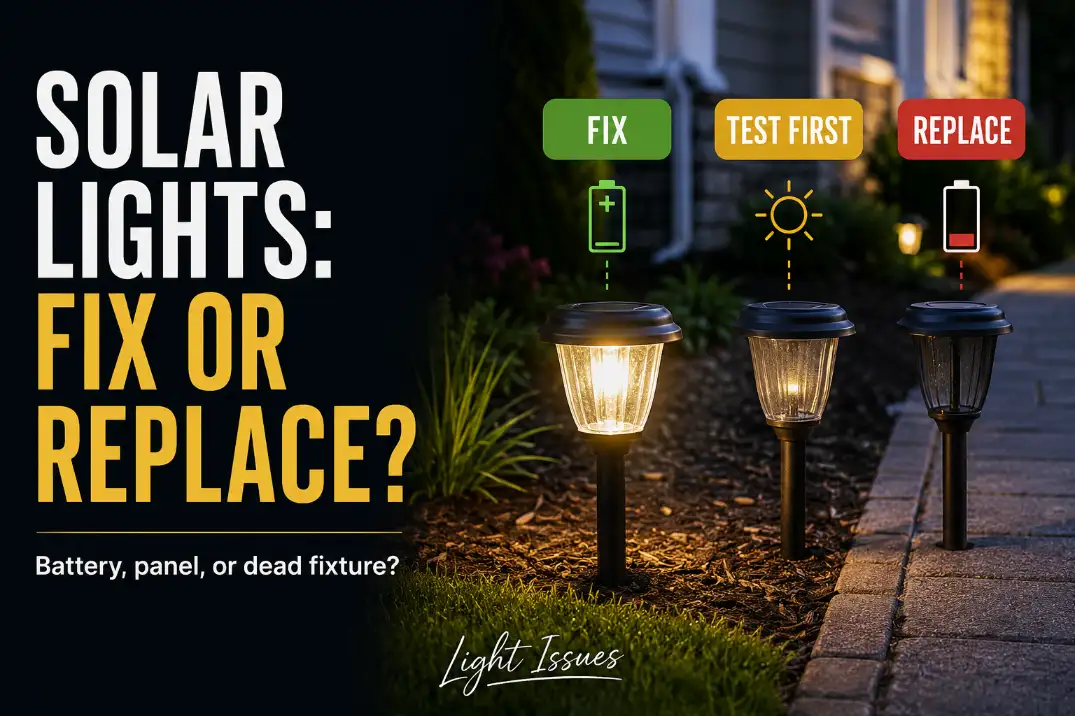
Solar outdoor lights are worth fixing when one replaceable part has failed: a weak rechargeable battery, dirty panel, poor sun exposure, or stuck sensor.
They are usually worth replacing when the same fixture still fails after 1–2 clear charging days, the panel is cloudy or cracked, water has reached the battery bay, or more than half a matching set fades together.
The first useful question is not “Does it turn on tonight?” It is “Can this light still collect and store enough charge?” A healthy small solar path light often needs about 6–8 hours of strong sun to give dependable evening output.
If it dies after 30–90 minutes despite a full sunny day, the problem is more likely charge storage, charge collection, or moisture damage than the LED itself.
Quick Decision: Fix One Bad Part, Replace a Failing Fixture
A solar outdoor light is usually worth fixing only when the failure is isolated. If the fixture is dry, the panel is clear, and the light still reacts when you cover the panel, a battery or placement fix may restore it.
If the panel is hazed, the contacts are corroded, and the light has already failed through several weather cycles, replacing it is the cleaner decision.
Fix it when the fixture still responds
Try fixing first if the light flickers, turns on briefly at dusk, or works better after a sunny day. Those signs mean the LED and control circuit may still be alive.
Clean the solar panel, move the light into stronger sun, check the switch, and test one compatible rechargeable battery before buying parts for the whole set.
Many small solar lights use 1.2-volt rechargeable AA or AAA NiMH batteries. If the battery is 2–3 years old and the fixture still looks clean, a battery swap is one of the few repairs that actually makes sense.
The broader failure pattern is covered in Why Solar Outdoor Lights Fail So Quickly, but the short version is simple: the light usually fails because stored power becomes unreliable, not because the LED suddenly forgets how to shine.
Replace it when the fixture has more than one failure
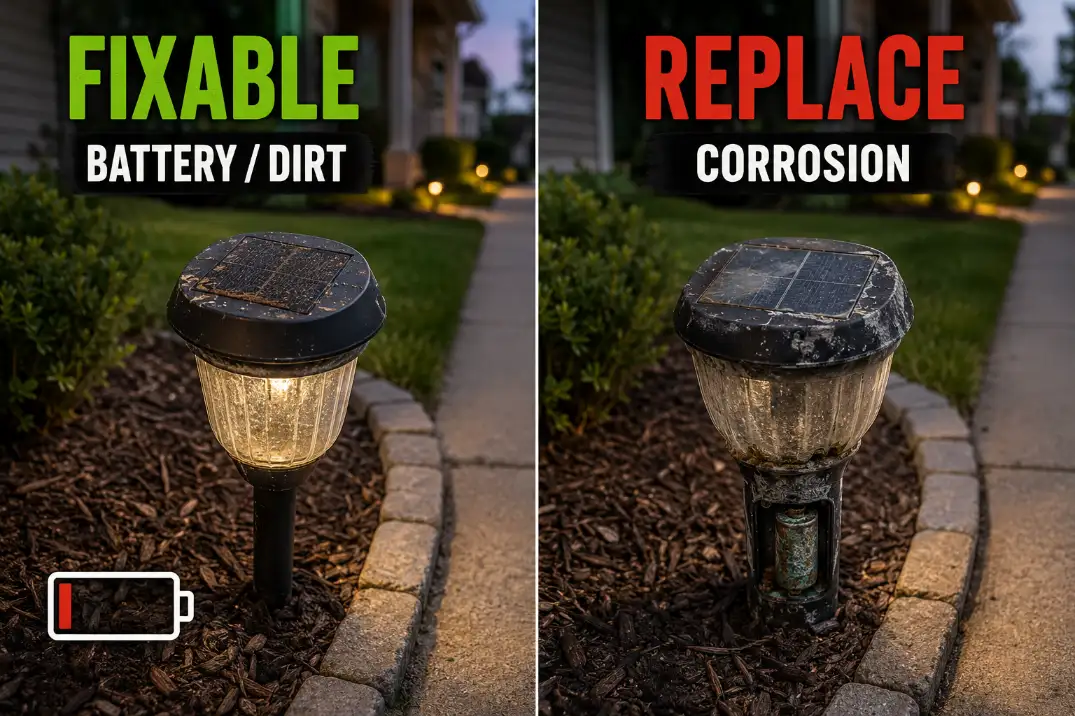
Replacement makes more sense when the light has a cloudy panel, cracked housing, wet battery compartment, or visible corrosion. A new battery can help a tired battery.
It cannot fix a panel that no longer charges well or a circuit board that has been exposed to moisture.
A useful cost rule: if one replacement battery costs more than about half the price of replacing that single light, repair only makes sense when the fixture is higher quality, visually matched, or hard to replace.
For cheap stake lights, repeated small fixes can cost more time than the fixture is worth.
The Checks That Actually Decide the Answer
The repair decision should move in this order: sun exposure, panel condition, battery condition, then water damage. That order matters because many homeowners replace the wrong part first.
Test the charging location before judging the fixture
A shaded solar light can look defective even when it is not broken. Lights under roof overhangs, beside dense shrubs, near north-facing walls, or under tree canopies may receive daylight without receiving enough charging sun.
Move one weak light to a location with strong direct sun for two clear days. If runtime improves from under 1 hour to 4–6 hours, the fixture was not the main issue.
The placement was. Replacing the light in the same shaded spot usually repeats the same problem, which is why Why Your Solar Outdoor Lights Aren’t Charging is often the better next read than another product search.
Treat panel cleaning as a test, not a cure
Cleaning the panel is worth doing, especially in dusty yards, sprinkler-heavy beds, or coastal areas where film builds up on plastic covers. Use a damp cloth and avoid abrasive pads that can haze the surface.
But panel cleaning is often overestimated. If the plastic remains milky, yellowed, or scratched after cleaning, the light may still collect too little energy. A clean failed panel is still a failed panel.
Pro Tip: Clean one weak light and leave a similar weak light untouched for one sunny day. If both run about the same that night, dirt was not the bottleneck.
Test one battery before repairing the whole set
Battery replacement is the most sensible repair when the fixture is otherwise dry and intact. But do not buy batteries for every light yet. Test one or two lights first with the correct rechargeable battery type.
A tired battery usually shows a specific pattern: the light turns on at dusk, then fades early within 1–3 hours. If a fresh compatible battery restores several hours of runtime, repair is valid. If it barely improves, the panel or internal circuit is more suspicious.
Inspect for water before doing more work
Moisture changes the repair math quickly. Look for rust, green or white crust, dark staining, trapped droplets, or a metallic smell inside the battery bay. Minor contact film can be cleaned once. Heavy corrosion is a replacement signal.
This is especially important in humid Florida yards, rainy Midwest seasons, coastal California areas, and northern states where freeze-thaw cycles stress cheap seams.
Moisture damage is one condition people underestimate because the outside of the light can still look acceptable.
Fix or Replace Decision Table
| Condition | Most likely issue | Best decision |
|---|---|---|
| Runs briefly after sunny days | Weak rechargeable battery | Replace one battery first |
| Works after moving to full sun | Poor placement or shade | Keep fixture, change location |
| Panel is cloudy, cracked, or yellowed | Poor charge collection | Replace fixture |
| Battery bay has green or white corrosion | Moisture damage | Replace unless fixture is high quality |
| More than half the set fades together | Aging set or low-grade parts | Replace the set |
| Battery costs over half of one new light | Poor repair value | Replace unless matched or premium |
| Light taps on and off at the switch | Loose contact or switch wear | Clean once, then replace if repeated |
What People Usually Waste Time Fixing
The wasted fix is not replacing a battery. The wasted fix is replacing a battery in a fixture that can no longer recharge it.
A dim LED is usually a symptom
A dim solar light often looks like an LED problem, but the LED is rarely the first part to blame. The symptom is weak light. The mechanism is usually low stored power, poor charging, or moisture-damaged contacts.
That distinction matters along walkways where several lights from the same package can behave differently. One fixture may get full afternoon sun and run 5 hours.
Another may sit behind a shrub and fade after 45 minutes. If the main issue is uneven brightness along a path, Solar Path Lights Dim or Uneven helps separate product failure from layout failure.
When one fix becomes three fixes
A simple fix is reasonable. Three small fixes on the same cheap light are usually a replacement signal.
If you have already cleaned the panel, replaced the battery, scraped corrosion, reset the switch, and moved the light into sun, the fixture has stopped being a good repair candidate.
At that point, the question is not whether one more trick might work for one night. It is whether the light can stay reliable for the next season.
Pro Tip: If corrosion returns after one cleaning, stop treating it as maintenance. Water is still getting in.
When Replacement Makes More Sense
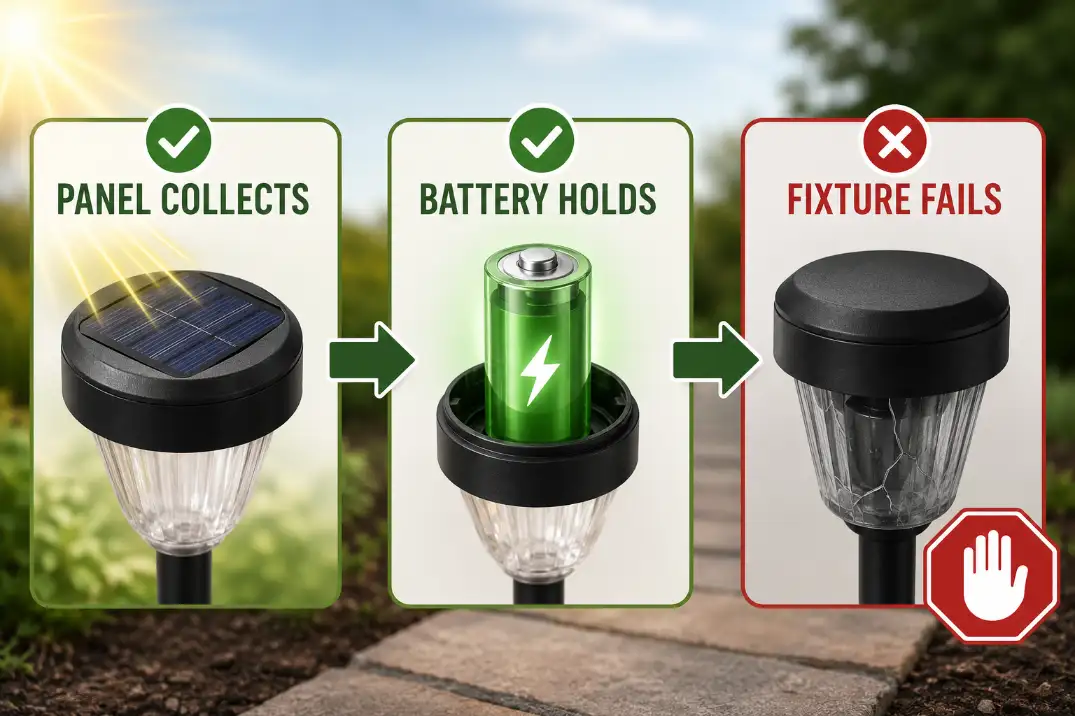
Replace the light when repair would only solve one part of a fixture that is already declining in several ways. Solar lights do not fail only by turning off completely. They also fail by becoming too unreliable for the job.
Replace one light when the failure is isolated
If one fixture fails but the rest of the set still runs 5–6 hours after dark, replace or repair only that fixture. The problem is probably local: shade, a bad battery, water intrusion, or one weak unit.
This is common along walkways, driveways, and garden beds where each light gets a different amount of sun. One failed light does not automatically mean the entire set is worn out.
Replace the set when decline is shared
If most of the set dims together, do not repair fixtures one by one. Shared decline usually points to aging panels, low-quality batteries reaching the same age limit, or a product line that was never built for long outdoor exposure.
A practical threshold: if more than half the lights in a matching set still have poor runtime after two clear charging days and one compatible battery test, replace the set.
The time spent chasing individual failures will usually exceed the value of the repair.
Replace solar when the job needs dependable light
Some solar lights still turn on but no longer fit the job. Decorative solar stakes can mark a garden edge. They are not always dependable enough for steps, long walkways, or security zones where darkness creates a real problem.
Winter makes this more obvious. A light that runs 6 hours in summer may run only 2–3 hours during short cold days. If the area needs consistent visibility through cloudy weeks, rain, or freezing weather, a low-voltage system is often a better long-term choice.
For that broader decision, Repair or Replace Outdoor Lights gives a stronger comparison between small fixes and system replacement.
A Practical Repair Sequence Before You Replace
Use a short repair sequence, not an endless one. The goal is to prove whether the light still deserves work.
Step 1: Run one real sun test
Turn the light off if it has a switch, clean the panel, and place it in full sun for a clear day. Two clear days are better after cloudy weather. If the light improves sharply, fix the placement before replacing parts.
Step 2: Try one compatible rechargeable battery
Use the same size and chemistry printed on the old battery or inside the compartment. Do not use a regular alkaline battery in a solar light designed for a rechargeable cell.
If one new battery restores usable runtime, repair the matching good fixtures. If it does not, stop blaming the battery.
Step 3: Check whether water has ended the repair
Open the battery bay and inspect the contacts. Light film may be cleanable. Crust, rust, staining, or water trapped inside the lens means the fixture is no longer a dependable repair candidate.
Rechargeable batteries should also be handled according to local recycling rules when they are replaced. That is a small step, but it matters when several lights in a set are being retired at once.
Step 4: Decide by reliability, not hope
If the light is under a year old, physically clean, and uses replaceable batteries, fixing is reasonable. If it is several seasons old, has a cloudy panel, and fails after wet weather, replacement is more honest.
A solar light that needs attention every few nights is not fixed. It is postponing replacement.
Questions People Usually Ask
Is it worth replacing batteries in solar outdoor lights?
Yes, when the fixture is dry, the panel is clear, and the light uses a common rechargeable battery.
It is less worthwhile when the battery costs more than half the price of replacing the light or when the fixture already shows corrosion, cracking, or panel haze.
Why do new solar lights fail quickly?
New solar lights often fail because they are placed in weak sun, shipped with low-grade batteries, or exposed to water before the seals prove themselves. Test one weak light in full sun before assuming every fixture is defective.
Should I replace solar lights with low-voltage lights?
Use low-voltage lighting when the area needs dependable brightness, safer walking visibility, or consistent operation after cloudy days. Solar is better for decorative glow and edge marking where variable runtime is acceptable.
Can cold weather make solar lights look broken?
Yes. Short winter days reduce charging time, and cold temperatures can reduce battery performance. In northern states, a solar light that performs well in summer may look weak in winter even if no single part has failed.
Bottom Line: Repair Only When the Failure Is Isolated
Solar outdoor lights are worth fixing when one clear part is limiting an otherwise healthy fixture. A better charging location, clean panel, or compatible rechargeable battery can restore a light that still has a clear panel, dry housing, and working sensor.
They are worth replacing when the problem is shared across the set, the panel no longer collects well, water has reached the internals, or the light no longer provides enough dependable output for the space.
The smartest decision is not to try every fix. It is to run one sun test, one battery test, and one moisture inspection, then stop when the fixture has crossed from repairable into unreliable.
For broader official guidance on outdoor solar lighting performance, see the U.S. Department of Energy.