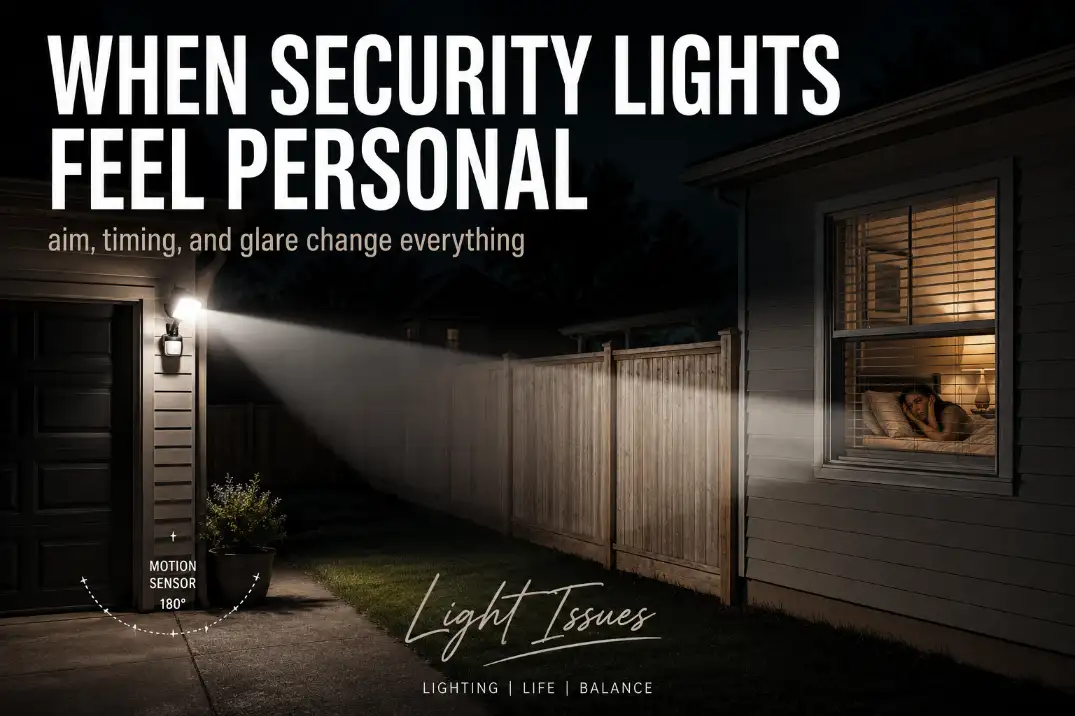
Motion sensor lights usually annoy neighbors for one of three reasons: the beam crosses the property line, the sensor triggers too often, or the light stays bright too long after each activation. The problem is rarely that motion lighting exists. The problem is uncontrolled lighting behavior.
Start with three checks: can the neighbor see the LED source directly, does the light activate more than 3–5 times in 30 minutes, and does each activation last longer than about 60–90 seconds?
Those signals matter more than the fixture brand. This is different from a normal porch light complaint because the sudden on-off pattern is often more disruptive than steady low light.
A 2,000-lumen floodlight flashing into a bedroom at 1:40 a.m. can feel more intrusive than a dimmer, shielded light that stays predictable.
The Real Reason Motion Lights Feel Personal
A steady outdoor light can be irritating, but a motion light adds surprise. The neighbor is not only seeing brightness; they are being interrupted by sudden contrast.
A dark window becomes bright, then dark again, then bright again. That repeated change is what makes the light feel aggressive even when the homeowner only meant to improve safety.
The trigger is the symptom, not the cause
The visible symptom is “the light keeps coming on.” The underlying mechanism is usually one of these: the sensor sees too much area, the fixture is aimed too high, or the light output is too strong for the distance involved.
A sensor aimed across a driveway may detect passing cars, pedestrians, tree movement, pets, HVAC exhaust, or reflected movement from wet pavement.
In humid Florida yards or rainy Midwest neighborhoods, reflective concrete and pale siding can make the same fixture feel harsher because more light bounces toward nearby windows.
Source visibility matters more than people think
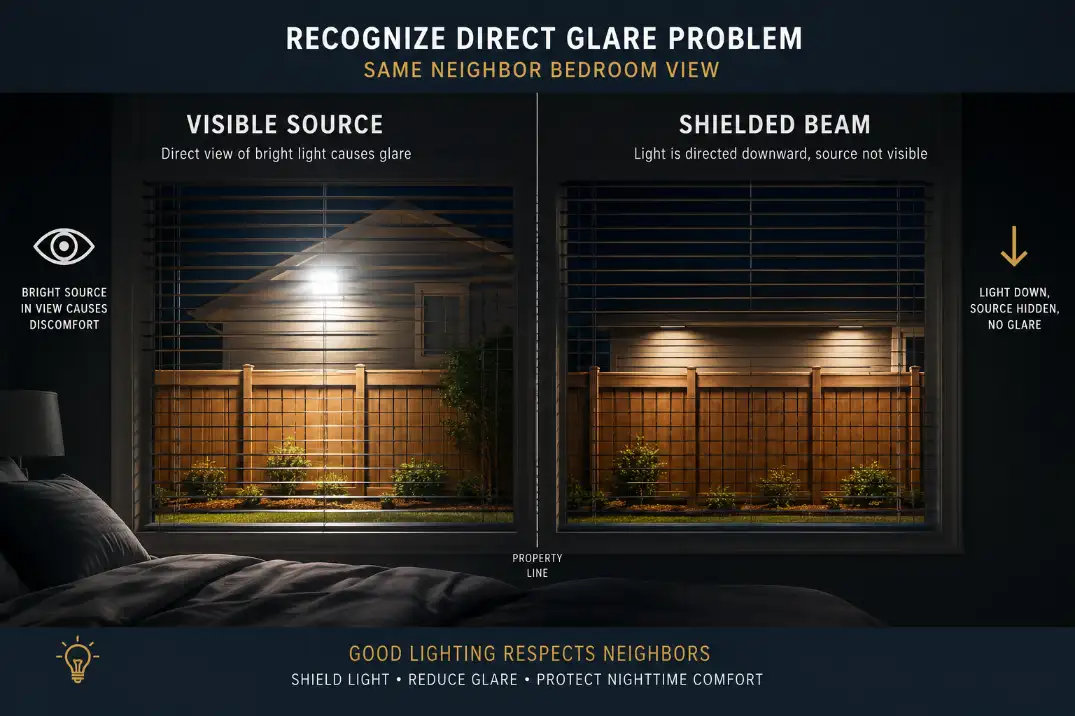
This is the part homeowners often underestimate. A little spill on a fence is one thing. A visible LED emitter or bare floodlight lens aimed near eye level is another.
If the neighbor can see the bright source from a bedroom, deck, or kitchen window, the light will feel much stronger than the ground illumination suggests.
That is why “it only turns on for a minute” is not always a good defense. One minute is short for security, but long enough to wake someone if the beam enters a room repeatedly overnight.
What Neighbors Usually React To First
Most complaints are not caused by one perfect technical failure. They come from a stack of small choices that add up after dark.
Direct glare beats spill light
A neighbor may say the light is “too bright,” but the more useful question is whether the light source itself is visible. If the fixture lens is shining directly into a window, lowering the lumen output may help only slightly.
The better fix is usually aim, shielding, or replacement with a full-cutoff fixture.
This distinction matters because glare is not the same as illumination. Illumination helps someone see the driveway. Glare makes someone else stare into the source.
Too much detection range
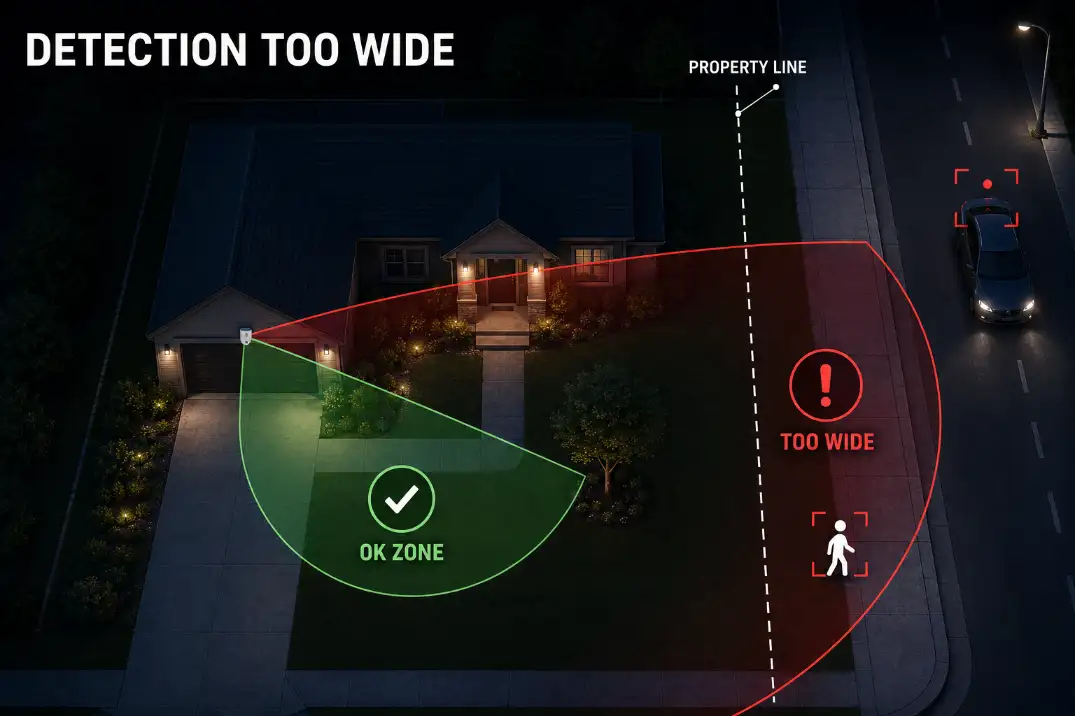
Many residential motion sensors can detect movement 30–70 feet away depending on model, angle, temperature, and sensitivity. That sounds useful until the sensor sees beyond the driveway or patio it was meant to protect.
If the detection zone reaches the sidewalk, street, shared fence, or a neighbor’s side yard, nuisance triggering becomes likely.
This is especially common with garage-mounted floodlights placed 8–12 feet high and angled outward. The higher position gives the sensor a wider view, but it also makes the light more likely to cross property lines.
If the light mostly reacts to traffic, branches, or people outside the property, the issue is closer to an outdoor motion sensor light that is too sensitive than a true security need.
Too much brightness for the location
A backyard gate, trash area, or side path usually does not need a high-output floodlight. For many residential tasks, a lower-output fixture in the 700–1,200 lumen range, aimed carefully, is less disruptive than a 2,000–3,000 lumen fixture pointed broadly.
Brightness is often overestimated as the solution. More lumens do not always mean better visibility. At short distances, excessive brightness creates glare, deep shadows, and sharper contrast.
The result can be worse for both sides: the homeowner gets harsher visibility, and the neighbor gets a light that feels aimed at them.
Too much hold time
Many motion lights allow hold times from 30 seconds to 10 minutes. For neighbor-sensitive areas, 30–90 seconds is usually enough for walking, unlocking a door, taking out trash, or crossing a driveway.
A 5-minute hold time may make sense near a work area, but it is excessive for a side yard facing another home.
Pro Tip: Set the timer after dark, not in daylight. A 3-minute hold time sounds minor in the afternoon and feels much longer when it hits a dark bedroom repeatedly at night.
Quick Diagnostic Checklist
Use this after the light has been active for at least one normal evening, not just during a quick test.
| What You Notice at Night | What It Usually Means | First Fix That Actually Matters |
|---|---|---|
| The neighbor can see the bare LED or floodlight lens | This is glare, not just brightness | Add a shield or aim the fixture lower |
| The beam crosses a fence or bedroom window line | The light is aimed beyond its job | Re-aim the hot spot inside the property |
| The light triggers several times in 30 minutes with no one using the area | The sensor sees too much street, sidewalk, tree, or yard movement | Narrow the detection zone before changing bulbs |
| Each activation lasts 3–10 minutes | The timer is set for convenience, not neighbor impact | Start around 60 seconds and increase only if needed |
| The light still feels harsh after aiming | Color temperature or exposed source may be amplifying glare | Use warmer 2700K–3000K light and shielding |
The most useful test is simple: stand where the neighbor is affected, or as close as possible on your own property. If you can see the bare LED source, the problem is not just brightness. It is uncontrolled direction.
Why the Obvious Fix Often Fails
The first instinct is usually to lower the sensitivity. Sometimes that works. Often, it only reduces the number of triggers while leaving the real annoyance untouched.
Lower sensitivity does not fix bad aim
If the floodlight still points toward a window, every remaining activation is still disruptive. Fewer flashes are better than constant flashes, but they do not solve direct glare.
This is where many homeowners waste time. They adjust the sensor dial three times, blame animals or wind, and leave the fixture aimed exactly where it was. A motion light that shines into the wrong place is still wrong even if it triggers less often.
A light that cycles repeatedly may also have a control issue, especially if it turns on and off without clear movement. In that case, the pattern may overlap with an outdoor motion light turning on and off rather than a simple neighbor-facing glare problem.
Brighter bulbs can make security worse
The other bad fix is upgrading the bulbs or installing a stronger fixture. That can backfire. Stronger light may create more glare at the camera, more reflection off pale siding, and more contrast behind shrubs or vehicles.
It can also make the property look more active from the street, which is not always the goal.
Security is not a free pass for uncontrolled light. A better security setup lights the approach path without exposing neighboring windows.
Neighbors usually object to the same things that make a motion light worse for actual visibility: harsh contrast, broad spill, over-triggering, and exposed glare.
The Fixes That Actually Change the Outcome
Good motion lighting does not need to disappear. It needs to become more precise. The order matters: aim first, shield second, reduce output third, then tune the sensor.
Aim the fixture lower than feels natural
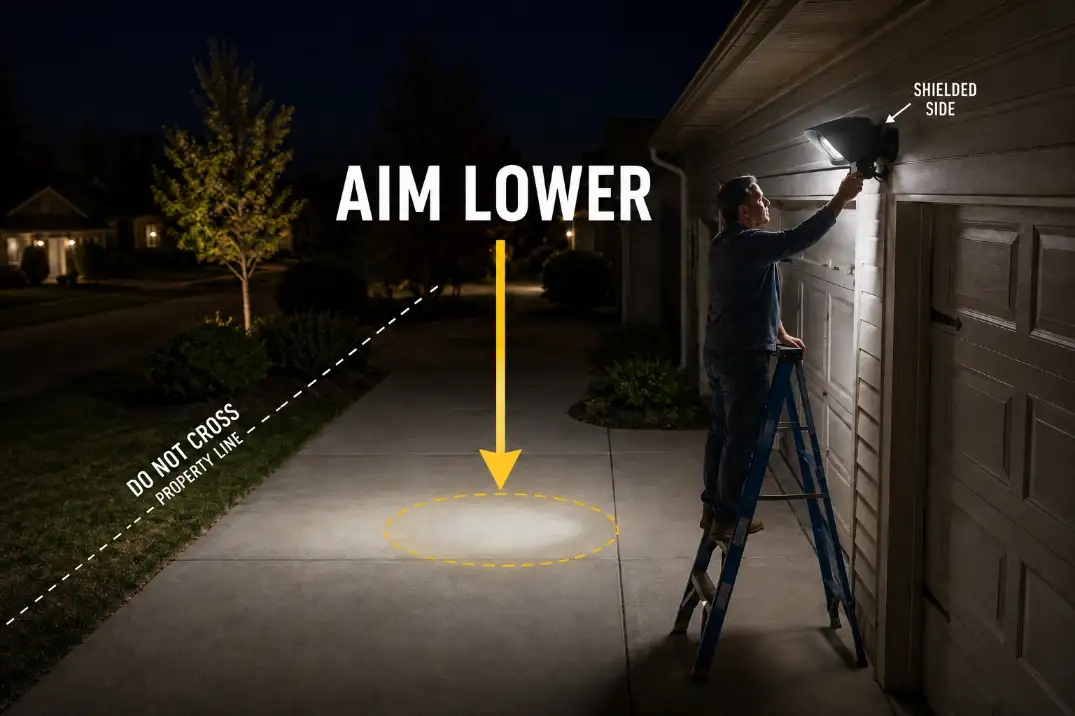
Most nuisance lights are aimed too high. The beam should land on the driveway, gate, steps, or walkway, not shoot outward into open space.
As a rough field rule, the brightest part of the beam should hit the ground within the property, often within 10–20 feet for side-yard or entry lighting.
If the light is mounted high on a garage or eave, small angle changes matter. Tilting a fixture down 10–15 degrees can move the hot spot away from a second-story window or fence line. Do this at night, with the light on, because daytime aiming is unreliable.
Add shielding before replacing everything
A side shield, visor, hooded fixture, or full-cutoff design can block the direct view of the source while keeping useful light on the ground. This is often the cleanest fix when the fixture is otherwise working.
Shielding matters more than many people expect. A 1,000-lumen shielded light can feel calmer than a 600-lumen exposed light if the exposed lamp is visible from the neighbor’s window. The issue is not only output; it is source visibility.
If the same light also shines directly into a neighboring home, the fix logic overlaps with how to stop outdoor lights from shining into a neighbor’s windows without removing needed safety lighting.
Shorten the timer
For most residential motion lights near property lines, start at 60 seconds. Increase only if there is a real task that requires more time. A long driveway may justify 2 minutes. A side gate usually does not.
The point where a routine timer adjustment stops making sense is when the light wakes or startles someone even at the shortest setting. If 30 seconds is still too disruptive, the problem is beam direction, shielding, fixture placement, or brightness.
Narrow the detection zone
Use the sensor head angle, sensitivity dial, and masking tape or manufacturer-provided shields if available. The goal is not maximum coverage. The goal is useful coverage.
A sensor should detect someone approaching the door, gate, or vehicle area. It should not detect traffic 50 feet away, branches beyond the fence, or movement inside a neighbor’s yard.
In cold northern states, some passive infrared sensors can behave differently because warm bodies stand out more strongly against cold backgrounds. A setting that seemed fine in September may become too reactive in January.
Before It Becomes a Neighbor Dispute
Motion light complaints get worse when the conversation stays vague. “Your light is too bright” is easy to dismiss. “It shines directly through our bedroom blinds for about 2 minutes every time a car passes” is harder to ignore and easier to fix.
What the affected neighbor should check first
The useful facts are practical, not emotional: where the beam lands, whether the LED source is visible, how often the light triggers, and how long it stays on. A simple log over two or three nights can show whether the problem is occasional or routine.
The strongest complaint is usually not “I dislike your light.” It is “the light crosses into our living space and wakes us repeatedly.”
What to ask for specifically
A better request is not “turn it off.” It is more specific:
Ask whether the fixture can be aimed lower, the timer shortened to about 60 seconds, the sensor range reduced, or a side shield added. Those changes preserve the homeowner’s safety goal while reducing the neighbor’s disruption.
If there is an HOA, city code, or county nuisance rule, adjustment is usually still the best first step. Local rules vary, but the recurring ideas are familiar: shield the source, avoid direct glare, keep light on the intended property, and use only as much brightness as the task needs.
When Motion Lighting Becomes a Placement Problem
Sometimes the fixture is simply in the wrong place. A garage corner, second-story eave, or fence-facing wall may give the light too much reach. You can tune it, but you may not be able to make it neighbor-friendly without moving it.
Shared fences need lower, tighter light
Side yards and shared fences are the highest-risk locations. A wall-mounted floodlight is often too broad for a narrow passage. A lower-output wall pack, step light, or shielded downlight may do the job better.
For backyard spaces, the better approach is often layered low light rather than one dramatic trigger.
That is especially true where privacy matters, because lighting a backyard without losing privacy depends on keeping illumination close to the activity area instead of broadcasting it across the lot.
Cameras do not always need floodlight brightness
Many modern security cameras perform better with moderate, even light than with a harsh floodlight. Overbright motion lights can wash out faces, license plates, or walkway detail, especially when the subject is close to the camera.
If the light exists mainly for camera support, test a lower brightness setting or a warmer, shielded fixture before assuming stronger is safer. The healthier condition is even visibility across the target area. The failing condition is a bright foreground with black shadows behind it.
A Neighbor-Friendly Motion Light Setup
A motion light that works well near neighbors usually has four traits: warm color, controlled beam, short timer, and limited detection.
Aim for warm white light around 2700K–3000K when possible. Keep the fixture shielded so the LED source is not visible from adjacent homes. Limit activation to the actual task area. Set the timer around 60 seconds, then adjust only if real use proves it too short.
This is also where glare and brightness get confused. A neighbor may say the light is “too bright,” but the decision-useful question is whether the source is visible and whether the beam crosses into living space.
If glare is the issue, reducing output alone may disappoint. A better fix may be shielding, aiming, or replacing a wide flood with a narrower fixture.
The same distinction is central to understanding why outdoor lights create glare even when the total wattage seems reasonable.
Pro Tip: After making changes, check the light from three positions: your target area, the property line, and the most affected window angle you can legally access. A light can look perfect from the driveway and still be wrong from the side.
Questions People Usually Ask
Are motion sensor lights rude to neighbors?
Not automatically. They become a problem when they point off-property, trigger constantly, or stay on long enough to interrupt sleep. A carefully aimed, shielded motion light with a short timer is usually less annoying than an all-night floodlight.
Is it better to leave a low light on instead?
Sometimes, yes. A low, shielded, warm fixture may be less disruptive than a bright motion light that keeps flashing. But leaving a poorly aimed light on all night is not an upgrade. The better comparison is controlled low light versus controlled motion light.
How bright should a residential motion light be?
For many entry, driveway, and side-yard tasks, 700–1,200 lumens is often enough when the fixture is aimed well. Larger areas may need more, but jumping to 2,000–3,000 lumens near neighboring windows should be treated as a design choice, not a default.
What if the light stays on all night?
That is a different failure pattern. The cause may be timer settings, test mode, photocell confusion, sensor fault, or constant detection.
If the fixture never shuts off normally, troubleshoot it like a motion sensor light that stays on all night before focusing only on neighbor complaints.
Bottom Line
Motion sensor lights annoy neighbors most when they behave unpredictably and shine beyond the area they are supposed to protect.
The fastest improvement is not usually a new fixture. It is better aim, shorter hold time, narrower detection, warmer color, and shielding that hides the light source from neighboring windows.
The best motion light does not announce itself across the block. It turns on only where needed, stays on briefly, and leaves the neighbor’s windows out of the beam.
For broader official guidance on shielded, purpose-driven outdoor lighting, see the National Park Service outdoor lighting principles.