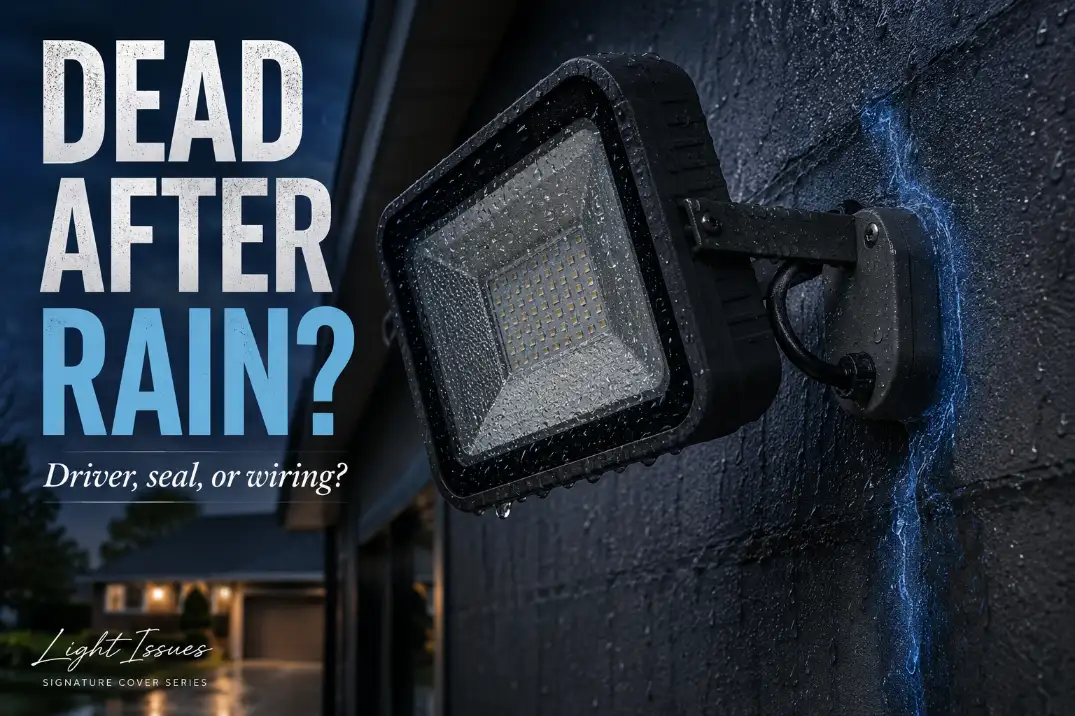
When an LED flood light stops working right after rain, the most likely failure is usually not the LED chips. It is moisture reaching the driver compartment, the junction box, or a weak wire connection.
If the flood light works again after drying, suspect a seal, cable-entry, or junction-box leak first. If it stays dead while power is present, the LED driver or internal electronics are more likely damaged.
Rain timing tells you more than fixture age. A light that dies within 0–6 hours of a storm, trips a GFCI, or comes back after 12–48 dry hours is behaving differently from a fixture that simply burned out over time.
Start with three checks: whether the breaker or GFCI tripped, whether the fixture recovers after drying, and whether there is fogging, rust, blackening, or water around the lens, gasket, cable entry, or wall box.
The Fastest Way to Separate Driver, Seal, and Wiring Problems
Do not begin by guessing which part is bad. Begin by reading the failure pattern. Replacing the whole flood light before checking the circuit can waste money, but resealing a fixture with a dead driver is just as pointless.
If the light died during or soon after rain
A failure within a few hours of rainfall points toward water intrusion or wet wiring. If the light is on a GFCI-protected outdoor circuit and the GFCI has tripped, the issue may be leakage current from moisture rather than a dead fixture.
One reset after the area is dry can help diagnosis. Several resets in a row do not fix anything. They just re-energize a wet fault.
If the light returns after drying
If the flood light works again after 12–48 dry hours, the driver may still be alive. That does not mean the fixture is healthy. It usually means moisture is entering, evaporating, and returning during the next rain.
That repeat pattern is close to the one explained in Why Your Outdoor Light Works Fine Until It Rains, but flood lights are especially exposed because they are often aimed outward, mounted high, and hit by angled rain that small porch fixtures never see.
If the light never returns
If the circuit has power and the fixture stays dead after 48 dry hours, the driver or internal electronics become the stronger suspect. LED drivers do not handle repeated wet-dry cycles well. Moisture can corrode contacts, weaken capacitors, or create a short path that permanently damages the electronics.
The symptom is “no light.” The underlying mechanism may be internal driver failure.
Quick Diagnostic Checklist
| Check | More Likely Cause | Next Move |
|---|---|---|
| GFCI or breaker trips after rain | Moisture leakage or wet wiring | Let dry, reset once, then inspect |
| Light works after 12–48 dry hours | Seal leak or wet junction box | Find the water entry path |
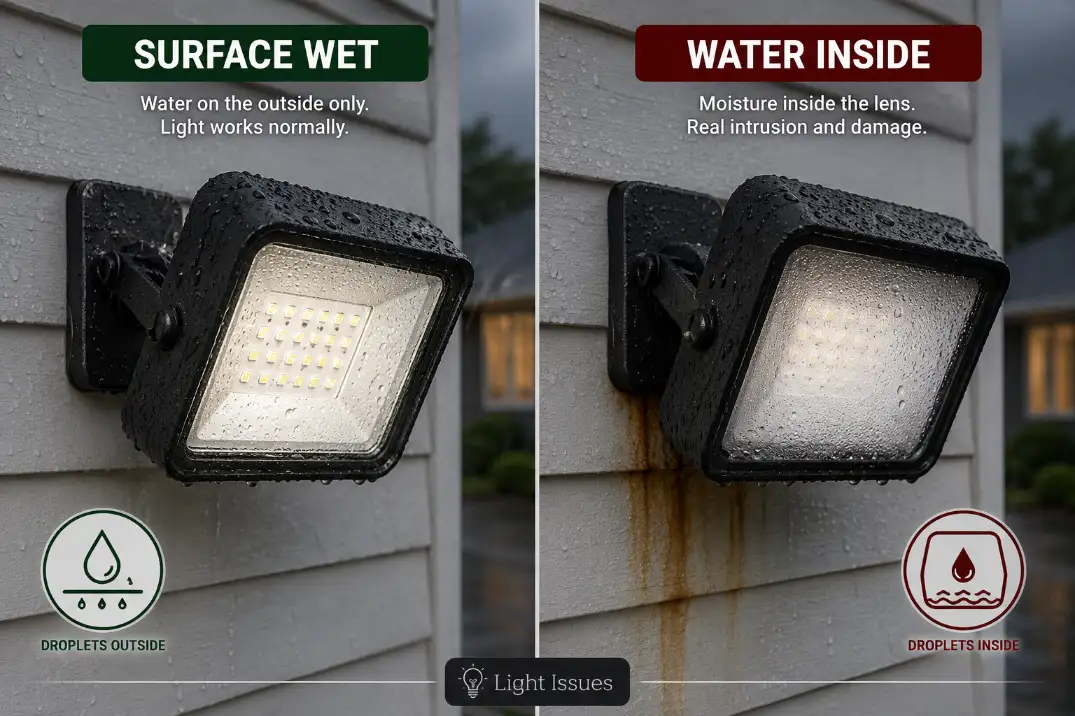
| Lens stays fogged over 24 hours | Water trapped inside fixture | Repair only if serviceable |
| Rust, green corrosion, or white powder at wires | Damaged outdoor connection | Replace with proper outdoor-rated connectors |
| Power present but fixture stays dead | Failed driver or internal electronics | Replace driver or fixture |
| Camera or motion sensor works but light does not | Control relay, driver, or lamp circuit | Separate smart-control issue from power failure |
The Symptom Matters More Than the Brand
Brand names, wattage, and fixture shape matter less than what the light actually does after rain. A 20-watt residential flood light and a 100-watt security flood can fail from the same basic moisture path.
Completely dead after rain
A totally dead light points first to GFCI trip, wet wiring, or driver failure. If other outdoor lights on the same circuit also fail, look upstream before blaming the fixture.
Flickering or glowing after rain
Flickering after rain often means moisture is creating unstable electrical contact. A failing driver may also pulse, delay startup, or flash once before shutting down.
This overlaps with the patterns in Outdoor LED Lights Flickering? Driver, Moisture, or Power Issue, but the rain timing narrows the diagnosis.
Only part of the LED panel works
If some LED rows or sections work and others do not, the LED board or internal module may be damaged. That is different from a full power loss. A partial panel failure usually means the fixture has already suffered internal damage, not just a wet switch.
Smart or motion flood light still responds but does not shine
Smart and motion flood lights add one more layer. If the app shows the device online, the camera works, or the motion sensor still clicks but the LEDs stay off, treat the sensor as a control signal, not proof that the lamp circuit is healthy.
App resets help only when the control system is confused. They do not dry a wet driver, fix a corroded splice, or restore a damaged LED module.
What People Usually Misread First
“Outdoor rated” does not mean waterproof forever
A flood light can be sold for outdoor use and still fail if the gasket is pinched, the mounting plate is loose, the cable entry faces upward, or the fixture sits where roof runoff hits it directly. Outdoor suitability depends on both the fixture and the installation.
The condition homeowners often overestimate is the metal housing. A solid shell looks reassuring, but the weak points are smaller: a 1/8-inch gasket gap, a cracked cable gland, a loose mounting screw, or a junction box that traps water behind the plate.
Damp-rated and wet-rated are not the same
A protected porch ceiling is not the same as an exposed driveway wall. Damp-location fixtures are meant for moisture and condensation where direct rain is not hitting the fixture. Wet-location fixtures are for places exposed to dripping water, rain, or spray.
If the flood light is mounted on an open wall, near a driveway, under a shallow eave, or where wind-driven rain reaches it, “outdoor style” is not enough. For direct sprinkler spray or harsh exposure, an IP65 or IP66 fixture is usually a better match than a vague weather-resistant label.
Condensation is not always harmless
A light fog inside the lens that clears in a few hours can happen when warm humid air cools overnight. Fogging that lasts more than 24 hours after dry weather is more concerning. That suggests water is trapped, not just temporary vapor.
For a broader breakdown of the difference between temporary dampness and damage, Moisture Damage in Outdoor Lighting Explained supports this diagnosis well.
Where Rain Usually Gets In
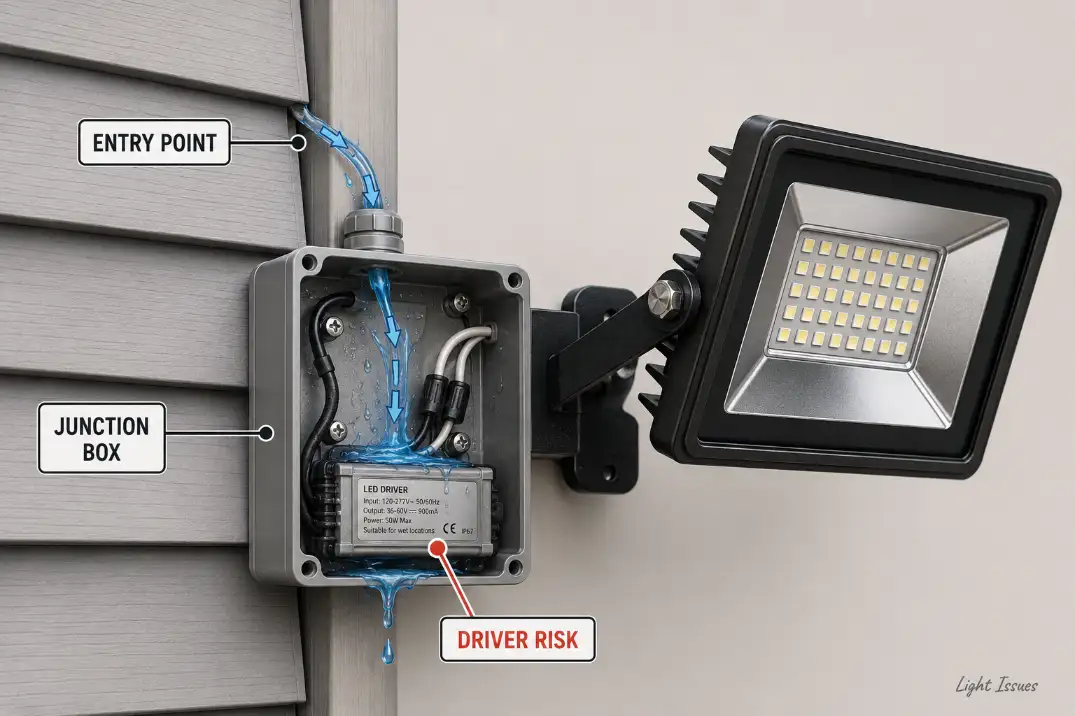
Most rain failures come from one of three places: the fixture seal, the cable entry, or the junction box behind the light. The repair changes depending on which boundary failed.
The fixture seal
A bad lens gasket lets water reach the LED board or driver cavity. This is common on older fixtures, cheaper sealed units, and lights exposed to years of sun.
In dry Arizona-style heat, rubber and plastic seals can harden and shrink. In humid Florida or coastal California conditions, seals may stay damp long enough for corrosion to accelerate.
A useful threshold: if water beads inside the lens or the fixture still shows internal fog after a full dry day, exterior caulk alone is usually too late. Water is already past the protective boundary.
The cable entry
The cable entry is small, but it can ruin the whole fixture. If the wire enters from above, the strain relief is loose, or old caulk has separated from the wall, water can track along the cable into the fixture or box.
This is why smearing sealant around the front edge often disappoints. The water may not be entering through the lens at all.
The junction box
A wet junction box can make a good flood light look dead. Loose wire connectors, indoor-style splices, missing gaskets, or a box that holds water can create intermittent power loss or trip protection devices during rain.
Corrosion is not cosmetic. Green copper staining, blackened insulation, white powder, or melted connector edges suggest electrical resistance and heat. A healthy connection should be tight, clean, and dry.
Driver Failure vs Wiring Failure
The driver converts household power into the controlled output the LEDs need. In many integrated flood lights, the driver is built into the fixture and not meant to be replaced separately. Wiring failure happens before power reaches the driver.
Signs that point toward the driver
Suspect the driver when the circuit is live, the switch is working, nearby lights on the same circuit still operate, and the flood light remains completely dead after drying. Driver trouble may also show up as delayed startup, pulsing, faint glow, or a single flash before total failure.
A healthy LED flood light should usually turn on within about 1 second after power is supplied. A failing driver may delay several seconds, flash, pulse, or shut back down as it warms.
If that behavior existed before the rain, the storm may have finished a driver that was already weak.
For a deeper internal-failure view, Outdoor LED Driver Failure is the better next read than a generic bulb-replacement guide.
Signs that point toward wiring
Suspect wiring when multiple outdoor lights fail together, the GFCI trips, or the fixture reacts when wires are moved. A light that works when bumped is not “almost fixed.” It has an unstable connection.
For low-voltage landscape flood lights, voltage drop can also confuse the diagnosis. A 12-volt fixture receiving only 9–10 volts at the end of a long wet run may dim, flicker, or fail to start even though the transformer is still working.
When the rain was really a storm
Rain sometimes gets blamed when the real trigger was the electrical side of a storm. If the flood light died during thunder, utility flicker, or a nearby surge — especially if other electronics or outdoor fixtures were affected — driver damage from a power event becomes more plausible.
The distinction is practical: rain-only failure that recovers after drying points toward moisture; storm-time failure that never recovers may be a driver killed by surge, water, or both.
The Fix That Often Wastes Time
The most common wasted fix is caulking around the visible edge of the fixture without opening the mounting area. It feels logical because the outside is wet, but it can trap moisture inside the box and hide the real entry point.
Pro Tip: Seal the top and sides of the mounting plate when appropriate, but do not blindly seal the bottom edge unless the fixture instructions call for it. A small drainage path can prevent trapped water.
Another weak fix is replacing the bulb. Most modern LED flood lights are integrated units with no separate bulb. If the housing says the LEDs are non-replaceable, the meaningful choices are wiring repair, driver repair if serviceable, or fixture replacement.
Safe Step-by-Step Diagnosis
Turn power off before opening the fixture or junction box. If the light is high on a wall, mounted near wet ground, or connected to line voltage, do not treat this like a low-risk cleaning job.
1. Check the circuit first
Look for a tripped breaker, outdoor GFCI outlet, or GFCI breaker. Many exterior circuits are protected from a garage, basement, bathroom, or exterior receptacle, so the reset may not be near the flood light.
If the GFCI trips again immediately after one reset, stop. That is not a stubborn switch. It is useful evidence of leakage or fault current.
If the main symptom is repeated tripping rather than a dead fixture, Outdoor Lights Tripping GFCI Outlets is the more specific diagnosis.
2. Inspect the outside before opening anything
Look for cracked lenses, missing screws, loose mounting plates, gaps in caulk, downward water streaks, and sprinkler overspray. A fixture hit by irrigation 3–5 nights per week can fail even in a dry climate because it never gets a proper drying cycle.
Sprinklers are commonly underestimated. Rain may get blamed, but a spray head pointed at the fixture can deliver water from the same angle for 10–20 minutes per cycle.
3. Open the junction box only when safe
With power off, inspect the wire connections. Outdoor splices should not look like indoor splices that happen to be outside. If the connectors are loose, rusty, wet, or packed into a box that holds water, the connection needs proper repair.
If you find corrosion, Corrosion in Outdoor Light Connections is more relevant than simply buying a brighter replacement fixture.
4. Know when to stop
Stop and call an electrician if the GFCI trips immediately again, you see burn marks or melted insulation, water is inside the junction box, or live-voltage testing is needed at a wall-mounted fixture. A multimeter can separate fixture failure from power loss, but only if the person using it knows how to test safely.
When Replacement Makes More Sense Than Repair
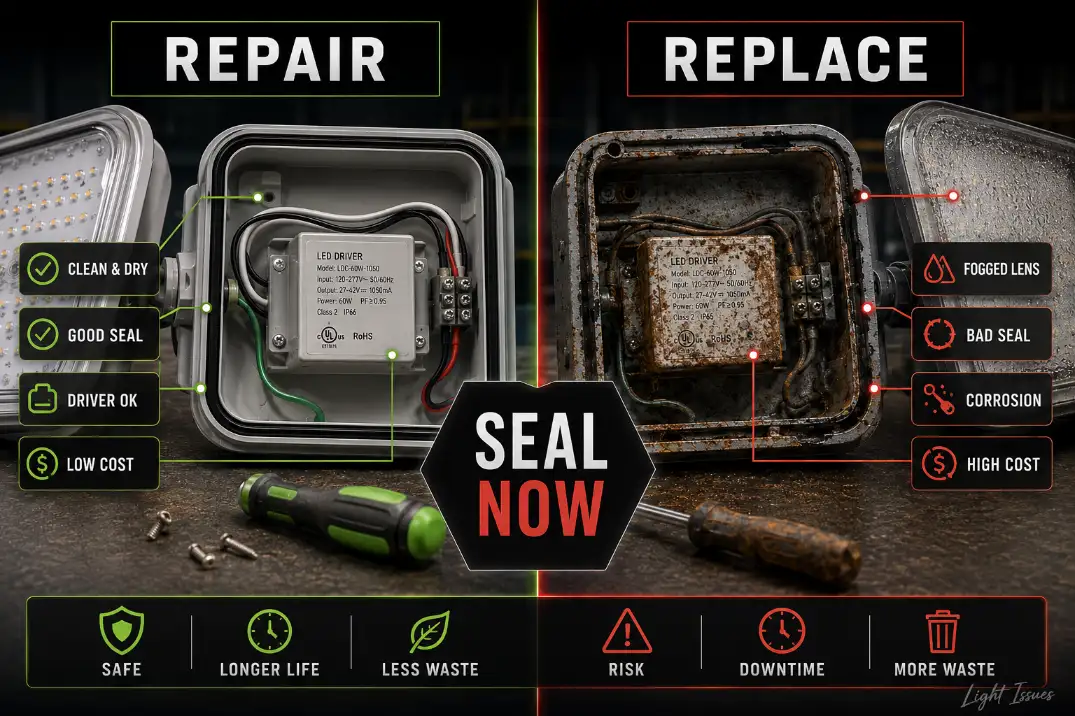
Repair makes sense when the fixture is serviceable, the housing is still sound, the driver can be replaced, and the water entry point is clear.
Replacement makes more sense when the lens is permanently fogged, the driver area is corroded, the gasket has failed in multiple places, or the fixture is an inexpensive sealed unit.
A routine fix stops making sense when the same light fails after two repair attempts or water has reached the internal electronics more than once. At that point, the problem is no longer “a little rain got in.” The fixture has lost its weather boundary.
Choose a wet-location-rated replacement for exposed walls, open eaves, driveway corners, coastal areas, and anywhere wind-driven rain or sprinkler spray can hit the light directly. Damp-rated fixtures belong in protected spaces, not direct rain.
What Changes in Different Weather Conditions
In humid climates, the drying window is longer. A fixture in coastal Florida may stay damp internally for 48 hours or more after wind-driven rain. In northern states, freeze-thaw cycles can widen small gaps because trapped moisture expands when frozen. In dry desert regions, UV exposure may age gaskets faster even though rainfall is less frequent.
The repair logic stays the same: identify whether water is entering the fixture, the wall box, or the wiring path. Climate mainly changes how fast that weak point turns into failure.
Questions People Usually Ask
Can an LED flood light dry out and be fine?
Sometimes, but only if water did not reach the driver or corrode the connections. If it works again after a day or two, treat that as a warning sign, not a complete repair.
Should I drill a drain hole in the fixture?
Usually no. Drilling can destroy the fixture’s rating, expose electronics, and create a new entry point. Fix the failed seal, cable entry, junction box, or replace the fixture.
Why does the flood light trip the GFCI only when it rains?
Rain creates a leakage path that may not exist when everything is dry. The problem may be inside the fixture, inside the junction box, or at an outdoor splice.
Is a higher IP-rated light always the answer?
Not by itself. A better-rated fixture helps only when the installation is also correct. A high-quality wet-location flood light mounted over a leaky box can still fail after rain.
The deciding question is not whether rain touched the fixture; it is whether water crossed into the wiring, driver, or junction box.
For broader official guidance on luminaire location ratings, see UL Code Authorities.