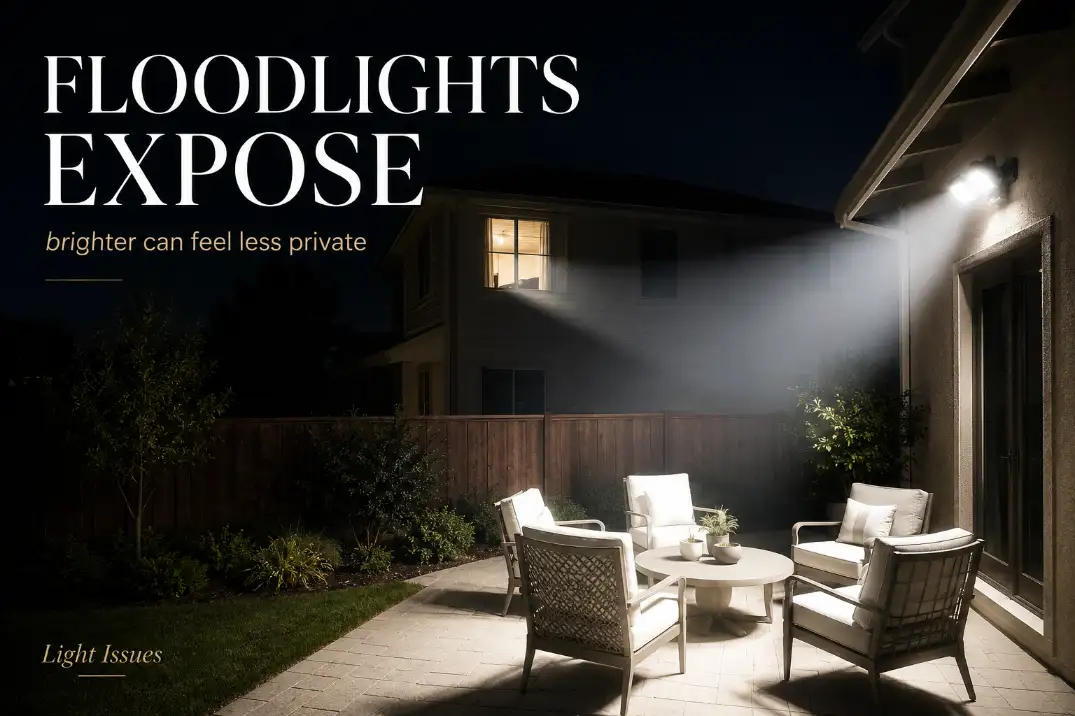
Floodlights are bad for backyard privacy because they create light trespass and visual exposure, not just brightness. The fixture may be on your wall, but if the beam crosses the fence line, lights faces at seated eye level, or reaches a neighbor’s bedroom window or patio, the yard stops feeling private.
Start with three checks: whether the LED lens is directly visible from the patio, whether the beam reaches the top of a 6-foot fence, and whether the light stays on longer than 60–90 seconds after motion stops.
This is different from a backyard that is simply too dark. A dark yard lacks useful light. A floodlit yard often has too much light traveling in the wrong direction.
Once a floodlight is mounted 8–15 feet high and aimed outward, it can make people, patios, windows, and fence lines more visible than they need to be.
The Real Problem Is Not Brightness. It Is Exposure.
Floodlights seem useful because they cover a wide area quickly. That is also why they are so risky for privacy. They do not politely stop at the grill, the back steps, or the gate. Unless they are shielded and aimed carefully, they wash across everything in their path.
A floodlight turns private space into a visible stage
Backyard privacy usually depends on partial darkness. Shadows around the fence, soft contrast near shrubs, and lower light around seating areas all help a yard feel less exposed. A floodlight removes that separation.
The problem is most noticeable around patios, decks, hot tubs, outdoor kitchens, and seating areas. These are places where people stay still for 10, 20, or 30 minutes at a time. If a floodlight brightens faces, shoulders, furniture, and movement, anyone viewing from an upstairs window, a neighboring deck, or the street can read the space more easily.
That is why a brighter fixture can make the yard feel less secure emotionally, even if it technically improves visibility. It lights the person, not just the path.
A visible lens is a privacy warning sign
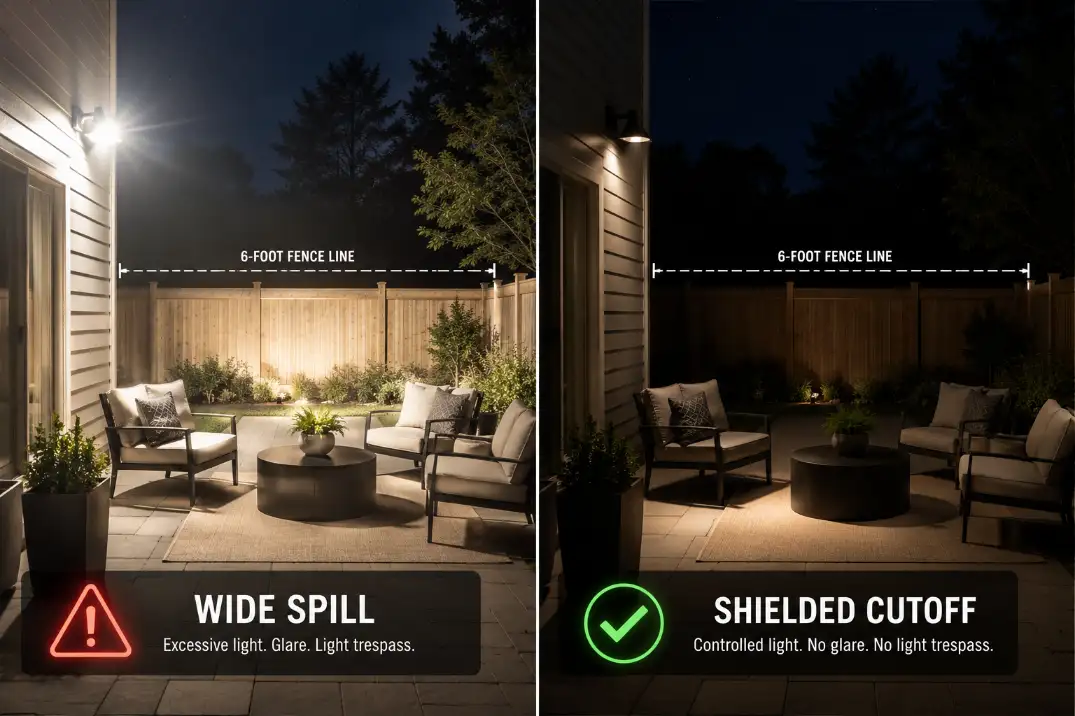
The fixture lens matters more than many homeowners expect. If the LED chips or bright glass face are visible from normal seated eye level, the light is probably producing glare.
Glare does two things at once: it makes the yard feel harsher from inside the space, and it makes the light source more noticeable from outside the space.
A floodlight can be advertised as “security lighting” and still be badly suited for backyard comfort. Security lighting watches a specific access point. Privacy-friendly lighting helps people move and use the yard without putting them on display.
For a broader privacy-first view of the same problem, Outdoor Lighting Privacy Problems explains why glare, overexposure, and light trespass often come from the same design mistake.
Floodlights Hurt Privacy on Both Sides of the Fence
A floodlight privacy problem is rarely one-sided. The homeowner may feel exposed in their own yard, while the neighbor may feel invaded by light entering a bedroom, patio, or side yard.
Your patio can lose privacy even if the light stays on your property
A fixture does not have to cross the property line to damage your own privacy. If the beam lights people more than surfaces, the yard becomes easier to observe. This is especially true on compact suburban lots, corner lots, and yards with second-story sightlines nearby.
A 6-foot fence can block a direct view at ground level, but it cannot stop light from making movement above or behind the fence more visible.
When a floodlight is mounted near an eave at 10–12 feet, the beam often travels over privacy structures instead of staying down on steps and walkways.
Your neighbor’s privacy can be affected even when the fixture is yours
The other side is light trespass. If the beam hits a neighbor’s bedroom window, upper deck, outdoor seating area, or bedroom wall, the issue is no longer just your backyard preference. It becomes a shared nighttime comfort problem.
This is where many people misread the situation. They check whether the fixture is mounted legally on their own house, but they do not check where the beam lands. For privacy, the landing point matters more than the mounting point.
In some communities, direct glare or light crossing into residential windows may also become a code or nuisance issue, so fixture control is not only a comfort upgrade.
When the main complaint is light entering another home, the fix usually needs to happen at the fixture: shielding, lowering the aim, narrowing the beam, reducing duration, or relocating the light.
The window-side problem is covered more directly in How to Stop Outdoor Lights From Shining Into Neighbor’s Windows.
What People Usually Get Wrong First
The most common mistake is treating floodlight privacy as a lumen problem. It usually is not. The better question is not “Is this light too bright?” It is “Is this light going somewhere it should not go?”
The fix that usually wastes money: buying a brighter floodlight
Replacing a harsh 1,200-lumen floodlight with a 3,000-lumen floodlight rarely solves privacy. It may brighten the yard, but it also increases spill, glare, and reflected light if the fixture is still exposed or aimed too high.
That is the point where a routine upgrade stops making sense. More output cannot fix a bad beam path. If the lens remains visible from the seating area or the beam still reaches the fence top, the problem is fixture control, not bulb strength.
A better privacy-oriented setup starts with lower, more controlled lighting. How to Light a Backyard Without Losing Privacy explains why smaller zones usually work better than one wide blast of light.
Security is often overestimated
A floodlight can help at a gate, driveway corner, garage approach, or side-yard access point. But using one floodlight to wash an entire backyard all night is usually poor privacy design.
A security light should answer a narrow question: “Who or what is near this access point?” It should not light every chair, fence panel, window, and person in the yard. A motion-triggered narrow beam that runs for 30–90 seconds near a gate is often more useful than a constant floodlight that runs for hours.
Reflected spill is often underestimated
Floodlights do not only cause problems through direct aim. Pale vinyl fences, white siding, concrete patios, pool decks, stucco walls, and reflective windows can bounce light into areas the fixture does not directly face.
This matters in humid Florida yards with light-colored pool decks, dry Arizona yards with pale walls and gravel, and California coastal lots where moisture and glass can make reflections sharper at night. Reflected spill may not look obvious from the switch, but it can be very noticeable from a bedroom or neighboring patio.
The Privacy Failure Test
Use this table before replacing the fixture, adding a second floodlight, or assuming the neighbor is simply being sensitive.
| What you see at night | What it usually means | Better correction |
|---|---|---|
| Fixture lens visible from patio seating | The glare source is exposed | Add shielding or replace the fixture |
| Beam reaches the top of a 6-foot fence | The light is traveling too high | Aim lower or use a cutoff fixture |
| Neighbor window catches direct light | Light trespass risk is high | Shield, narrow, or relocate the light |
| Faces are brighter than the ground | People are being exposed | Use lower task lighting |
| Motion light stays on 3–5 minutes | Timing may create nuisance | Reduce to 30–90 seconds |
| Patio feels bright but edges feel dark | Contrast is poorly controlled | Use smaller layered lights |
The most decision-useful row is the lens test. If the bright source is visible from where people sit, the setup will probably feel exposed even after you reduce the brightness.
Pro Tip: Test the light from the receiving side, not just from the switch. Stand at the fence line, the patio chair, and the nearest window view. The problem often becomes obvious from one of those positions.
What Works Better Than a Backyard Floodlight
The best replacement is not necessarily a weaker light. It is a more selective lighting plan.
Use task zones instead of yard wash
A private backyard does not need equal brightness everywhere. It needs useful light where people move, step, cook, unlock doors, or gather.
That usually means smaller zones:
- a low light at steps;
- a shielded fixture at the back door;
- a focused light near the grill;
- soft path lighting along walking routes;
- under-rail or under-cap lighting around decks.
The practical difference is scale. A grill area might need light across a 4-by-6-foot work zone. A floodlight may wash a 25–30-foot area, including faces, fences, windows, and neighboring views that never needed light.
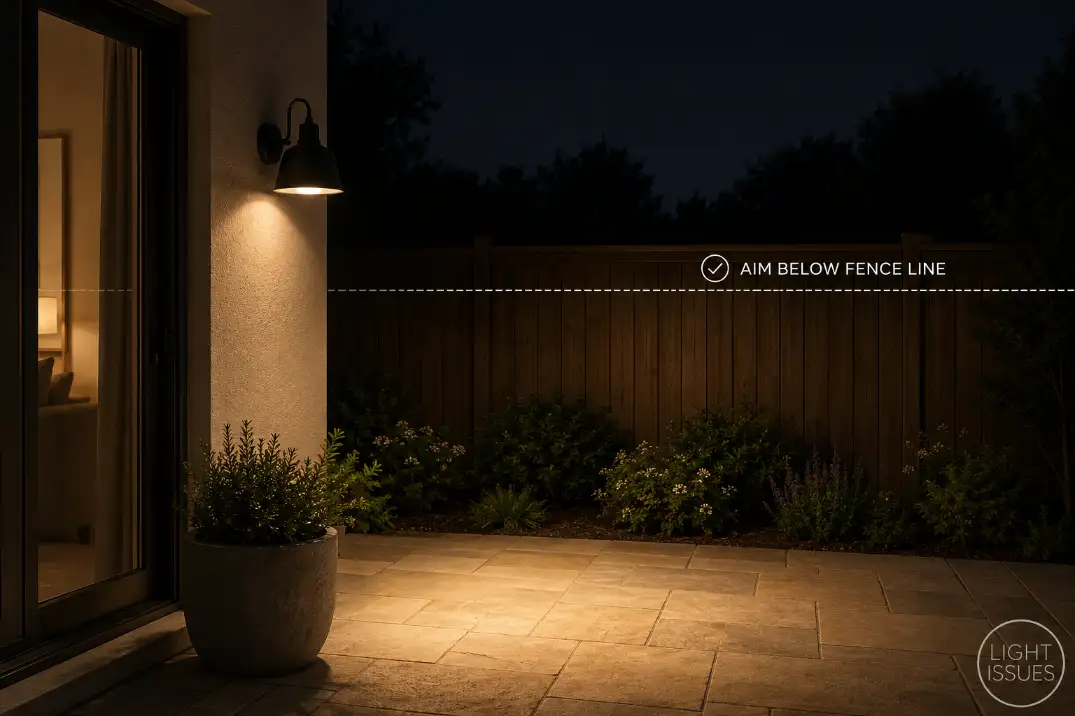
Aim light at surfaces, not open air
Good backyard lighting lands on something useful: a step, path, table, lock, threshold, or work surface. Bad backyard lighting travels through open air until it hits whatever happens to be in the way.
For privacy, this distinction matters more than brand or fixture style. A shielded 700-lumen wall light aimed down can feel more private than a 2,000-lumen floodlight aimed outward.
Warm light around 2700K–3000K usually feels calmer for patios and seating areas, while 4000K–5000K often feels clinical or exposed.
This is where glare and privacy overlap. Why Outdoor Lights Create Glare explains the fixture-level problem: the visible source often causes more discomfort than the amount of light on the ground.
When a Floodlight Still Makes Sense
Floodlights are not always wrong. They become a problem when they are used as the default backyard lighting system.
Acceptable use is narrow, shielded, and temporary
A floodlight can make sense when it is:
- aimed at a specific access point;
- shielded so the lens is not visible from neighboring views;
- angled below eye level;
- set to motion activation rather than constant-on use;
- limited to about 30–90 seconds for normal pass-through activity.
That is a very different setup from a high-mounted floodlight washing a whole patio for hours. The first is a security tool. The second is outdoor exposure.
If the light is installed for security but spends most of its time lighting people, fences, and windows, it is no longer acting like security lighting.
Motion settings can make or break privacy
Motion floodlights often annoy neighbors not because they turn on, but because they turn on too often, stay on too long, or cover too wide a zone.
If a fixture activates 15–20 times in one evening from branches, passing cars, pets, or movement next door, it stops feeling protective and starts feeling intrusive.
Sensitivity and timing matter as much as aim. A light that activates briefly near a gate is easier to defend than one that repeatedly blasts across fences and windows.
If repeated activation is the main issue, Why Motion Sensor Lights Annoy Neighbors at Night is the better next diagnostic path.
Quick Checklist Before You Keep the Floodlight
Use this as the final decision rule.
- Can you see the bare LED lens from the main seating area?
- Does the beam reach the fence top or cross the property line?
- Are faces brighter than the ground or walking surface?
- Does the light enter a neighbor’s bedroom window, patio, or deck area?
- Does motion activation last longer than 90 seconds for a normal pass-through?
- Is the light cooler than 4000K in a patio or seating area?
- Would a shielded wall light, path light, or step light solve the actual task with less exposure?
If two or more answers point to spill, glare, or overexposure, the floodlight is probably the wrong fixture for backyard privacy.
The Bottom Line
Floodlights are bad for backyard privacy when they expose people, windows, and neighboring spaces instead of lighting only the task area. The real problem is usually not brightness alone. It is high mounting, wide beam spread, visible glare, long motion timing, cool color temperature, and poor cutoff.
The better fix is not to make the yard dark. It is to make the light more selective. Keep light low, warm, shielded, and aimed at surfaces.
Use floodlights only for narrow security moments, not as all-night backyard ambience. Once the beam stops crossing fences and lighting faces, the yard starts feeling private again.
For broader official guidance on glare, light trespass, and responsible shielding, see the Colorado Plateau Dark Sky Cooperative outdoor lighting guide.