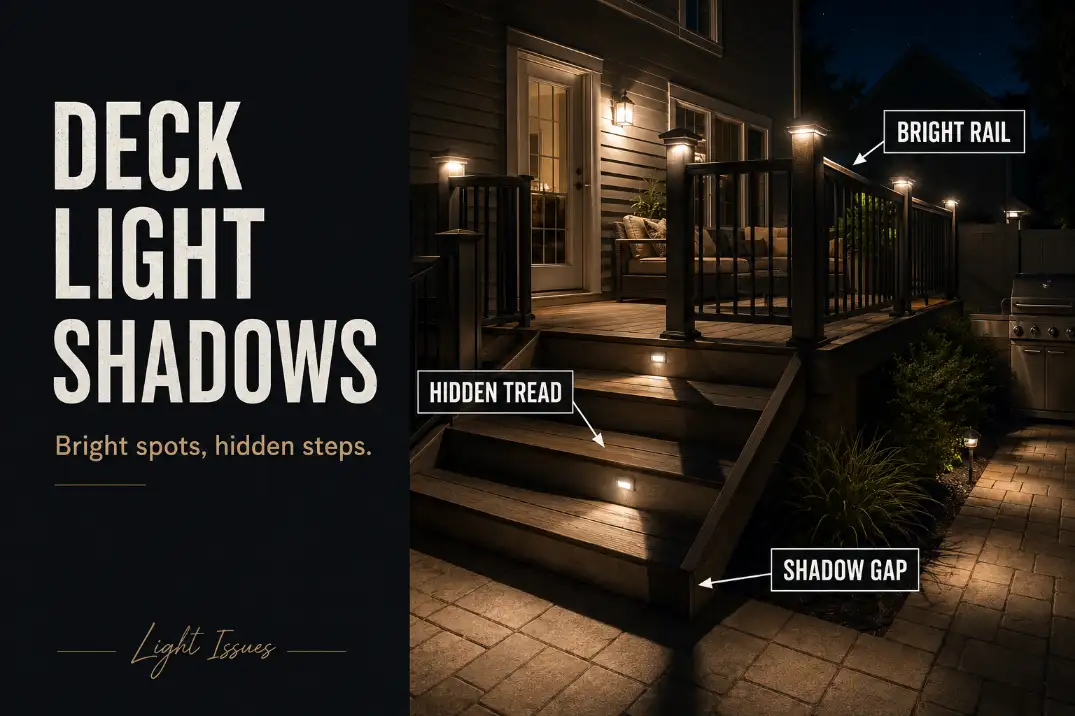
Deck lights create unsafe shadows when the light source is bright enough to catch your eye but positioned too high, too far back, or behind rail parts to reveal the stair edge.
The deck can look bright from the yard while the first step, last step, landing, or turn toward the grill route remains hard to read. That is a placement and contrast problem before it is a brightness problem.
Start with three checks: stand 6–10 feet from the stairs, look at the tread edge from the direction you actually walk, and wait until your eyes have adjusted outside for 15–20 minutes.
If you cannot identify the next level change within about 1–2 seconds, the lighting is not giving enough safety information.
This differs from a simply dim deck: in a shadow problem, something looks bright, but the walking surface still disappears.
The Real Problem Is Contrast, Not Just Low Light
Bright hardware can hide the useful edge
A glowing rail cap, post light, or wall fixture can make the deck feel finished without making the route safer. Safety depends on whether the eye can read a level change before the foot reaches it. If the rail is bright but the stair nose is dark, the fixture is lighting the wrong thing.
This is why a brighter bulb often makes the deck feel worse. It raises contrast around the fixture while the blocked area stays dark.
The result is a bright object surrounded by shadow bands, especially around rail posts, balusters, stair noses, and chair legs.
The same visibility trap shows up in Why Brighter Outdoor Lights Can Make Visibility Worse, where glare and contrast overpower the surface the light was supposed to reveal.
A top landing light is not the same as readable treads
A light near the back door or top landing may be useful, and in many situations it is part of the expected stair-lighting setup.
But practical deck safety still depends on what the person sees while moving. A top light that shines behind your body can leave the next tread in your own shadow.
Code language and local enforcement can vary, but practical safety still comes down to whether the person can read the next level change before stepping.
A visible fixture does not automatically mean the tread edge is visible from normal approach distance.
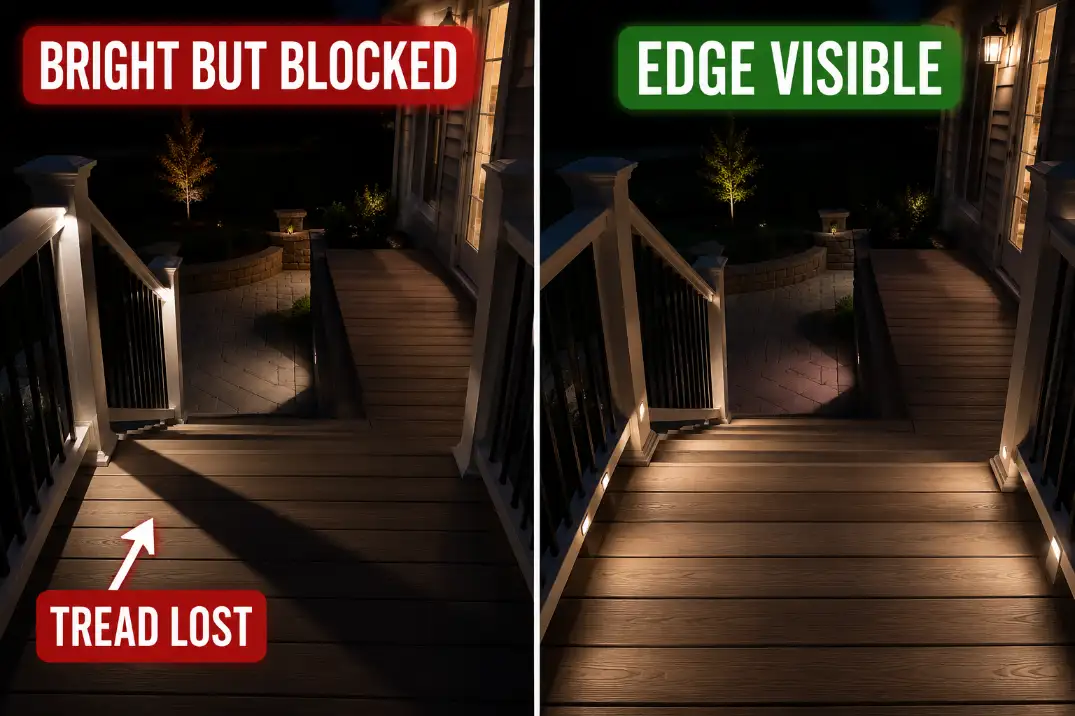
Quick Diagnostic Checklist
Use this quick check before replacing bulbs or adding more fixtures.
- Stand at the top and bottom of the stairs from 6–10 feet away and check whether the tread edges read clearly.
- Look after 15–20 minutes outside, not immediately after walking out from a bright kitchen.
- Check whether rail posts, balusters, chairs, planters, or your own body cast shadows across the walking line.
- Watch for one bright fixture surrounded by dark gaps near stairs, landings, grill routes, and deck-to-patio transitions.
- If a step light fades after 20–30 minutes of runtime, test power and moisture before blaming layout.
- Treat a hidden first or last step as more urgent than a slightly dark decorative corner.
Pro Tip: Test the deck while walking at a normal pace. Standing still and staring at the stairs can make a weak lighting layout seem better than it is.
Where Deck Lights Most Often Create Shadows
Rail and post lights often light the wrong plane
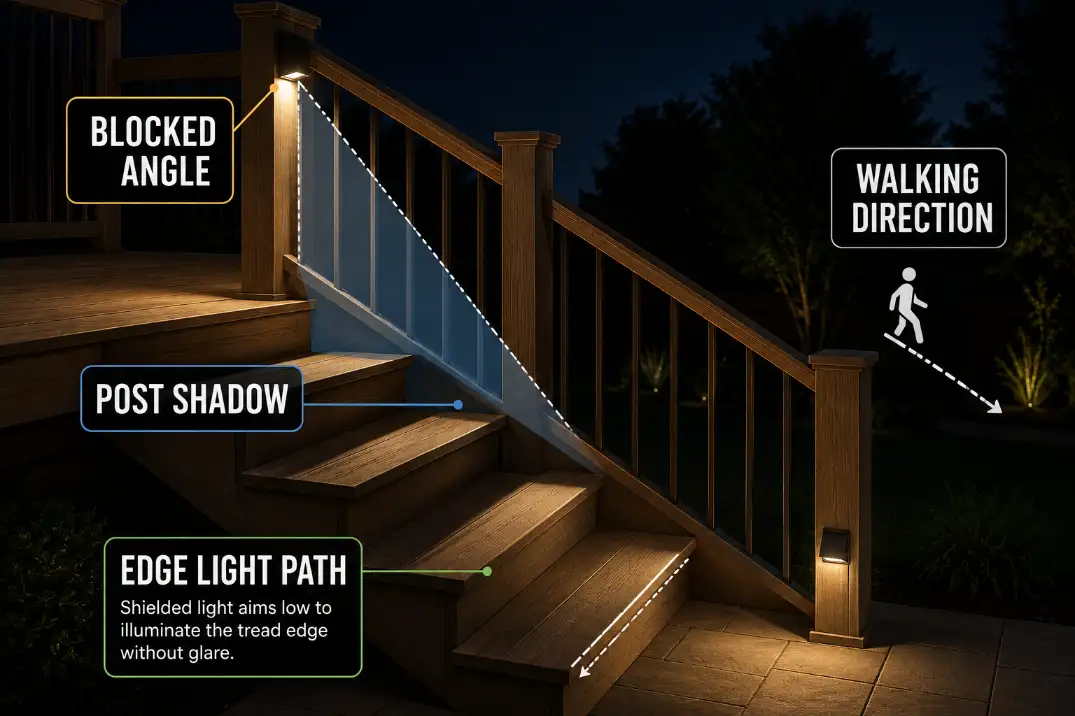
Rail lights and post cap lights are popular because they look built in. The problem is that many of them light vertical structure better than the horizontal walking surface. A rail can glow beautifully while the tread below it breaks into alternating light and dark bands.
On a small deck, this can be enough to make a 36-inch walking route feel uncertain. The issue is stronger near turns, stair runs, and deck-to-patio transitions because the eye needs a clean edge cue, not decorative brightness.
When the same problem extends into the whole outdoor living area, Patio and Deck Lighting Problems gives a wider diagnosis of how deck, patio, step, and seating zones interact.
Wall lights can turn the user into the shadow
A back-door wall light feels logical because it is close to the entry. But if it sits behind the person walking out, the body can block the next step.
From inside the house, the deck may look bright. From outside, the tread edge may disappear directly under the person’s shadow.
This is one of the easiest conditions to overestimate. Homeowners often judge the deck from the door or window, where the fixture looks strong. The better test is from the route: top of stairs, bottom of stairs, grill path, and patio return.
Step lights can still miss the tread nose
Step lights are not automatically safe. A riser light mounted too low may brighten the vertical riser while leaving the tread nose above it vague. A small fixture aimed straight outward can also glare into the eye without showing foot placement.
For many deck stairs, the goal is not to flood every inch of tread. The goal is to make level changes and direction shifts readable.
If shadows repeat every 2–3 treads, the fixture spacing may be too wide, the beam may be blocked, or the light may be aimed at the wrong plane.
Which Deck Light Type Helps Safety Most?
A useful deck lighting plan usually combines fixture types instead of expecting one bright source to solve every surface. The safest fixture is the one that reveals the next level change without becoming the thing your eye stares at.
| Fixture type | What it lights well | Shadow risk | Best safety use |
|---|---|---|---|
| Post cap lights | Post tops and rail rhythm | Treads below may stay dark | Accent and orientation, not primary stair safety |
| Rail lights | Rail line and nearby deck edge | Posts can cast hard bands | Route support when aimed downward |
| Wall lights | Door area and upper landing | Body shadow can hide steps | Entry support with a second lower cue |
| Riser step lights | Stair face and nearby tread | Can miss tread nose if too low | Direct stair-edge visibility |
| Under-rail lights | Walking edge below the rail | Furniture may block output | Soft route guidance on deck perimeters |
| Recessed deck lights | Surface markers and transitions | Can glare if overused or too bright | Landings, edges, and direction changes |
The table does not mean every deck needs all six. It means the fixture should match the surface that is actually disappearing. If the tread edge is the problem, a prettier rail light is usually the wrong first fix.
Why the Obvious Fix Often Fails
Brighter bulbs increase contrast before they improve safety
The most common wasted fix is replacing deck bulbs with stronger ones before checking where the light lands. If the fixture is blocked by a rail post, aimed at a wall, or shining into the user’s eyes, more output only makes the bright area louder.
A shielded fixture in the 2700K–3000K range often feels safer than a harsh exposed point because it reduces glare and helps the eye hold nearby detail.
For step lighting, small controlled sources in the rough range of 12–100 lumens per fixture can be enough when they aim at the tread edge. Too much output from the wrong angle can make shadows sharper.
More fixtures can create more shadows
Adding lights around every post can make the deck look expensive but still unsafe. Multiple point sources can create competing shadows from rail parts, furniture, planters, and people standing near the edge.
If the first fixture is harsh, adding a second harsh fixture may not fill the shadow; it may add another one.
Placement problems follow the same logic as other outdoor lighting misses. A fixture can be working perfectly and still miss the target, which is why How to Fix Poor Outdoor Light Placement is relevant when the deck light works but the safe surface remains unclear.
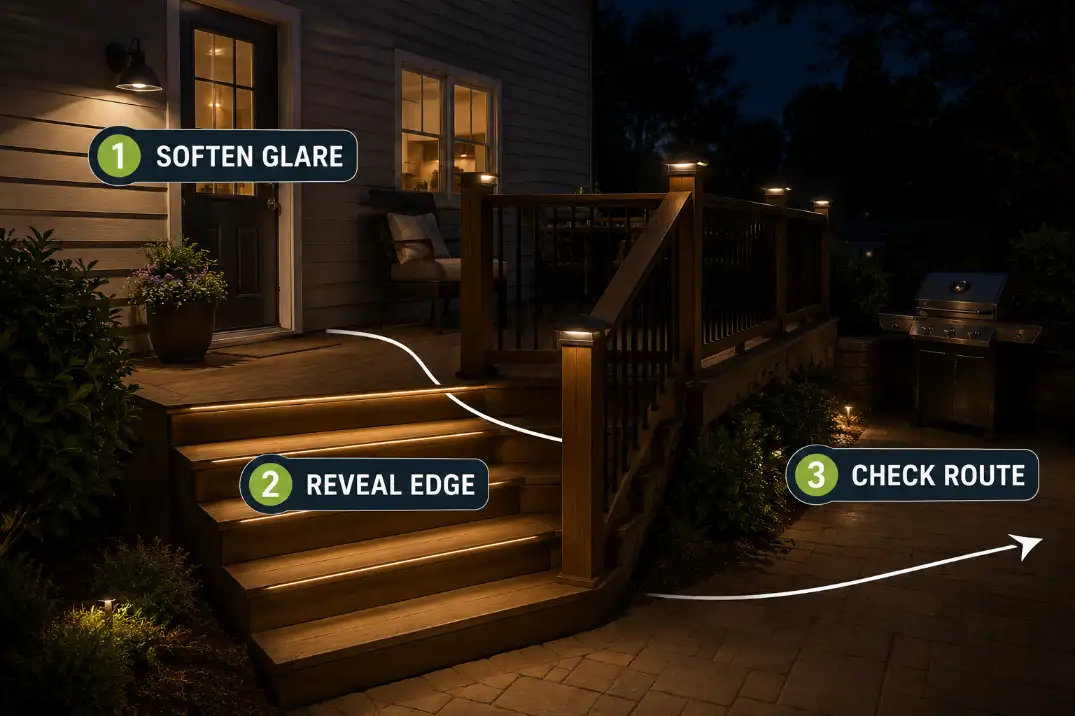
The Fix Order That Actually Improves Safety
1. Soften glare before adding output
Start with the fixture your eye notices first from the walking route. If your eye goes to the bulb, rail glow, or wall glare before it goes to the tread edge, the source is dominating the scene.
Shielding, dimming, angling, or replacing that fixture may do more than adding another light.
This is especially true on compact decks where the route from the door to the stairs or grill is only about 36 inches wide. One exposed source can overwhelm the whole route.
2. Reveal the edge before decorating the deck
After glare is controlled, light the safety cues in order: step edges, landing edges, direction changes, and regular walking paths. Decorative rail rhythm comes after those points read clearly.
If stair shadows appear between every second or third tread, add a better edge cue rather than increasing the wall light.
If a landing feels vague, place the cue at the level change, not halfway across the deck. If the route to the grill is interrupted by chair shadows, fix furniture clearance and fixture direction together.
A general rule helps: deck lighting should show the surface that changes level, not just the object that holds the fixture.
3. Add a second angle only where one angle is blocked
A second fixture makes sense when one light cannot reach around a railing, post, stair turn, or landing. It does not make sense when the first fixture is simply too harsh. Fix glare first, then fill the blocked edge.
For route lighting, low shielded fixtures spaced about 3–4 feet apart can help where movement is tight or interrupted.
Recessed surface markers may work better at 4–6 feet apart along a landing or perimeter, but only if they do not become a row of glare dots.
The exact spacing depends on fixture output, mounting height, board color, and how much the rail blocks the beam.
When a Routine Lighting Fix Stops Making Sense
Stable shadows usually mean placement
If the same tread disappears every dry night, the cause is probably geometry: fixture direction, railing obstruction, stair nose shadow, or furniture blocking the light. That is a layout problem.
Moving, shielding, or adding a better edge cue is more useful than buying a stronger bulb.
This is where the article’s main rule holds: a shadow is a map of what the light cannot reach.
Changing shadows point to output or weather problems
If the shadow pattern changes after rain, after 20–30 minutes of runtime, or after winter, do not assume the layout suddenly became bad. Wet lenses, dirty covers, corroded connections, voltage drop, and moisture inside the fixture can all reduce output.
Outdoor deck fixtures also need the right exposure rating. In open rain, coastal moisture, or exposed stair areas, a wet-location fixture with an appropriate weather rating matters more than a decorative fixture that only looks outdoor-friendly.
When the fixture choice itself is questionable, Outdoor Light Weatherproof Ratings is a better next step than redesigning the layout.
A changing shadow is usually not just a design clue. It can be a performance clue. If the fixture output drops over the evening, the stair may look safe at dusk and unsafe later at night.
Cold weather can make that harder to judge. After winter, grime, shifted covers, trapped moisture, and stressed connections can all reduce useful light before the fixture fully fails.
Electrical symptoms change the decision
A placement fix stops making sense when the lights flicker, shut off, trip a GFCI, fail only on one side, or dim heavily at the end of a 12-volt run. Those are not normal shadow symptoms. They suggest the system may not be delivering stable power.
If a low-voltage step light is dim at the farthest stair, test the voltage and connections before moving fixtures. Low Voltage Step Lights Not Working is the better diagnostic path when the light output itself is unreliable.
Pro Tip: Stable shadow, solve placement. Changing shadow, check output, moisture, and power before adding more lights.
Questions People Usually Ask
Are rail lights enough for deck stairs?
Rail lights can help with orientation, but they are not enough if the tread edge still disappears. Use them as route support, not as the only safety cue for stairs.
Should every deck stair have its own light?
Not always. A short stair run may become readable with well-placed low side lighting or a few controlled step fixtures. But if individual treads fall into alternating shadow bands, dedicated stair-edge lighting usually makes more sense.
Do solar deck lights fix stair shadows?
Solar lights can help mark edges, but they do not automatically fix blocked light. If they fade late at night, sit in shade, or lose charge in winter, the tread may disappear again after a few hours.
Is a floodlight safer for deck steps?
Usually not. A floodlight may make the deck look brighter from the yard, but it can create face glare and hard shadows under rails, stair noses, and furniture. Controlled direction is usually safer than raw brightness.
For broader residential stair illumination language, see the International Residential Code.