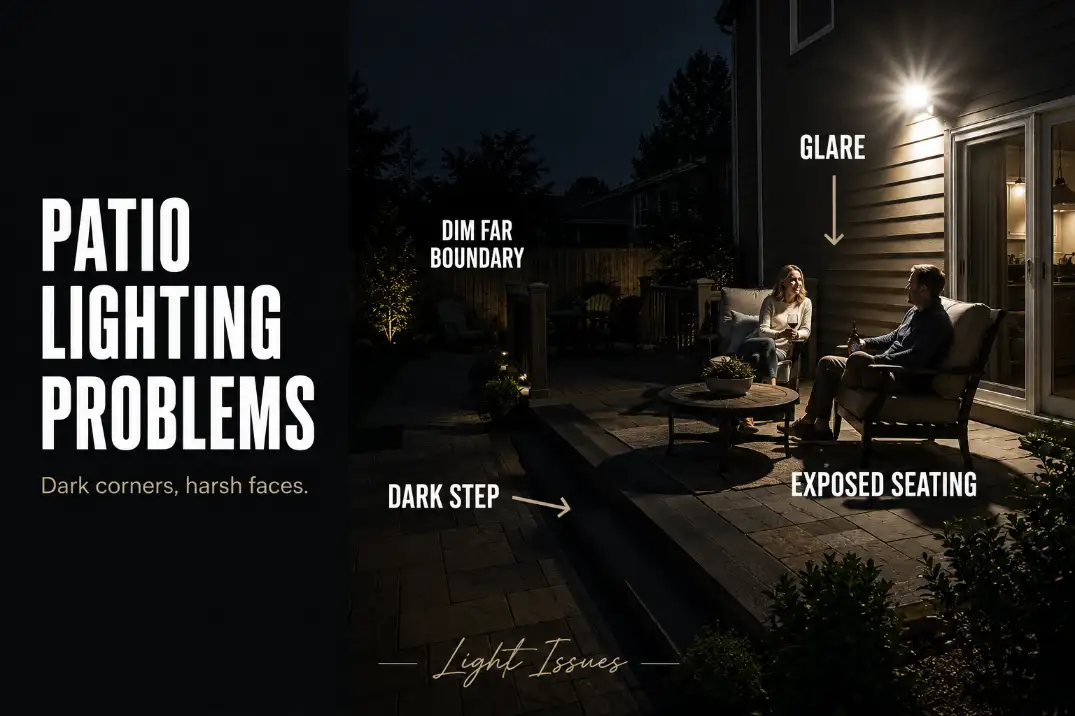
Patio and deck lighting fails when it lights the fixture, the wall, or the people before it lights the surfaces they actually use. The space may feel dark because the step edge and walking route disappear, harsh because the bulb is visible from the chair, or exposed because the seating area is brighter than the boundary around it.
Start from the main chair, not from the switch. Look for a visible bulb, check whether the step edge reads from 6–8 feet away, and walk the route from the back door to the seating area after 15–30 minutes of darkness.
If the light turns on but the patio still feels uncomfortable, this is probably not a fixture failure. It is a placement, direction, contrast, or spill problem.
A brighter bulb only helps when output is truly low. If the fixture is already the brightest thing in view, more brightness usually makes the space harsher.
Why Patio and Deck Lighting Feels Wrong After Dark
The first mistake is treating a patio or deck like a security zone. Outdoor living areas need visibility, but they also need comfort.
People sit still, turn toward each other, carry plates, step down, and look across the yard. A light that works for unlocking the back door can feel aggressive when it hits faces for an hour.
Dark Means the Use Zone Is Missing Light
A patio can look lit from inside the house while still failing outside. The reason is simple: the light may hit the door, wall, or open air instead of the table edge, chair pull-out area, step, or grill route.
Useful outdoor living light lands where people actually move and make decisions. It should help someone see the edge of a deck step, the start of a rail, the grill controls, or the walkway back to the door.
If those surfaces disappear while the fixture itself looks bright, the problem is not low brightness. It is misplaced brightness.
Harsh Means the Fixture Is in the Eye
Harsh patio lighting usually comes from a visible bulb, exposed lens, high wall fixture, or beam aimed across the seating area. A fixture mounted 7–9 feet high near a back door often throws light outward at face height.
That may brighten the wall and patio, but it also creates glare and sharp shadows.
This is why the common “just use a stronger bulb” fix often disappoints. The fixture gets brighter, faces look flatter, the dark edges feel darker by comparison, and the patio still does not feel relaxed.
Exposed Means the Boundary Is Too Dark
A seating area can feel exposed even when the chairs are bright. The eye compares the lit people against the darker yard around them.
When the patio is a bright island and the fence, planting edge, or deck perimeter disappears, people feel visible but not sheltered.
That is the same comfort problem behind Patio Lighting Feels Like a Stage. The issue is not simply “too much light.” It is light placed where it makes people noticeable instead of where it helps the outdoor room feel balanced.
The 10-Minute Patio and Deck Lighting Check
Do this check before buying new fixtures. It separates a true low-output problem from a layout problem.
Sit Where People Actually Sit
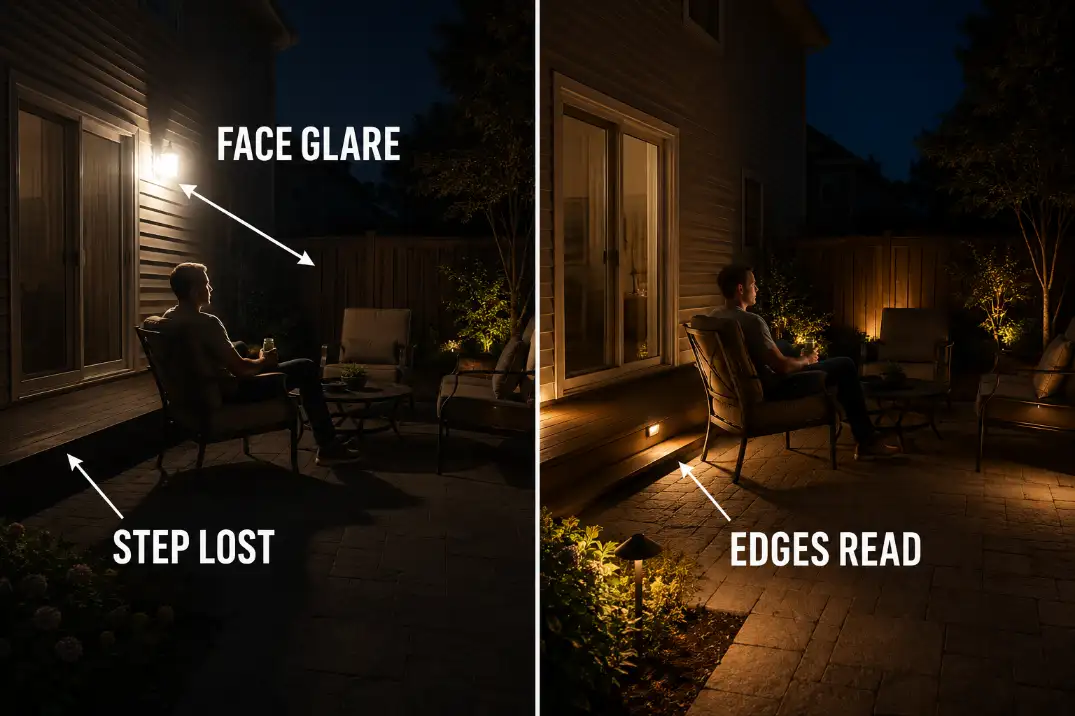
Sit in the main chair and look toward the house, the grill, the steps, and the fence line. If the brightest object in your view is the light source itself, the fixture is probably too exposed, too high, or aimed too directly.
A better patio lighting setup lets you notice the table, route, and edge conditions before you notice the bulb.
Walk the Normal Route
Start at the back door and walk to the seating area. Then walk from the seating area to the grill, stairs, or side gate. If a transition disappears within the first 3–5 steps, prioritize that route before adding decorative light.
A 4–7 inch deck step can become hard to read at night when wood, concrete, pavers, or shadow are similar in color. The edge should be visible from about 6–10 feet away, not only when your foot is already near it.
Stand at the Outer Boundary
Move to the fence, side yard, or planting edge and look back at the patio. If the light spills beyond the living zone or shines toward neighboring windows, the layout is wasting comfort and privacy.
Spill light can make the patio feel more exposed because it broadcasts the seating area instead of containing it.
Pro Tip: Judge the lighting after 20 minutes outside, not immediately after turning it on. Glare and dark edges often feel worse once your eyes adjust to the darker yard around the patio.
Why the Obvious Fix Often Fails
Most patio and deck lighting problems are not solved by adding one brighter source. That fix only makes sense when the current fixture is dim, shielded, and aimed correctly but still cannot reach the use area.
More Lumens Can Make Contrast Worse
When the fixture is already visible or aimed across the patio, more output creates a stronger hot spot.
The space may look brighter in a photo, but the real experience can get worse: faces wash out, the far edge goes black, and the deck step still does not read cleanly.
That pattern is close to Why Brighter Outdoor Lights Can Make Visibility Worse. The eye does not judge comfort by total brightness. It judges the relationship between bright sources, useful surfaces, and surrounding darkness.
Cooler LEDs Make Small Mistakes Louder
Cooler outdoor LEDs can make patios feel sharper than necessary. A warm range around 2700K–3000K usually feels calmer for seating, dining, and relaxed backyard use.
Cooler 4000K+ light may be useful for certain task areas, but it becomes harsh quickly when aimed at faces, glass doors, pale siding, or white patio ceilings.
Changing color temperature can soften the mood, but it will not correct a beam pointed into the seating area. If the bare bulb or hot lens is still visible from the chair, direction and shielding matter more than color.
String Lights Are Mood, Not Full Diagnosis
String lights can make a patio feel warmer, but they rarely solve the main functional problems by themselves. They usually light the upper scene and create atmosphere.
They do not reliably mark a deck edge, reveal a grill control, open up a 30–36 inch walking route, or stop glare from a wall fixture.
Use string lights as a mood layer after the safety and comfort layers work. When they are used as the only source, the patio can look charming while still feeling dark at the feet and exposed at the edges.
Dark, Harsh, and Exposed Mean Different Lighting Problems
Treating every patio lighting complaint as “not enough light” leads to wasted changes. The symptom matters because each one points to a different mechanism.
| What You Notice | What It Usually Means | Better First Fix | Fix That Often Wastes Time |
|---|---|---|---|
| Seating feels dark | Light misses the actual use zone | Add low, shielded light near the chair edge or table path | Replacing the door bulb with a brighter one |
| Faces look washed out | Beam hits eye level or reflects off glass or walls | Shield, lower, or redirect the fixture | Switching to a cooler LED |
| Deck step disappears | Edge has too little contrast or grazing light | Add step, rail, or low side lighting | Relying on overhead string lights |
| Patio feels exposed | Seating is brighter than the surrounding boundary | Add soft boundary light near fence or planting | Flooding the whole backyard |
| Bright spots and black gaps appear | Fixtures are spaced or aimed at isolated targets | Rebalance placement and overlap | Adding one random extra fixture |
| Neighbor side feels too visible | Light spills beyond the living zone | Use warmer, lower, shielded, directional light | Installing a stronger security floodlight |
A patio with bright spots and dark gaps usually needs a placement correction before more output. If the pattern repeats across the yard, Outdoor Lights Create Bright Spots and Dark Gaps explains why uneven contrast can make a space feel less safe even when several fixtures are working.
Where Patio and Deck Lighting Should Work First
Good outdoor living lighting starts with movement and boundaries. Atmosphere comes after the space is readable.
Decks Lose Edges First
Deck lighting has to protect transitions: stair edges, rail starts, post bases, and the change from deck boards to patio, grass, or landing.
A low step or dark board edge can disappear faster than a large open patio because the surface is often one continuous color.
For decks, the first priority is not lighting the whole platform. It is making the level changes legible before someone reaches them.
Patios Lose Routes First
Patios usually fail along the route: back door to seating, seating to grill, seating to steps, or chair pull-out to walkway. A 30–36 inch clear movement zone around chairs should remain readable after dark.
If people have to pause before walking around the table, the light is not supporting the space.
This is where decorative lighting often underperforms. A lantern, string light, or wall sconce may create a pleasant scene but still leave the actual walking line unclear.
Covered Patios Bounce Glare
Covered patios and pergolas add another problem: reflection. White ceilings, pale walls, glass doors, and glossy siding can bounce light back into the seating area.
A fixture that seems modest in an open yard can feel much harsher under a cover.
If the ceiling glows brighter than the table or step edge, the fixture may be lighting the structure more than the outdoor room.
Fix the Lighting in Layers, Not All at Once
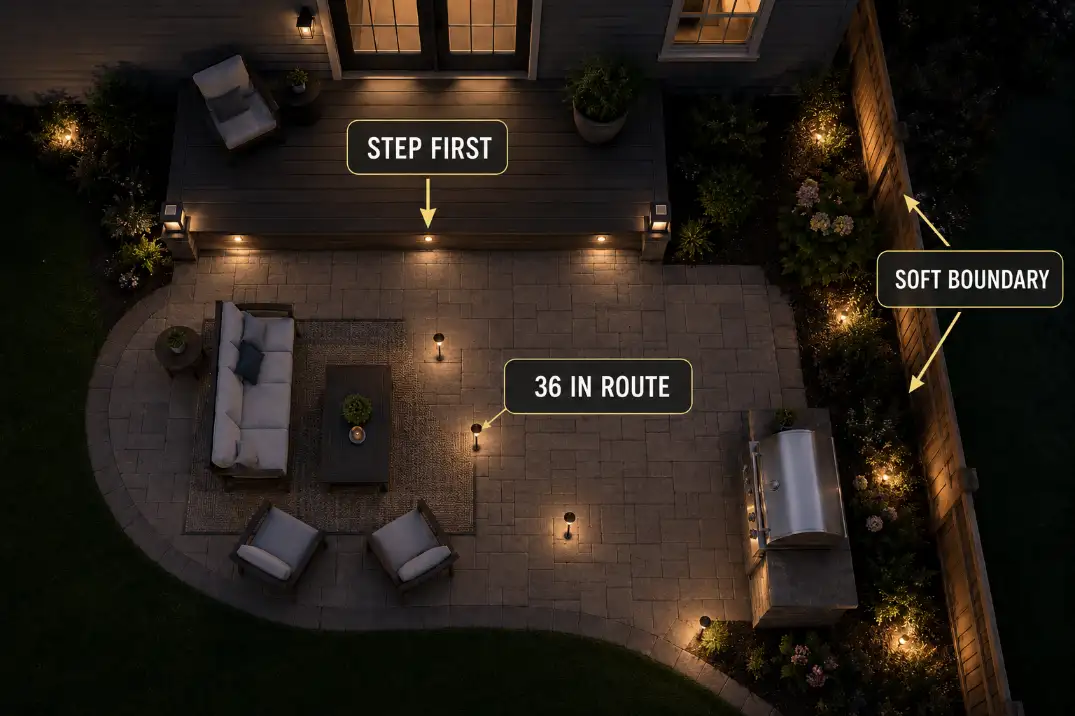
The best repair order is edge, glare, boundary, then mood. This keeps the project practical and prevents fixture shopping before the real missing layer is clear.
Layer 1: Mark the Edges
Start where someone could misstep: deck stairs, patio thresholds, surface changes, and low retaining edges. Low, shielded fixtures placed about 12–18 inches above or beside the walking surface can often do more than one bright wall light.
The goal is not to make every stair look theatrical. The edge simply needs to read before the foot reaches it.
Layer 2: Remove Eye-Level Glare
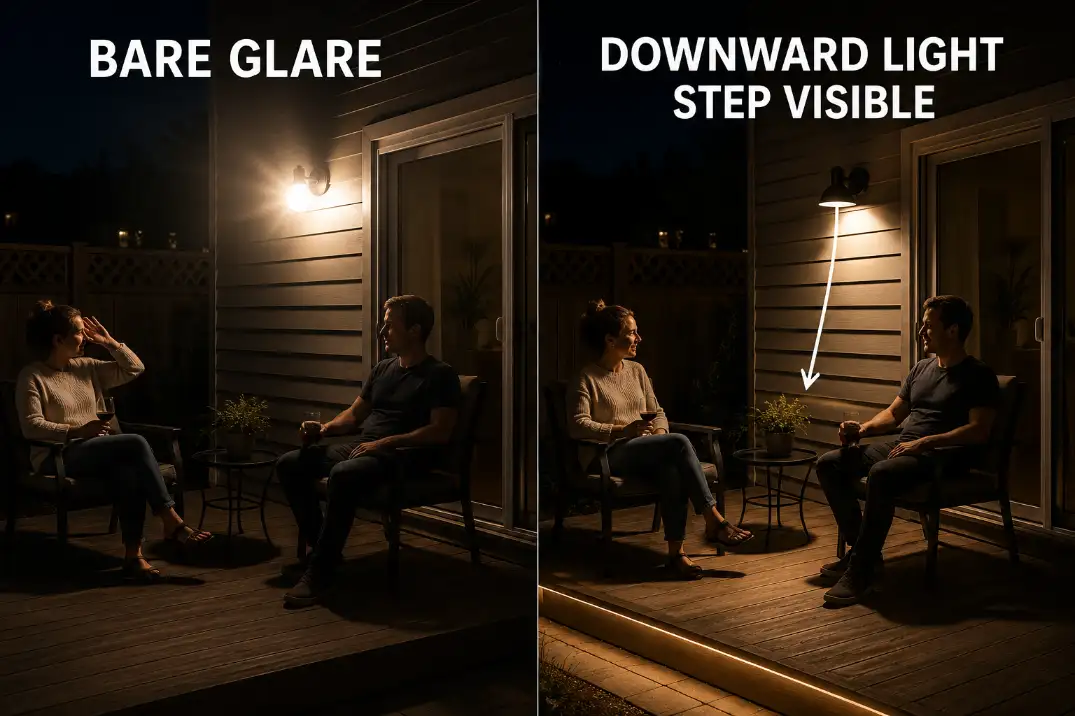
If people can see the bare LED, glowing lens, or hot center of the fixture while seated, fix that before adding more light.
Use a shielded fixture, lower output lamp, better angle, warmer color, or a fixture that sends light downward instead of across the patio.
A shielded source usually feels calmer than a visible source with the same brightness because the light lands on surfaces instead of in the eye.
Layer 3: Add a Soft Boundary
After the edges and routes work, give the patio a soft outer edge. This can be a low light near planting, a shielded fixture near a fence, or a gentle glow along the far side of the deck.
The point is not to light the whole yard. It is to stop the seating area from feeling like a bright island.
This is where comfort and privacy overlap. How to Light a Backyard Without Losing Privacy is useful when the patio feels visible from the side yard, fence line, or neighbor-facing edge.
Layer 4: Add Atmosphere Last
String lights, lanterns, accent lights, and decorative glows work best after the practical layers are solved. If they come first, they can hide the real issue.
A patio can look styled but still have a dark step, harsh wall glare, or exposed seating position.
Pro Tip: Before permanently adding a fixture, test the idea with a temporary low light from the same direction. If a lower, shielded test light makes the step or route easier to read, placement was the missing layer.
When the Standard Fix Stops Making Sense
Some patio and deck lighting problems stop being visual design problems. If the lights flicker, dim unevenly, trip a GFCI, fail after rain, or work differently from one end of the run to the other, changing the bulb or fixture style may only delay the real diagnosis.
Uneven Dimming Points to Power Delivery
Low-voltage patio and deck lights can weaken when the cable run is too long, the transformer is overloaded, or connections are poor.
If the first fixtures on the run look normal but the farthest fixtures are noticeably dimmer, the issue may be voltage drop rather than bad layout.
At that point, Low Voltage Landscape Lighting Problems is the better direction because power balance has to be checked before more fixtures are added.
Rain-Triggered Problems Point to Moisture
Deck posts, patio edges, planters, and covered corners often collect more moisture than homeowners expect. If a light works normally until rain, sprinkler spray, or freeze-thaw weather, inspect seals, cable entries, splices, and GFCI behavior before redesigning the lighting plan.
A problem that appears within 24–48 hours after rain is a moisture clue, not a normal comfort-lighting complaint. In colder northern states, seasonal movement and winter moisture can make deck and patio fixtures more vulnerable after months of exposure.
Neighbor Glare Needs Control, Not Power
If the problem is light crossing a fence, hitting a neighbor window, or making the patio visible from the side, adding stronger light is the wrong move.
The fix is usually lower height, better shielding, warmer output, narrower direction, or moving the source closer to the area that actually needs light.
Floodlights are especially risky around outdoor living spaces. They can help with temporary cleanup or security, but they usually make patios feel harsh, flat, and exposed when used as the main lighting source.
Quick Diagnostic Checklist
- If the bulb or lens is the brightest thing from the chair, fix glare before adding brightness.
- If a step edge is not visible from 6–10 feet away, prioritize edge lighting.
- If the seating area is bright but the fence line disappears, add soft boundary light.
- If the route around chairs is not readable within a 30–36 inch zone, light the movement path.
- If the problem appears after rain or within 24–48 hours of wet weather, check moisture and connections.
- If far fixtures are weaker than near fixtures, check voltage drop or transformer load.
- If string lights look nice but the patio still feels unsafe, add targeted lower light.
Questions People Usually Ask
Should patio lighting be bright enough to light the whole backyard?
No. A patio or deck should make the living area, routes, steps, and nearby boundaries readable. Lighting the entire backyard often creates glare, spill, and a less private seating area.
Are string lights enough for a deck or patio?
They can be enough for mood, but not usually for safety or task visibility. Deck steps, grill areas, thresholds, and chair routes need more targeted light than string lights usually provide.
What color temperature works best for patio and deck lighting?
Most outdoor living spaces feel better around 2700K–3000K. Cooler light can work for specific tasks, but it becomes harsh when aimed toward faces, glass, pale walls, or covered patio ceilings.
When should I stop adjusting bulbs and call an electrician?
Call an electrician if lights flicker, trip a GFCI, dim unevenly, show water inside the housing, or behave differently after rain. Those signs point to power, moisture, or connection issues rather than normal patio comfort problems.
For broader official guidance on light output, color, and direction, see the U.S. Department of Energy.