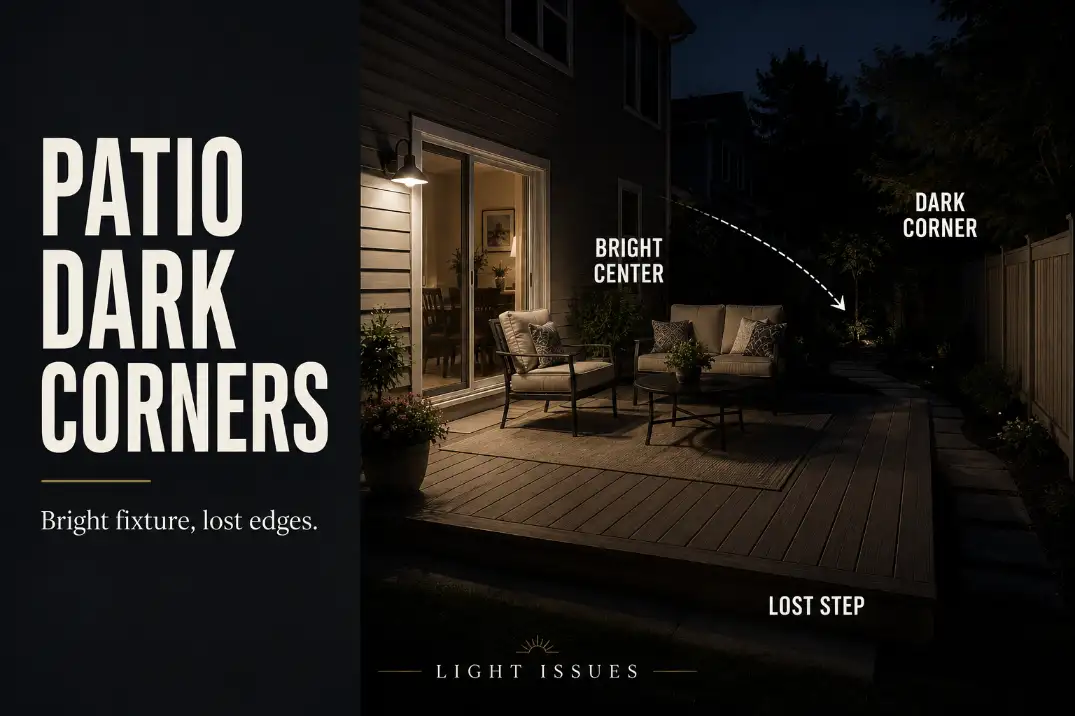
Patio lighting usually has dark corners because one bright source is lighting the center while the edges, routes, and step changes never receive useful light.
This is usually a coverage-and-contrast problem, not a total brightness problem. Start by checking whether the brightest fixture is in your direct view, whether the far edge is more than about 12–15 feet from the nearest useful light source, and whether a step or chair leg disappears from 6–10 feet away.
That pattern is different from a patio that is dim everywhere. A dim patio lacks total output. A patio with dark corners often has enough light, but it is spent on siding, faces, furniture backs, or the area closest to the door.
The fix is not automatically a stronger bulb. It is usually better light control, better edge coverage, and a clearer order of priorities.
Dark Corners Usually Come From One of Four Patterns
Most patio dark corners are easier to fix once you identify the type of darkness. The corner itself is the symptom; the mechanism is usually falloff, obstruction, glare, or a missing route.
| Dark-corner pattern | What it looks like | Better first response |
|---|---|---|
| Falloff corner | The area near the house is bright, but the far edge fades out | Add controlled light closer to the outer edge |
| Blocked corner | Furniture, a grill, planter, umbrella, or pergola interrupts the beam | Move the obstruction or light the route beside it |
| Glare-shadow corner | The fixture is bright to look at, but the floor and corner feel darker | Shield or soften the dominant source first |
| Dead-route corner | Seating looks fine, but the step, grill path, or gate route disappears | Light movement edges before adding decorative glow |
The far boundary matters more than the patio center
The center of a patio is often the easiest area to light because it sits near the house, door, or wall fixture. The far boundary is what makes the space feel usable.
If the fence-side edge, planting border, or last chair zone drops out, the patio feels smaller and less reliable after dark.
A good patio lighting layout lets you understand three things at once: where people sit, where feet move, and where the patio ends.
If only the seating area is visible, the lighting may look finished from inside the house but still fail outside. That same placement issue often appears across patios, decks, and transitions, especially when one fixture is expected to do too many jobs, as explained in Patio and Deck Lighting Problems.
Glare can make a corner seem darker than it is
The eye adapts to the brightest thing in view. A bare bulb, clear glass wall sconce, or exposed flood-style fixture can make the area around it feel darker because your night vision keeps resetting around the source.
That is why some patios feel bright and hard to use at the same time. The problem is not a lack of light. It is light placed where the eye notices the fixture more than the surface.
Pro Tip: Stand in the seating area for 3–5 minutes before judging the layout. If your eyes keep returning to the fixture instead of the step, grill path, or far edge, glare is part of the dark-corner problem.

Diagnose the Corner Before Changing the Bulb
The first useful decision is whether the dark corner is a layout problem or a power problem. Most dark corners are layout problems unless a fixture is dimming, flickering, shutting off, or failing only after rain.
Check what the light actually reaches
Look at the surface being lit, not just the fixture. A wall light mounted 6–8 feet high may brighten siding, chair backs, and faces while barely touching the walking surface.
A path light behind a planter may light leaves instead of the patio edge. String lights may create overhead atmosphere while leaving chair legs and deck transitions vague.
A healthier layout has overlapping pools of soft light. A failing layout has a hard jump between a bright center and a dark edge.
If the last readable area ends 10–12 feet before the corner, adding a bulb in the same fixture usually will not move enough useful light to the missing zone.
Separate falloff from electrical weakness
If all lights work normally but the corner is still dark, think placement first. If the first fixtures in a low-voltage run look normal while the far fixtures are clearly weaker, the issue may involve voltage drop, transformer load, or a long cable run. That diagnosis belongs in the power system, not the patio layout.
This distinction matters because moving furniture, replacing bulbs, or adding decorative string lights will not fix a weak far-end circuit.
If your patio or yard has bright spots followed by black gaps, the pattern may be closer to Outdoor Lights With Bright Spots and Dark Gaps.
Use hesitation as a practical threshold
A patio corner becomes a real problem when it changes how people move. If someone slows down before a step, avoids the grill route, or cannot read the edge of a chair from normal walking distance, the lighting is not doing its job.
As a practical field check, a step edge should be readable before someone is standing on it. If the edge only appears at 1–2 feet away, the light is arriving too late. If it reads from about 6–10 feet away without glare, the layout is much healthier.
Why the Obvious Fix Often Fails
Replacing the bulb is worth trying only after the beam already lands in the right place. If the beam is aimed at the wrong surface, more output usually makes the bright area harsher while the dark corner stays weak.
More output can deepen the contrast
A 1000-lumen wall fixture near the door may make the siding and seating area look bright, but it can also make the far edge feel darker by comparison. The center becomes more exposed while the corner remains underlit.
That is the common mistake: treating a dark-corner symptom as a brightness shortage. The better question is whether the missing area is receiving any controlled light at all. If not, increasing output at the same source mostly increases contrast.
Exposed sources create the wrong kind of visibility
Clear glass fixtures, bare bulbs, and unshielded patio lights are often worse than they look in product photos. They show you the light source instead of the patio surface.
Once the source becomes the brightest object in the scene, the step, chair legs, and far boundary lose definition.
This is also why a patio can feel uncomfortable even after the dark corner is partly improved. If people feel watched, exposed, or lit from the front, the lighting has moved from useful to theatrical.
That comfort problem is closely related to the pattern covered in Why Patio Lighting Feels Like a Stage.
Fix Patio Dark Corners in the Right Order
The best fix order is simple: control the brightest source first, light the movement edges second, and pull the far boundary back into view last. That order prevents the common overcorrection of adding more light before the existing glare is under control.
First, soften the dominant glare source
Start with the fixture your eye notices first. If it has a clear lens, exposed bulb, cold color, or outward-facing beam, it may be creating the contrast that makes the patio corner seem darker.
A warmer bulb in the 2700K–3000K range, a frosted lens, a shielded fixture, or a lower-output lamp can make the whole patio easier to read. The goal is not to weaken the wall light. The goal is to stop it from overpowering every other surface.
Second, light the route and step edge
After glare is controlled, trace the path from the back door to the seating, grill, deck step, side gate, or storage area. Those movement lines should read before someone reaches them.
A low shielded fixture near a step, under-rail light, small downlight, or controlled path light often does more than another high wall fixture. The beam should land on the walking surface or edge, not across people’s eyes.
For low-voltage layouts, fixture distance and cable length can also shape the result.
If the far side of the patio consistently looks weaker than the near side, the issue may connect to reach and falloff rather than the corner alone. That broader pattern is covered in Why Your Outdoor Lights Don’t Reach Far Enough.
Third, add soft far-boundary light
Once the step and route are readable, add just enough light to the far corner, fence line, planting edge, or outer patio boundary.
This does not need to match the brightness near the house. It only needs to tell the eye where the usable outdoor room ends.
Small shielded accents, low perimeter lights, or a softly aimed light on a fence-side planting area can make the patio feel deeper without flooding the yard. This is especially useful on compact patios where a black far edge makes the whole space feel smaller.

Conditions That Make Patio Corners Look Worse
Some patio corners only fail under certain conditions. Those are still real failures, but the cause may not be the fixture alone.
Wet surfaces reduce edge contrast
After rain, pavers, stone, concrete, and deck boards can darken or reflect light unevenly. A step edge that looks acceptable on a dry night may disappear on a wet one.
In humid or rainy regions, this can make a weak corner feel unsafe even when the fixture output has not changed.
If the corner only becomes a problem after rain, prioritize surface edges and route lighting before adding decorative glow. Wet conditions punish vague lighting more than they punish low mood lighting.
Furniture changes can create new shadows
A patio layout may work in spring and fail in summer after an umbrella, sectional, grill, storage box, or large planter moves into the beam path. This is easy to miss because the lighting system did not change.
If a corner became dark after furniture was rearranged, do not redesign the whole system first. Move the obstruction, change the aim, or add a low light beside the route.
Furniture-shadow problems usually need a local correction, not a major lighting upgrade.
Dark corners are not always outdoor darkness
Sometimes the patio looks darker because nearby indoor or porch light is too bright. Looking out from a bright kitchen into a low-lit patio can make the far corner seem black. After a few minutes outside, the corner may read better.
That does not mean the issue is imaginary. It means the patio should be judged from the place where people actually sit and walk, not only from behind glass.
When Another Light Stops Making Sense
Adding another patio light stops making sense when the darkness follows a failure pattern instead of a coverage pattern.
If one fixture used to work but now dims after 20–30 minutes, flickers after rain, or shuts off while nearby lights stay on, diagnose the fixture, wiring, or power supply before redesigning the patio.
Do not redesign around a failing fixture
A dead or weak fixture can make the layout look worse than it is. If the corner light is supposed to reveal the step or boundary but no longer performs, adding extra lights nearby may hide the real fault without fixing it.
Look for moisture inside the lens, corroded connections, loose splices, or a section that fails only after weather changes.
If the whole backyard still feels dark after more lights have already been added, the problem may be broader than one patio corner and closer to Backyard Still Dark After Adding Lights.
Stop when the patio becomes readable, not bright
A good patio lighting fix does not make every square foot equal. Equal brightness often feels flat, harsh, and overbuilt. The better standard is readability.
The route should be understandable, the seating area should feel comfortable, and the far boundary should show enough to make the patio feel complete. Once those conditions are met, more light usually adds glare, not usefulness.
Questions People Usually Ask
Can I fix dark patio corners without adding new wiring?
Sometimes. If the problem is glare, aim, bulb color, furniture blocking, or an exposed source, you may improve the patio by softening the main fixture, changing the lens, moving furniture, or redirecting existing lights.
If the missing corner is far beyond the existing light path, a new controlled source may still be needed.
Are string lights enough for patio dark corners?
String lights help atmosphere more than edge visibility. They can make the patio feel active while still leaving chair legs, step edges, and far corners vague. They work best as a comfort layer, not as the only source for movement routes.
Should the far corner be as bright as the seating area?
No. The far corner only needs to be readable. Matching the seating brightness can make the patio feel overlit and reduce comfort. A soft edge light that reveals the boundary is usually better than a bright fixture aimed across the patio.
For broader official guidance on efficient outdoor lighting choices, see the U.S. Department of Energy.