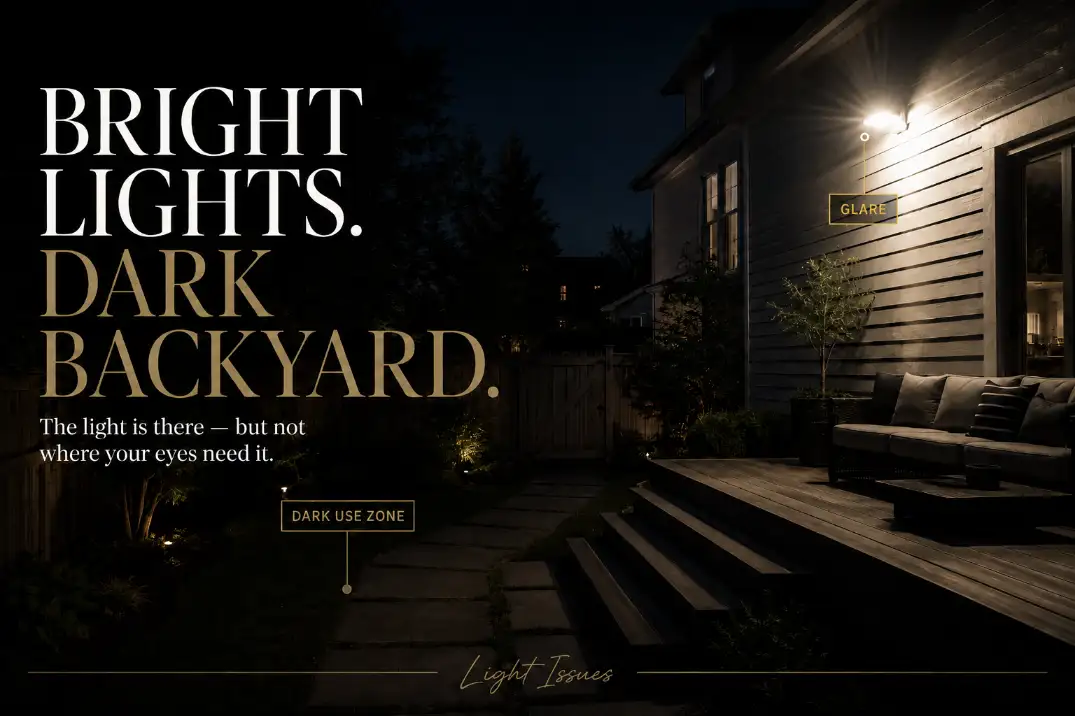
A backyard usually still feels dark after adding lights because the light is not landing on the zones people actually use.
Start with three checks: can you see the ground 10–15 feet ahead, do you look directly into a bright fixture, and are steps, gates, grill areas, or seating edges still hidden after full dark?
If the wall or fence looks bright but the walking surface disappears for more than 6–8 feet, the problem is layout, not bulb strength.
That is different from a weak or failing lighting system. A failing system usually dims across most fixtures, flickers, shuts off, or fades after 2–4 hours.
A mislit backyard often has plenty of output, but the light is trapped on siding, fences, open air, or decorative features. Brighter bulbs rarely fix that. They usually make glare stronger while the useful areas remain hard to read.
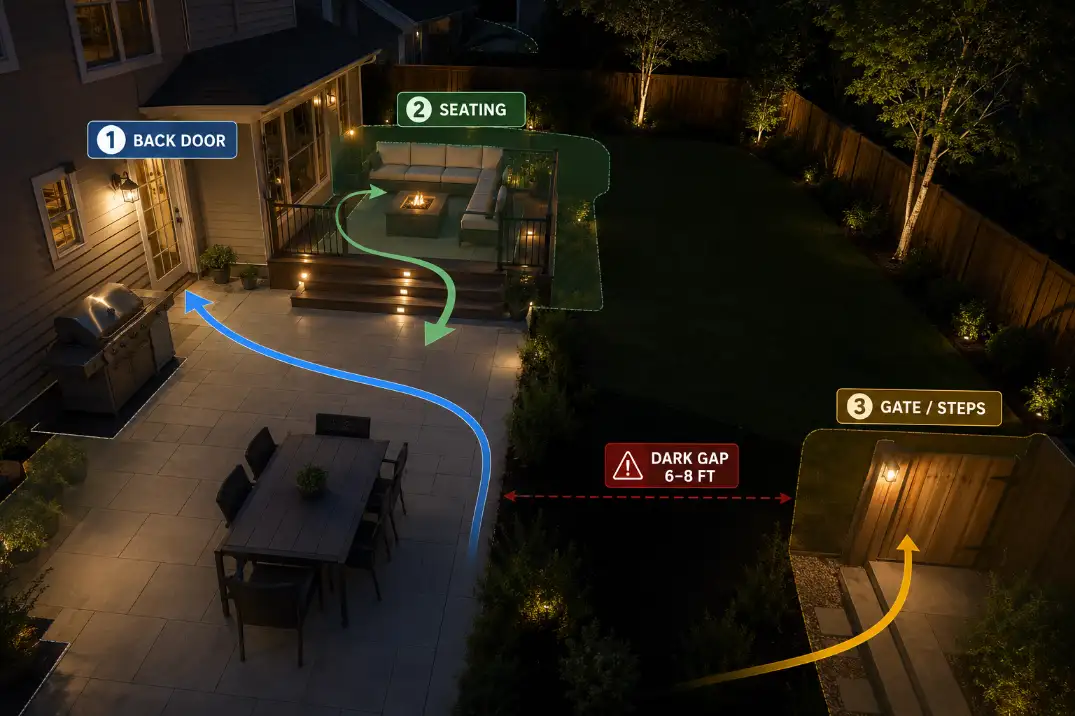
The 3-Walk Test That Shows What Is Really Missing
Do this after the yard is fully dark, not at dusk. Dusk hides contrast problems because your eyes are still getting help from the sky.
Back door to seating area
Walk from the back door to the main seating area. If you notice the fixture before you notice the patio edge, the light is aimed at your eyes instead of the surface. This is common with wall-mounted floodlights above rear doors.
The goal is not to make the entire patio bright. The goal is to make chair legs, steps, tables, and walking edges readable without making people squint.
Seating area to gate or side yard
Next, walk from the seating area to the side gate, shed, trash area, hot tub path, or pool equipment route. These secondary routes are where backyard lighting plans often fail. The patio may look finished while the actual movement path drops into darkness.
If the route loses its edge for more than 6–8 feet, add or reposition light near the transition. Do not start by lighting the entire lawn. Empty grass is rarely the highest-value target.
Grill, deck, or step route
Finally, walk from the grill, deck, or outdoor kitchen area to the nearest step or level change. If your body blocks the light while you cook, carry food, or step down from the deck, the fixture is in the wrong relationship to the task.
Backyard darkness is usually revealed by movement, not by standing at the door and asking whether the yard “looks lit.”
Why More Brightness Usually Does Not Fix It
Bright spots are not usable light
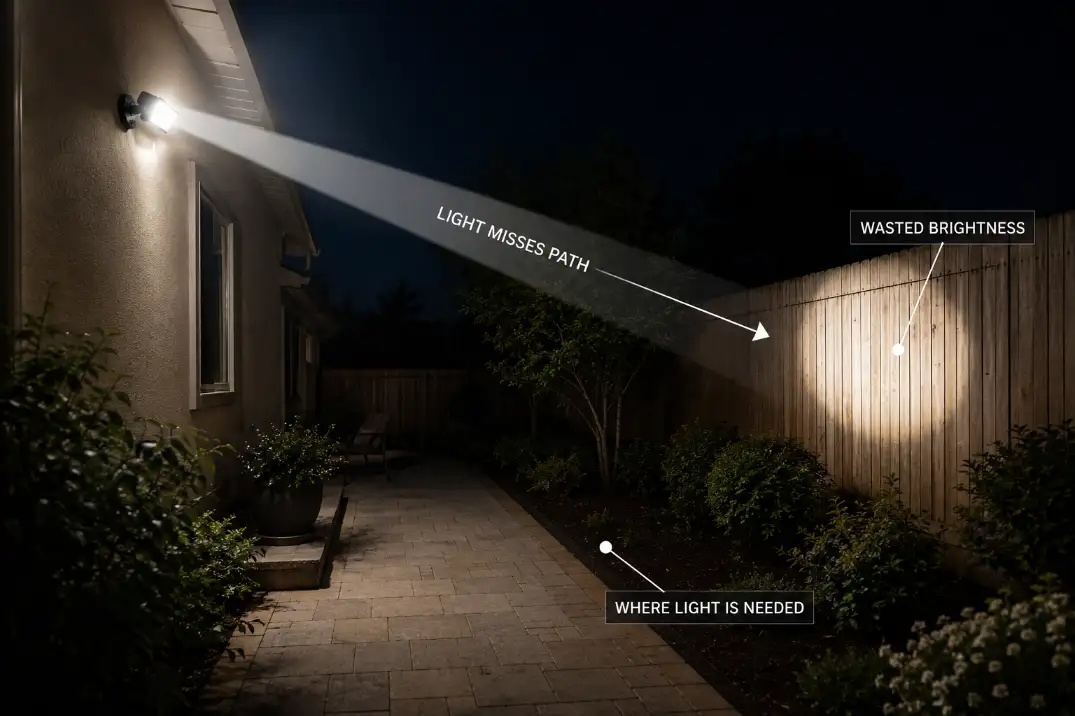
A bright fixture can make the backyard look “lit” from inside the house while still failing outdoors. That happens when the light hits siding, a fence, or a patio slab but not the walking surface. Your eye adapts to the brightest thing in view, so the darker areas feel even darker.
This is why one 1,200-lumen wall light can feel less useful than several lower-output fixtures placed near steps, paths, and seating edges. The issue is not total output. It is whether the light gives your eyes consistent information across the spaces you use.
When bright patches sit beside dead zones, the pattern is similar to Outdoor Lights Creating Bright Spots and Dark Gaps: the system is producing contrast instead of clarity.
Glare makes the yard feel darker
Direct glare is one of the biggest reasons a newly lit backyard still feels uncomfortable. If you can see the bulb, LED panel, or bare lens from a chair or walkway, your eyes adjust to the fixture. The lawn, steps, and gate then seem darker by comparison.
A useful test is to stand in the darkest usable area and look back toward the house. If the fixture pulls your attention before the ground does, reduce glare first. Add a shield, tilt the beam down, switch to a softer lamp, or move the light source lower and closer to the target.
Pro Tip: Before replacing bulbs, temporarily block the glare side of one fixture with cardboard or painter’s tape and recheck the yard after dark. If the space feels easier to read, brightness was not the real problem.
One fixture cannot cover backyard zones
A backyard is not one space. It is a collection of zones: patio, grill area, deck steps, side gate, lawn edge, shed route, pool or hot tub edge, and sometimes a dog run or trash path. One fixture mounted 8–10 feet high on the house may reach part of that area, but it rarely covers all of it evenly.
This is where many DIY upgrades disappoint. The fixture is powerful enough, but the yard is too segmented. Fences, pergolas, trees, grill carts, furniture, and planter boxes interrupt the beam path.
If the light appears strong but lands beyond the place you need it, the problem overlaps with Outdoor Lights That Miss the Target Area. Re-aiming or relocating the fixture usually beats adding more wattage.
The Fixture May Be Wrong Even If the Bulb Is Bright
Floodlights are poor comfort lights
Floodlights are useful for short security bursts. They are not great comfort lights for patios, conversation areas, or outdoor dining. A flood mounted high on the house often creates a bright wall, hard shadows, and uncomfortable glare.
That does not mean floodlights are bad. It means they need the right job. Use them for motion-triggered access near gates, sheds, garage corners, or side yards. For a seating area, a lower-glare mix of downlights, wall sconces, step lights, or small area lights usually feels better.
Path lights only mark edges
Path lights help people follow a route, but they do not always make a seating area, grill zone, or deck feel usable. If the patio still feels gloomy even though the path is lined with lights, the path lights may be doing their job while the seating area has a separate lighting gap.
A patio usually needs light from more than one direction. A small wall light, shielded downlight, or low-output fixture near the table can make the space usable without turning the lawn into a stage.
Uplights decorate more than they guide
Tree uplights and fence uplights can look attractive, but they rarely solve navigation by themselves. They pull the eye upward or toward a vertical surface. That can make the backyard feel dramatic, but it does not necessarily help someone see a step, hose, chair leg, or uneven paver.
Use decorative uplighting as an accent. Handle movement and safety with lights that actually reach ground-level surfaces.
Security Lighting and Comfortable Backyard Lighting Are Different
Security lighting can be brighter, but only briefly
Security lighting has a different job. It needs to reveal motion, discourage unwanted activity, or help a camera capture a clearer image. A motion light near a side gate, garage corner, or shed can be useful, especially if it turns on for 30–90 seconds and then shuts off.
The mistake is using that same light as the main backyard comfort light. A harsh fixture that works for alert lighting can make a patio feel exposed and unpleasant when it stays on continuously.
Comfort lighting needs layers
Comfort lighting is quieter. It uses lower brightness, warmer color, and better placement. For most backyard seating areas, 2700K–3000K feels more natural than cooler daylight lamps. Cooler lamps can make pale concrete, vinyl fencing, and light siding feel harsh.
Layered backyard lighting means one light does not have to do everything. A small step light handles the level change. A shielded path light marks the route. A soft area light helps the table. A motion fixture covers the gate. That approach feels more natural than trying to solve the whole yard with one intense beam.
If a motion light is part of the system but does not come on when expected, treat that as a separate detection issue rather than a general darkness issue. The troubleshooting path is closer to Motion Sensor Light Won’t Turn On at Night.
Fix the Darkness in the Right Order
1. Reduce glare first
If glare remains, every other fix becomes harder to judge. Start by shielding exposed bulbs, tilting adjustable fixtures downward, or replacing harsh clear lamps with softer options. A small aim change of 10–15 degrees can be enough to move the beam from eye level onto the ground.
If fixing the dark area requires aiming a floodlight toward a neighbor’s window or over the fence line, the design is already failing. A lower, shielded fixture closer to the target zone is the better answer.
2. Aim light at ground-level surfaces
The most useful backyard surfaces are usually low: steps, pavers, deck boards, gate thresholds, grill pads, and patio edges. A fixture that lights a fence beautifully may still fail if the walking route remains vague.
Many wall fixtures should be aimed so the main beam lands within about 15–25 feet, depending on the fixture and yard size. Aiming far across the yard often creates glare, long shadows, and wasted light.
When the fixtures work but the layout still feels wrong, the broader cause is often covered by Outdoor Lighting Placement Problems. The product may be fine; the position may not be.
3. Light transitions before open lawn
Backyard lighting should prioritize places where people change direction, change level, or change activity. Patio to lawn. Deck to step. Grill to table. Seating to gate. House to trash area.
Lighting open lawn first usually wastes energy and visual attention. Most people do not need every square foot of grass illuminated. They need enough information to move naturally.
4. Fill gaps after aim is corrected
Once glare and aim are fixed, look for remaining dark gaps. Along paths, fixture coverage gaps wider than about 8–12 feet often feel broken, especially if there is no spill light from the house or patio.
Do not automatically replace every fixture. Add the smallest useful layer where the gap occurs. A single step light or low shielded path light can solve a problem that a bigger floodlight never could.
Backyard Darkness Patterns and the Better Fix
| What still feels dark | What is probably wrong | Better lighting move | Avoid starting with |
|---|---|---|---|
| Patio is bright, but chairs feel gloomy | Light is behind or above people | Add soft side or overhead layer | Bigger wall bulb |
| Steps disappear | No light at the level change | Add a step light or nearby downlight | Distant floodlight |
| Fence glows, but lawn feels black | Beam hits vertical surface | Aim down or shield the fixture | More lumens |
| Grill area is shadowy | Your body blocks the light | Add side or task light | Path lights only |
| Side gate feels unsafe | No lighting beyond patio zone | Add motion downlight or path layer | Lighting the whole lawn |
| Yard fades after a few hours | Solar runtime or charging issue | Check panel exposure and battery | Re-aiming first |
When the Standard Fix Stops Working
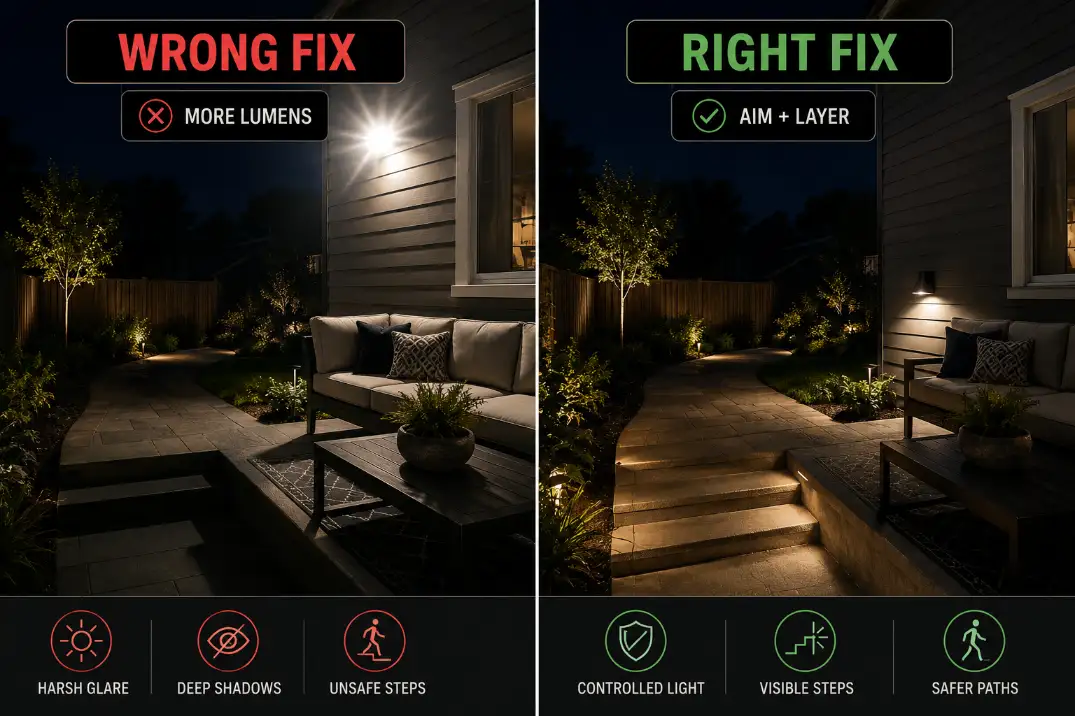
Stronger bulbs stop helping when glare increases faster than visibility
If a moderate bulb increase does not make the ground, steps, or seating edge easier to read, stop increasing output. The problem is no longer brightness. It is beam control.
This is the point where homeowners often waste money. Replacing a 700-lumen lamp with a 1,500-lumen lamp may make the siding brighter and the fixture more annoying without improving the dark route to the gate.
Solar lights stop helping when runtime is the issue
Solar lights can mark edges well, but many small solar stakes cannot carry a backyard lighting plan by themselves. In winter, shaded yards, and northern states with shorter days, some solar lights fade after 4–6 hours or lose strength after cloudy stretches.
If the backyard looks acceptable right after sunset but feels dark later, the issue may be charging or battery capacity rather than placement.
That pattern fits Why Solar Outdoor Lights Fail So Quickly and What’s Really Causing It more than a normal fixture-aim problem.
Replacing fixtures stops making sense when the layout is wrong
New fixtures will not fix a bad plan if they go in the same locations and point in the same directions. Replace a fixture when it cannot be shielded, aimed, dimmed, or matched to the job. Otherwise, move or adjust first.
A routine upgrade stops making sense when the same symptoms remain: visible glare, dark walking edges, bright fences, and hidden steps. Those are layout signals, not shopping signals.
Backyard Conditions That Change the Answer
Fences and walls can help or hurt
A fence can reflect soft light back into the yard, but it can also become the brightest object in view. White vinyl fencing, pale stucco, and light-painted walls are especially likely to create contrast. If the fence glows while the ground stays vague, the beam is too high or too vertical.
Darker wood fences absorb more light, so they may need closer, lower fixtures around gates and turns. The fix is still not “more light everywhere.” It is better placement near the usable route.
Trees, pergolas, and shrubs interrupt beams
Plants and structures do not need to be huge to cause darkness. A 3-foot shrub can block a low path light. A pergola can interrupt a wall fixture. A tree canopy can make an uplight look beautiful while the ground below remains difficult to read.
In humid areas such as Florida or the Gulf Coast, dense seasonal growth can change a lighting plan within a few months. In dry Arizona yards, the same shadow problem may come from boulders, walls, or dense desert shrubs.
Wet surfaces can exaggerate glare
After rain, sealed concrete, pavers, composite decking, and stone can reflect more light toward your eyes. In Midwest storm seasons or coastal California fog, a backyard that seemed acceptable when dry may suddenly feel harsher and less readable.
That is not always an electrical failure. If the lights stay on steadily but the yard feels worse, reflection and contrast are likely. If fixtures flicker, trip a GFCI, or shut off after rain, then moisture and wiring deserve attention.
Questions People Usually Ask
Should backyard lights be warm white or daylight?
Warm white is usually better for patios, paths, and seating areas. A 2700K–3000K range tends to feel comfortable and reduces the harsh look that cooler daylight bulbs can create on concrete, siding, and fencing.
Do I need more lights or better placement?
If the yard has bright spots and dark gaps, start with placement. If every light is weak, fading, or shutting off, then output, power, battery, or timer problems become more likely.
Is it okay for part of the backyard to stay dark?
Yes. Unused lawn and planting beds do not need equal brightness. A good backyard lighting plan protects movement routes and activity zones while allowing some natural shadow.
Bottom Line
A backyard that still feels dark after adding lights usually has a distribution problem, not a simple lack-of-light problem.
Start by walking the actual routes people use, then reduce glare, aim light onto ground-level surfaces, and add small layers at steps, gates, seating edges, and task zones.
Brighter bulbs should come later, and only when the fixture already points at the right surface. If the wall, fence, or fixture is the brightest thing you see, the backyard is not underlit in the useful sense. It is mislit.
For broader official guidance on reflectors, covers, controls, and efficient outdoor lighting design, see the U.S. Department of Energy.