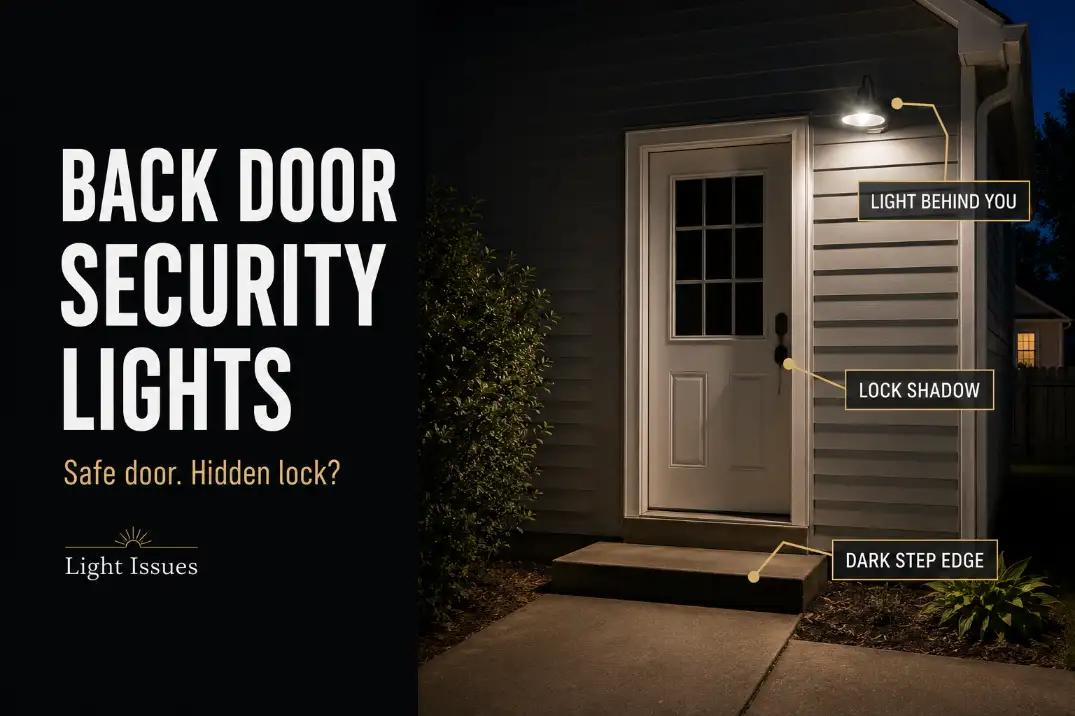
A back door security light usually fails because the light is behind the task, not because the bulb is too weak. The door may look bright from the yard while the lock, keypad, handle, threshold, and first step stay hidden under your own body shadow.
Check the problem from the place where you actually unlock the door. Stand 18–24 inches from the lock, hold your hand where the key or keypad would be, and watch whether the working area goes dark. Then step back 3–4 feet and see whether the first step edge is still visible.
A useful back door light should make the lock readable within about 2 seconds after turning on, not after your eyes adjust for 10–15 seconds.
The best fix is usually a side-aimed, shielded door light for the lock, plus a small support light only if the step edge still disappears.
This is not the same as a weak fixture. A weak fixture leaves the whole entry dim. A shadow problem creates bright siding, bright concrete, and one dark patch exactly where your hand or foot needs information.
Door Shadow
The door can look safe while the lock stays hidden
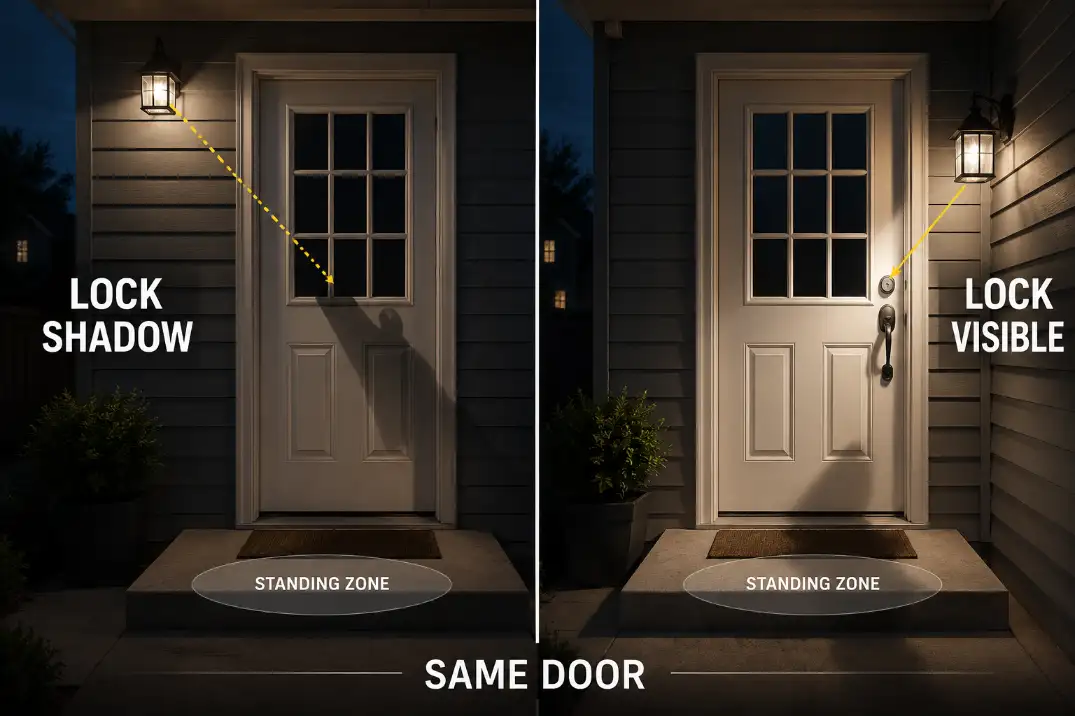
The most misleading back door lighting problem is a bright wall with a dark lock. From the patio, the fixture looks strong. From the person’s normal standing position, the shoulder, head, hand, or grocery bag blocks the beam before it reaches the lock face.
That is why a brighter bulb often changes the wrong thing. It may make the siding brighter and the concrete hotter, but the shadow still lands across the deadbolt. If the shadow moves when your body moves, the issue is fixture geometry.
This is the same false-security pattern behind many cases where security lights feel less safe at night: the area looks lit, but the useful detail is still hidden from the person using the space.
The shadow test that matters
Do the test after full dark, not at dusk. Stand where you normally unlock the door. If your hand makes the keyway, keypad, or handle harder to see, the light is behind the task zone.
If the lock stays readable while your body is in normal use position, the placement is doing its job.
A back door light passes only when the lock, handle, mat edge, and first step remain visible during real use. It fails when the entry looks bright only before someone stands in front of it.
Lock Visibility
The real target is only a few square feet
Back door lighting does not need to light the whole backyard. The critical area is small: the lock face, keypad, handle, threshold, mat edge, landing, and first 3–4 feet of walking surface.
That is why a wide security flood can feel powerful but still perform poorly at the door. It may throw light 25 feet into the yard while missing the 8-inch working area where your hand actually needs detail.
The better standard is simple: can you read the lock, find the handle, and see the first step without squinting or leaning sideways? If not, the light is not serving the door, even if the wall looks bright.
Glare is not useful brightness
People often overestimate brightness and underestimate glare. A harsh fixture near a door can shine into your eyes, wash out a keypad, and flatten a wet threshold. More output does not help if it makes the useful detail harder to read.
For back entries, controlled downward light is usually better than raw floodlight power. The same principle applies to outdoor security lights without glare: useful visibility comes from controlled light landing on the task, not from blasting the whole entry.
Aim Check: Judge the light from the approach path, not from the yard. If the fixture looks bright but the lock looks dull or flat, you are judging the wrong surface.
Step Edge
A hidden step is the safety failure
The lock gets most of the attention, but the step edge is often the more serious problem. Many back doors have a 4–7 inch step down, a narrow concrete pad, a dark mat, or a landing that blends into the patio at night. If the light is behind you, your body can hide the exact edge your foot needs to find.
Rain makes this worse. A wet black mat and dark concrete can look like one continuous surface. In freezing northern climates, a thin ice line near the threshold can disappear even when the door itself looks bright.
The safer condition is immediate recognition. The front edge of the landing should be visible from at least 3 feet away, before your foot commits. If you only see the edge after pausing and looking down, the light is not doing enough for movement.
When more light makes the edge harder to read
A very bright fixture can flatten the area instead of clarifying it. Pale concrete, glossy paint, wet decking, and reflective door glass can bounce light back toward your eyes. The result is a brighter entry with less edge definition.
That is why the “just make it brighter” fix can backfire. When a step edge disappears under glare or body shadow, the problem is not a shortage of light. It is poor contrast.
This is the same visibility mistake behind situations where brighter outdoor lights make visibility worse.
| Back door condition | What it usually means | Better fix |
|---|---|---|
| Lock disappears when you stand at the door | Light is behind your normal task position | Add side light or change beam angle |
| Step edge vanishes under your body shadow | The fixture cannot see the walking surface | Add low support light near the landing |
| Door is bright but your eyes strain | Glare is stronger than usable light | Shield or aim the light downward |
| Yard is bright but handle is dull | Beam spread is too broad | Use task-focused door coverage |
| Shadow improves when you step aside | Fixture location is the problem | Do not solve with a brighter bulb |
Light Behind You
Above-door placement is convenient, not always correct
The common above-door light is easy to understand: wiring is often already there, and the fixture looks centered. But centered is not automatically useful.
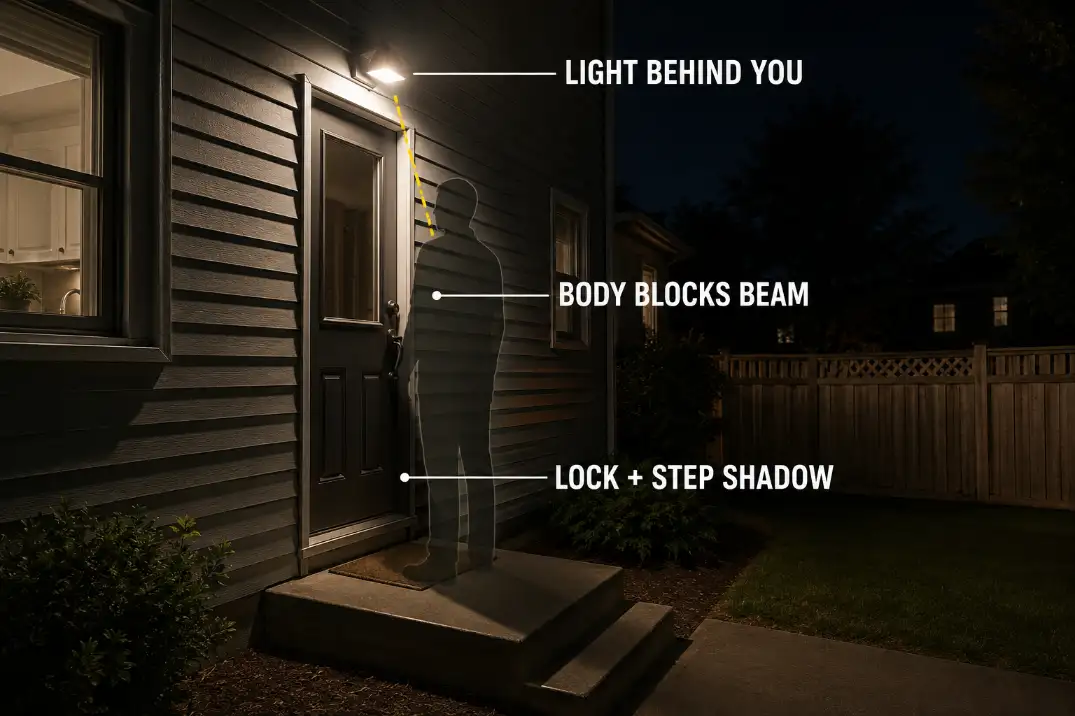
When the light sits above or behind the person approaching the door, the person becomes the obstruction.
This happens often under small roof overhangs. The overhang limits downward spread, the fixture throws light outward, and the person creates a moving dark zone on the lock and threshold.
The setup looks normal in daylight and can look fine from the patio. It only fails during use.
That false-confidence pattern is common in security lighting. A bright center makes the space feel covered while the detail you actually need stays hidden near an edge, behind a shoulder, or below the line of sight.
It is the same reason floodlights create blind spots when the beam looks strong but misses the useful approach zones.
The brighter-bulb fix often wastes time
A brighter bulb is the wrong first fix when the shadow moves with your body. That is the clearest sign that the beam is being blocked before it reaches the target.
Try a temporary test before buying anything. Stand at the door after dark and hold a flashlight from the side for 60–90 seconds.
If the lock and step become clearer from that side angle, the fixture needs a better source position or beam direction. Another brighter bulb will not solve the geometry.
Fix Boundary: If a side-held flashlight fixes the lock shadow faster than a stronger bulb would, treat the problem as placement, not output.
Side-Mounted Light
Side light crosses the task zone
A side-mounted light works better because it reaches the lock from across the task zone instead of from behind the person using the door. The hand can move normally without covering the whole lock face.
For many back doors, the useful range is a shielded fixture about 66–78 inches above the landing and 18–30 inches to one side of the lock.
That is not a rigid code rule; it is a practical visibility range. The beam should reach the lock, handle, threshold, and first few feet of approach without pointing into the user’s eyes.
Aiming matters as much as fixture type. If the head points straight out into the yard, it may miss the door task. If it points too sharply down, the lock may still look flat.
The better aim is slightly downward and slightly across the lock side, which makes where to aim outdoor security lights more useful than simply choosing a stronger fixture.
Fixture choice is a decision boundary
This is the point where the buying decision matters. A bare flood head, exposed lamp, or harsh motion fixture can create glare and still leave a lock shadow.
A shielded wall light, compact adjustable head, or controlled low-glare security fixture is usually a better match for a back door.
For this specific problem, skip fixtures that only advertise maximum brightness. Look for shielding, aim control, useful downward spread, and enough adjustment to keep the beam on the lock and landing instead of in your eyes.
If your current fixture is bright but uncomfortable to look toward, the next move is usually not more lumens. It is a fixture with better shielding and beam control.
A useful buying shortlist should focus on controlled door coverage, adjustable aim, and low-glare output, which is why best low-glare outdoor security lights fits this decision point naturally.
Color temperature also affects comfort. Around 2700K–3000K usually feels easier near a door than cold blue-white light. Very cool light can make siding and wet concrete look sharper, but it does not automatically make the lock easier to read.
Motion timing matters too. A back door light should stay on long enough for unlocking, stepping in, carrying bags, or checking the landing. A 15-second shutoff is too short for real use. A 60–120 second hold time is more practical for most entries.
Support Light
One light may be solving the wrong job
A single fixture can sometimes handle a flat landing and lock. It struggles when the door has a side approach, raised threshold, deck step, narrow landing, or dark walking surface. That is because the lock and the ground need different light angles.
The lock needs face light. The step edge needs surface contrast. Trying to solve both with one high fixture behind the user is why many back doors look bright but still feel unsafe.
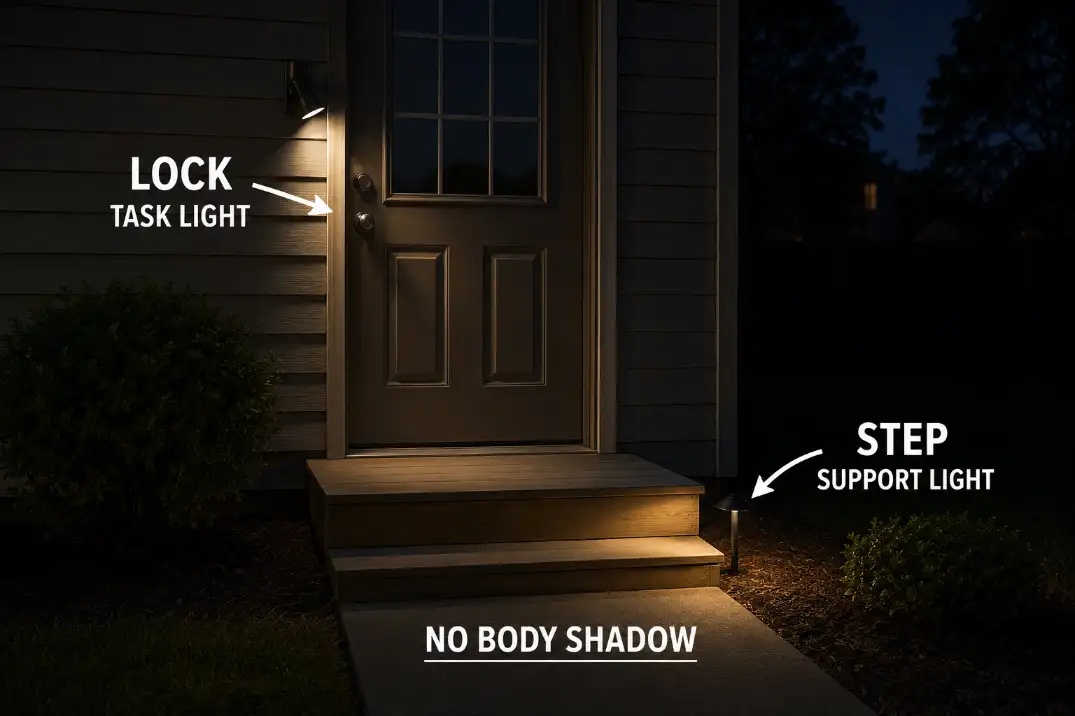
A support light should not compete with the door light. It should do one job: show the ground. That may mean a small shielded path light beside the approach, a low step light near the landing, or a compact fixture aimed across the surface instead of into the yard.
The cleaner two-light setup
The strongest back door arrangement is usually one task light for the lock and one support light for the step or approach. The task light makes the lock readable. The support light makes the foot zone understandable.
This setup also avoids the common overcorrection: installing one oversized floodlight that creates glare, hard shadows, and neighbor spill. If you need more visibility at the door, split the job before you increase the intensity.
Fix Boundary: If the lock is clear but the ground still looks uncertain, add low support light. If both the lock and ground disappear behind your body shadow, fix the main door light angle first.
Quick Diagnostic Checklist
Use this after full dark, at least 20–30 minutes after sunset.
- Stand 18–24 inches from the door and see whether your hand shadows the lock.
- Step back 3–4 feet and check whether the landing edge is visible.
- Confirm the lock is readable within about 2 seconds after the light turns on.
- Look for glare in your eyes before useful light reaches the door.
- Hold a flashlight from the side for 60–90 seconds; if visibility improves, the fixture angle is wrong.
- Test wet surfaces if possible, because rain can hide the mat and threshold edge.
Questions People Usually Ask
Are motion sensor lights good for back doors?
Yes, if the sensor activates before you reach the lock and the light stays on long enough to use the door. A motion light that turns on only when you are already at the threshold is late. For most back doors, a 60–120 second on-time is more useful than a quick burst.
Should a back door light be above the door or beside it?
Above the door is common, but beside the door often works better for lock visibility. A side-mounted light can illuminate the lock without letting your body block the beam. If the wiring is already above the door, careful aiming and shielding become more important.
How bright should a back door security light be?
Use enough light to read the lock and see the first step, not enough to flood the whole backyard. If a brighter bulb increases glare while the lock shadow remains, brightness is not the real problem.
Can one light cover the lock, step, and walkway?
Sometimes. One well-placed side light may be enough for a flat landing. If there is a step, narrow side approach, or dark patio surface, a second low support light usually handles the ground better than one stronger wall fixture.
For broader official guidance on efficient lighting quality and design, see the U.S. Department of Energy’s Lighting Design.