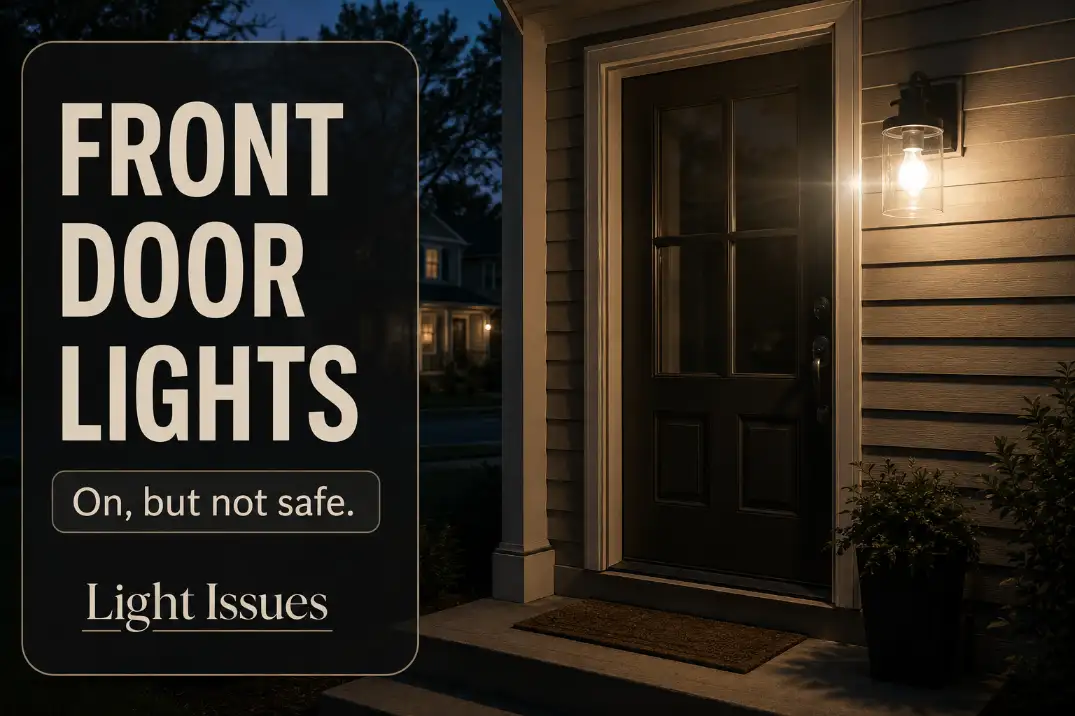
A front door light can be bright, attractive, and still fail the moment someone actually walks up to the door. That is why “front door lights that don’t feel safe” should not be diagnosed by brightness alone.
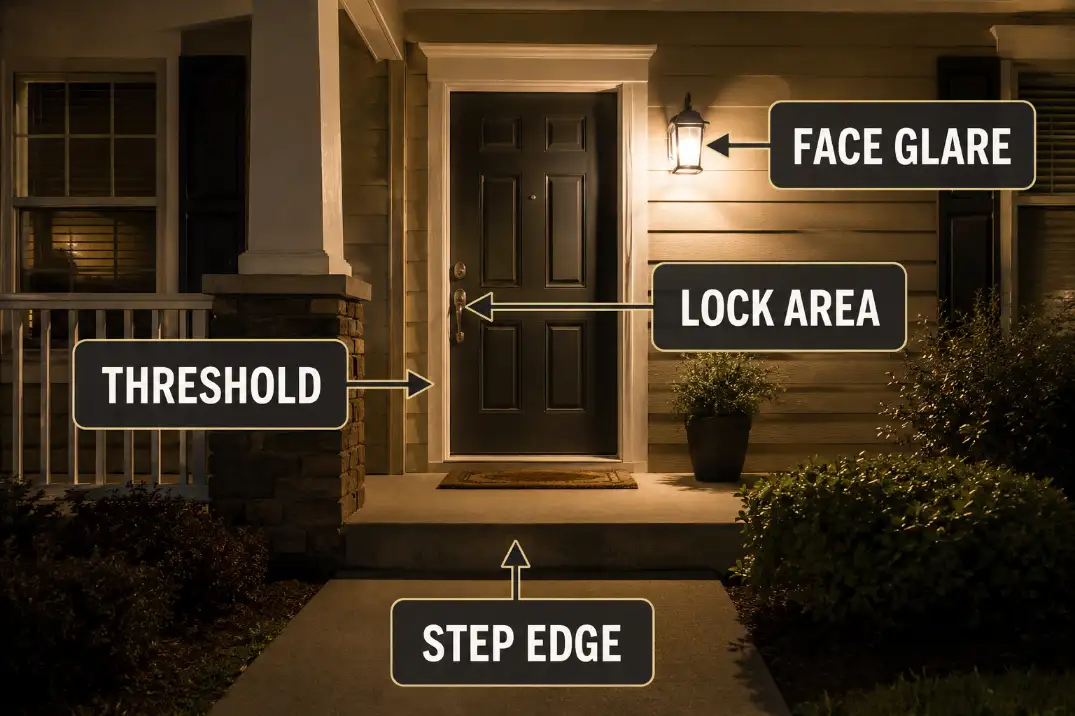
The real question is not, “Is the porch light on?” It is, “Can someone read the threshold, see the step edge, recognize a face without glare, find the lock, and understand the porch edges during a normal nighttime entry?”
When that answer is no, adding a stronger bulb may only make the entry harsher. In some cases, it can even make visibility worse by creating a bright center and darker surrounding shadows, the same kind of contrast problem that often makes brighter outdoor lights create worse visibility instead of a safer-looking space.
Why a Front Door Light Can Feel Unsafe Even When It Works
A working front door light can fail because it lights the wrong thing. It may brighten the siding, the glass, or the general porch area while leaving the actual entry tasks unclear.
The useful test is simple: stand where a visitor, family member, or delivery driver would actually stand. Look down at the threshold. Face the fixture. Reach for the lock. Step toward the door from the normal approach path. If any part of that movement feels visually uncertain, the light is not doing its job yet.
| What feels wrong | Likely failure | What to test |
|---|---|---|
| Dark at the door | Threshold contrast failure | Mat, sill, and first step before stepping in |
| Light hits your eyes | Glare problem | Fixture from visitor height |
| Feet feel uncertain | Poor level-change visibility | Step edges and landing edges |
| Lock is hard to use | Task-zone miss | Door hardware from the normal standing position |
| Porch feels exposed | Uneven field balance | Bright center versus dark porch edges |
This is why front door safety lighting has to be judged from the user’s position, not from the sidewalk, the curb, or the real estate-photo angle.
Dark Threshold
A dark threshold is one of the most common reasons a front door light feels unsafe even when the porch looks lit. The porch may glow from outside, but the exact transition between the walking surface, doormat, sill, and door can still disappear.
This often happens with recessed doors, deep trim, dark mats, overhead-only fixtures, or a side-mounted light that throws the door frame into shadow. From the street, the porch can look fine. From the person entering, the important line is lower and closer: where the foot lands next.
Treat the threshold as the first suspect when the unsafe feeling starts before anyone reaches for the handle. If the mat blends into the landing, or the sill disappears into a dark strip, the problem is not general porch brightness. It is contrast at the door transition.
Do not test this from the yard. Walk the normal route after full dark and pause before stepping onto the mat. If you have to slow down, look twice, or guess where the surface changes, the light is missing the transition zone.
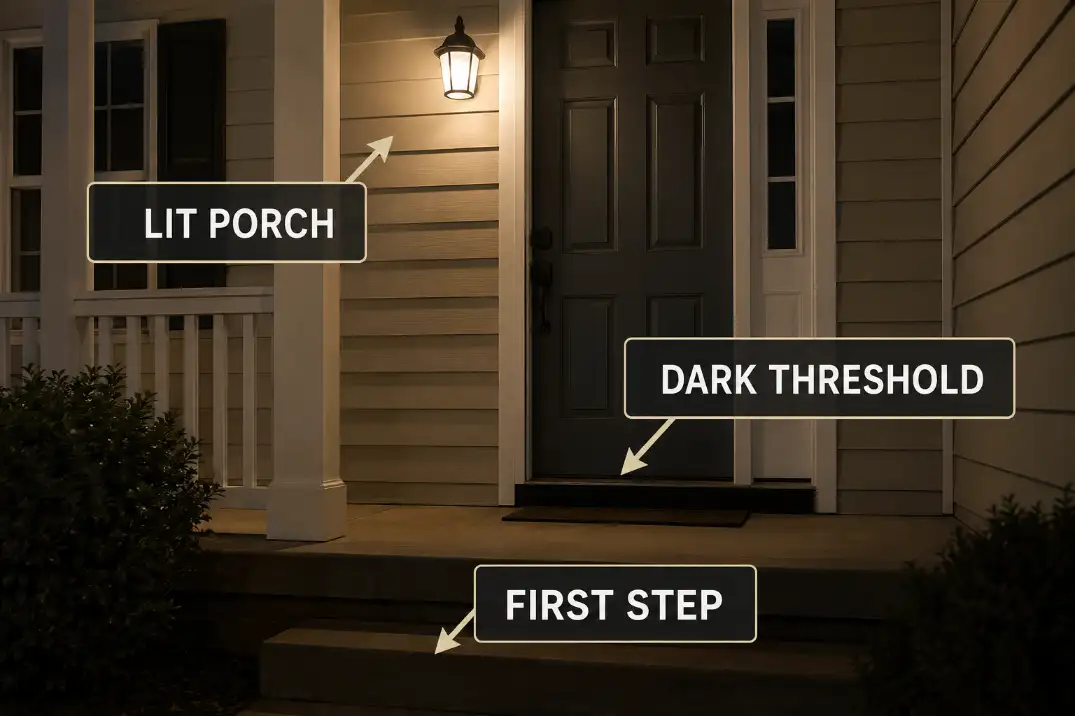
A small lighting adjustment may solve it if the fixture can send usable light toward the lower door area. If the fixture mostly lights the wall, glass, or ceiling, the threshold may need a different light angle or a secondary low-level source rather than more brightness from the same poor direction.
Face Glare
Face glare is different from darkness. The entry can feel unsafe because the light is too aggressive in the wrong direction.
This usually comes from exposed bulbs, clear glass lanterns, fixtures mounted near eye level, glossy doors, reflective sidelights, light-colored siding, or lights aimed outward toward the person approaching. Instead of helping the visitor see the porch, the fixture becomes the brightest thing in the scene.
Glare changes behavior. A person may look away from the door, squint, turn their head, or stand slightly off to the side. That small discomfort matters because front entry lighting has a social task too: a visitor should be visible without feeling blasted by the light.
Stand where a visitor would stand and look toward the door. If the bulb, lens, or reflected hot spot pulls your eye before the door hardware does, glare is controlling the entry. In that case, a brighter lamp will likely make the problem worse.
For a deeper glare mechanism, the same pattern appears across outdoor spaces when outdoor lights create glare by exposing the source instead of controlling the beam.
Glare also hides small details. A bright clear bulb beside the door can make the lock, keypad, or handle area feel less readable because the eye keeps adjusting to the hot spot. That does not mean the door needs to be darker. It means the light needs better shielding, softer diffusion, or a direction that supports the task instead of fighting it.
Step Visibility
Step visibility is not the same as threshold visibility. The threshold is the door transition. Step visibility is about level change: a raised landing, a porch drop-off, one step down to the walkway, uneven pavers, or a narrow stair edge.
A front door light can brighten the wall and still leave the step edge flat. That becomes a problem when the light comes from behind the person, from one side only, or from directly above. The step may technically be visible, but the edge lacks definition.
This failure shows up in movement. Someone slows down near the landing, reaches for the rail earlier than expected, or hesitates before stepping down. That does not point to a decorative lighting issue. It points to a level-change visibility issue.
Look for shadows under nosings, rail shadows that cut across the landing, and dark edges where the porch meets the walk. Side-cast light can help if it defines the edge, but it can also hide one side of the step if the beam is too narrow.
Where the approach path matters, the diagnosis may overlap with broader walkway lighting.
If the first unsafe moment happens before the porch, not at the door, the issue may be closer to path lights and walkway safety than to the porch fixture itself.
The useful test is not whether the step is lit from a distance. It is whether the edge is readable while walking at normal pace, without leaning forward or stopping to study the ground.
Lock Visibility
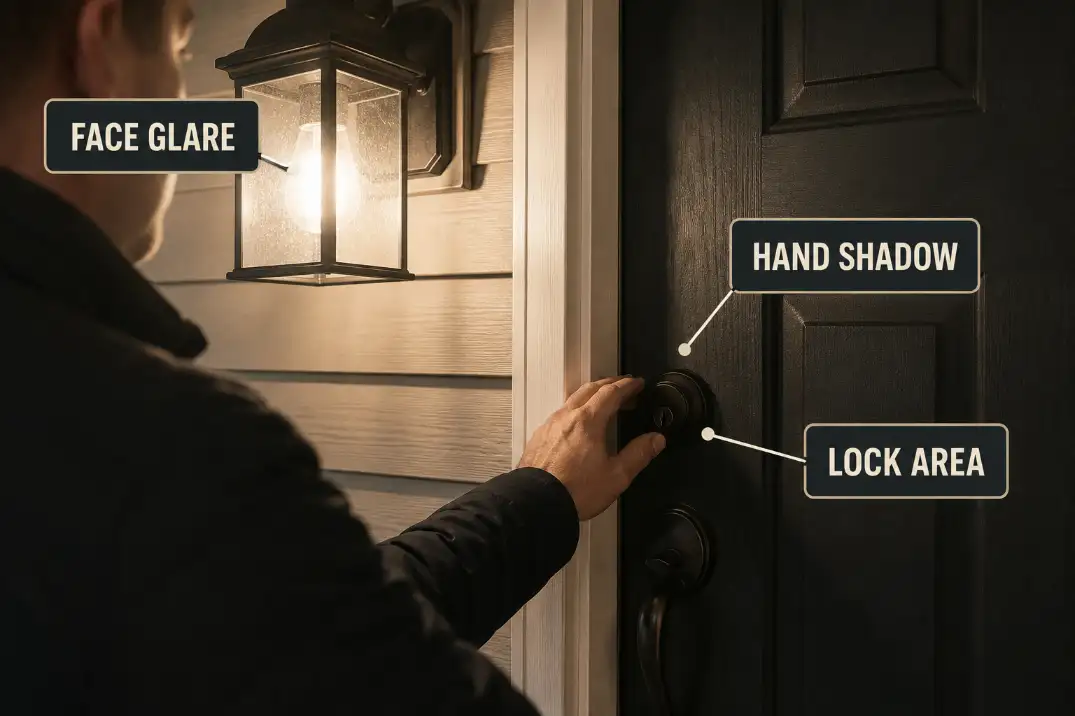
A front door light can pass the general porch test and still fail the hand task. Lock visibility is about the small area where the person actually uses the key, deadbolt, keypad, handle, package shelf, or smart lock face.
This failure often shows up as hand shadow. The fixture may be behind the person, above the shoulder, or on the wrong side of the door. When the person reaches for the lock, their own hand blocks the light.
Dark hardware makes the problem worse. So do glossy lock faces, reflective keypad screens, deep door recesses, and sidelights that throw a reflection across the lock area. The porch may feel lit until the person tries to unlock the door.
Stand where you normally unlock the door. Do not judge from the porch steps. Reach for the lock with your normal hand. If your hand covers the useful light, or the keypad washes out when you lean in, the fixture is missing the task zone.
This is the same diagnostic logic behind lock shadows near back door security lights: the light may be present, but the hand task is still in the wrong shadow.
If the lock area fails, start with aim, bulb harshness, and fixture direction. Replacement only starts to make sense when the fixture shape or mounting position cannot send controlled light to the task zone without adding glare.
Porch Balance
Porch balance is the whole-field test. It asks whether the entry feels evenly understandable, not whether one spot looks bright.
A single bright fixture can create a strong center around the door while the porch edges fall away. That makes corners, columns, package areas, planter edges, side walls, and the walkway connection feel darker by comparison.
This is why a porch can look “well lit” in one photograph but feel uncomfortable in person. The eye adapts to the brightest point. If that point is the bulb or a hot wall patch, the surrounding porch may feel more shadowed than it really is.
Balance becomes the diagnosis when the threshold, step, and lock each have smaller issues that all trace back to the same pattern: one point is over-lit while the rest of the porch is under-supported.
Check from the actual approach path. The door should not feel like a bright target floating inside dark edges. The step, side edge, lock area, and immediate porch boundary should all be readable enough to make the entry feel settled.
If the only way to make the edges visible is to over-brighten the door, the fixture is working too hard from one point. That may call for softer support lighting, better shielding, or a different fixture pattern rather than more output.
Night Entry Test
The final diagnosis should happen during a real nighttime entry, not while standing under the light and staring at the fixture. Test after full dark, with the porch in its normal condition: usual bulb, usual door glass, usual mat, usual plants, usual seasonal shadows.
Use this sequence:
- Approach from the normal path.
Walk from the driveway, sidewalk, or front walk at a natural pace. Notice whether the porch reads as an entry zone or just a bright spot. - Pause before the threshold.
Look at the mat, sill, and first foot placement. If the transition is unclear before stepping in, diagnose threshold contrast first. - Face the fixture.
Stand where a visitor would stand. If the light hits the eyes, reflects off glass, or makes you look away, diagnose glare before adding brightness. - Read the step edge.
Step up or down as you normally would. If the edge disappears, the fix needs to define level change, not simply brighten the wall. - Unlock the door.
Use the key, keypad, handle, or deadbolt normally. If your hand creates shadow or the lock face reflects light, the task zone is failing. - Check the porch edges.
Before going inside, glance at the side wall, package area, planter edge, railing, and walkway connection. If the center is bright but the edges feel vague, diagnose porch balance.
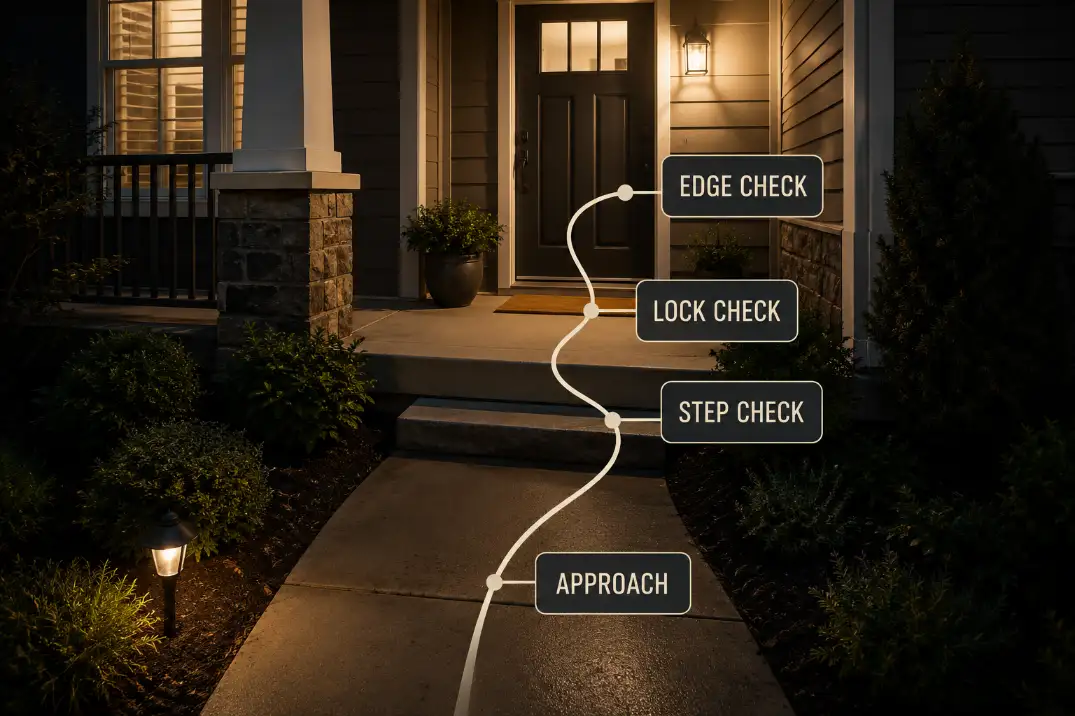
If the light fails only one part of the sequence, fix that specific failure first. A dark threshold may need better lower-door coverage. A glare problem may need shielding or a softer source. A lock shadow may need the task zone lit from a better angle. A porch balance problem may need support at the edges instead of a stronger center light.
The right front door light is not the brightest one on the block. It is the one that lets a person approach, see the step, stand comfortably, unlock the door, and understand the porch edges without glare or guesswork.
For broader energy and control guidance on exterior lighting, the U.S. Department of Energy provides general outdoor lighting guidance.