
A trash-area light can turn on reliably and still fail its only useful job. The fence looks bright and the bin tops are easy to see, but the handle, wheel area, and narrow strip of ground beside them disappear. Inside the house, that same light may create a bright patch across a nearby window.
This is usually not a brightness shortage. It is a beam-path problem. The light is being stopped by an open lid, sent past the working area onto the fence, or aimed far enough outward to reach the window. A stronger bulb or brighter fixture often intensifies those wrong surfaces without improving the places where a person handles the bin.
The useful diagnosis follows four points in order: lid, fence, ground, and window. Test them during an actual trash run—with a bag in hand and the lid moving—because a closed-bin inspection hides the most important failure.
Lid Shadow
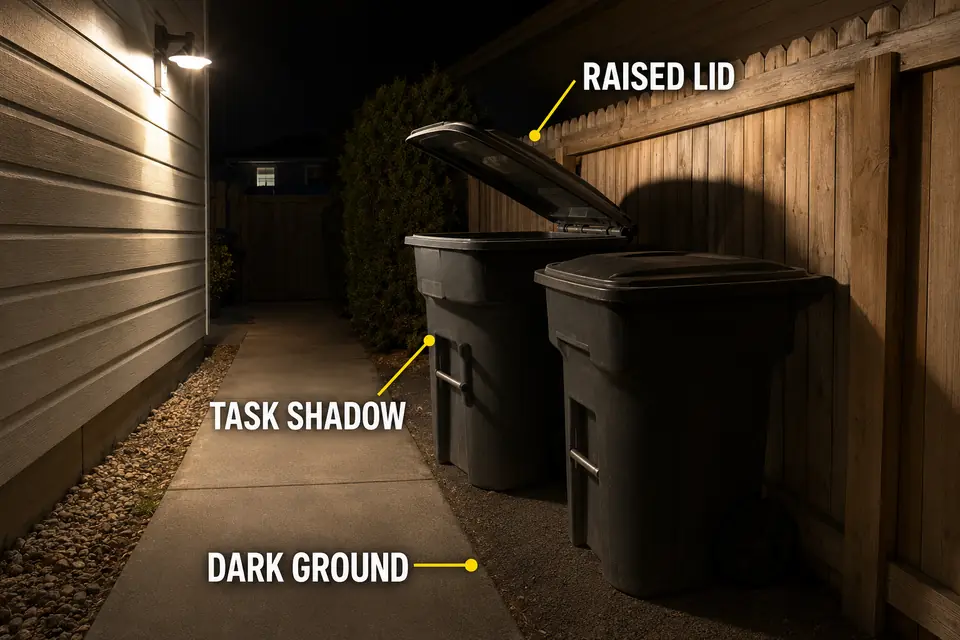
The first test is whether the light still works when the lid is fully open. A closed lid is low and predictable; a raised lid becomes a broad moving obstruction between the fixture and the working side of the bin.
This is especially common when a wall-mounted light shines diagonally across the bin tops. The closed lids look well illuminated, but an open lid blocks the beam just as the user reaches toward the handle or bag opening. More output does not remove that obstruction.
Test the moving shadow
Observe the area with the lid closed, partly raised, and fully open. If the dark patch grows or moves across the handle, opening, or standing area as the lid rises, the lid—not low output—is controlling the failure. General darkness stays relatively stable; an obstruction shadow follows the lid angle.
Check from the position used to load the bin. Look at the handle before opening, the bin opening during loading, and the ground where a dropped item would land. The light does not have to reveal every side of the container, but those three points should remain readable throughout the motion.
The wrong response is to aim higher so the beam passes over the raised lid. That lengthens the light path and makes window or upper-fence spill more likely. The stronger move is to reach the working side without depending on light passing over the lid. The same distinction between visible brightness and useful coverage appears when outdoor lights miss their target area.
Fence Spill
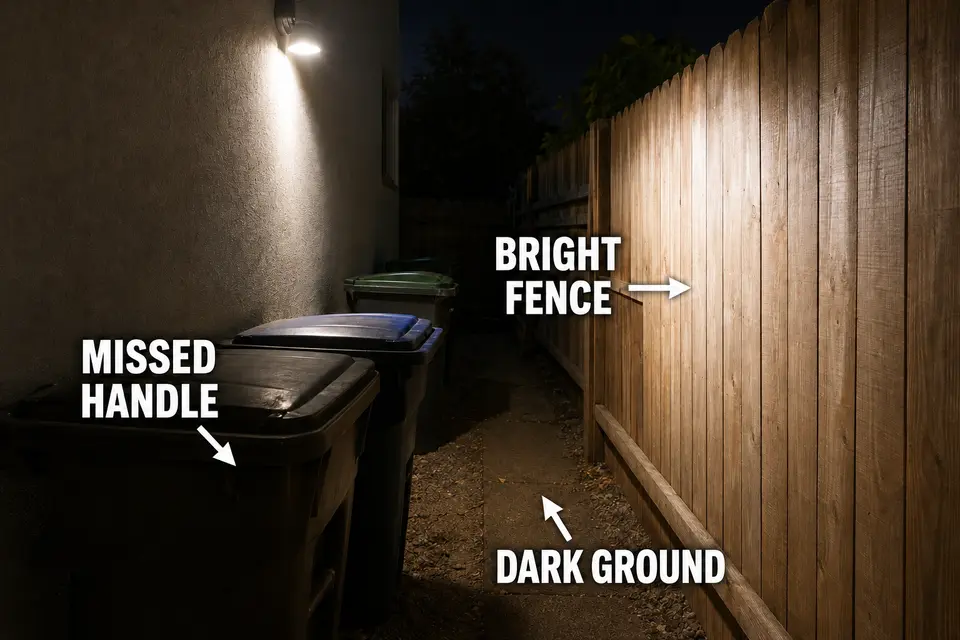
A bright fence is not evidence that the trash area has enough useful light. In a narrow side yard, it may prove the opposite: the beam has passed over the working zone and terminated on the nearest large vertical surface.
That bright background can make the darker handle and ground harder for the eye to distinguish. Pale vinyl, painted wood, and damp fence boards make the imbalance more obvious because they return more visible light than the pavement or dark-colored bins.
Stand where the bin is normally handled and briefly shield the bright fence from view with one hand. If the ground and bin details become easier to read, the scene is suffering from brightness imbalance rather than a simple lack of light.
Some fence illumination is unavoidable in a tight passage. The decision is which surface receives the brightest part of the beam. Move that emphasis down and inward until the fence becomes background illumination rather than the dominant target. This is also why narrow side-yard lights can leave the path dark even when the space looks brightly lit overall.
Motion Timing
Beam placement is irrelevant if the sensor discovers the user after the useful part of the approach. The light should reveal the ground before the person enters the narrow bin area—not switch on only when a hand reaches the lid.
Side-yard sensors often face across the passage instead of along it. A gate, fence post, house corner, or the bins themselves can also conceal an approaching person until late in the route.
Test the response while carrying a bag and walking at a normal pace. If the light activates only after you turn toward the fixture, the likely problem is detection direction rather than illumination. Adjusting beam brightness will not correct that delay.
The on-time period must cover arrival, opening, loading, closing, and the start of the return walk. Roughly 60 to 120 seconds is a reasonable test range, not a universal setting. The right duration is simply long enough to complete the normal task without waving for another trigger.
Do not use an excessively long on-time setting to hide poor detection. A light that stays on for several minutes after noticing the wrong movement can still miss the person approaching the bins. Persistent late activation belongs to the broader diagnosis of motion lights that miss the walk path.
Short Beam
The beam should end where the trash task ends. It needs to cover the approach immediately around the bins, the handles and openings, and the ground where the user stands—not the full length or height of the side yard.
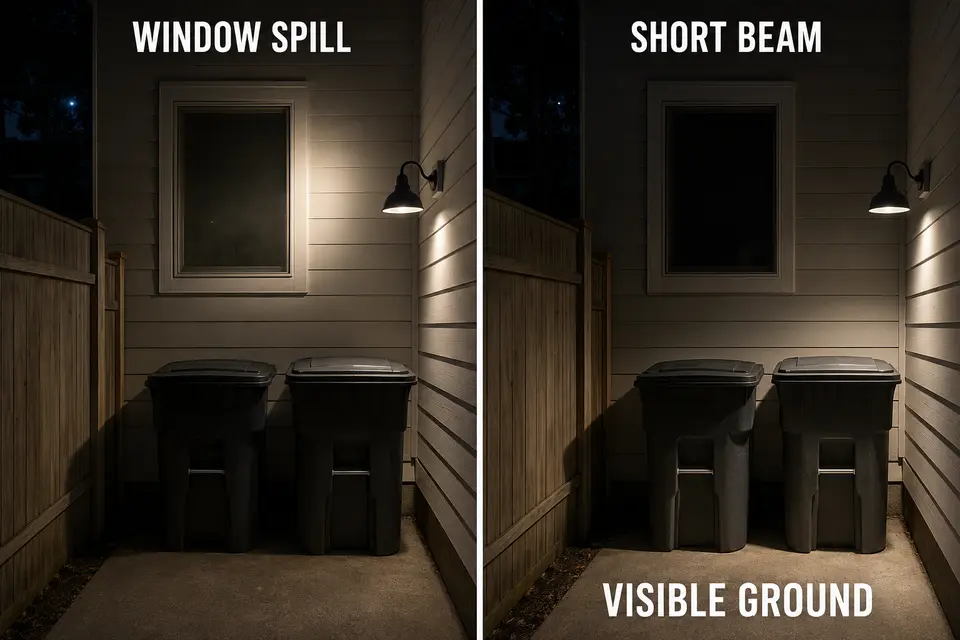
This limited assignment becomes critical when a window is nearby. A long, shallow beam can pass over the bins, strike a distant section of fence, or remain directly visible from the room. A shorter downward beam keeps the useful area below the window line.
Aim for containment, not reach
Make small aim changes after dark. Move the brightest area toward the working face of the bins and the immediate ground rather than spreading adjustable heads apart to make the entire passage look evenly illuminated.
Shielding can reduce upward and sideways escape, but it cannot rescue every mounting position. A fixture directly behind an opening lid may remain obstructed even with good cutoff. One mounted close to a window’s sightline may remain visible indoors despite a modest downward adjustment.
Judge the result by where the beam finishes. If the upper fence, eaves, window frame, or wall beyond the bins remains among the brightest surfaces, the throw is still longer or wider than necessary. The principles behind a fully shielded outdoor light help contain spill, but shielding still has to work with the lid position and mounting angle.
Ground Visibility
Ground visibility—not fence brightness—is the performance test. Trash areas contain small obstacles that disappear easily: bin wheels, displaced lids, uneven pavement, wet leaves, and objects dropped while carrying a bag.
Walk the route from the house or gate and look for continuity rather than perfectly even illumination. The direction and edges of the path should remain readable before reaching the bins. At the working point, the standing area should stay visible with the lid fully raised.
Pay particular attention to the wheels and the narrow gap between containers. If they merge into one dark mass, the beam is landing too high or too far away. A modest amount of controlled light on the pavement often provides more useful information than a large bright patch on the fence.
Test while carrying something and while stepping backward after closing the lid. A scene can appear adequate when inspected from a fixed position yet fail during the turning and backward movement that actual bin use requires.
Window Check
The final aim is approved from the window, not from beside the fixture. Outdoor glare may look contained at ground level while the source remains directly visible from a bed, chair, or standing position inside the room.
Wait until the room is normally dark, trigger the light, and view it from the occupied position. Separate three possible failures: direct sight of the source, a concentrated reflection from the fence, and a moving flash as the lid rises. Each identifies a different escape path.
Repeat the outdoor test with the lid closed and fully open. After lowering or narrowing the beam enough to remove window intrusion, confirm that the handle and standing ground remain visible. If one small adjustment fixes the window but destroys the task lighting, the mounting position may be fundamentally wrong. Endless fine-tuning will not overcome incompatible sightlines.
The correct setting is the one that survives the entire routine: approach, open, load, close, and leave.
If the ground remains readable, the fence no longer dominates, and the window stays visually quiet, the beam is doing its job.
If those conditions cannot coexist, change the fixture position or light path instead of adding brightness.
For broader guidance, DarkSky and the Illuminating Engineering Society recommend targeted, low-level, controlled lighting in their Five Principles for Responsible Outdoor Lighting.