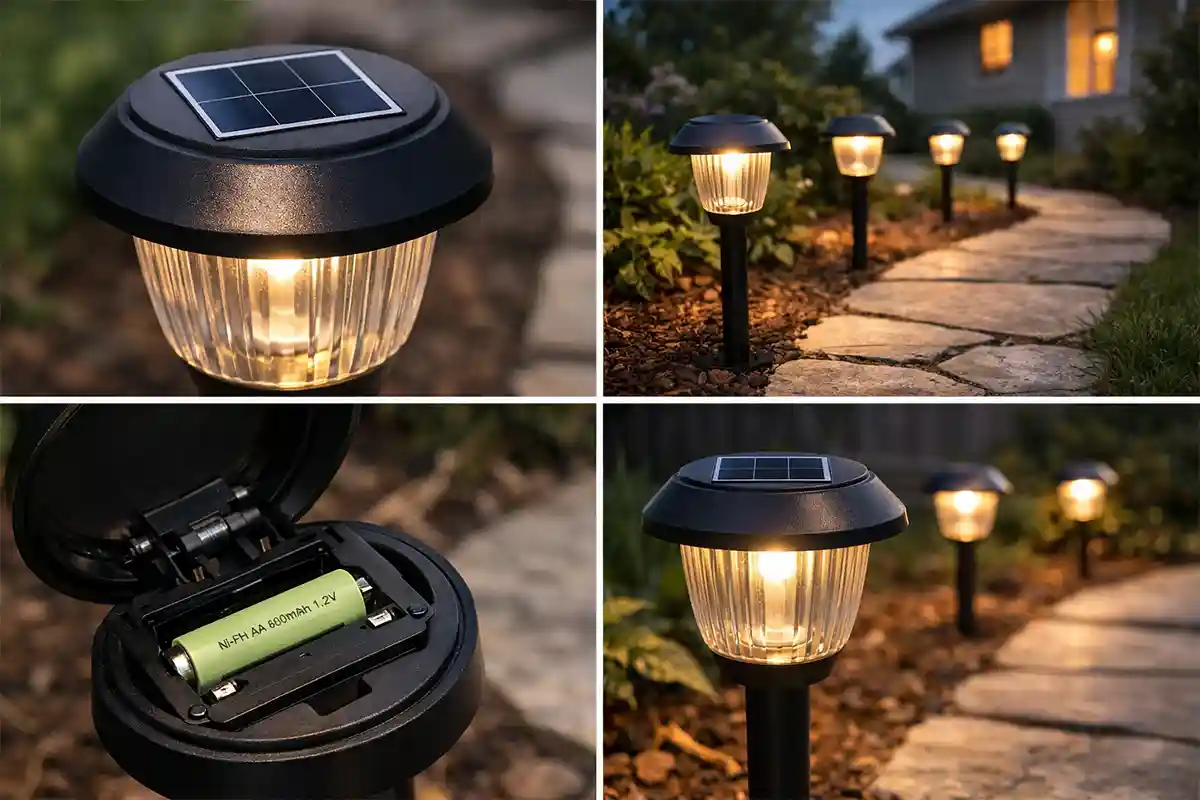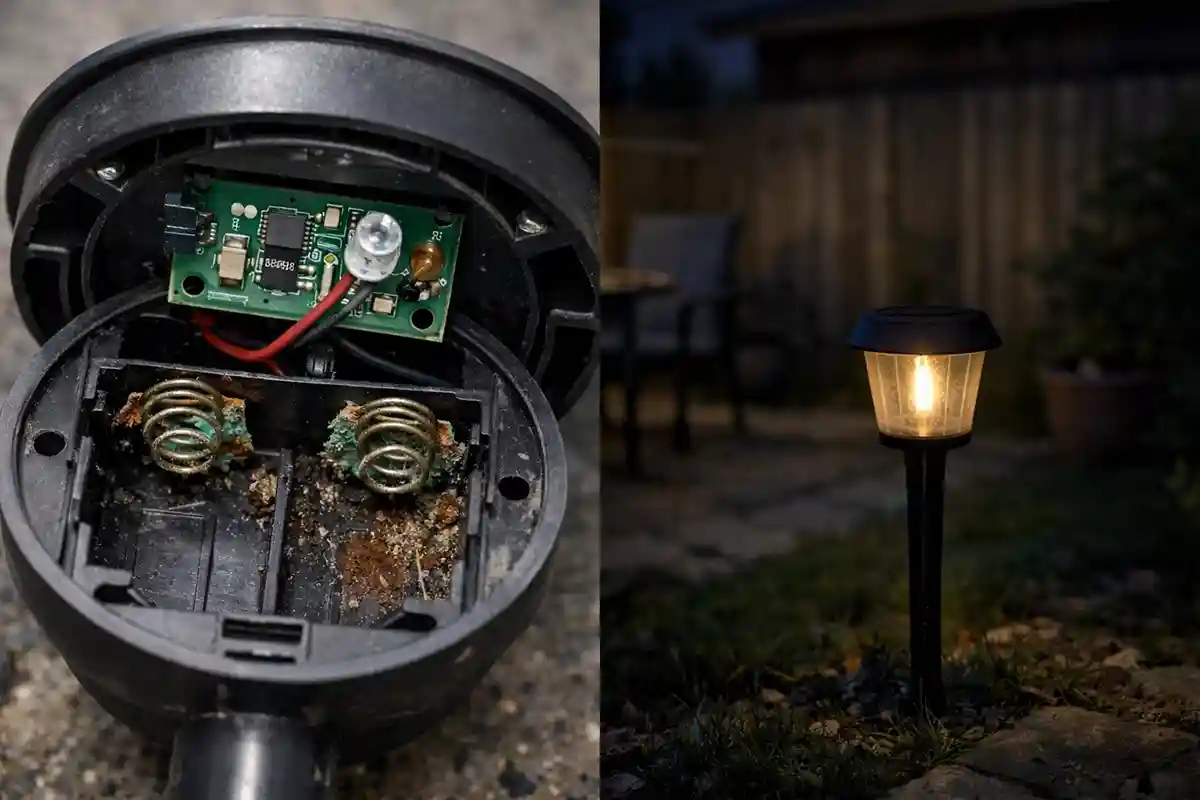
Moisture does not need to pool at the base to cause issues. A hairline gap around the battery door, less than a quarter inch wide, can allow humid air to enter repeatedly. When warm daytime air cools overnight, condensation forms inside the housing.
At first, you might only notice a slight haze inside the lens or faint discoloration on the metal contacts. Over time, corrosion builds where the battery touches the terminals. That thin layer increases resistance and reduces how efficiently the battery receives charge.
A single rainstorm rarely destroys a fixture. The real problem comes from repeated wet-dry cycles. You may see lights running shorter after several damp evenings, especially if they sit near sprinkler spray or low spots where water collects along the walkway edge.
Why Solar Outdoor Lights Fail So Quickly explores how environmental exposure builds gradually, even when no dramatic failure is visible.
Some situations improve with cleaning and better sealing. Others indicate deeper internal wear. The key difference lies in how long moisture has been interacting with the internal components and whether early-stage imbalance has already shifted into structural decline.
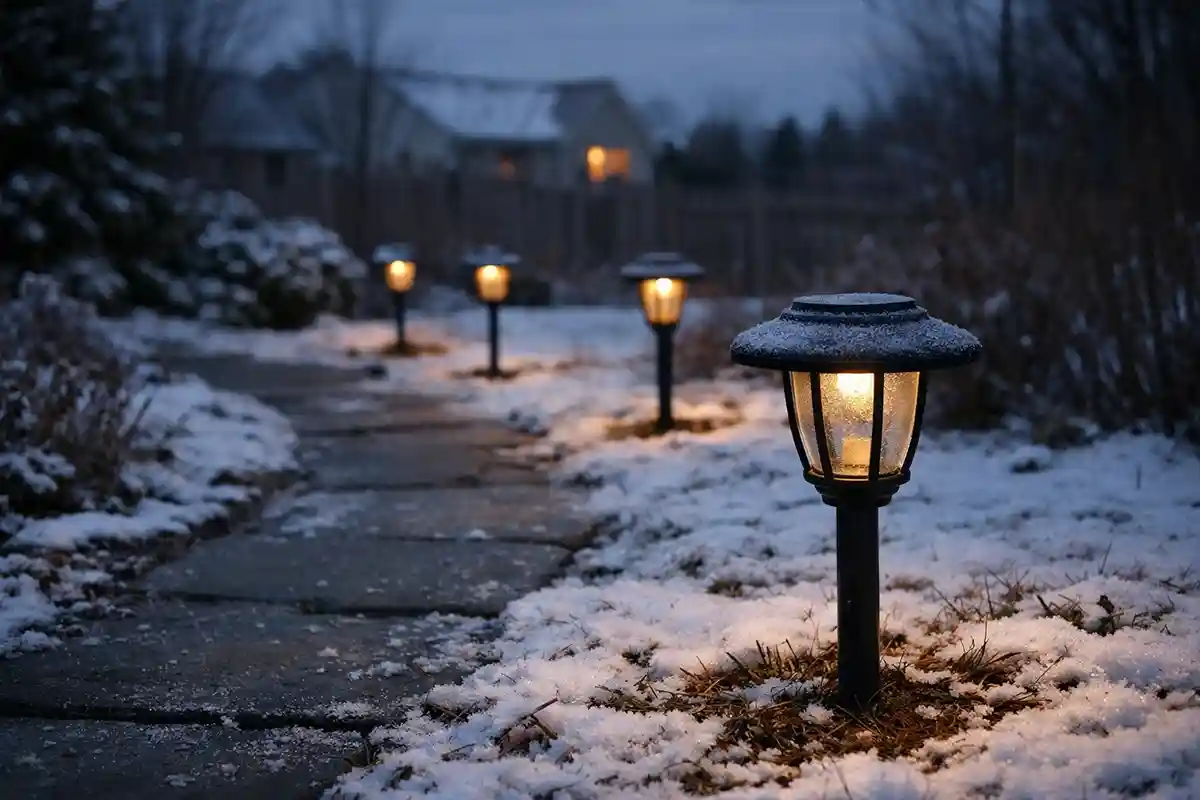
When a solar light stands 18 inches tall along a walkway but leans slightly toward a siding wall, the panel loses part of its midday exposure. Even a 10-degree tilt away from direct sun reduces charging strength. Small physical misalignments like this often create the first imbalance in the system.
Level 1 – Surface-Level Adjustment
This level changes only surface conditions. The panel might be wiped clean, leaves trimmed back within 12 inches, or the fixture straightened so it stands vertical instead of angled toward the driveway slope. The structural change is minimal and does not involve relocation.
The behavior affected is how efficiently sunlight enters the panel. With a clean surface and clear sky exposure, more light converts into stored energy. The observable result is slightly longer runtime, often adding one to two hours on clear days. The impact depth is shallow, but it addresses minor performance dips.
Level 2 – Directional Correction
Here, the change involves orientation and angle relative to the sun’s path. A fixture positioned flat on level soil may not match seasonal sun angles. Adjusting the tilt slightly toward the southern sky, especially when the sun sits lower during fall, increases direct exposure.
This structural shift affects the timing of peak charging. Instead of receiving indirect light at a sharp angle, the panel captures stronger rays for a longer window. The visible outcome is steadier brightness later into the evening. The impact depth is moderate because it corrects entry direction rather than just cleaning the surface.
A common but incorrect belief is that solar panels must remain perfectly flat to function properly. In many regions, a slight directional tilt actually improves daily energy capture.
Battery Size Mismatch Creates Hidden Stress
Level 3 – Entry-Plane Rebalance
This stage changes what happens beneath the panel, inside the 2-inch battery compartment. Replacing a 2000 mAh battery with one closer to the original 800–1000 mAh specification realigns charging capacity with panel output. It may also involve tightening battery contacts that sit loosely against the metal terminals.
The structural change affects the energy entry plane—the point where power moves from panel to battery. When battery capacity matches daily charge limits, the cell reaches full charge more consistently. The observable result is more stable runtime across consecutive nights, even after cloudy afternoons.
Many homeowners assume larger batteries always last longer. In small fixtures, oversized batteries remain partially charged and degrade faster. The impact depth here is significant because it corrects internal balance rather than surface exposure.
Seasonal Voltage Fluctuations Change Performance Patterns
Level 4 – Structural Reset
This level involves relocation or replacement. A fixture that sits 6 inches from a fence casting afternoon shade may need to be moved 3 to 5 feet into open lawn. In other cases, a unit installed in soil that collects water after rain may require elevation above grade.
The structural element being changed is the overall energy pathway—from sunlight entry to nighttime discharge. By improving exposure from mid-morning through late afternoon, the battery receives more complete daily cycles. The observable outcome is consistent performance even after two overcast days.
The depth of impact is the greatest at this stage. If internal circuitry has degraded due to heat or moisture, replacing the entire unit resets both environmental and electrical variables.
Outdoor Lights Tripping GFCI Outlets highlights how moisture-related electrical instability can influence multiple outdoor systems, reinforcing why structural placement matters.
Comparative Stability Matrix
| Solution Level |
Structural Depth |
Stability Impact |
Typical Use Case |
| Level 1 – Surface-Level Adjustment |
▢ |
Minor runtime improvement |
Dust, debris, light shade within 12 inches |
| Level 2 – Directional Correction |
▣ |
Moderate consistency gain |
Panel misaligned by angle or slope |
| Level 3 – Entry-Plane Rebalance |
▣ |
Strong cycle stabilization |
Oversized battery or loose contacts |
| Level 4 – Structural Reset |
■ |
Long-term reliability restoration |
Chronic underperformance after prior fixes |
Lower levels adjust exposure and alignment. Higher levels change how energy flows through the system.
How do I know Level 1 is enough?
If runtime improves noticeably after cleaning or minor repositioning within a few days, deeper intervention is usually unnecessary.
When should I move from Level 2 to Level 3?
If angle correction does not restore consistent nightly runtime after clear weather, internal battery compatibility may be the issue.
What signals the need for Level 4?
If new batteries and better positioning still result in short runtime, structural reset or fixture replacement becomes more realistic.
Can multiple levels apply at once?
Yes. A fixture 4 feet from open lawn but installed in damp soil may require both directional correction and structural reset.
Each level increases the depth of change. Choosing correctly depends on whether the issue shifts with sunlight conditions or remains stable despite surface improvements.
Identifying Temporary Stress vs. Structural Decline
A solar light standing 20 inches tall along a straight driveway edge may dim after two cloudy days. That does not automatically mean the battery or circuit board is failing. Temporary stress often shows up after short-term changes like overcast weather, light frost on the panel surface, or leaves hanging 8 inches above the fixture.
Staying too shallow in your fix can create long-term frustration. If you only clean the panel but the light still sits 2 feet inside a shaded fence line, runtime may improve slightly but continue declining over weeks. The behavior pattern becomes repetitive: brief improvement followed by steady fade. That repetition signals the need to move beyond surface-level adjustments.
On the other hand, jumping straight to full fixture replacement can be unnecessary. If performance improves significantly when the unit is temporarily moved 3 feet toward open lawn, internal electronics may still be stable. Replacing the entire light at that stage adds cost without solving the placement imbalance.
A common but incorrect belief is that once a battery starts dying quickly, the entire fixture is permanently defective. In reality, many systems sit at the wrong intervention level rather than beyond repair.
When Replacement Stops Working as a Fix
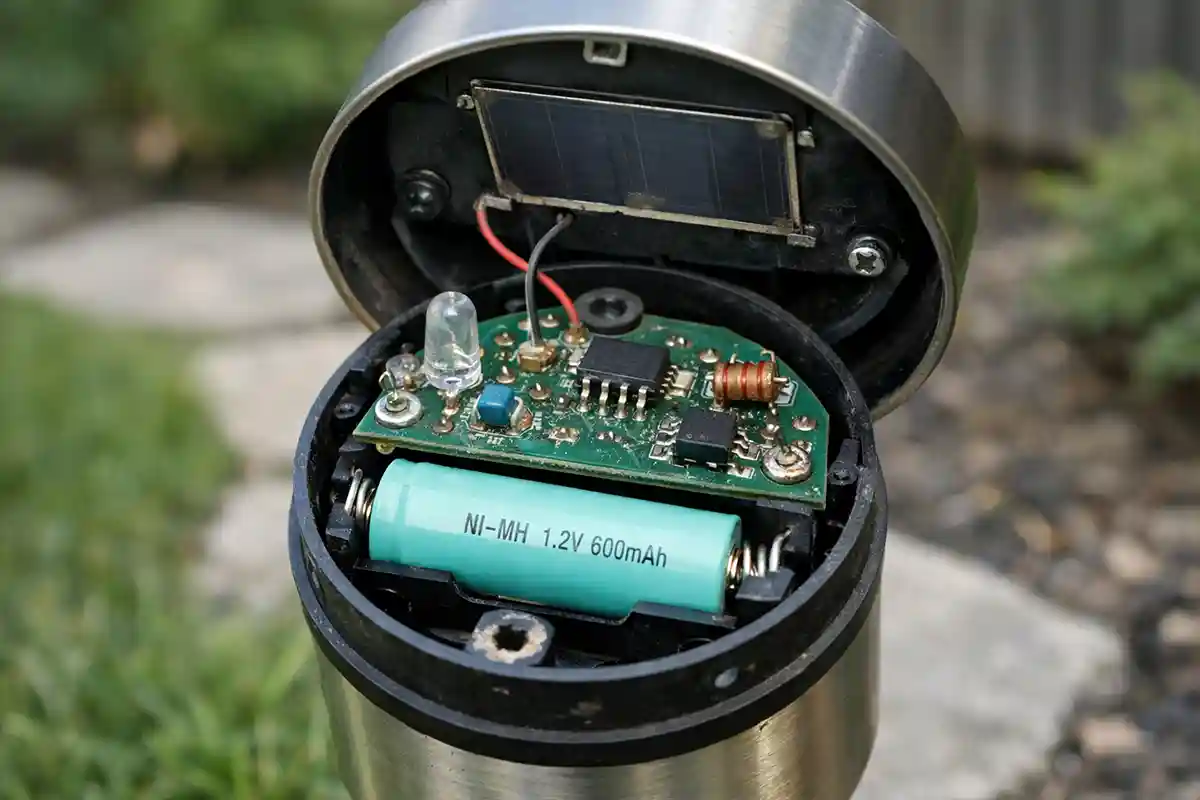
Repeated battery swaps that restore brightness for only a week or two point to a deeper imbalance. When the fixture sits 6 inches above damp mulch and the internal board shows corrosion along solder joints, the entry plane itself has been compromised. In that case, continuing to install new batteries simply feeds a stressed system.
If runtime shortens even after three consecutive clear days with direct sun exposure from 10 a.m. to 4 p.m., the current solution level is likely too shallow. That observation becomes the threshold for stepping up. Structural reset may be required when repeated environmental correction does not stabilize output.
However, if runtime extends predictably after repositioning or cleaning, escalation is unnecessary. The key difference is whether improvement sustains across several charge cycles rather than just one evening.
A system that truly stabilizes shows consistent shutoff times, no faint glow at dawn, and no rapid drop-off after mild weather shifts. The panel remains properly aligned with the sun’s arc, and contact surfaces stay dry even after rain moving downhill across the soil slope.
Observable Level-Selection Checklist
-
Runtime remains under 3 hours after two clear days.
-
Light sits within 12 inches of a vertical shade source.
-
Panel surface shows visible haze or dirt film.
-
Battery compartment contains moisture or corrosion marks.
-
Brightness fades sharply after the first hour nightly.
-
Repositioning 3–5 feet into open space improves performance.
-
New battery loses noticeable capacity within 2 months.
-
Fixture leans more than 10 degrees from vertical.
These observations help determine whether a surface adjustment, directional correction, entry-plane rebalance, or full structural reset is appropriate.
Circuit Protection and Cutoff Failure
When cutoff regulation weakens, the battery drains too deeply each night. A light that glows faintly along the window line of the house until sunrise is not shutting down properly. That lingering discharge lowers long-term capacity and reinforces the stress cycle.
If intervention is delayed, the pattern progresses. First, runtime shortens. Next, deeper nightly discharge accelerates internal wear. Finally, surrounding fixtures—especially those within 2 feet of the same moisture or heat source—begin showing similar symptoms. The effect area widens because the underlying exposure condition remains unchanged.
Stable systems look different. Panels sit level or slightly angled toward open sky, roughly centered between driveway edge and lawn. No moisture collects at the battery door after rain flows downhill. Runtime remains steady for weeks, not days.
For broader solar performance guidance, consult National Renewable Energy Laboratory (NREL).