
Replacing another landscape light becomes frustrating when a different fixture fails a few weeks later. Each purchase means checking another bulb type, connection, or replacement stake—and the yard still has uneven lighting.
A complete replacement kit becomes worth considering when several fixtures have separate failures and keeping them working requires repeated purchases. It gives you a chance to choose the fixtures, power supply, and cable as one planned installation.
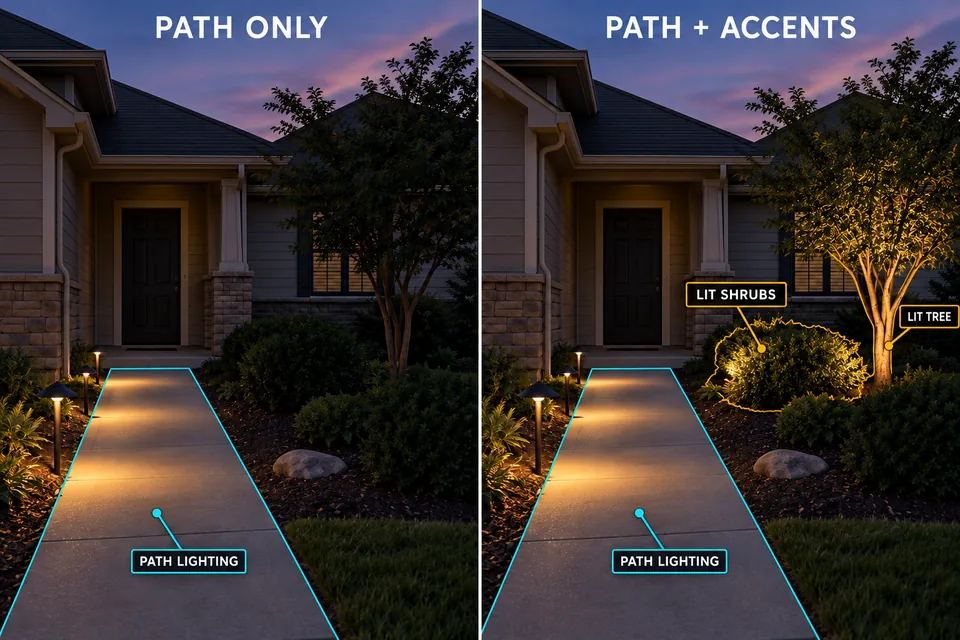
Choose a complete low-voltage path lighting kit for a walkway-focused renewal. Choose a complete mixed landscape lighting kit when you also need directed light for planting beds, a wall, or a tree.
Set the replacement boundary first. One failed bulb does not justify a new system. Several lights going out together may indicate a shared supply problem. And if your existing transformer and cable are healthy and compatible, replacing those components may be unnecessary.
For an Aging Walkway System, Start With a Complete Path Kit
A complete path lighting kit fits a route where several fixtures are deteriorating, matching replacements are difficult to find, and restoring consistent coverage has become a series of separate shopping trips.
Its strongest benefit is a coordinated purchase: you can select the light color, coverage, power supply, and service approach together. A package containing the required transformer and main cable also makes the core project cost easier to compare upfront.
Focus on three buying filters:
- Useful fixture count: Enough path lights for the intended positions, including bends and entrances.
- Controlled illumination: Shielded designs that direct light toward the walking surface, with consistent color temperature across the set.
- A complete, maintainable package: Suitable transformer and cable included, plus available replacement bulbs or individual fixtures.
Choose the count from the layout rather than the largest number printed on the box. More fixtures do not guarantee better coverage, especially when light distribution is poorly documented.
If restoring the walking route is the main job, put the purchase toward a path kit that covers it properly. This is the category to browse when you need the core installation components together and want to stop matching replacement lights one at a time.
RENEW THE WALKWAY IN ONE PLANNED PURCHASE
Complete Low-Voltage Path Lighting Kits
Replace a deteriorating collection of path lights with a coordinated set for your walking route.
Choose a package with the transformer and main cable included to reduce separate component shopping and compare the core project cost upfront.
Look for: enough path fixtures, shielded light, cable suited to the measured route, and a clear replacement option when one light eventually fails.
For Paths and Planting Areas, Choose a Mixed Kit
A complete mixed landscape lighting kit fits a larger renewal: the walkway fixtures need replacing, and the old accent lights around the beds or entrance are also reaching the end of their useful service.
The advantage is buying both lighting functions together while checking their compatibility and combined load. The critical detail is the balance of fixture types.
A ten-light package containing four path lights and six spotlights will not suit a walkway needing eight path positions. Count the route lights first, then identify the separate features you actually want illuminated.
Prioritize:
- The right fixture mix: Enough path lights without unwanted accent heads taking their place.
- Accent lights suited to the targets: Beam information and output appropriate to the feature’s size and distance.
- Power and cable for both areas: A supported layout that reaches the walkway and the planting or wall targets.
Do not assume a small included spotlight can illuminate a mature tree canopy or a broad wall effectively. Likewise, separate scheduling for path and accent lights is a feature to verify, not an automatic benefit of buying a mixed kit.
When both lighting jobs need renewal, start with a mixed kit that supplies the correct balance. It can bring the project into one purchase without leaving you shopping for extra path lights immediately afterward.
REBUILD PATH AND ACCENT LIGHTING TOGETHER
Complete Mixed Landscape Lighting Kits
Renew the walking route and selected landscape features with a package planned for both jobs.
Choose the right fixture mix so your purchase provides the path coverage you need as well as useful accent lighting.
Look for: sufficient path lights, suitable spotlight beams and output, an included transformer, and main cable for the full layout.
If the replacement boundary is still unclear, check which outdoor lights are worth repairing or replacing before committing to the full installation.
Check What the Package Actually Includes
Once you know the category, compare the contents. “Complete” is useful only when the listed components cover your installation.
A package photo may show an entire illuminated yard while the selected purchase option contains fixtures only. Read the contents for that exact option, including any choices affecting the transformer, bulbs, or cable.
| Component | What to confirm |
|---|---|
| Transformer | Included, with suitable output and capacity for the planned installation |
| Main cable | Included length, gauge, and installation rating |
| Light sources | Bulbs included for socketed fixtures, or clearly identified integrated LEDs |
| Connections | Supplied connectors suitable for the intended location |
| Mounting | Stakes or other required mounting components included |
| Controls | Timer, photocell, or scheduling features included or purchased separately |
Short leads attached to individual fixtures are not the main cable needed to reach them from the transformer.
Also check whether the system uses standard landscape cable connections or proprietary plugs. Preconfigured connections can simplify assembly, but extensions and replacement fixtures may depend on that product family.
A lower advertised price can become less attractive after missing components are added. Compare each candidate as a usable installation, including what you would still need to buy.
Confirm Compatibility Before Reusing Existing Components
A kit does not automatically make every part of an older installation obsolete. A sound transformer or usable cable may be worth retaining, provided its condition and specifications support the new fixtures.
Check the fixtures’ stated input voltage and whether they require AC, DC, or accept both. Match those requirements to the power supply rather than relying on the phrase “low voltage.”
For the transformer, follow the manufacturer’s load calculation and operating limits. Include any retained lights on the same supply and any planned additions. Physical connection compatibility alone does not establish electrical compatibility.
Cable reuse also needs more than an intact-looking section near the transformer. Its gauge, condition, routing, and connections must suit the new layout. Reusing a deteriorated cable can carry an old fault into a new installation.
If only the fixtures need replacing, the extra transformer and cable in a complete kit may offer little value. The strongest case for the complete package is when those components are also needed or the existing installation cannot be confidently matched to the replacement fixtures.
This guide concerns transformer-fed low-voltage landscape lighting. Household-voltage landscape fixtures are a different replacement project.
Measure the Cable Route Before Choosing the Package Size
Walkway length and cable length are different measurements.
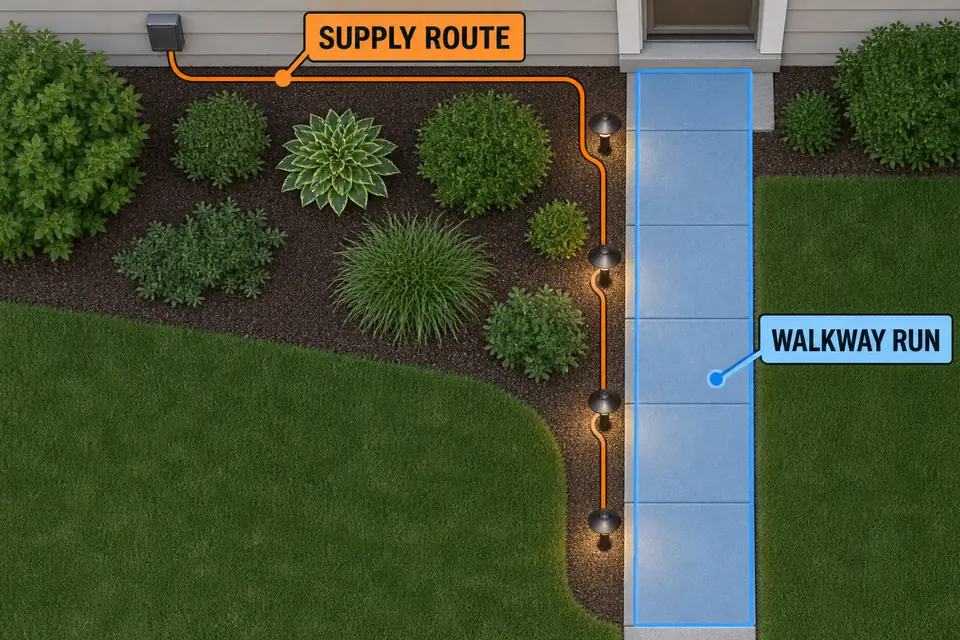
For example, a 25-foot route from the transformer to the first light plus 40 feet through the lighting area already totals 65 feet, before installation allowances. A kit containing 50 feet of main cable would fall short even though the walkway is only 40 feet long.
Trace the intended route along suitable bed edges and include branches to separate lighting areas. Do not use a straight-line measurement that assumes the cable can pass through every obstacle.
Cable selection also depends on electrical load and distance. Manufacturer cable-sizing guidance identifies both factors as part of choosing the appropriate cable.
Check the proposed runs against the kit documentation. A larger transformer alone does not correct voltage drop along an unsuitable cable run.
For a spread-out yard, prioritize a supported wiring layout over a generous fixture count. A package with plenty of lights can still be unsuitable if its cable provisions cannot serve their intended positions.
Choose a System You Can Service After the First Failure
Before ordering, answer one practical question: what would you buy if one light failed next year?
For replaceable-bulb fixtures, check the bulb base, permitted dimensions, electrical requirements, and access method. The advantage is retaining a usable housing when only the light source needs replacement.
For integrated LEDs, establish whether the module is serviceable or a matching individual fixture is available. Some designs have replaceable LED components; others require replacing the fixture.
Inspect the supporting hardware too. A damaged stake connection, stem attachment, or aiming joint can make a light unusable even when its LED still works. Available replacement stakes and individual fixtures can matter more than decorative features or additional lighting modes.
For yards exposed to irrigation, coastal salt, or winter maintenance, review environmental suitability and warranty exclusions. A finish described as “bronze” identifies appearance, not necessarily the underlying material.
Finally, avoid treating a kit purchase as a guarantee against future faults. Its value comes from suitable components, a supported layout, and a practical maintenance path.
Match the Purchase to the Renewal You Actually Need
Choose a complete path lighting kit when the walking route is the project and the package supplies the components you need.
Choose a mixed kit when both the route and specific landscape targets need renewal, with enough of each fixture type to finish the job.
Before paying, confirm the exact contents, electrical compatibility, measured cable routes, and replacement options. Those checks distinguish a useful system purchase from another box of lights that still leaves the installation incomplete.