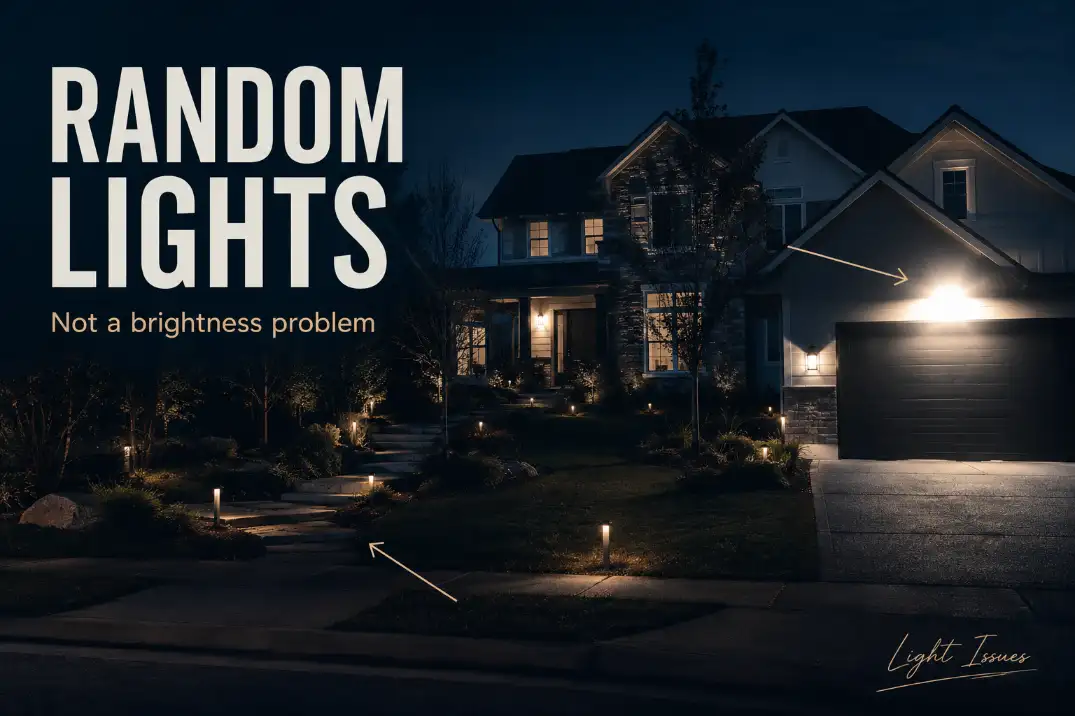
Outdoor lights usually look random when fixtures were added one at a time instead of planned around routes, surfaces, and visual balance.
The first things to check are spacing, aim, glare, and color consistency. A yard can have plenty of light and still look accidental if one fixture blasts a wall, another leaves a 7-foot dark gap on the walkway, and a cool-white security light fights with warm path lights.
This is different from a simple weak-light problem. Weak lighting means the fixtures are mostly in the right places but do not produce enough usable light.
Random lighting means the system has no hierarchy. The porch, path, driveway, steps, trees, and security zones are all competing instead of working together.
The fix is not automatically “add more lights.” Often, the fastest improvement comes from re-aiming, dimming, shielding, or removing the fixture that dominates the scene.
The 4 Checks That Reveal an Unplanned Lighting Layout
Route
Start with the route people actually use at night: driveway to front door, patio to steps, side gate to trash area, or garage to entry door. If someone has to guess where the next step, edge, or turn is, the lighting is not doing its main job.
A planned layout makes the route readable before it decorates the yard. Accent lights on trees, walls, or columns should support that route, not distract from it.
Rhythm
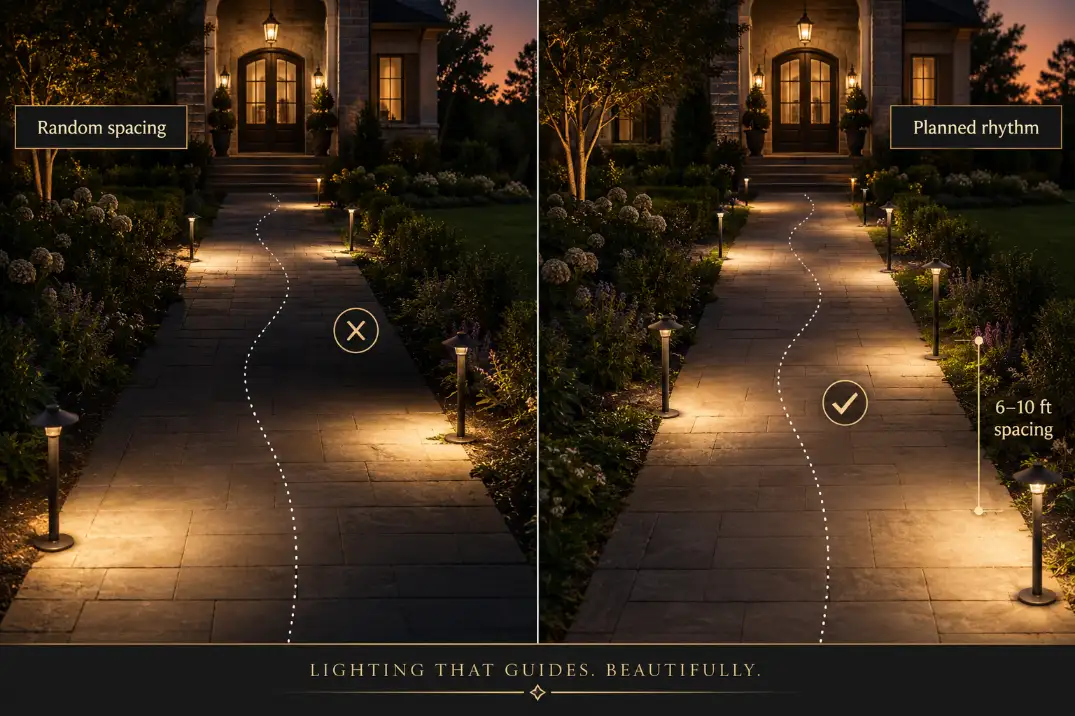
Path lights should feel connected. For many residential walkways, spacing around 6–10 feet works better than random clusters, although the right distance depends on fixture height, beam spread, and surface color. Dark mulch, asphalt, and wet pavers absorb more light than pale concrete or stone.
When one section has lights 3 feet apart and the next has a 9-foot gap, the eye reads the layout as improvised even if every fixture is working.
Glare
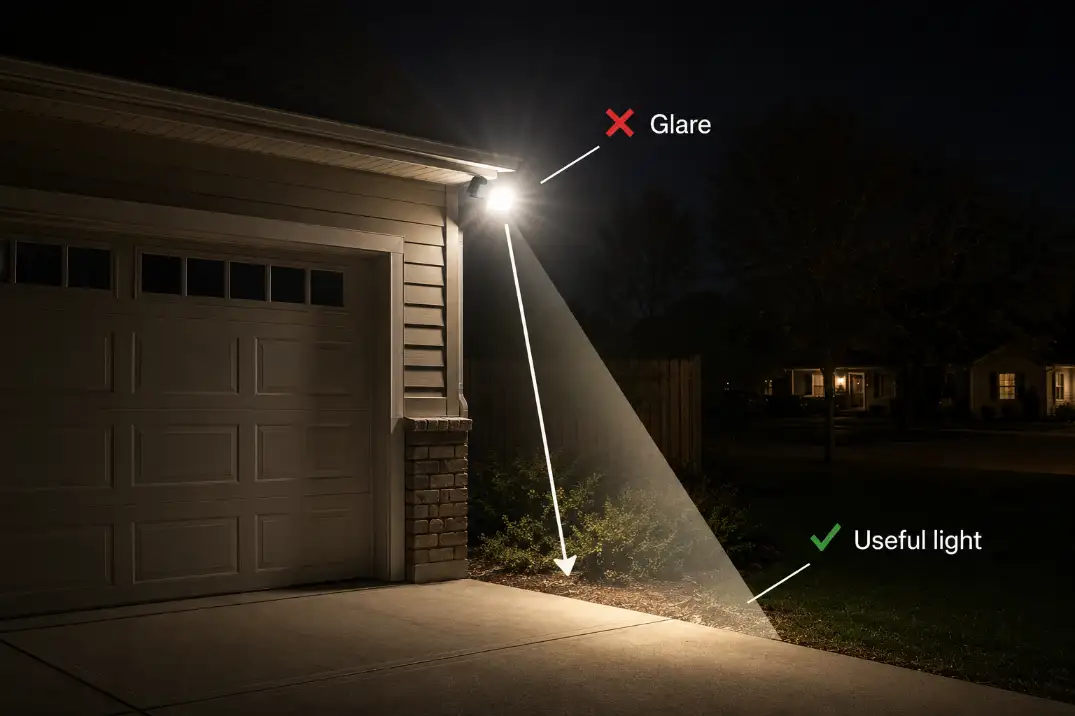
If you notice the bulb before you notice the surface it lights, the fixture is probably too exposed, too bright, or aimed too high. Planned outdoor lighting usually shows the effect, not the source.
This is where many homeowners misread the problem. A bright fixture can make a yard feel darker because glare reduces your eye’s ability to adapt.
Consistency
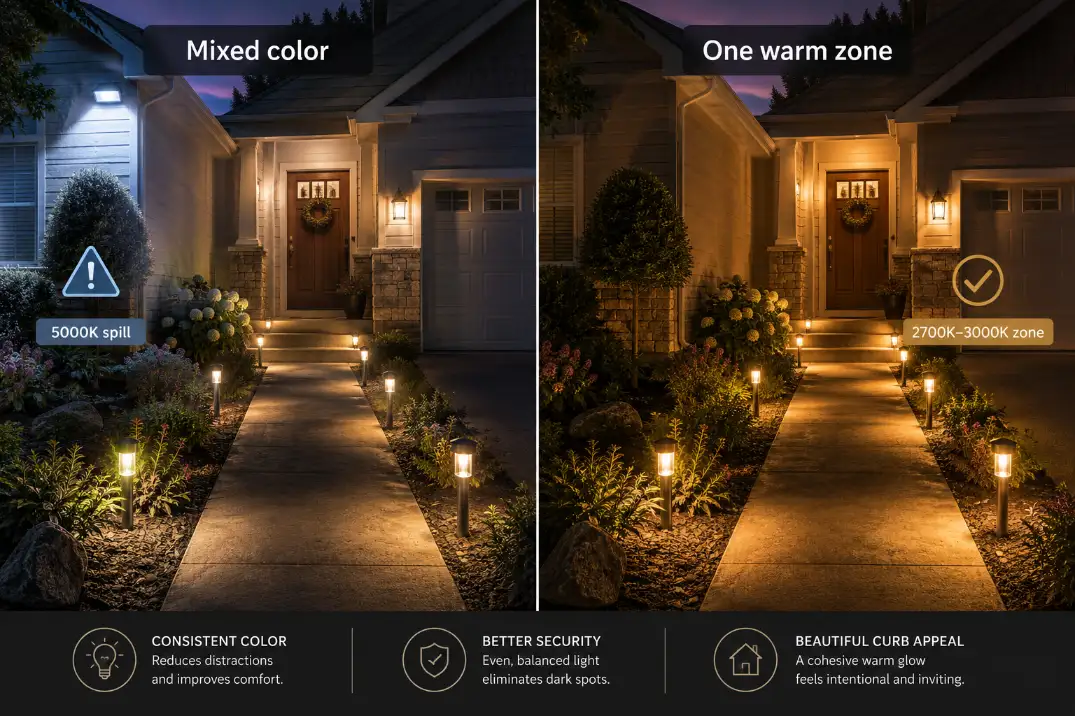
A yard can look patched together when one area uses warm 2700K path lights, another uses 5000K security lights, and solar stakes fade to a bluish dim glow after a few hours. Not every fixture has to match, but lights in the same visual zone should feel related.
Color temperature is easy to overlook because each bulb can look acceptable by itself. The mismatch becomes obvious only when the whole yard is viewed from the street, driveway, or patio.
Why Outdoor Lighting Starts Looking Accidental
Most random-looking outdoor lighting is not designed badly all at once. It grows that way. A porch light is installed first. Then a garage motion light gets added. Later, solar path lights go near the walkway. A dark corner feels unsafe, so a floodlight goes up. Each choice may make sense in isolation, but together they do not create order.
Fixtures Are Solving Different Problems
Security lights, path lights, entry lights, and accent lights have different jobs. A motion light is meant to reveal movement. A path light should guide feet without glare. An entry light should make the door, lock, and threshold readable. An accent light should shape a tree, wall, or architectural feature.
The layout starts looking random when these jobs blur. A floodlight tries to act like a path light. A path light tries to highlight shrubs. A porch light becomes the brightest thing in the yard even though the driveway edge is still dark.
If a fixture is working but the useful area remains unlit, the issue is often target placement rather than power. That pattern is covered more directly in Outdoor Lights Miss Target Area.
Spacing Looks Random Before Brightness Does
Brightness gets blamed first because it is obvious. Spacing usually explains the unplanned look sooner.
A row of path lights does not need perfect symmetry, but it does need rhythm. When fixture spacing changes without a reason, the eye catches it. This is especially obvious along straight walkways, driveway borders, and fence lines.
Uneven spacing can also create a false diagnosis. A homeowner may think the bulbs are too dim when the real problem is that the light pools do not overlap. If the dark gaps between path lights are wider than about 6–8 feet on a main walking route, spacing and beam spread deserve attention before bulb upgrades.
Mixed Color Temperatures Break the Layout
Warm white light around 2700K–3000K usually feels more natural for residential paths, patios, porches, and planting beds. Cooler light around 4000K–5000K can be useful for security zones, but it looks harsh when scattered through a warm landscape.
The common mistake is replacing bulbs one at a time without checking the label. After a few seasons, the yard may contain warm porch bulbs, cool garage floods, bluish solar stakes, and yellowed older LEDs. Nothing is technically broken, but the system looks pieced together.
Pro Tip: Match color temperature by zone before replacing fixtures. A consistent 2700K–3000K path and entry zone often looks more planned than a brighter mix of mismatched bulbs.
What People Usually Misread First
Bright Does Not Mean Planned
A single high-output floodlight can make the whole yard feel less organized. When one fixture is 3–5 times brighter than nearby lights, it becomes the visual anchor whether or not it is lighting anything important.
The symptom is brightness imbalance. The underlying mechanism is contrast. If one wall or shrub is overlit, nearby steps, grass, or pavement look darker by comparison. That is why adding a brighter bulb can make the yard feel harsher without making it safer.
Symmetry Is Often Overestimated
Symmetry helps around a front door, garage, or formal entry. It does not solve every layout. A curved walkway, sloped front yard, wide driveway, or uneven planting bed needs functional rhythm more than mirror-image placement.
A planned system does not mean every fixture has a twin. It means the important zones connect visually: parking area, route, steps, door, gate, seating area, and transition points.
Layering Is Not the Same as Adding More Fixtures
Good outdoor lighting has layers, but those layers need priority. Route lighting comes first. Entry lighting comes next. Accent lighting supports the scene. Security lighting should cover a defined area without overpowering everything else.
When security lights, accent lights, and path lights all compete for attention, the yard feels busy instead of designed. The problem is not the number of layers. It is the lack of order between them.
Dark Gaps Matter More Than Fixture Count
A yard with 14 poorly aimed fixtures can look worse than one with 6 placed carefully. The useful question is not “Do I have enough lights?” It is “Do the lights connect the areas people actually use?”
| What you see | Most likely issue | Better next move |
|---|---|---|
| Bright wall but dark walkway | Aim or fixture type is wrong | Redirect light toward the walking surface |
| Bright pools separated by darkness | Spacing or beam spread is wrong | Reset spacing before adding fixtures |
| Visible bulb glare | Fixture is exposed or aimed too high | Shield, lower, or re-aim the fixture |
| Same path has warm and cool patches | Color temperature mismatch | Standardize bulbs within that zone |
| Entry looks bright but yard feels chaotic | No hierarchy | Prioritize route, entry, then accents |
If the main visible issue is sharp bright spots with dark gaps between them, the more specific repair path may be closer to Outdoor Lights Bright Spots Dark Gaps.
Why Adding More Lights Often Makes It Worse
Adding lights feels logical because the yard looks incomplete. But if the existing lights are aimed poorly, spaced unevenly, or visually mismatched, more fixtures usually multiply the disorder.
The Wasted Fix: More Solar Stakes
Solar stakes can guide a path, but they rarely fix a broken lighting plan by themselves. Many have a small light pool, limited beam control, and output that fades after 4–6 hours, especially after cloudy weather or during short winter days in northern states.
That does not make solar lights useless. It means they need sun exposure, consistent spacing, and realistic expectations.
If half the stakes are dim by 9 p.m. while the others stay bright, the yard will look random even if the original placement was tidy. That problem is closer to How to Fix Solar Lights With Uneven or Dimming Output than a layout problem alone.
Beam Spread Changes the Whole Layout
Two fixtures with the same lumen rating can behave completely differently. A narrow beam creates a sharp highlight. A wide beam spreads light but may spill into eyes or flatten the scene. A path fixture should push light downward and outward. A wall wash should graze a vertical surface evenly. A security light should cover a defined zone without becoming the brightest object in the neighborhood.
This is why lumens alone are a poor planning tool. A 300-lumen narrow spotlight aimed at a shrub can look harsher than a 600-lumen shielded fixture aimed at the ground.
The Visible-Bulb Problem
Outdoor lighting looks more professional when the surface is visible and the source is controlled. If the bulb, diode, or reflector is visible from normal walking height, the fixture can create glare even when it is not especially powerful.
Garage floodlights are common offenders because they are often mounted 8–12 feet high and tilted outward. The beam reaches far, but it also hits the eyes, the street, or a neighbor’s window. The result feels bright, exposed, and unplanned.
Pro Tip: Stand at the sidewalk, driveway edge, and nearest window angle. If the fixture face shines directly at you, shielding or re-aiming will usually help more than changing wattage.
How to Reset the Layout Without Starting Over
A better layout starts by removing confusion, not by buying everything new.
Choose the Primary Route
Pick the route that matters most after dark. For many homes, that is driveway to front door. For others, it is patio to steps, gate to side door, or garage to trash area.
Light that route first. On steps, the tread edge matters more than the riser. At gates, the latch side matters more than the fence panel. At driveways, the edge where people step out of a vehicle matters more than the center of the concrete.
Remove the Visual Bullies
A visual bully is any light that dominates the scene without improving navigation or safety. Oversized porch bulbs, exposed garage floods, and accent lights aimed too high into trees are common examples.
Turn off the harshest fixture for one night and look again. If the rest of the yard suddenly feels calmer, the problem was not too little light. It was one fixture overpowering the system.
This is also where routine bulb swapping stops making sense. If a fixture is pointed at the wrong surface, a different bulb cannot make the layout coherent. For broader placement issues, Outdoor Lighting Placement Problems is often the better diagnosis than another brightness upgrade.
Build Overlap, Not Islands
Good outdoor lighting does not need to make every inch equally bright. It needs enough overlap that the eye can move from one useful area to the next without hitting black gaps.
A path with isolated circles of light looks dotted. A path with soft overlap looks intentional. A patio with a bright center and black perimeter can feel disconnected from the yard. A driveway with one bright garage flood but dark vehicle edges can still feel unsafe.
If a backyard still feels unusable after new lights were added, the issue may be that the lights are not connecting the functional zones. That pattern is covered in Backyard Still Dark After Lights.
Check the Street and Neighbor View
A layout can look acceptable from the porch but harsh from the sidewalk or next-door window. This matters in US neighborhoods where homes sit close together, especially with side-yard security lights or garage-mounted floods.
The fix is usually practical, not complicated: aim down, shield the source, reduce output, or narrow the beam. Light trespass does not just annoy neighbors. It also makes your own lighting look less controlled.
What Changes by Yard Type and Climate
Dense Plantings Break the Pattern
Shrubs that were small when the lights were installed can block beams within one or two growing seasons. In humid regions such as Florida, fast-growing plants can fill open gaps quickly. A fixture that once lit a walkway may now light only the back of a hedge.
Do not treat every blocked beam as a failed fixture. Sometimes the target moved because the landscape grew.
Desert and Coastal Sites Expose Different Problems
In dry Arizona-style landscapes, pale gravel, stucco, and stone can reflect light strongly, so small fixtures may look brighter and harsher than expected. In coastal California or other salt-air locations, lens haze and corrosion can reduce output gradually, making some fixtures fade while others stay bright.
If spacing still looks correct but one section has become weaker over time, inspect lenses, connections, and fixture condition before redesigning the whole layout.
Freeze-Thaw Movement Can Shift Aim
In northern states, freeze-thaw cycles can tilt stake lights or loosen fixtures. A path light leaning 10–15 degrees may throw most of its beam off the walkway. After heavy rain, soft soil can also let fixtures settle unevenly.
That is why a layout can look fine in October and scattered by March. The design did not necessarily fail. The physical aim changed.
When Not to Add More Lights Yet
Do not add fixtures until the existing layout passes a few basic tests:
- The brightest fixture is not aimed into open space or eye level.
- Path light spacing does not swing wildly from one section to the next.
- Bulbs in the same visual zone are not separated by more than about 1,000K in color temperature.
- The main route has no dark walking gaps wider than about 6–8 feet.
- The bulb or reflector is not the first thing you notice from the street.
- Important surfaces are actually catching the light.
If most of those checks fail, adding fixtures only gives you more pieces to correct later.
When a Full Redesign Makes More Sense
Small adjustments work when the fixtures are mostly in the right places. A redesign makes more sense when the system has no clear hierarchy, uses mixed fixture types without purpose, or leaves major travel areas dark after re-aiming.
The practical cutoff is simple: if more than half the fixtures need to be moved, shielded, replaced, or rewired to support the actual routes, stop treating the problem as maintenance. At that point, you are not fixing a layout. You are creating one.
A planned outdoor lighting system does not need to be elaborate. It needs priorities. Light the route first, control glare, match color by zone, soften transitions, and let accent lights support the scene instead of fighting for attention.
Questions People Usually Ask
Should all outdoor lights match?
Not exactly. Fixtures can vary by job, but lights in the same visual zone should feel consistent in brightness, color temperature, and direction. A path, entry, or patio area looks more planned when the lights relate to each other.
Why did my new outdoor lights make the yard look worse?
New lights can increase contrast, expose uneven spacing, or create glare. If the added fixture is much brighter, cooler in color, or aimed differently than the existing lights, it may make the layout look more random instead of more complete.
Is it better to use fewer outdoor lights?
Often, yes. Fewer lights placed with clear purpose usually look better than many fixtures competing for attention. The goal is not the highest fixture count. It is readable routes, controlled sources, and balanced zones.
For broader official guidance on efficient residential lighting choices, see the U.S. Department of Energy.