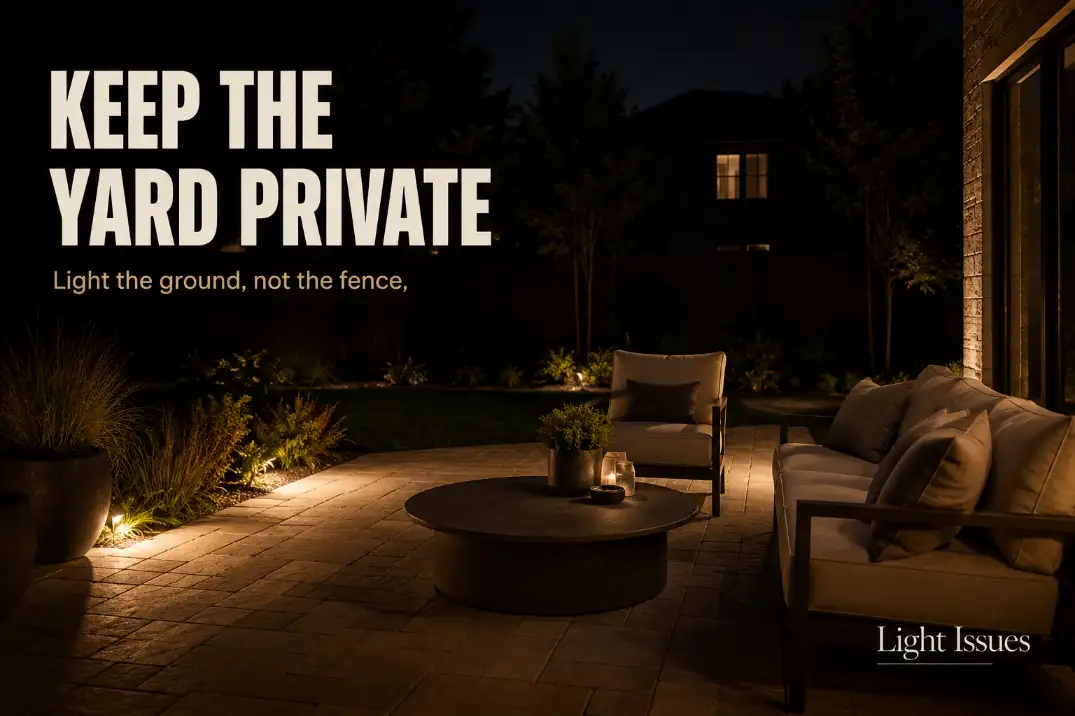
The best way to light a backyard without losing privacy is to control where the light stops. Privacy usually fails when the brightest surface is behind people, the bulb is visible from outside the seating area, or a wide beam reaches the fence, neighbor’s window, or second-story sightline.
Before buying more fixtures, check three things: can you see the light source, does the fence glow, and does the patio still feel exposed after 10–15 minutes of eye adjustment?
Most private backyards need less brightness than people expect. Path lights often work at 100–300 lumens each, seating areas usually need soft layered light rather than a flood, and warm color temperatures around 2200K–2700K feel less exposing than cool white light.
The goal is not to brighten the whole yard. It is to make walking, eating, and conversation comfortable while the property edges stay visually quiet.
Backyard Privacy Works Both Ways
Backyard privacy has two sides. Your patio should not feel exposed from the outside, and your lighting should not make a neighbor’s window, fence, or outdoor space feel invaded.
In practice, both problems usually come from the same mistake: light is leaving the area it was supposed to serve, which is the broader issue behind Outdoor Lighting Privacy Problems.
Your privacy fails when the yard becomes a stage
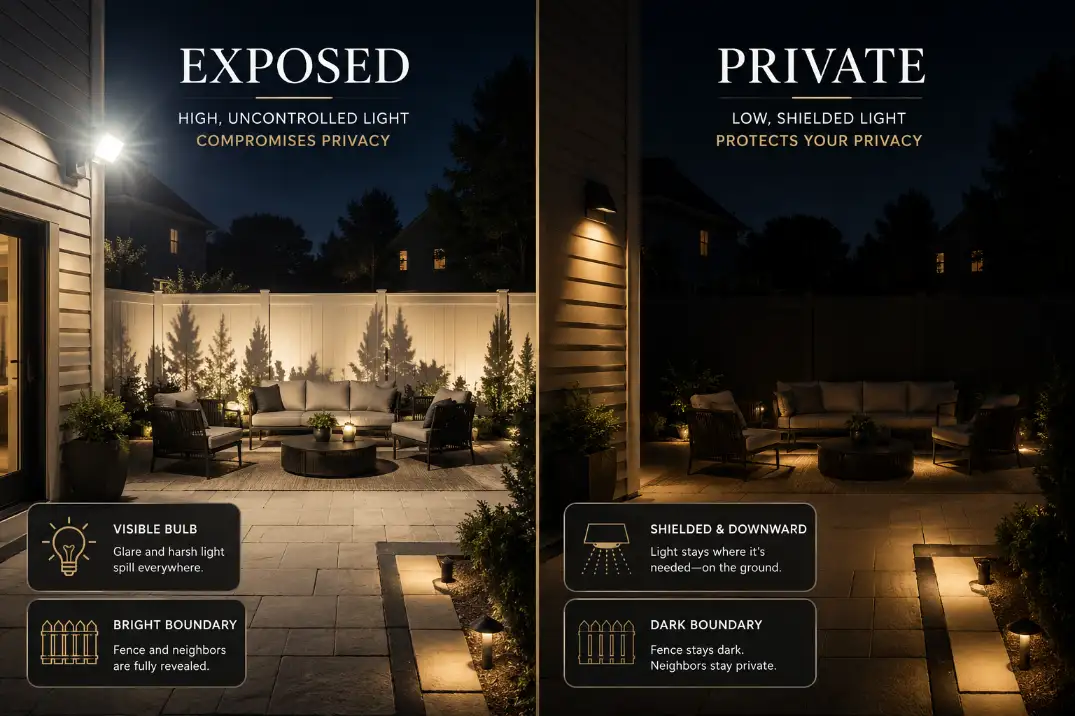
If the fence, wall, hedge, or upper background is brighter than the patio surface, people sitting in the yard become easier to see. A glowing fence behind a seating area creates silhouettes. A bare lamp near eye level draws attention to the exact place you want to feel calm.
Neighbor privacy fails when the beam crosses the useful zone
A fixture does not need to be extremely bright to become intrusive. If the beam reaches a neighbor-facing window, upper fence boards, or a second-story wall, it is doing more than its job.
The fix is usually not a taller screen. It is a tighter beam, better shielding, warmer output, and a lower aim angle.
Run the test from two positions: sit in the patio and look outward, then stand near the property edge and look back.
If faces are easy to read from outside the seating area, your privacy is failing. If the beam reaches a neighboring window line, their privacy is failing.
The Privacy-First Lighting Order
A private lighting plan should follow a specific order. If you skip the order, you can spend money on dimmers, plants, or decorative fixtures and still end up with a backyard that feels visible from the outside.
1. Hide the source first
A visible bulb is more damaging to privacy than many homeowners realize. Even a moderate-output fixture can feel intrusive if the LED chip or lamp is visible from a chair, sidewalk, upstairs window, or neighboring yard.
Stand at the edge of the yard and look back toward the patio. If your eye goes straight to the glowing source, fix shielding before changing brightness.
A hooded, recessed, or down-aimed fixture often improves privacy more than simply reducing an 800-lumen light to 400 lumens.
This is where placement matters more than product style. A fixture can be attractive and still wrong if it throws light across the yard instead of down into the use area.
When the beam misses the useful surface, the issue is closer to Fix Poor Outdoor Light Placement than a lack of backyard lighting.
2. Aim below eye level
Backyard privacy improves when light stays below normal sightlines. Low path lights, step lights, under-rail lights, and shielded downlights usually work better than high wall floods because they reveal surfaces without lighting people like subjects.
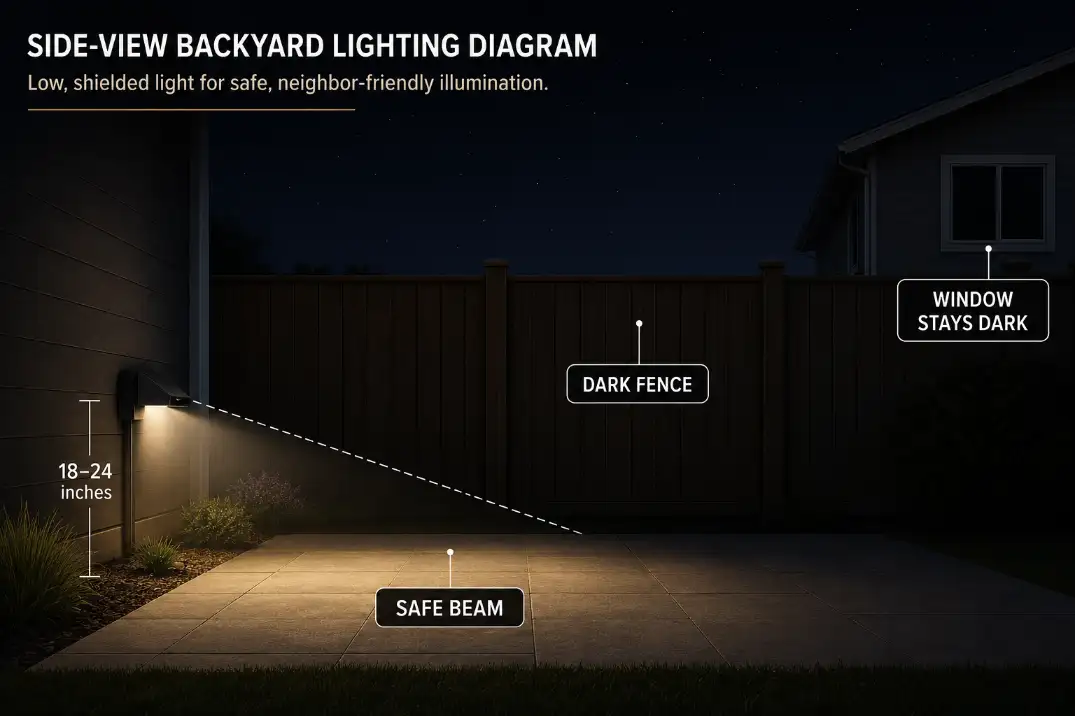
As a practical range, path fixtures around 18–24 inches high can work well when shielded and spaced carefully. For seating areas, the safest pattern is soft light on the table, deck, step edge, or ground plane rather than direct light on faces.
3. Keep the perimeter dark
The fence is not the target. This is the mistake that makes many privacy lighting plans fail.
A bright fence becomes a backdrop. If people sit between the viewer and that glowing background, their movement and silhouettes become easier to read. Privacy screens, hedges, and lattice can all lose value when they are lit from the wrong direction.
The better rule is simple: light the place where people walk or sit, and let the boundary stay darker.
What People Usually Misread
Backyard privacy lighting is not only about how much light you add. It is about what the light makes visible.
Plants are often overestimated
Plants, vines, bamboo screens, and fence panels can help privacy during the day, but they do not automatically solve night privacy. If a fixture washes the screen with light, the screen becomes part of the visible scene. Movement behind it can stand out more, not less.
Plants work best as dark boundaries. Light should stop before the hedge or fence unless you are intentionally using a very small, shielded accent.
In humid climates, dense planting can also trap moisture around fixtures, so using plants to hide poor lighting can create maintenance problems without solving the actual visibility issue.
Reflections are often underestimated
White vinyl fences, pale pavers, pool water, glossy furniture, and glass doors can bounce light farther than expected. A fixture that looks gentle over mulch may feel harsh over white concrete.
This is why two yards with the same lumen output can feel completely different at night.
If the patio looks washed out, the privacy problem may actually be glare. The symptom is exposure, but the mechanism is uncontrolled brightness and reflection.
When glare becomes the dominant issue, the fix shifts from privacy screening to beam control and surface brightness.
Use This Layout Instead of Lighting the Whole Yard
A strong backyard privacy layout does not begin at the fence. It begins where people actually move.
| Privacy goal | Do this | Avoid this |
|---|---|---|
| Keep seating private | Light the table, floor, or step edge | Light the fence behind people |
| Protect neighbor-facing areas | Keep beams downward and inward | Let light reach windows or upper fence lines |
| Make paths safe | Use shielded 100–300 lumen path lights | Use one high floodlight for the whole route |
| Keep the yard comfortable | Use 2200K–2700K warm light | Use cool white light against dark surroundings |
| Add security | Use short, targeted motion lighting | Leave wide floods on all evening |
Start with doors, steps, and paths
These areas deserve priority because they affect safety. A back door landing, deck step, or walkway can be lit with focused low output instead of a broad fixture. If the path still feels unclear, add another shielded fixture before increasing brightness dramatically.
Four carefully placed 150-lumen fixtures usually feel calmer and more private than one 700-lumen light trying to cover the same area.
Add small pools of light where people sit
Seating areas should feel usable, not displayed. A table light, under-bench light, low deck light, or warm downlight can give enough visibility for drinks, plates, and facial expression without making the whole patio visible from across the yard.
Avoid aiming light across the conversation zone. Side glare makes people squint and creates silhouettes.
If the patio has bright spots and dark gaps, the fix is usually better beam control, not more total output; Outdoor Lights Bright Spots and Dark Gaps explains that failure pattern more directly.
Pro Tip: Test the seating area after full darkness, not at dusk. Dusk hides glare because the surrounding light level is still doing part of the work.
When Security Lighting Works Against Privacy
Security lighting is the fastest way to ruin an otherwise private backyard. The problem is not that security lighting is bad. The problem is using a wide floodlight as permanent ambient lighting.
A motion light aimed down at a specific gate, step, driveway edge, or back door can be useful. A wide beam aimed across the yard makes people, fences, windows, and neighboring walls more visible. It can also create harsh contrast, making the area beyond the beam harder to see.
The better pattern is temporary and targeted: aim the fixture downward at roughly a 30–45 degree angle, use the narrowest useful detection zone, and keep activation short.
For many entry situations, 30–90 seconds is enough. If the light needs to stay on for hours, it is no longer acting as security lighting; it has become the backyard’s main lighting layer.
Motion sensors can also create privacy problems when they trigger too often. A light that turns on every time a branch moves or a pet crosses the yard draws attention to the space.
In that case, sensitivity and detection angle are the issue, not brightness alone. Before replacing the fixture, check the pattern described in Outdoor Motion Sensor Light Too Sensitive.
When the Standard Fix Stops Working
The standard advice is to dim the lights, add plants, or use warmer bulbs. Those can help, but they stop making sense when the beam pattern is wrong.
Dimming does not fix spill
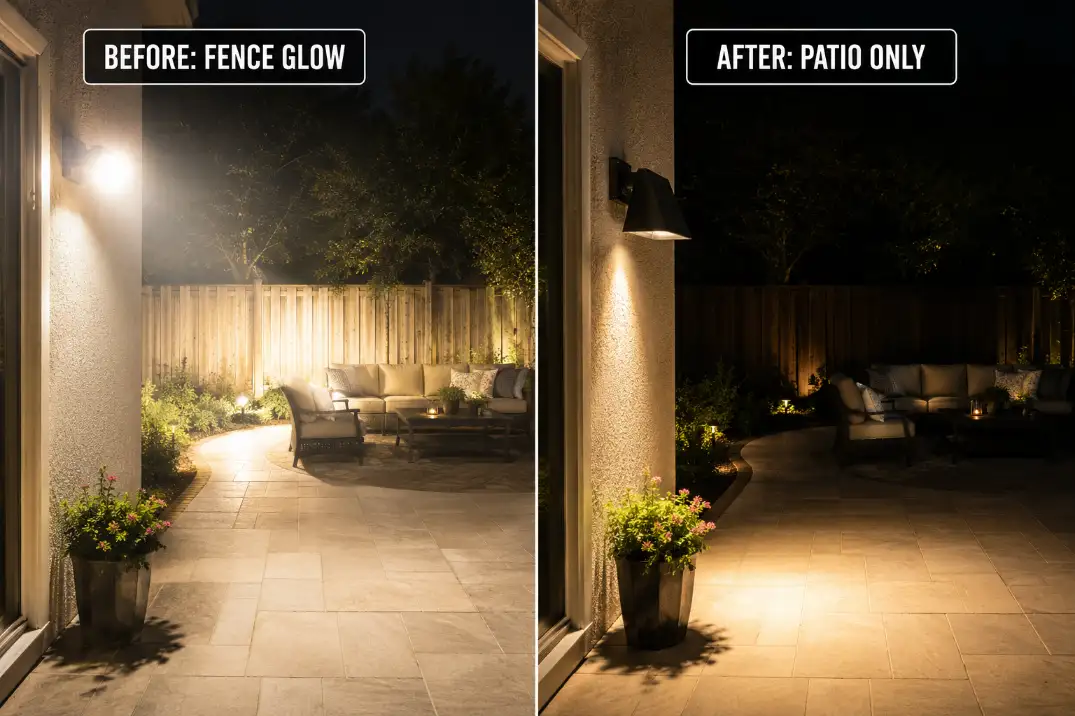
If the fixture points at the fence, dimming only creates a dimmer glowing fence. If the bulb is visible from outside the patio, dimming only creates a softer visible bulb. The first repair is shielding and aim.
Plants do not fix a staged patio
If people are lit from the front or side, plants behind them cannot restore privacy. The seating area itself must be less exposed. Move the light lower, redirect it toward the surface being used, or use smaller sources closer to the activity.
More fixtures can make privacy worse
Adding lights around the perimeter often feels logical because it defines the yard. But if every edge glows, the space becomes easier to read from outside. A private yard usually has fewer lit boundaries and more controlled light near the house, path, and seating area.
A Private Backyard Should Have Dark Edges
The strongest backyard lighting plans do not make every feature visible. They create enough light for movement and comfort while allowing the outer parts of the yard to stay quiet.
In a small urban yard, this matters even more because fences and windows are close. In a large suburban yard, the mistake is usually overreach: trying to light the whole lawn instead of the route and destination.
Around pools or pale hardscape, lower output becomes more important because reflection can make the same fixture feel twice as bright.
The clearest final test is the two-way privacy test. From inside the patio, look outward and check whether the yard feels exposed. Then stand near the property edge, about 20–30 feet away if the yard allows it, and look back.
If you can read faces, see the bulb, or identify the fence as the brightest surface, your privacy is not protected yet. If the beam reaches a neighbor-facing window line, their privacy is not protected either.
A good backyard lighting plan should make the useful areas safer without turning the yard, fence, or neighboring window into part of the scene.
For broader official guidance, see Utah State University Extension’s outdoor lighting guidance.