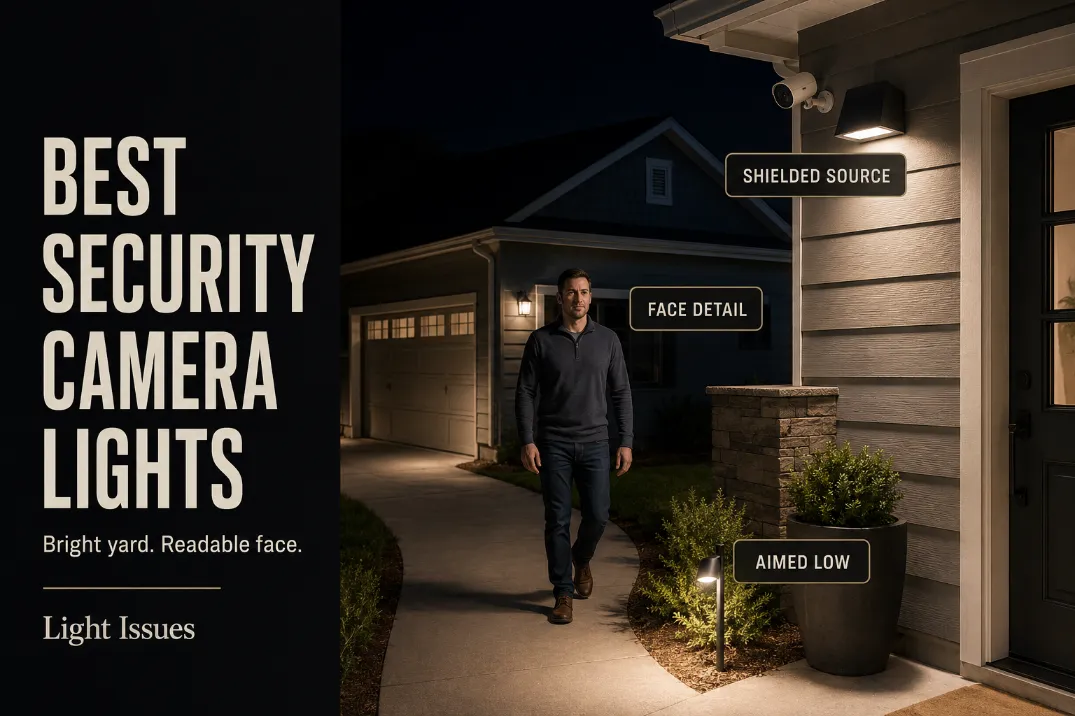
The best outdoor lights for security cameras are not always the brightest security lights. A camera needs usable contrast more than raw brightness: the face, walkway, car door, package drop, or gate has to stay readable when the light turns on.
If the fixture is visible inside the camera frame, reflects off pale siding, or triggers only after someone is already at the door or beside the car, the footage can look brighter but become less useful.
Start with three checks: keep the light source outside the camera’s direct view, aim the beam below eye level, and make the motion zone start before the person reaches the target area.
For many homes, a 600–1,000 lumen shielded porch light works better near a doorbell than a 2,000 lumen exposed floodlight. In driveways, a 20–40 ft early trigger zone often matters more than adding another bright head.
Best for Doorbells
Choose shielded porch light, not a mini floodlight
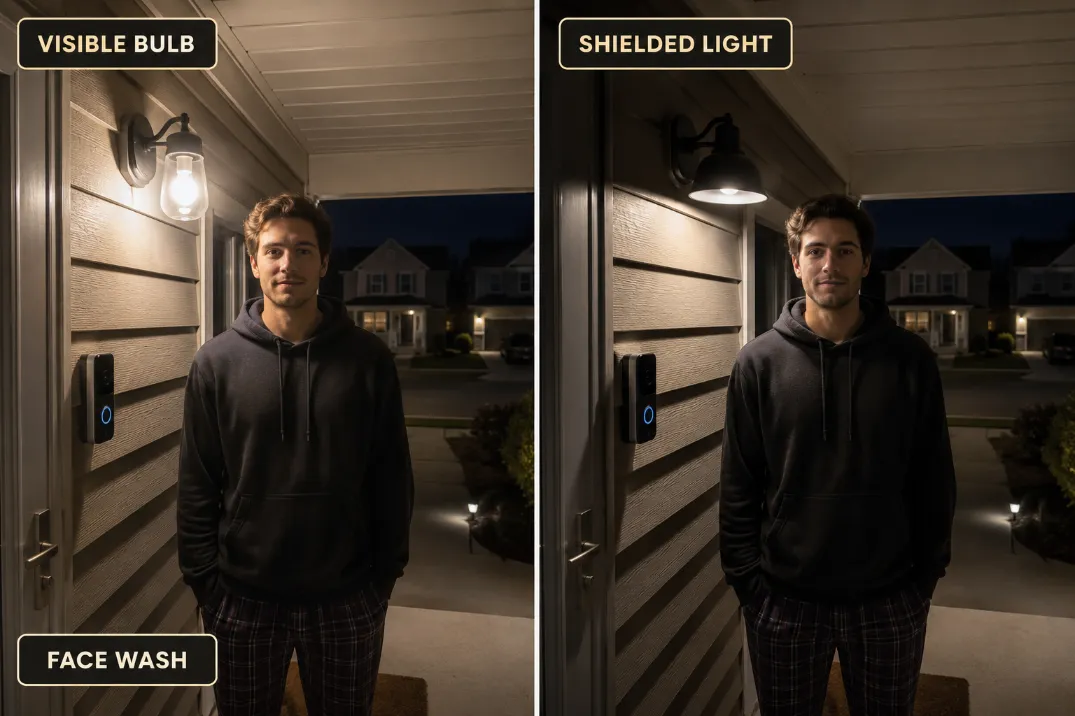
Doorbell cameras usually fail at close range. The person’s face is often only 3–8 ft from the lens, so even a moderate exposed bulb can flatten features, reflect off glass storm doors, or create a bright wall patch beside the camera.
The best choice is usually a shielded wall light, downward porch light, or low-glare fixture with a frosted lens.
Look for warm white light around 2700K–3000K, a covered source, and enough spread to light the approach without pointing directly at the lens.
A clear-glass decorative sconce can look good in product photos but still be a poor camera light if the bulb is visible from the doorbell view.
Light the face zone, not the whole entry
For a front door, the target is not the lawn or the full porch wall. It is the face zone near the step, lock, package area, and walkway approach.
A porch fixture that holds steady for 30–90 seconds after motion is usually more useful than a harsh blast that turns on and off quickly.
A common waste of time is replacing the doorbell camera before checking the light. If the daytime image is sharp but the night image loses faces only after the porch light turns on, the camera is reacting to lighting contrast, not failing as a device.
Use this category when the bulb, glass shade, or wall hotspot appears in the camera preview. The goal is to keep the face zone readable without putting the light source inside the lens view.
🟧 Shop shielded downward outdoor wall lights for doorbell cameras.
Best for Driveways
Pick adjustable dual-head motion lights
Driveways need wider coverage than porches, but that does not mean the best option is the brightest floodlight on the shelf.
For a one- or two-car driveway, an adjustable dual-head motion light is usually the safest category because each head can be aimed across the pavement instead of into the camera.
A practical range is often about 2,000–4,000 lumens total for a driveway fixture, depending on distance, siding color, vehicle reflection, and camera sensitivity.
The important part is beam control. Two smaller adjustable heads aimed low usually beat one broad exposed floodlight mounted high above the garage.
Put the trigger zone before the car
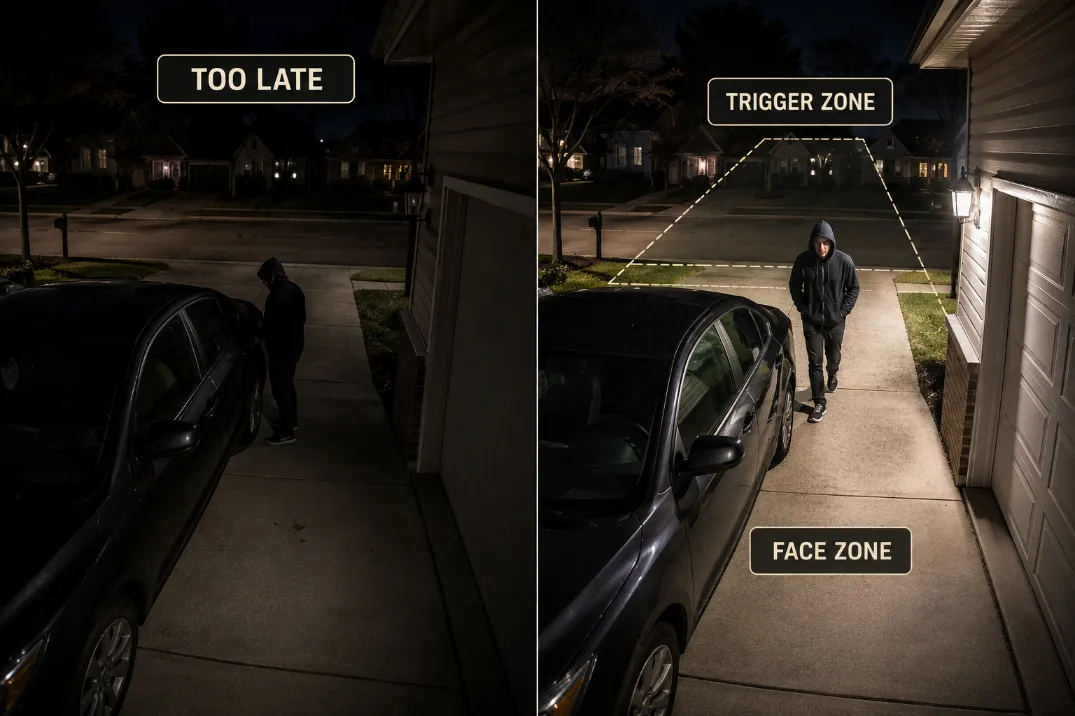
The fixture should activate while someone is still approaching, not after they are beside the vehicle. For most residential driveways, set the sensor so motion starts 20–40 ft before the main face or car-door zone.
If the light turns on only when someone reaches the bumper, the clip may capture the back of a head, a shoulder, or a blown reflective surface.
Mounting height matters here. A light at 8–12 ft can work well if the heads tilt downward and the sensor sees the approach path.
A very high fixture often looks powerful from the street but creates sharp shadows under hats, hoods, and vehicle mirrors.
Choose this when the camera watches a garage, parked cars, or a long approach path. Adjustable heads let one beam cover the walking route while the other supports the car-door zone without shining back into the camera.
🟧 Shop adjustable motion sensor security lights for driveway cameras.
Best for Backyards
Use wider, softer coverage
Backyard cameras usually need area awareness more than tight face capture. The better fixture is often a wide, diffused motion light or a pair of lower-output fixtures that fill the patio, gate, shed path, or back door without making one white hotspot.
This is where people commonly overestimate brightness and underestimate darkness between objects. A 3,000 lumen backyard flood can still leave the grill corner or side gate unreadable if the beam hits the patio table and dies there. Spread, aim, and object placement matter more than the number on the box.
If your footage shows a bright deck rail and a dark person behind it, the symptom is “not enough visibility,” but the mechanism is misplaced light. The fixture is lighting the foreground object, not the route the camera needs to see.
Keep decorative lighting separate
String lights, sconces, and patio lights may make the backyard feel inviting, but they do not always help a camera. They can create bright dots in the frame that force the camera to darken the rest of the scene.
For more on that broader pattern, Outdoor Lights Ruin Security Cameras explains why a brighter-looking yard can still produce weaker footage.
Use decorative lights for atmosphere. Use shielded security lights for the camera’s target zones.
Use this category when the camera watches a patio, back gate, shed path, or yard route instead of one close face zone. A motion sensor outdoor wall light gives the camera usable coverage without turning the nearest wall, fence, or deck rail into the brightest object in the clip.
🟧 Shop motion sensor outdoor wall lights for backyard security cameras.
Best Low-Glare Options
Look for cutoff, shielding, and frosted lenses
The best low-glare lights for security cameras have one thing in common: the light source is controlled. Full-cutoff fixtures, shielded wall lights, frosted lenses, and downward heads reduce the bright point that causes camera exposure problems.
The best category for a camera is usually not “maximum brightness.” It is “controlled brightness.” If the bulb, LED board, or flood head is directly visible in the camera preview, the fixture is already suspect.
For buyers choosing mainly around glare control, Best Low-Glare Outdoor Security Lights is the closer category match than a general security floodlight guide.
Choose warmer light near cameras
For most residential camera zones, 2700K–3000K is a safer starting point than icy 5000K light. Cooler light can look sharp in a product listing, but on pale siding, wet concrete, white garage doors, and reflective license plates, it can feel harsher and produce more visible glare.
A useful threshold: if the face or plate area loses detail for more than about 2 seconds after the light switches on, the fixture is too direct, too bright, too close to the lens, or aimed at the wrong surface.
| Camera Area | Best Light Category | Useful Range | Main Risk |
|---|---|---|---|
| Front door | Shielded porch wall light | 600–1,000 lumens | Exposed bulb near lens |
| Driveway | Adjustable dual-head motion light | 2,000–4,000 lumens total | Triggering too late |
| Backyard | Wide diffused motion light | 1,500–3,000 lumens | Bright foreground, dark route |
| Side gate | Narrow shielded downlight | 700–1,500 lumens | Beam crossing fence or window |
| Camera-heavy home | Low-glare security fixture | 2700K–3000K | Overlighting the frame |
Best Motion Fixtures
Prioritize adjustable sensor control
A good motion fixture for cameras should let you adjust detection range, sensitivity, duration, and sometimes dusk-to-dawn behavior. Fixed-sensor lights are cheaper, but they often force the wrong timing: too sensitive near streets, too late near driveways, or too broad near neighbor windows.
A practical hold time is usually 60–180 seconds. Shorter can cut off while someone is still moving through the frame. Longer can annoy neighbors or keep the camera locked into a high-contrast scene.
If the light misses the walking route, the sensor is the first suspect, not the bulb. Motion Lights Miss Walk Path covers that failure pattern more directly when the fixture turns on, but not soon enough to help the clip.
Separate the beam from the lens
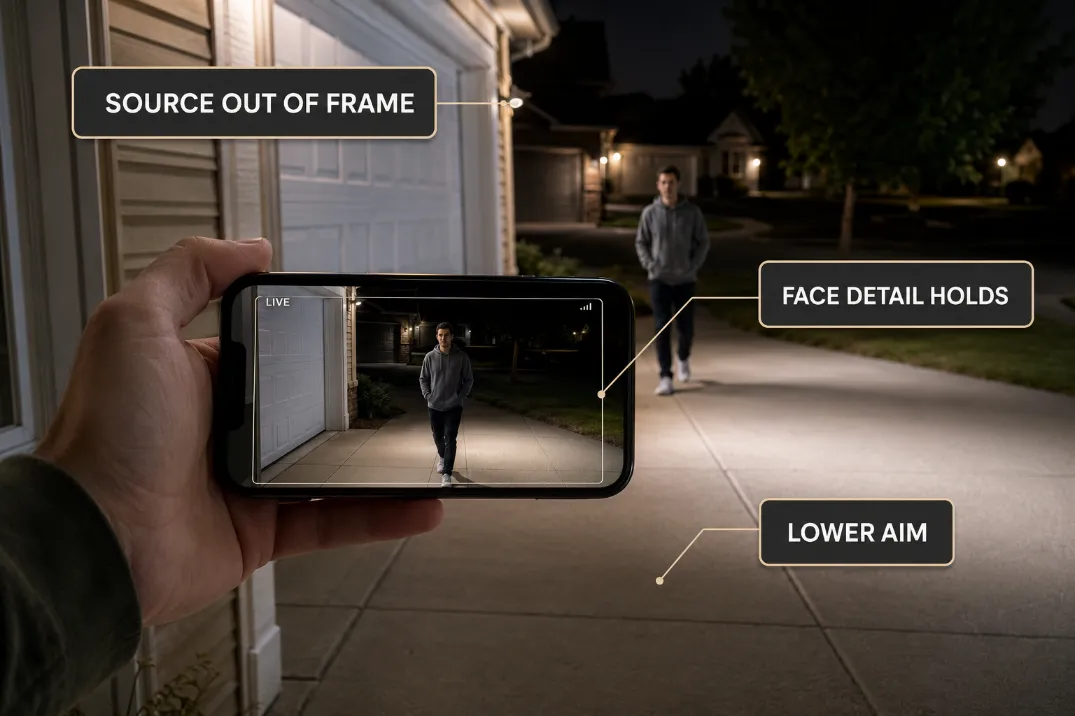
The best setup usually places the beam across the path while keeping the fixture outside the camera’s direct view. A light mounted beside the camera can work, but only if the head is shielded and aimed below the camera’s main sightline.
Aim becomes the deciding factor after purchase. Even a strong fixture can fail if it points into siding, a car windshield, a glossy door, or the camera lens itself.
Buying Check: Before replacing the fixture, open the live camera view at night and turn the light on manually. If the light source itself is the brightest object in the preview, buying more lumens will usually make the clip worse.
For setup after purchase, Aim Outdoor Security Lights is more useful than simply choosing a stronger replacement.
What to Avoid
Avoid exposed floodlights near the camera
The most common bad buy is a bright exposed floodlight mounted near the camera because it seems like the “security” choice. It can make the property look safer while hiding the thing the camera should record.
That is the difference between a symptom and the mechanism: the symptom is washed footage; the mechanism is too much direct brightness inside the camera’s exposure range.
Broad floodlights also create blind spots when they light the wrong surface first. If your camera sees a white garage door, pale wall, or reflective car before it sees the person, Floodlights Create Blind Spots is the more likely problem than weak output.
Avoid clear glass, upward beams, and decorative glare
Clear-glass sconces, up-and-down wall lights, and exposed LED panels are risky near cameras. They may look premium during the day and still fail at night.
Upward spill is especially poor near doorbells and garage cameras because it lights the wall, soffit, or lens area instead of the walking surface.
Also avoid choosing by maximum detection range alone. A 70 ft sensor range is not automatically better if it triggers on passing cars, street movement, or tree motion. For camera footage, accurate timing beats maximum reach.
Be careful with floodlight cameras
A floodlight camera can make sense when you are building a new setup from scratch and want one device to handle the camera, motion detection, and light together. It may also help when there is no good place to mount a separate camera and a separate fixture.
But it is not automatically the best fix for an existing doorbell, driveway camera, or backyard camera. If the current camera position is already good, a separate shielded or adjustable light often gives more control.
You can aim the light at the approach path while leaving the camera aimed at the face, gate, or vehicle zone.
A floodlight camera can still wash out its own footage if the light heads are too broad, too close to reflective siding, or aimed across a white garage door.
The product category is convenient, but it does not remove the basic rule: the camera should see the lit subject, not the brightest source or reflection first.
Avoid lighting that creates neighbor conflict
Camera-friendly lighting should still stay neighbor-friendly. A fixture that solves your camera glare by blasting across a shared driveway or into a bedroom window creates a different problem.
Shielded, lower-aimed lights usually work better because they keep the route visible without turning the whole property line into a stage.
Where privacy and glare overlap, Neighbor-Friendly Outdoor Lights is the safer next step than adding another motion head.
Quick Buyer Filter
Use this short filter before choosing the fixture category:
- If the camera is at a doorbell, choose a shielded porch light before a floodlight.
- If the camera watches parked cars, choose adjustable motion heads with an early trigger zone.
- If the camera sees the fixture directly, choose a more shielded design or move the light.
- If the footage improves when the light is off, the problem is glare, not darkness.
- If the light activates after the person reaches the target, fix sensor aim before buying more lumens.
- If neighbors can see the source from windows or cars, choose cutoff and lower aim.
Questions People Usually Ask
Are floodlights bad for security cameras?
Floodlights are not automatically bad, but exposed floodlights near the camera are risky. A floodlight works best when it is shielded, adjustable, aimed below the lens, and placed so the camera sees the lit person or route before it sees the bright source.
Is warm white or daylight better for camera lights?
Warm white around 2700K–3000K is usually safer near homes because it reduces harsh glare on siding, doors, and wet pavement. Daylight color can help color contrast in some open areas, but near a porch camera it often looks harsher than necessary.
Should the light be above or below the camera?
Usually above or to the side, but not shining directly into the lens. The exact position matters less than the camera preview. If the fixture appears as a bright source in the frame, move the beam, shield the source, or choose a lower-glare fixture.
When does replacing the fixture stop making sense?
Replacement stops making sense when the fixture category is fine but the layout is wrong. If the head is pointed at pale siding, the sensor triggers too late, or the camera sees the bulb directly, a better version of the same fixture may repeat the same failure.
For broader official guidance on responsible exterior lighting, see the Illuminating Engineering Society’s outdoor lighting guidance.